Free tools Windows power users keep installed
One-click scans. No signup required.
Some links on this page are affiliate links: if you buy through them we may earn a commission, at no extra cost to you.
Edge AI is usually the right fit when a business needs an immediate decision, must keep operating through network interruptions, or faces strict data-residency constraints. Cloud AI is usually better for large models, centralized training, elastic capacity, and organization-wide analytics. For many companies, the strongest design is hybrid: run the minimum safety-, latency-, or privacy-sensitive inference locally, then use cloud infrastructure for training, fleet orchestration, reporting, model evaluation, and lower-priority requests.
The choice is architectural rather than ideological. Device limits, data classification, operating conditions, staffing, and total cost all matter. The sections below explain where each approach works, what it costs to operate, and how to test a design before committing to a fleet or a cloud contract.
As an Amazon Associate I earn from qualifying purchases.
What is the difference between edge AI and cloud AI?
Edge AI runs a model on or near the device that creates the data: a camera, sensor, phone, vehicle computer, industrial gateway, or wearable. Cloud AI sends data over a network to centralized infrastructure for inference, storage, analytics, or training. Hybrid AI divides the workload between those locations.
That location decision changes the system’s timing, connectivity requirements, data exposure, hardware burden, and operating model. Edge processing can continue during an outage and can send only events or features upstream. Cloud processing can draw on larger CPUs, GPUs, memory pools, and datasets, but it normally depends on a functioning network path and introduces provider, quota, and transfer considerations.
#1 Best Overall
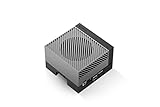
- The NVIDIA Jetson AGX Orin 64GB Developer Kit makes it easy to get started with Jetson Orin. Compact size, lots of connectors, and up to 275 TOPS of AI performance make this developer kit perfect for prototyping advanced AI-powered robots and other autonomous machines.
- The developer kit includes a Jetson AGX Orin 64GB module, and can emulate all the Jetson Orin modules. It supports multiple concurrent AI application pipelines with the NVIDIA Ampere GPU architecture, next-generation deep learning and vision accelerators, high-speed IO and fast memory bandwidth. Now you can develop solutions using your largest and most complex AI models to solve problems such as natural language understanding, 3D perception, and multi-sensor fusion.
- Jetson runs the NVIDIA AI software stack, and use-case specific application frameworks are available, including Isaac for robotics, DeepStream for vision AI, and Riva for conversational AI. You can save significant time with NVIDIA Omniverse Replicator for synthetic data generation (SDG), and by using NVIDIA TAO toolkit to fine-tune pretrained AI models from the NGC catalog.
- Jetson ecosystem partners offer additional AI and system software, developer tools, and custom software development. They can also help with cameras and other sensors, as well as carrier boards and design services for your product.
- With the computing capability of more than 8 Jetson AGX Xavier systems in a developer kit that integrates the latest NVIDIA GPU technology with the world’s most advanced deep learning software stack, you’ll have the flexibility to create tomorrow’s AI solution as well as today’s.
Where the computation happens
- Edge: The model executes on a constrained local processor or a nearby gateway. Raw inputs can remain on-site, with a small result, feature vector, or alert sent elsewhere.
- Cloud: The device uploads inputs to a regional or centralized service. The service performs inference and may retain the data for analytics, monitoring, or subsequent training.
- Hybrid: A local model makes the immediate decision while the cloud handles model development, aggregation, policy, dashboards, and requests that do not have a hard response deadline.
Why the distinction matters to a business
A machine-vision stop signal, vehicle collision warning, or medical-device alert has a different requirement from a monthly demand forecast. The first class may fail if it waits on a round trip; the second may benefit from a large centralized dataset. Treating every workload as either fully local or fully remote often creates unnecessary cost or risk.
How does edge AI work in a production system?
An edge deployment collects data, runs preprocessing and inference locally, applies a policy, and optionally forwards selected information. The complete system includes more than the model: device identity, secure boot, operating-system patches, model signing, telemetry, storage, and a way to recover a failed unit.
Recommended Free Tools
Typical edge path
- Capture: A sensor, camera, microphone, or application produces an input.
- Preprocess: The device resizes, filters, normalizes, or otherwise prepares the input. This step can reduce memory and compute use.
- Infer: A compact model produces a classification, detection, score, or forecast on the local CPU, GPU, neural-processing unit, or gateway accelerator.
- Act: A local rule or control loop decides whether to stop a machine, unlock a door, notify a worker, or continue operating.
- Report: The device sends an event, feature summary, sample, or health record to a central service when policy and connectivity allow.
Local execution avoids a remote round trip, but it does not make response time unlimited. Thermal throttling, shared workloads, storage speed, and model size can still create bottlenecks. Measure the full capture-to-action path on the intended hardware, not just the model’s laboratory inference time.
What edge hardware must provide
Hardware selection is a constraint-setting exercise. A unit must have enough memory for the model and runtime, processing headroom for peak input rates, storage for logs and rollback images, and a power and thermal envelope appropriate to its location. Outdoor, mobile, and industrial installations may also need enclosure protection, vibration tolerance, and a service plan. A gateway can consolidate several sensors, but it becomes a shared failure point that needs redundancy and physical protection.
How does cloud AI work in a production system?
Cloud AI moves data to a centralized environment where elastic compute and storage can serve many devices or business teams. A managed endpoint may scale inference capacity, while separate pipelines store training data, run evaluation, register model versions, and expose analytics.
Strengths of centralized processing
- Large models and datasets can run on pooled CPUs, GPUs, and high-capacity storage.
- One deployment can serve many sites, products, or business units.
- Training, evaluation, observability, and model updates can use common tooling and staff.
- Capacity can expand for a batch job or seasonal demand without installing hardware at every location.
Constraints to plan for
Every request needs a network path, authentication, available service capacity, and an acceptable transfer time. High-volume video, audio, or sensor streams can increase bandwidth and recurring transfer charges. Provider quotas, regional outages, retention settings, access policies, and contract terms become part of the risk assessment. A cloud endpoint may be centrally managed, but it is not automatically compliant or private; the organization still has to define what is collected, who can access it, how long it is retained, and where it is processed.
Windows Errors? Fix Them Before They Spread
Repair common Windows errors and clear accumulated junk for a smoother, more stable PC - no reinstall needed.Free scan · no reinstallCrashes, No Sound, or Screen Glitches?
Random freezes, missing sound and display glitches usually trace back to one bad driver. Find and replace yours safely.Free scan · under a minuteWhat is the difference across latency, privacy, cost, and scale?
The following comparison describes the architectural trade-offs. Actual performance and cost depend on the workload, hardware, region, traffic pattern, and operating practices; there is no universal edge or cloud winner.
| Decision axis | Edge AI | Cloud AI |
|---|---|---|
| Response time | Avoids a remote round trip and supports real-time decisions, although device compute can bottleneck. | Network travel adds delay, while centralized infrastructure can run demanding models. |
| Connectivity | Can continue during intermittent or lost connectivity if the required model and policy are local. | Normally depends on a network path to the service. |
| Data movement and privacy | Can keep raw inputs local or transmit summaries; local processing alone does not guarantee privacy. | Data crosses networks and provider systems, so contracts, controls, retention, and residency require review. |
| Compute and model size | Limited by device CPU or GPU, memory, power, and thermal envelope. | Elastic CPUs, GPUs, and storage support large models, datasets, and training. |
| Bandwidth | Often reduces transmission by sending features, metadata, or events. | Raw or high-volume inputs can increase network use and recurring transfer costs. |
| Scaling and operations | Requires procurement, provisioning, patching, monitoring, replacement, and fleet lifecycle management. | Centralized deployment and scaling are simpler, but usage, quotas, provider dependence, and service reliability need governance. |
| Cost structure | May reduce bandwidth and cloud-inference spend, but adds device, energy, maintenance, and replacement costs. | Avoids much edge hardware, but creates recurring compute, storage, network, and observability charges. |
Which is better for my business: edge or cloud AI?
Start with the decision that must be made, not the location where the model is fashionable. A six-step assessment exposes whether local, centralized, or hybrid processing is justified.
1. Set latency and availability requirements
Write down the maximum acceptable time from input to action and the behavior required during a network outage. If a safety or control decision must happen immediately, place the minimum required inference and policy at the edge. If a delayed answer is acceptable and connectivity is dependable, a cloud endpoint may be simpler.
2. Classify every data flow
Map personal, sensitive, regulated, confidential, and residency-constrained data from capture through storage, logging, support, and model training. Local processing can reduce the amount that leaves a site, but a device may still upload diagnostics or use a cloud service by default. Review encryption, access, retention, deletion, and regional processing for both designs.
Rank #2

- Stability: Can be used stably for a long time
- Design: Robust design, easy to maintain
- Easy to install: simple operation, easy to install
- Application Scenario:Widely used in many industrial environments
- Correct use:Correct use can extend the service life of the product
3. Size the model and workload
Identify peak input rate, model memory, accelerator needs, context length, storage, and retraining frequency. Compact detection or filtering models are candidates for local execution. Large language models, deep analytics, broad cross-site correlation, and training jobs generally benefit from cloud GPUs and centralized storage. A two-stage design can use a small edge model to reject ordinary events and send ambiguous cases to a larger cloud model.
4. Calculate total cost of ownership
Include hardware purchase or rental, power, connectivity, cloud inference, storage, egress, observability, patching, installation visits, spares, replacement cycles, and staff time. For edge fleets, model the cost of a technician reaching a failed unit. For cloud systems, model peak traffic, retained data, idle capacity, and the cost of a provider outage or migration.
5. Define the lifecycle before deployment
Document device identity, secure boot, signed model packages, staged updates, rollback, drift monitoring, patch windows, human override, and end-of-life handling. Decide how a unit behaves when the model is unavailable, a sensor is faulty, or the cloud cannot be reached. A design without these paths is incomplete even if its inference accuracy is excellent.
6. Use hybrid when requirements conflict
Keep the immediate action local while sending summarized features, selected samples, and low-priority requests upstream. The cloud can train and evaluate new versions, coordinate a fleet, compare sites, and provide a fallback for cases that exceed local capacity. This arrangement limits exposure and latency without giving up centralized learning.
The Tool Desk
Outbyte Driver Updater FREEFix the driver behind crashes, sound loss and screen glitchesFind Drivers →Outbyte PC Repair FREERepair Windows errors before they cause bigger problemsFix Now →Which industries benefit most from edge AI?
Manufacturing and robotics
Machine-vision alarms and control loops often need a local response because stopping a line cannot wait for a round trip. A gateway can aggregate cameras and sensors, enforce local safety rules, and continue in a plant network outage. The cloud is useful for fleet analytics, cross-site reporting, root-cause analysis, and retraining on reviewed examples. Separate the model’s recommendation from the machine’s safety interlock so a software error cannot bypass established controls.
Vehicles, drones, and remote equipment
Navigation, obstacle detection, and emergency decisions belong on the vehicle or aircraft when coverage is uncertain or seconds matter. Cloud services can supply maps, historical analysis, simulation results, and signed model updates when a connection returns. Plan for stale maps, degraded sensors, limited storage, and a safe fallback mode rather than assuming continuous service.
Healthcare and financial services
Local or regional processing can reduce exposure of sensitive records and help meet residency requirements, but it does not remove governance duties. Define who may inspect inputs, where logs reside, how long outputs are retained, and how a human reviews a high-impact recommendation. Financial or clinical decisions may require explainability, audit trails, and a documented override regardless of where inference runs.
Customer service and enterprise analytics
Centralized processing is usually suitable when requests benefit from a large knowledge base, frequent model updates, elastic capacity, and organization-wide context. Keep secrets and personal data out of prompts and logs unless the access and retention design explicitly permits them. Edge components can still perform local redaction or classification before a request is sent to a central model.
Retail and smart buildings
Local camera or sensor inference can trigger an immediate occupancy, safety, or equipment event while transmitting only counts, metadata, or short clips selected by policy. Cloud aggregation supports forecasting, energy optimization, cross-site dashboards, and administrative control. Establish retention limits for video and provide a way to disable collection in spaces where it is not justified.
Is edge AI cheaper than cloud AI?
Not by definition. Edge AI can lower bandwidth and per-request cloud charges, but it introduces hardware, electricity, installation, patching, monitoring, spares, and eventual replacement. Cloud AI avoids much of that physical fleet work, yet recurring compute, storage, transfer, and observability charges can rise with traffic and retention.
Rank #3

- Brilliant AI Performance for production: on-device processing with up to 70 TOPS AI performance with low power and low latency, Due to the high thermal demands of Super mode, only the J30 Series supports upgrading to Super mode via the JetPack 6.2 update.
- Hand-size edge AI device: compact size at 130mm x120mm x 58.5mm, includes NVIDIA Jetson Orin NX production module, a heatsink, enclosure, and a power adapter. Support desktop, wall mount, fit in anywhere
- Expandable with rich I/Os: 4x USB3.2, HDMI 2.1, 2xCSI, 1xRJ45 for GbE, M.2 Key E, M.2 Key M, CAN and GPIO
- Accelerate solution to market: pre-installed JetPack with NVIDIA JetPack 5.1.1 on the included 128GB NVMe SSD, Linux OS BSP, 128GB SSD, support Jetson software and leading AI frameworks and software platforms
- Comprehensive certificates: FCC, CE, RoHS, UKCA
Costs that are easy to miss at the edge
- Procurement, shipping, mounting, calibration, and site visits.
- Power, cooling, enclosure, and connectivity at each location.
- Inventory, spare units, secure disposal, and end-of-support replacements.
- Fleet identity, remote management, patch testing, and incident response.
- Engineering work to compress, quantize, and validate a model for each hardware class.
Costs that are easy to miss in the cloud
- Uploading raw media and downloading results at sustained volume.
- Storage and backup retention for inputs, labels, features, and logs.
- Idle capacity, autoscaling limits, quotas, and duplicate environments for testing.
- Monitoring, security controls, regional replication, and support tiers.
- Migration effort if a model, API, or region must change.
Because workloads differ, no verified universal percentage saving or latency advantage applies across businesses. Build a pilot budget using measured traffic, power, accuracy, response time, and staff effort rather than a headline estimate.
Does edge AI work without an internet connection?
Yes, if the required model, inputs, policy, and operational data are available locally. An edge system can continue its defined functions during an outage, then queue health records or selected events for later synchronization. It cannot perform a cloud-only operation while disconnected, such as querying a remote knowledge base or downloading a new model.
What’s actually slowing this PC down?
Pick the symptom - the matching free tool is one click away.
Design an explicit offline mode
- Set a maximum age for cached maps, policies, credentials, and model files.
- Define what happens when local storage fills or a clock cannot be synchronized.
- Queue events with integrity protection and bounded retention.
- Show operators whether the system is online, degraded, or operating on stale data.
- Test recovery after long outages, power loss, and an interrupted synchronization.
Is edge AI more private?
Keeping raw data on a device can reduce transmission and central retention, but it is not an automatic privacy guarantee. A compromised device may expose the model or stored inputs, and firmware may send diagnostics to a service that was not included in the initial data-flow diagram. Local models can also be extracted or tampered with if signing, access control, and physical protections are weak.
Cloud processing has a different risk profile: data crosses networks and provider systems, so the organization must assess encryption, identity, administrative access, retention, deletion, residency, subcontractors, and contractual use of data. In either architecture, minimize collection, log access, separate production from training data, and document the purpose of each transfer.
How do I combine edge and cloud AI in a hybrid architecture?
A practical hybrid design assigns each function to the location that satisfies its requirement instead of duplicating everything. The edge handles time-critical action; the cloud handles expensive or shared work.
- Define the local contract: Specify inputs, output schema, maximum response time, safe defaults, and behavior when dependencies fail.
- Filter and summarize: Send events, features, counts, or carefully selected samples rather than an unrestricted raw stream.
- Centralize learning: Use cloud storage and compute for labeling, training, evaluation, drift analysis, and model-version registration.
- Stage updates: Sign packages, deploy to a small canary group, monitor accuracy and health, and keep a tested rollback version.
- Coordinate policy: Push configuration through an authenticated control plane, with versioning and an audit record for every change.
- Provide fallback: Decide whether an unusual case is queued, escalated to a human, processed by a cloud model when available, or rejected safely.
Hybrid does add interfaces and failure modes. Data schemas, clock differences, duplicate events, partial updates, and inconsistent model versions need explicit handling. The cloud should not silently become a single point of failure for a function advertised as offline-capable.
Quick wins for a faster PC:
Fix the driver behind crashes, sound loss and screen glitchesFind Drivers →Clear out junk files and repair common Windows errorsFree Scan →Scan for outdated or missing drivers - takes under a minuteDriver Scan →What security and governance controls are required?
The Canadian Centre for Cyber Security describes edge AI as often hybrid and emphasizes responsibility for device, model, identity, patching, monitoring, safety, and human control. Those responsibilities remain even when a device runs without a network.
Device and model protection
- Use unique device identities, least-privilege credentials, secure boot, encrypted storage, and signed firmware and model artifacts.
- Limit debugging interfaces and physical access; assume an attacker may obtain a device and attempt model extraction.
- Maintain an inventory of hardware, software, model versions, owners, and support status.
Operational oversight
- Monitor health, temperature, storage, input quality, confidence distributions, latency, and drift.
- Keep human override and manual-safe procedures for high-impact decisions.
- Record which model and policy produced an action so incidents can be reconstructed.
- Test provider controls, data residency, retention, quotas, outage procedures, and contract terms for cloud services.
Microsoft’s AI workload guidance identifies latency, throughput, cost transparency, model drift, compliance, explainability, privacy, and residency as nonfunctional requirements. Google Cloud groups comparable architecture work under operational excellence, security, reliability, cost optimization, and performance optimization. Treat these as design gates, not documentation to complete after launch.
Independent reader supportYour contribution helps us test, update, and keep practical guides available for everyone.How should a business pilot edge and cloud AI?
Run the same representative workload through candidate designs and measure the entire system. A model that scores well on a test set can still fail because the camera angle changes, the network is congested, or a device overheats.
Pilot measurements
- Capture-to-action response time at normal and peak load.
- Accuracy, false positives, false negatives, and confidence by site or operating condition.
- Behavior during packet loss, a full outage, power interruption, and delayed synchronization.
- Bandwidth, storage growth, energy use, device temperature, and cloud utilization.
- One-time deployment effort and recurring costs, including staff and service visits.
- Time to update, verify, roll back, and replace a device or model.
Use representative conditions
Include night scenes, unusual inputs, seasonal changes, poor connectivity, firmware variations, and the oldest supported hardware. Measure a sufficiently long period to expose drift and maintenance work. No primary, owner-published benchmark establishes a universal edge-versus-cloud latency, cost, or accuracy advantage across businesses, so a workload-specific pilot is the defensible basis for a decision.
Rank #4

- 【Core Parameters】★AI Perf: 117/157 TOPS★GPU: 1024-core N-VI-DIA Ampere architecture GPU with 32 Tensor Cores★CPU: 8-core Arm Cortex-A78AE v8.2 64-bit CPU 2MB L2 + 4MB L3★Memory: 16GB 128-bit LPDDR5 | 102.4GB/s★Storage: Supports external NVMe 【Note: This kit does not include a SSD and pre-installed system. User need to provide your own NVMe M.2 SSD of at least 256GB and flash the operating system onto it yourself. 】
- 【Empowered by Large Al Model, Enhanced Human-Computer Interaction】Jetson Orin Super leverages three AI models and incorporates an AI voice interaction module. This multimodal visual system matches the scene being described, enabling environmental awareness and AI visual gameplay. Combined with a large-scale voice module and camera, it enables speech-to-text, semantic analysis, natural conversation, and real-time video analysis, enabling advanced embodied AI applications.
- 【Revolutionize the Industry】Jetson Orin NX modules deliver unmatched performance and efficiency for small, low-power robotics and autonomous machines, making them ideal for drones, handheld devices, and more. The module can be easily used in advanced applications in manufacturing, logistics, retail, agriculture, medical and life sciences, and comes in a highly compact and energy-efficient package.
- 【Revolutionizing AI with Unmatched Performance】The Jetson Orin NX system module adopts the Ampere architecture GPU, a new generation of deep learning and vision accelerators, high-speed I/O, and fast memory bandwidth to support multiple AI application processes. Granular structured sparsity to improve the operating throughput of Tensor Core, and can use larger and more complex AI model development solutions in natural language understanding, 3D perception and multi-sensor fusion.
- 【Tutorial materials provided】The JETSON system based on Ubuntu 22.04 provides a complete desktop Linux environment with accelerated graphics, supporting NVIDI-ACUDA 12.6, TensorRT 10.7.0, cuDNN 9.6.0, OpenCV 4.10.0, etc. The performance on AI LLM, VLM and visual Transformer is significantly improved compared with the previous generation.
What can go wrong, and how do I fix it?
Local inference is too slow
Profile preprocessing, model execution, storage, and post-processing separately. Reduce input size or model complexity, use an available accelerator, batch only when the deadline permits, and remove competing workloads. If the required model still exceeds the device envelope, move a noncritical stage to a gateway or cloud while retaining a smaller local safety model.
Accuracy drops after deployment
Check for changed lighting, camera placement, sensor calibration, population shifts, and data-quality failures. Review labeled edge samples, monitor confidence and error rates, and retrain or recalibrate through a staged release. Do not automatically replace a local model with a larger remote one without rechecking outage behavior and data-transfer obligations.
Devices disappear from management
Verify power, clock, certificates, connectivity, storage, and the update agent in that order. Keep an out-of-band recovery path, a known-good image, and a replacement procedure for units that cannot be repaired remotely. Fleet monitoring should alert on silence before a business process depends on a missing device.
Cloud bills or transfer volume spike
Inspect raw-stream uploads, log verbosity, retention, retries, and autoscaling. Move filtering closer to the source, sample routine events, set budgets and quotas, and separate high-value data from debug telemetry. Confirm that a cost control does not discard evidence needed for safety, compliance, or incident analysis.
Do these 3 things before closing this tab:
1Clear out junk files and repair common Windows errors2Fix the driver behind crashes, sound loss and screen glitches3Repair Windows errors before they cause bigger problemsThe network outage creates unsafe behavior
Rehearse the outage and inspect every dependency, including authentication, time synchronization, policy retrieval, and remote dashboards. Define a bounded degraded mode with clear operator indicators and a safe stop or fallback action. A statement that a system “works offline” is meaningful only when those scenarios have been tested.
What is the practical decision rule?
Choose edge AI when immediate local action, outage tolerance, or reduced raw-data movement is a hard requirement and the model fits the device envelope. Choose cloud AI when the workload needs large models, centralized context, elastic compute, or frequent organization-wide analysis and can tolerate network dependence. Choose hybrid when both sets of requirements are real: local inference protects the immediate operation, while cloud services provide the scale, learning, and oversight that devices cannot.
Frequently Asked Questions
What hardware runs edge AI?
Edge models can run on CPUs, GPUs, neural-processing units, phones, cameras, industrial gateways, vehicle computers, and other embedded systems. The correct choice depends on model memory, input rate, power, thermal limits, enclosure, and available operating-system support; a gateway may be preferable when several sensors share one protected location.
How are edge AI models updated securely?
Maintain an inventory and deliver signed model packages through an authenticated channel. Roll out to a small canary group, verify health and accuracy, retain the previous version for rollback, and record the model and policy version associated with every decision.
What happens when an edge device fails completely?
The service should have a documented failure mode: a redundant unit, a safe stop, a manual process, or a queued operation that resumes later. Keep spare hardware, tested recovery images, and alerts for missing telemetry so replacement does not depend on discovering the problem through a customer or operator.
Can regulations require local or regional AI processing?
Some sectors and jurisdictions impose residency, retention, access, or transfer conditions that can favor local or regional processing. The requirement is not always a blanket edge mandate; review the specific data categories, processing locations, contracts, audit duties, and human-oversight rules with qualified legal and compliance teams.
Quick Recap
Product prices and availability are accurate as of the date/time indicated and are subject to change. Any price and availability information displayed on Amazon at the time of purchase will apply.

