What’s actually slowing this PC down?
Pick the symptom - the matching free tool is one click away.
Some links on this page are affiliate links: if you buy through them we may earn a commission, at no extra cost to you.
Using AI does not automatically make one creative work less original. In controlled studies, AI help sometimes raised the novelty and quality ratings of an individual story, yet the stories produced with AI were more alike as a group. Other experiments found fewer, less varied ideas when an image generator became part of early ideation. The fairest answer is therefore conditional: AI can improve an individual result while narrowing the range of results, and its effect depends on the task, when it enters the process, and how originality is measured.
What does “original” mean when people discuss AI-assisted creativity?
Originality is not a single score. It can mean that one poem, image or story contains an unusual idea; that a creator develops many different ideas; that a portfolio is unlike other portfolios; or that an audience perceives the maker as genuinely creative. Those are related but distinct outcomes.
As an Amazon Associate I earn from qualifying purchases.
Quick wins for a faster PC:
Clear out junk files and repair common Windows errorsFree Scan →Scan for outdated or missing drivers - takes under a minuteDriver Scan →Repair Windows errors before they cause bigger problemsFix Now →AI studies use different measures for these outcomes. Judges may rate a finished story’s creativity or novelty. Researchers may calculate semantic similarity among many submissions, count ideas and their variety, or ask observers how creative the person behind a work seems. A result can improve on one measure and worsen on another without contradiction.
That distinction explains why the answer to the title question cannot be a simple yes or no. Before accepting a claim that AI “reduces originality,” ask: whose output was measured, what task they performed, when the AI appeared, and whether the comparison concerns a single work or a collection.
#1 Best Overall

- Large Spiral Notebook: Measuring 8.5" x 11" with standard 7mm college-ruled lines, this large spiral notebook provides plenty of room for journaling, planning, note-taking, and creative writing. Its spacious pages make it ideal for work, study, or personal reflection.
- Practical & Reliable Design: The sturdy double-wire binding ensures effortless page turning and a flat writing surface, while the elastic closure strap keeps pages secure. The lightweight yet firm cover protects your notes and fits neatly into bags or backpacks for everyday use.
- Customizable Pages & Table of Contents: Includes 4 table of contents pages to keep your notes organized and easy to reference. Contains 50 sheets/100 lined pages that allow you to write on both sides, each page allows you to customize page numbers and dates, making it the ultimate notebook for you.
- Premium 100gsm No-Bleed Paper: Crafted with thick, smooth 100gsm paper, each page resists ink bleed-through for a clean writing experience. Perfect for use with pens, pencils, markers, or highlighters—each stroke stays crisp and clear.
- Stylish & Artistic Covers for You: Choose from a stunning collection of designs—from dreamy night gardens and watercolor mountains to bright floral patterns and nature-inspired scenes with deer or butterflies. Each cover expresses a different mood, making this notebook a beautiful and giftbale accessory for women who value both creativity and elegance.
Does AI make an individual creative work less original?
Not necessarily. The strongest direct evidence for writing points in the opposite direction for individual short stories: access to AI-generated ideas increased evaluators’ ratings of creativity, writing quality and enjoyment.
What happened in the short-story experiment?
Doshi and Hauser’s 2024 Science Advances experiment involved online writers creating short fiction. Participants could work without AI ideas or receive up to five ideas generated for them. Compared with writers who had no AI access, stories from writers given one AI idea received a 5.4% increase in evaluated novelty. Access to as many as five ideas produced an 8.1% increase in evaluated novelty.
The gains were especially pronounced among participants who scored as less creative at baseline. Evaluators also rated the AI-assisted stories higher for overall creativity, writing quality and how enjoyable they were to read. These are ratings of finished individual stories, not proof that every AI-assisted work is better or that the writers’ underlying creative ability changed permanently.
Why the same study still raises an originality concern
Although individual stories scored better, the collection of AI-assisted stories was more similar from one story to the next than the collection written without AI. The study’s authors, Anil R. Doshi and Oliver P. Hauser, summarized the trade-off this way: “These results point to an increase in individual creativity at the risk of losing collective novelty.” The experiment is bounded: it tested online participants making short fiction with a limited menu of AI ideas, not professional novelists, visual artists or every kind of creative work.
This is the clearest example of two levels moving in opposite directions. If your goal is to make one draft more polished or immediately appealing, AI assistance may help. If your goal is for a group of creators to produce work that does not converge on the same themes, structures or stylistic cues, the same assistance can be a liability.
Why can individual creativity rise while a group becomes more alike?
Generative systems are trained to produce likely, coherent continuations. When many people receive suggestions from the same kind of system, those suggestions can steer them toward overlapping premises, wording and structures. Each person may turn a suggestion into a competent, distinctive-enough finished piece, while the set of pieces loses some of its spread.
Individual quality and collective diversity answer different questions
- Individual evaluation: Does this one work seem novel, useful, well written or enjoyable compared with a control work?
- Within-person variety: How many different directions does one creator explore before choosing?
- Between-work diversity: How different are the outputs produced by many people using the same assistance?
- Perceived authorship: Does an observer see the creator as the source of meaningful decisions, rather than merely accepting a machine’s first suggestion?
A higher score on the first measure cannot compensate for a lower score on the third if a newsroom, class or studio needs a broad range of ideas. Conversely, a highly diverse set can contain many weak drafts. Decide which level matters before judging whether AI helped.
Rank #2

- Perfect Quality: Our notebook is made of high-quality faux leather with hand-stitched binding, ensuring durability and luxury. The soft cover provides a comfortable touch, making it ideal for students and professionals.
- Vintage Design with Embossed Cover: This notebook features a beautiful vintage design with an embossed cover, adding a unique and elegant touch. Available in classic black and brown and gray and pink, there's something for every style.
- Thicker Acid-Free Pages: With 300 Pages of thick acid-free paper, our notebook is 20-50% thicker and smoother than regular paper. It is compatible with most pens and environmentally friendly, protecting your eyesight.
- Functional and Stylish: The unique embossing process creates a raised texture on the cover, enhancing its aesthetic appeal. With dimensions of 5.7 x 8.3 inches, it is perfect for travel, business, or back-to-school use.
- Great Gift Choice: Our notebook is an excellent gift choice for loved ones, friends, family, or colleagues. Available in various classic colors, it combines style and functionality.
Does generative AI make people think alike across many pieces of writing?
Evidence from college-admissions essays suggests that AI can reduce the rate at which new ideas appear across a collection, although that finding is specific to admissions writing rather than a universal law of creativity.
What the essay-diversity studies found
A 2025 article in Computers in Human Behavior: Artificial Humans reports three preregistered studies covering 2,200 college-admissions essays. The authors compared the contribution of each additional human-written essay with that of each additional essay produced with GPT-4 assistance. Each new human essay added more new ideas to the pool; successive GPT-4 essays added fewer. The difference remained when the investigators changed the prompt and model parameters.
The relevant outcome is collective diversity: how quickly a growing stack of essays accumulates distinct ideas. It does not establish that every GPT-4 essay is unoriginal, nor does it show that an AI-assisted applicant copied another applicant. Admissions prompts themselves are semantically narrow, and the population and genre differ from fiction, advertising, game design or fine art.
What this means for portfolios and teams
If a school, agency or product team asks many people to respond to the same brief with AI available at the start, review the portfolio for convergence rather than evaluating only the strongest entry. Repeated metaphors, identical problem framings and the same sequence of benefits can indicate that the assistance is narrowing the search space. This is a portfolio-level warning, not a verdict on any one contributor’s integrity or talent.
Can AI anchor creators on its first idea?
Yes, under some ideation conditions. An experiment in visual ideation found more fixation on an initial example and fewer ideas with less variety and lower originality when participants used an image generator.
What the visual ideation experiment measured
Wadinambiarachchi and colleagues studied 60 participants in a 2024 CHI paper. The task involved generating visual concepts with image-generator support and comparing them with a baseline condition. In the AI-supported condition, participants tended to stay closer to the first example they encountered. Their idea sets were smaller in variety, and the ideas were rated as less original than those from the baseline.
“Fixation” does not mean the participant lacked imagination. It means an early cue became an anchor, making alternative directions less likely to be explored. An image is a particularly strong anchor because it supplies concrete composition, color and subject choices at once. The finding should not be generalized to every prompt, model or stage of a creative workflow.
Rank #3
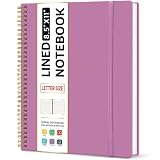
- Large Spiral Notebook: Measuring 8.5" x 11" with standard 7mm college-ruled lines, this large notebook offers ample space for detailed note-taking, journaling, and task management. Its spacious pages are perfect for capturing ideas, organizing thoughts, and managing projects—whether at work, school, or in your home office.
- Premium No-Bleeding Paper: Crafted with 100gsm smooth paper, our lined notebook ensures a luxurious writing experience without ink bleed-through. Ideal for gel pens, fountain pens, ballpoints, and highlighters. Each line flows evenly, allowing you to focus on creativity and organization without interruptions.
- Versatile for Multiple Uses: Designed for multiple purposes, Taja spiral notebook meets the needs of professionals, students, writers, and creatives alike. It’s ideal for taking meeting notes, class lectures, and project plans, or organizing Bible studies and brainstorming sessions. A perfect all-in-one tool for work and personal productivity.
- Customizable Pages & Table of Contents: Includes 4 table of contents pages to keep your notes organized and easy to reference. Contains 50 sheets/100 lined pages that allow you to write on both sides, each page allows you to customize page numbers and dates, making it the ultimate notebook for you.
- Practical Design for Long-Lasting Use: Built for long-lasting use, our journal notebook features a strong double-wire spiral binding for smooth page-turning and a lay-flat design for ease of writing. The elastic closure strap keeps your pages secure and tidy, waterproof plastic cover keep pages clean. Slim and lightweight, it fits seamlessly into briefcases, backpacks, or tote bags, making it the perfect companion for work, school, or travel.
Why timing changes the risk
AI shown before a person has formed a broad set of possibilities can define what counts as a plausible answer. AI used after a creator has selected a direction has less opportunity to determine the search space, although it can still influence details. The distinction is between using a system to open exploration and using it to elaborate a decision that already belongs to the creator.
What does the broader evidence say about homogenization?
A 2026 systematic review and meta-analysis provides a wider, task-sensitive view. Across 19 studies and 61 effect sizes, it found a small but statistically significant tendency toward homogenization in human–AI co-creation.
The pooled effect was stronger in semantically constrained ideation tasks, where people must answer a relatively specific brief, than in minimally constrained divergent-thinking tasks that invite many directions. A small average effect is not evidence that every use of AI reduces creativity. It means that, across the included studies, similarity increased slightly more often than it would by chance, with the size of the change depending on the task and design.
Meta-analysis also combines unlike measures and populations. A semantic-similarity index is not the same thing as an editor’s judgment of originality, and neither is identical to a creator’s sense of authorship. Treat the review as evidence of a recurring pattern, not a universal penalty attached to AI.
The Tool Desk
Outbyte PC Repair FREEClear out junk files and repair common Windows errorsFree Scan →Outbyte Driver Updater FREEScan for outdated or missing drivers - takes under a minuteDriver Scan →Does it matter whether AI is used early or late?
Timing affects how observers judge the creator and can influence how much independent thinking is visible in the final work. A 2026 proceedings report describes three preregistered experiments with 940 participants. Evaluators perceived creators as less creative when AI entered early in the process rather than later.
Early assistance versus late assistance
Early use can make the AI’s framing look like the source of the concept. Late use—such as revising language, testing alternatives or helping elaborate a direction already chosen by the person—leaves more evidence of human problem framing. In the experiments, elaboration on AI suggestions reduced the negative perception associated with early entry: people were judged more favorably when they substantially developed the suggestion instead of accepting it unchanged.
This result concerns perceived creativity, not a laboratory proof that late use always produces more novel artifacts. It nevertheless matters in classrooms, commissioning and collaborative workplaces, where an audience evaluates both the work and the maker’s contribution.
Rank #4

- Journal is appropriate for grades K-2. It contains 100 double-sided, primary ruled sheets that measure 7-1/2" x 9-3/4".
- Double-sided primary ruling is printed with solid and dotted lines. Ideal for beginning students who want to improve their handwriting.
- Top half of each page is blank for illustrating stories. Cover includes a manuscript alphabet for reference.
- Sewn binding is smooth, helps keep pages securely in place and lays flat when open
- Includes 1 primary journal in a randomly selected color: Red, Blue, Green or Purple. Color will vary with each purchase.
How should you compare claims that AI changes originality?
Use the following checklist before drawing a conclusion from a study, benchmark or anecdote.
| Question | Why it changes the interpretation |
|---|---|
| What is the unit of analysis? | One person’s output can improve while diversity across a collection declines. |
| What was the task? | Short fiction, visual ideation and admissions essays impose different constraints and invite different kinds of originality. |
| What role did AI play? | An initial idea, a visual example, drafting help and late editing expose creators to different forms of anchoring. |
| When did AI appear? | Early exposure can shape the search space; later assistance may support elaboration after a human direction exists. |
| What was measured? | Evaluator ratings, novelty scores, idea count, variety, semantic similarity and perceived creator authenticity are not interchangeable. |
| Who participated? | Online participants and college students may respond differently from professional creators with established practices. |
| Was the setting controlled? | A timed experiment isolates a mechanism but may not predict months of real-world use, revision and feedback. |
For the primary studies discussed here, see the 2024 short-story experiment, the 2024 visual-ideation paper, the 2025 essay-diversity study, the 2026 review and the 2026 timing study.
Independent reader supportYour contribution helps us test, update, and keep practical guides available for everyone.How can a creator use AI without surrendering originality?
No workflow guarantees originality, but you can reduce the specific risks identified in these experiments by protecting independent exploration and treating AI output as material to interrogate rather than a default answer.
1. Generate a private, unaided first pass
Write down several premises, thumbnails, melodies, headlines or solution paths before opening a generator. This creates a record of your own search space and makes it easier to notice when a later suggestion pulls you toward a familiar template.
2. Ask for breadth, not one polished answer
When you do consult AI, request genuinely different directions and compare them with your initial list. Reject options that merely swap nouns while preserving the same structure. Treat the suggestions as prompts for questions, not as a ranked list of what you should make.
Do these 3 things before closing this tab:
1Scan for outdated or missing drivers - takes under a minute2Clear out junk files and repair common Windows errors3Fix the driver behind crashes, sound loss and screen glitches3. Delay concrete exemplars when exploration is the goal
For visual work, avoid looking at a generated image before you have explored composition and subject choices yourself. If you need a reference, use several contrasting examples rather than allowing one image to become the anchor. This is a risk-control practice derived from the fixation finding, not a tested rule for every tool.
4. Make the decisive transformations yourself
Explain why you kept, changed or discarded each AI suggestion. Combine unrelated starting points, add personal observations and test the result against the brief. Elaboration matters because observers in the timing experiments responded better when creators developed suggestions instead of accepting them untouched.
Best Value

- Journal is appropriate for grades K-2. It contains 100 double-sided, primary ruled sheets that measure 7-1/2" x 9-3/4"
- Double-sided primary ruling is printed with solid and dotted lines. Ideal for beginning students who want to improve their handwriting
- Top half of each page is blank for illustrating stories. Cover includes a manuscript alphabet for reference
- Sewn binding is smooth, helps keep pages securely in place and lays flat when open
- Available in Blue
5. Audit the whole set, not only the winner
For a team or class, lay outputs side by side and mark recurring premises, metaphors, layouts and endings. If many pieces cluster around one pattern, reopen ideation with the shared pattern hidden or prohibited. A portfolio review catches collective convergence that a quality ranking of individual pieces will miss.
6. Keep a human-only comparison
Save at least one version made without AI for major projects. Compare not just polish but the number of distinct directions considered, the specificity of the point of view and the distance between your work and the rest of the set. This gives you a practical baseline without pretending that originality can be reduced to one number.
Crashes, No Sound, or Screen Glitches?
Random freezes, missing sound and display glitches usually trace back to one bad driver. Find and replace yours safely.Free scan · under a minutePC Slower Than It Used to Be?
A free scan shows the junk files, broken settings and background clutter dragging Windows down - then fixes them in one click.Free scan · Windows 10 & 11What are the main limitations of the current evidence?
- The short-story experiment used typical online writers and a bounded fiction task; it did not test professional writers or all creative media.
- The visual study had 60 participants and examined a particular image-ideation setup, so its fixation result may not transfer to every generator or workflow.
- The essay analysis covered college-admissions writing, a genre with shared prompts and conventions; its collective-diversity result should not be treated as a finding about every field.
- The 2026 review pooled 19 studies and 61 effect sizes with different tasks and measures. Its small average homogenization effect is informative but not deterministic.
- The timing experiments measured how evaluators perceived creators. Perception of authorship is different from the measurable novelty of an artifact.
These limits do not cancel the patterns. They define where the patterns are credible: individual and collective outcomes can diverge; constrained tasks are more vulnerable to convergence; and early, concrete suggestions can anchor a search. Claims that go beyond those conditions need separate evidence.
So, does using AI make creative work less original?
The most accurate answer is conditional. AI can raise the judged novelty and quality of a single work, particularly for a less-creative participant in a bounded task. At the same time, common AI suggestions can make many works more alike, reduce variety during some forms of ideation and influence audiences to see the creator as less creative when AI leads the process.
Judge originality at the level that matters for your goal. For one deliverable, inspect the human decisions and the transformations between suggestion and final form. For a portfolio, class or team, measure how widely the ideas diverge. Preserve unaided exploration, introduce AI after you have a direction when possible, and challenge the first plausible answer instead of treating fluency as originality.
Frequently Asked Questions
Can an AI-assisted work still be genuinely authored by a person?
Yes. Authorship and originality depend on the decisions a person makes, not simply on whether a generator appeared somewhere in the workflow. A creator who selects a direction, changes the premise, supplies personal knowledge and accepts responsibility for the final choices has contributed more than someone who publishes an untouched suggestion.
Recommended Free Tools
Does asking an AI for unusual ideas prevent creative convergence?
Not reliably. A request for novelty can change the wording of suggestions while leaving the underlying assumptions shared by many users. To test whether it helped, compare the range of concepts with ideas generated independently rather than trusting a prompt label such as “be original.”
How can an editor detect homogenized AI-assisted submissions?
Review submissions as a set and look for repeated story engines, metaphors, visual compositions or benefit claims. Semantic-similarity software can flag clusters, but a human review is still needed to decide whether the overlap is meaningful or simply required by the brief.
Are professional artists and writers represented in these findings?
Only to a limited extent. The described experiments primarily used online participants, students or genre-specific samples, so established professionals with strong personal methods may respond differently. Treat the findings as mechanisms to watch for, not as a prediction of every expert’s practice.
Quick Recap
Product prices and availability are accurate as of the date/time indicated and are subject to change. Any price and availability information displayed on Amazon at the time of purchase will apply.
Free tools Windows power users keep installed
One-click scans. No signup required.

