Freedom251 › Virtualization Management Software
ZStack
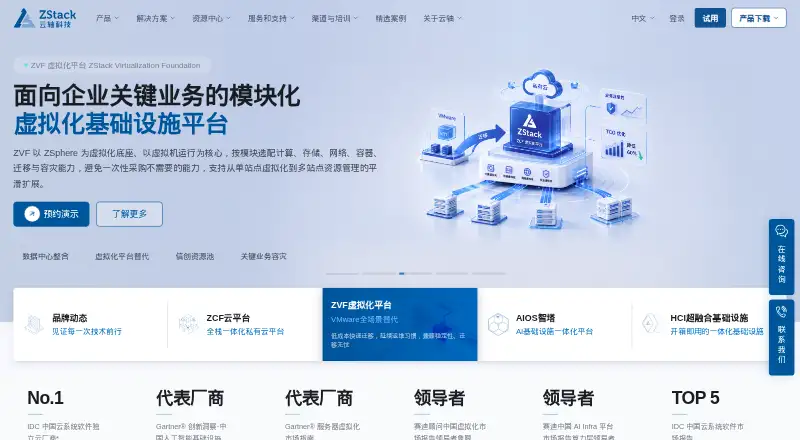
What ZStack is
ZStack provides self-hosted infrastructure software for organizations managing data-center compute, networking, and storage. Its product scope includes private cloud, virtualization, AI infrastructure, hyperconverged infrastructure, storage, networking, container cloud, and multi-cloud management. ZCF combines compute, storage, networking, containers, and security in a software-defined private-cloud platform with a unified portal, operations, and identity management. It manages hosts, disks, images, and snapshots, with scheduling and elastic scaling. ZStack supports KVM, elastic bare metal, and management of heterogeneous virtualization platforms. ZStone provides block, file, and object storage; Zaku manages Kubernetes clusters and containers alongside virtual machines. ZStack Cloud Enterprise integrates with Alibaba Cloud, provides a RESTful API, and supports local, cross-region, and hybrid-cloud backup and recovery. The company lists high-availability policies and migration of mainstream Windows and Linux cloud hosts through a UI. Free plans list full features for three months for ZStack ZSphere or one year for ZStack Cloud. ZStack describes ZCF as suitable for enterprises with demanding compliance, security, stability, or performance requirements, including private-cloud deployments in their own data centers. ZLR enterprise disaster recovery is marked as coming soon.
Who it suits
It suits enterprises building private clouds or managing infrastructure in their own data centers, including organizations with compliance, security, stability, or performance requirements. Its self-hosted deployment and listed products cover compute, storage, networking, and containers.
What it does well
- ZCF combines compute, storage, networking, containers, and security.
- ZStone provides block, file, and object storage.
- Cloud Enterprise supports hybrid-cloud backup and recovery.
- Native RESTful API is available.
What to know first
- ZLR enterprise disaster recovery is marked coming soon.
- ZStack Cloud Standard is available only in selected regions.
- ZSphere's listed free period is three months.
Limits
ZStack ZSphere is listed as free with full features for three months and unlimited server deployment. ZStack Cloud is listed as free with full features for one year and single-server deployment; ZStack Cloud Standard is available only in selected regions.
Plans
| Plan | Billed and limits | Price |
|---|---|---|
| ZStack ZSphere | Unlimited server deployment · full features · free for three months | Free |
| ZStack Cloud | Single server deployment · full features · free for one year | Free |
As zstack.io lists them, read 4 Oct 2026. The maker's own page has the final word.
Getting started
- Visit the ZStack website.
- Choose ZStack ZSphere for unlimited server deployment or ZStack Cloud for single-server deployment.
- Download the installation files for the selected product.
- Deploy the software in your environment; ZStack is self-hosted.
- Use the documentation, API Explorer, or SDKs to work with the platform.
ZStack is a self-hosted infrastructure platform for organizations operating private clouds and data centers. It is best suited to enterprise infrastructure teams that want to manage compute, storage, networking and containers together. Its breadth is compelling, but the free deployments have different scope limits and ZStack Cloud Standard is restricted to selected regions.
Overview
ZStack covers private cloud, virtualization, AI and hyperconverged infrastructure, storage, networking, container cloud and multi-cloud management. ZStack Cloud provides IaaS management for data-center compute, network and storage; ZCF combines those resources with containers and security in a software-defined private cloud with a shared portal, operations and identity management.
This breadth can suit teams that want virtual machines, containers and storage under one infrastructure environment. It is aimed at operators building and managing enterprise infrastructure, not people seeking a general desktop virtualization tool. Shanghai Yunzhou Technology Co., Ltd. is headquartered in Shanghai and was founded in 2015.
Key features
ZCF manages hosts, disks, images and snapshots, with scheduling, elastic scaling and scheduled tasks. It supports KVM virtualization, elastic bare metal and heterogeneous virtualization management; listed hypervisors include KVM, XDragon and VMware vSphere. Live migration and high availability are supported, useful for teams consolidating virtualization operations and continuity policies in one platform.
ZStone offers block, file and object storage, with optional replication or erasure coding and compatibility with existing SAN, NAS and shared block storage. That range can help organizations integrate different storage needs without limiting the platform to a single storage type. Zaku creates and manages Kubernetes clusters, supports orchestration plus Helm and image repositories, and can manage containers alongside virtual machines.
ZCF can manage public-cloud resources, including Alibaba Cloud, and uses OVN/OVS for network virtualization. ZStack Cloud Enterprise integrates with Alibaba Cloud across control and data planes. Enterprise backup supports local, cross-region and hybrid-cloud backup and recovery, while migration tools move cloud hosts running mainstream Windows and Linux systems through a UI.
Security capabilities include vTPM 2.0, Secure Boot, KMS key management, role-based access controls, audit logs and national-cryptography encryption. The company says ZCF-based compliance supports classified cybersecurity protection and cryptographic assessment construction. ZLR enterprise disaster recovery is marked as coming soon, with capabilities and metrics subject to its released version; organizations choosing it for that specific need should account for that gap.
A native RESTful API, API Explorer, installation files, high-availability suite, historical versions, images and SDKs support deployment and development. Documentation, training videos, certification training, a community and knowledge base provide operational resources, alongside separate sales and after-sales phone options.
Pricing
ZStack uses a freemium model with a free plan and a 365-day trial. ZStack ZSphere costs nothing and provides unlimited server deployment with full features for three months. Its server allowance makes it the more suitable option for evaluating multi-server deployment, but the free period is shorter.
ZStack Cloud costs nothing and provides single-server deployment with full features for one year. That longer period suits a single-server evaluation or deployment, but the one-server cap makes it a weaker fit for teams assessing a broader cloud footprint. ZStack Cloud Standard is available only in selected regions, so regional eligibility matters before selecting a plan.
Platforms
ZStack is self-hosted and supports Linux, web and API access. Its installation files and SDKs support deployment and development, while its native RESTful API works with HTTP-supported languages. The self-hosted model suits organizations running infrastructure in their own data centers, but places deployment and operation within that environment.
Who it's for
ZStack is strongest for enterprise infrastructure teams building private clouds where security, compliance, stability or performance are priorities. Its industry solutions include education, energy, manufacturing, finance, telecom, healthcare and government. Teams that need to manage compute, storage, networks, virtual machines and Kubernetes together have a clear reason to consider it; those needing ZLR enterprise disaster recovery now should look elsewhere until that product is released.
Pros and cons
- Broad infrastructure coverage: ZCF, ZStone and Zaku span private cloud, multiple storage types and Kubernetes alongside virtual machines.
- Enterprise security and continuity features: Access controls, audit logs, encryption, live migration and high availability address common infrastructure requirements.
- Free options have useful but distinct scopes: ZSphere permits unlimited server deployment for three months, while ZStack Cloud permits one server for a year.
- Regional restriction: ZStack Cloud Standard is available only in selected regions, which can rule it out for some deployments.
- Disaster recovery gap: ZLR is still marked as coming soon, so it is not a dependable choice for teams requiring that enterprise offering immediately.
Alternatives
For a broader comparison, see Virtualization Management Software. Choose Proxmox VE instead if its free plan and platform range better fit your virtualization needs; its Premium plan is priced per occupied physical CPU socket. Virtuozzo Infrastructure is another freemium option, with a self-install plan capped at 96 physical cores and 1TB of storage.
Apache CloudStack is a free IaaS alternative. Consider LXD for a free, self-hosted option covering KVM-based virtual machines and system containers, or oVirt for its free community virtualization edition. VMware Workstation Pro, virt-manager and Xen Project Hypervisor are also alternatives.
Verdict
Choose ZStack if your enterprise team wants a self-hosted control plane that brings private-cloud compute, storage, networking, virtualization and containers together, with security and hybrid-cloud capabilities. Its two free deployment options provide meaningful ways to evaluate or run the platform, but their server limits differ, regional availability can constrain ZStack Cloud Standard, and ZLR is not yet ready. Look elsewhere if those limits conflict with your deployment or disaster-recovery requirements.
Verdict
ZStack offers a broad set of self-hosted infrastructure products, with capabilities spanning private cloud, storage, and containers. Check product-specific deployment and availability limits before choosing.
Questions
What does ZStack cost?
ZStack ZSphere is listed as free for three months, with unlimited server deployment and full features. ZStack Cloud is listed as free for one year, with single-server deployment and full features.
Does ZStack have a free plan or trial?
Yes. The pricing model is freemium, and the listed plans provide free access for three months or one year, depending on the product.
Which platforms does ZStack support?
The listed platforms are API, Linux, self-hosted, and web. Deployment is self-hosted.
Which hypervisors does it support?
The supported hypervisors are KVM, XDragon, and VMware vSphere.
Can ZStack connect to public-cloud services?
ZStack Cloud Enterprise integrates with Alibaba Cloud in both control and data planes. ZCF can also manage public-cloud resources and work with platforms such as Alibaba Cloud.
Who makes ZStack?
The company identifies itself as Shanghai Yunzhou Technology Co., Ltd. (云轴科技), headquartered in Shanghai, China. It was founded in 2015.
Facts from ZStack's own pages
- API
- The product provides a native RESTful API and documentation for development with HTTP-supported languages. · en.zstack.io, 4 Oct 2026
- Audience
- ZStack describes its offerings as cloud infrastructure for enterprises and lists industry solutions including education, energy, manufacturing, finance, telecom, healthcare, and government. · static.zstack.io, 4 Oct 2026
- Availability
- ZStack Cloud Enterprise includes high-availability policies for business continuity. · en.zstack.io, 4 Oct 2026
- Backup
- ZStack Cloud Enterprise backup supports local, cross-region, and hybrid-cloud backup and recovery scenarios. · en.zstack.io, 4 Oct 2026
- Company
- The company identifies itself as Shanghai Yunzhou Technology Co., Ltd. (云轴科技), headquartered in Shanghai and founded in 2015. · zstack.io, 3 Oct 2026
- Compliance
- The company says its ZCF-based compliance capabilities support classified cybersecurity protection and cryptographic assessment construction. · zstack.io, 3 Oct 2026
- Compute
- ZCF manages cloud hosts, disks, images, and snapshots and supports scheduling, elastic scaling, and scheduled tasks. · zstack.io, 3 Oct 2026
- Containers
- Zaku supports one-click Kubernetes cluster creation and management, container orchestration, Helm and image repositories, and can manage containers alongside virtual machines. · zstack.io, 3 Oct 2026
- Deployment
- The download page offers ZStack Cloud installation files, a high-availability suite, historical versions, images, and SDKs. · zstack.io, 4 Oct 2026
- Downloads and API
- The official download page lists ZStack Cloud installation files and SDKs, while the documentation menu links to an API Explorer. · zstack.io, 3 Oct 2026
- Founded
- 2015 · zstack.io, 28 Sept 2026
- Headquarters
- Shanghai, China · zstack.io, 28 Sept 2026
- Hybrid cloud
- ZStack Cloud Enterprise integrates with Alibaba Cloud public cloud in both control and data planes. · en.zstack.io, 4 Oct 2026
- Integrations
- ZCF can manage public-cloud resources and work with platforms such as Alibaba Cloud; its network virtualization is based on OVN/OVS. · zstack.io, 3 Oct 2026
- Limits
- ZStack Cloud Standard is available only in selected regions. · en.zstack.io, 4 Oct 2026
- Migration
- The migration service supports moving cloud hosts running mainstream Windows and Linux systems to ZStack Cloud through a UI. · en.zstack.io, 4 Oct 2026
- Notable limit
- ZLR enterprise disaster recovery is marked as coming soon, and the page says its capabilities and metrics are subject to the released version. · zstack.io, 3 Oct 2026
- Product
- ZStack Cloud is an Infrastructure as a Service platform for managing compute, network, and storage resources in data centers. · en.zstack.io, 4 Oct 2026
- Product scope
- ZStack offers private-cloud, virtualization, AI infrastructure, hyperconverged infrastructure, storage, networking, container-cloud, and multi-cloud management products. · zstack.io, 3 Oct 2026
- Security
- ZStack's security solution lists virus protection, access control, intrusion detection and prevention, virtual patching, integrity monitoring, and log auditing. · en.zstack.io, 4 Oct 2026
- Storage
- ZStone provides block, file, and object storage, with optional replication or erasure coding and support for existing SAN, NAS, and shared block storage. · zstack.io, 3 Oct 2026
- Support
- The company says it provides product and service support and lists sales and contact email addresses on its site. · static.zstack.io, 4 Oct 2026
- Virtualization
- ZStack Cloud can manage KVM and VMware vCenter resources through the same interface. · en.zstack.io, 4 Oct 2026
- Who it serves
- ZStack describes ZCF as suitable for enterprises with high compliance, security, stability, or performance requirements, including organizations building private clouds in their own data centers. · zstack.io, 3 Oct 2026
Where ZStack stands on Freedom251
- Virtualization Management Software#12 of 34