Freedom251 › Key Management Software
OpenStack Barbican
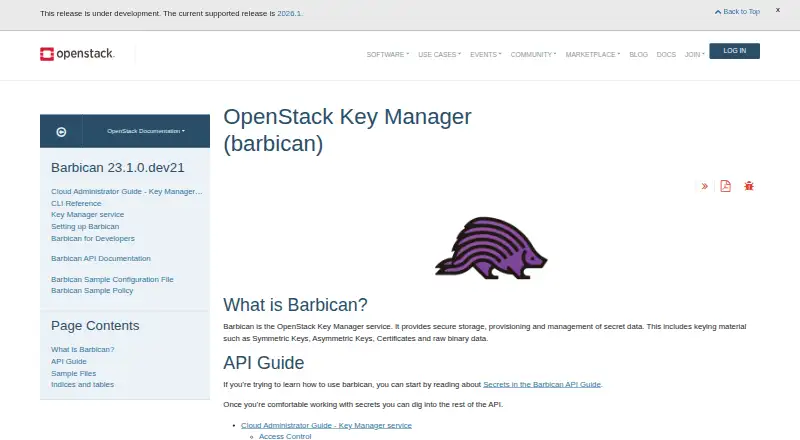
What OpenStack Barbican is
OpenStack Barbican manages secrets for OpenStack environments, including keys, certificates, passwords, and raw binary data. Its barbican-api component provides a REST interface for provisioning and managing secrets, while barbican-worker and barbican-keystone-listener handle other service functions. Operators can use plugins to store secrets in software-based stores or hardware such as HSMs. Documented options include KMIP, Dogtag, Vault, and PKCS#11; with PKCS#11, master encryption and HMAC keys reside in the HSM. Operators can also create plugins for secret storage, generation, and event handling, with support status varying from stable to experimental or out-of-tree. The default Simple Crypto plugin stores its single encryption key in plaintext in barbican.conf, making careful restriction of service-node access important. Container ACL settings do not extend to associated secrets, and ACL functionality applies only with Keystone integration. Barbican is free and open source under Apache 2.0. Its installation documentation assumes an existing working OpenStack deployment.
Who it suits
Barbican suits OpenStack operators who need to provision and manage secrets through an API and choose storage plugins. Its installation documentation assumes a working OpenStack deployment.
What it does well
- REST API for provisioning and managing secrets
- Plugins can use software stores or HSMs
- Documented KMIP, Dogtag, Vault, and PKCS#11 options
- Custom plugins can handle storage, generation, and events
What to know first
- Default encryption key is plaintext in barbican.conf
- Container ACL settings do not extend to associated secrets
- Installation assumes a working OpenStack deployment
Plans
| Plan | Billed and limits | Price |
|---|---|---|
| Open source Barbican | No plan limits stated | Free |
As docs.openstack.org lists them, read 4 Oct 2026. The maker's own page has the final word.
Getting started
- Open the Barbican documentation site
- Start with a working OpenStack deployment
- Follow the installation documentation for deployment
- Choose a documented secret-store or crypto plugin
OpenStack Barbican is a self-hosted key manager for operators who already run OpenStack and want to manage secrets through its native API. Its storage plugins allow a choice of software stores or HSM-backed custody, but teams must own the deployment and secure the service nodes.
Overview
Barbican handles encryption keys, certificates, passwords and raw binary data. Its REST API provisions and manages these secrets within OpenStack. The service combines an API, a worker and a Keystone listener; the listener updates Barbican’s database representation of a project when Keystone deletes it.
This is a fit for OpenStack operators, not a turnkey vault for teams without an existing OpenStack deployment. Installation documentation assumes that foundation is already working, placing deployment and ongoing security responsibilities with the operator.
Key features
Storage choice and HSM support
A plugin architecture supports software-based stores and hardware devices. Documented integrations include KMIP, Dogtag and Vault, alongside PKCS#11 crypto plugins. With PKCS#11, master encryption and HMAC keys reside in an HSM, making Barbican relevant where hardware-backed key custody matters. Plugin support can be stable, experimental or out-of-tree, so operators should account for integration maturity.
Security and access controls
The default Simple Crypto plugin stores its single encryption key in plaintext in barbican.conf. That makes access to service nodes a critical security boundary; the default is not a reason to treat the deployment as secure without careful restriction. Container ACL settings also do not carry over to associated secrets, and ACL functionality applies only when Barbican is integrated with Keystone. Teams relying on container settings to govern secret access should plan for that limitation.
Operator extensibility
Operators can develop plugins for secret storage, generation and event handling. This flexibility can accommodate deployment-specific needs, but custom plugins add work and plugin maturity varies.
Pricing
Barbican is open source under the Apache 2.0 license. The Open source Barbican plan costs nothing, with no plan limits stated. There is no free trial; the software is free rather than a time-limited evaluation. This suits teams able to operate it themselves, while teams seeking a managed service or supported deployment should compare alternatives.
Platforms
Barbican supports API, Linux and self-hosted deployment. Its self-hosted model aligns with operator control, but also means teams need to provide and maintain the OpenStack environment it assumes.
Who it's for
Choose Barbican if you operate OpenStack and want its REST API, configurable secret stores or HSM integration under your own control. Look elsewhere if you need a standalone vault, managed hosting, or container ACLs that automatically govern associated secrets.
Pros and cons
Pros
- Open source and free, with self-hosted deployment for teams that want control over their environment.
- Storage plugins include software stores and HSM options, with PKCS#11 placing master encryption and HMAC keys in the HSM.
- Custom plugins can extend storage, generation and event handling to suit operator needs.
Cons
- Installation assumes a working OpenStack deployment, narrowing its fit for teams without that infrastructure.
- The default Simple Crypto key is stored in plaintext in barbican.conf, requiring strict limits on service-node access.
- Container ACL settings do not propagate to associated secrets, and ACLs require Keystone integration.
Alternatives
Consider Thales CipherTrust Data Security Platform if you want a free Community Edition and a free trial across API, Linux, self-hosted and web platforms.
Oracle Cloud Infrastructure Secret Management is another free option, with 5,000 secrets per tenancy and 30 active versions per secret.
Tencent Cloud API Gateway may suit API users seeking a free first-year allowance of one million calls per month, with excess calls and outbound traffic billed on a pay-as-you-go basis.
Bloombase KeyCastle is a paid option with a free trial.
CrystalKey 360 is a paid alternative for API, Linux, self-hosted, web and Windows platforms.
Entrust Certificate Manager is a paid option without a free plan, with pricing discussed with Entrust experts.
Utimaco Enterprise Secure Key Manager is a paid alternative with client licensing described as independent of key volume and scalability.
AWS Key Management Service may suit API and web users willing to pay $1 a month per KMS key, with API requests charged separately and a 20,000-request monthly free tier across Regions.
For broader comparisons, browse Encryption Key Management Software, Key Management Software, Virtualization Management Software, Cloud Automation Software, Cloud Management Software and Secrets Management Tools.
Verdict
Barbican is a strong fit for OpenStack operators who want a free, extensible key manager and the option of HSM-backed keys. Its main reason to choose is control over secret-storage integrations; its main reason to look elsewhere is the operational burden, especially securing the default plaintext key and working around ACL limits.
Verdict
Barbican offers OpenStack-native secret management with configurable storage integrations, including HSM support. Operators should account for its default key-storage tradeoff and the limits on container ACLs.
Questions
How much does OpenStack Barbican cost?
The listed Open source Barbican plan costs nothing.
Is Barbican open source?
Yes. It is provided under the Apache 2.0 license.
Which platforms does Barbican support?
The listed platforms are API, Linux, and self-hosted.
Which secret-store integrations are documented?
Documented plugins include KMIP, Dogtag, and Vault, alongside PKCS#11 crypto plugins.
Does Barbican support HSMs?
Yes. Its PKCS#11 crypto plugin interfaces with an HSM, where master encryption and HMAC keys reside.
Facts from OpenStack Barbican's own pages
- ACL limitation
- Container ACL settings are not propagated to associated secrets, and ACL functionality applies only when Barbican is integrated with Keystone. · docs.openstack.org, 4 Oct 2026
- API
- The barbican-api service provides an OpenStack-native REST API for provisioning and managing secrets. · docs.openstack.org, 4 Oct 2026
- Components
- The service includes barbican-api, barbican-worker, and barbican-keystone-listener components. · docs.openstack.org, 4 Oct 2026
- Customization
- Operators can develop custom plugins for secret storage, generation, and event handling; plugin support status can be stable, experimental, or out-of-tree. · docs.openstack.org, 4 Oct 2026
- Deployment requirement
- The installation documentation assumes a working OpenStack deployment. · docs.openstack.org, 4 Oct 2026
- HSM support
- The PKCS#11 crypto plugin interfaces with a Hardware Security Module, with master encryption and HMAC keys residing in the HSM. · docs.openstack.org, 4 Oct 2026
- Integrations
- Documented secret-store plugins include KMIP, Dogtag, and Vault, alongside PKCS#11 crypto plugins. · docs.openstack.org, 4 Oct 2026
- Keystone
- The Keystone listener manages Barbican database representations of Keystone projects when those projects are deleted. · docs.openstack.org, 4 Oct 2026
- License
- The OpenStack project is provided under the Apache 2.0 license. · docs.openstack.org, 4 Oct 2026
- Purpose
- Barbican is the OpenStack Key Manager service for secure storage, provisioning, and management of secrets such as keys, certificates, passwords, and raw binary data. · docs.openstack.org, 4 Oct 2026
- Secret stores
- A plugin architecture lets operators store secrets in software-based stores or hardware devices such as HSMs. · docs.openstack.org, 4 Oct 2026
- Security tradeoff
- The default Simple Crypto plugin stores its single encryption key in plaintext in barbican.conf, so access to service nodes must be restricted carefully. · docs.openstack.org, 4 Oct 2026
Where OpenStack Barbican stands on Freedom251
- Key Management Software#2 of 25
- Encryption Key Management Software#2 of 24
- Cloud Computing platform#4 of 22
- Virtualization Management Software#8 of 34
- Cloud Infrastructure as a Service (Cloud IaaS) Software#6 of 24
- Secrets Management Tools#12 of 46
- Infrastructure as a Service (IaaS) Software#5 of 18
- Cloud Automation Software#13 of 32
- Data Center Automation#10 of 22
- Cloud Management Software#16 of 35
- Cloud Orchestration Software#13 of 27