Freedom251 › Key Management Software

KeyRack
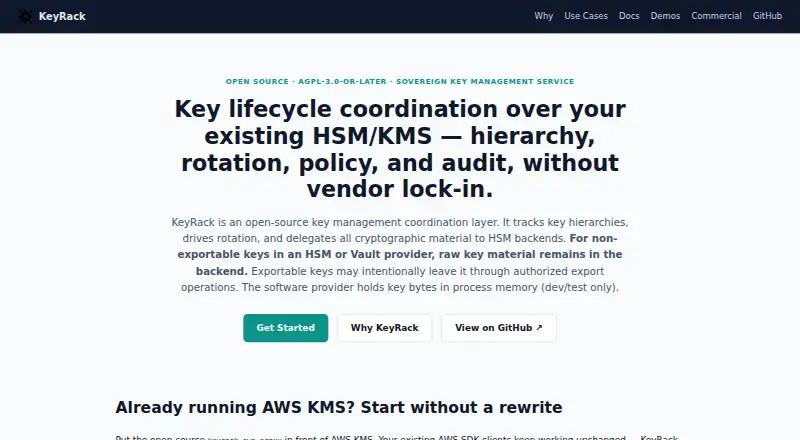
What KeyRack is
KeyRack is an open-source key management coordination layer that you deploy in your own infrastructure. It tracks key hierarchies, coordinates rotation and delegates cryptographic operations to configured backends, rather than acting as a hosted cloud KMS. Its KEK-wrapping hierarchies support namespace-scoped rules and cascade operations. Authorization is delegated to an external policy decision point such as Cedar or OPA, with checks on every operation.
Available backends include PKCS#11, HashiCorp Vault Transit, a KMIP client and in-process software for development and testing. Audit events can be sent to NATS, files or stdout and include BLAKE3 hash-chain linking; Ed25519 signing is optional. Non-exportable keys in an HSM or Vault provider remain there, while exportable keys may leave through authorized export operations. KeyRack does not bundle an identity provider, but can integrate with OIDC-compliant providers including Keycloak, Auth0, Okta, Azure AD and Google Identity Platform. The maker identifies regulated industries, multi-cloud platforms, SaaS providers using HYOK and OpenStack operators as audiences. Its open-source core is self-deployed under AGPL-3.0-or-later at no cost; commercial extensions are separate.
Who it suits
KeyRack is aimed at teams in regulated industries, multi-cloud platforms, SaaS providers using HYOK and OpenStack operators. It suits organizations that want to deploy key management software in their own infrastructure and connect it to external policy and identity systems.
What it does well
- Open-source core is available free of charge.
- Self-hosted deployment keeps the software in your infrastructure.
- Supports HSM-backed keys and customer-managed keys.
- Authorization is checked on every operation.
- Audit events support BLAKE3 hash-chain linking.
- Integrates with listed OIDC identity providers.
What to know first
- Commercial extensions are separate from the open-source core.
- Commercial licensing price is available by contacting KeyRack.
- TLS is opt-in for gRPC; the REST listener serves plain HTTP.
- GCP Cloud KMS and Azure Key Vault shims are roadmap items.
Limits
The open-source core is self-deployed under AGPL-3.0-or-later; commercial extensions are separate. The REST listener serves plain HTTP, and TLS is opt-in for gRPC; the maker recommends terminating HTTPS at a reverse proxy.
Plans
| Plan | Billed and limits | Price |
|---|---|---|
| Open source core | AGPL-3.0-or-later · self-deployed · commercial extensions are separate | Free |
| Commercial licensing | Contact KeyRack for pricing and evaluation access · Commercial extensions include HA clustering, key pooling, AWS KMS and Barbican shims, management UI, vendor HSM adapters, and KMIP server | On request |
As keyrack.io lists them, read 7 Oct 2026. The maker's own page has the final word.
Getting started
- Visit https://keyrack.io/.
- Deploy the open-source core in your own infrastructure.
- Configure a supported backend such as PKCS#11, HashiCorp Vault Transit or a KMIP client.
- Connect an external policy decision point such as Cedar or OPA.
- Connect an OIDC-compliant identity provider if needed.
- Use GitHub issues for project issues or the responsible disclosure process for security vulnerabilities.
KeyRack is a self-hosted coordination layer for teams managing key hierarchies and cryptographic operations across their own infrastructure. It suits operators with an existing identity provider, policy service and key backend; its free core is capable, but it is neither a hosted KMS nor a turnkey security boundary.
Overview
KeyRack coordinates key use and rotation while delegating cryptographic work to backends such as PKCS#11, HashiCorp Vault Transit, a KMIP client or in-process software for development and testing. That makes it a fit for organizations seeking control over where keys reside, rather than a managed cloud service. With non-exportable keys in an HSM or Vault provider, raw key material stays there; authorized export operations can move exportable keys out.
Self-deployment also means operating and securing the service yourself. KeyRack does not include an identity provider, and authorization depends on an external policy decision point. Its REST listener serves plain HTTP and gRPC TLS is opt-in, so the maker recommends terminating HTTPS at a reverse proxy. Teams that need encrypted listeners configured by default should account for this before deployment.
Key features
Hierarchies and authorization
KEK-wrapping hierarchies, namespace-scoped rules and cascade operations provide a structure for organizing keys and applying changes across related keys. Authorization is checked on every operation and delegated to a policy decision point such as Cedar or OPA. This separation suits teams with established policy controls, but adds a dependency for those that do not already run such a service.
Audit and custody
Audit events can flow to NATS, files or stdout and use BLAKE3 hash-chain linking; Ed25519 signing is optional. These are useful controls for teams building audit pipelines, though the signing step must be enabled deliberately. Key custody depends on the backend and key configuration: non-exportable keys remain in an HSM or Vault provider, while authorized exports can release exportable material.
Integrations and identity
OIDC-compliant identity providers can include Keycloak, Auth0, Okta, Azure AD or Google Identity Platform. Commercial extensions add AWS KMS and OpenStack Barbican shims, accepting standard AWS SDK requests and exposing the Barbican REST API respectively. GCP Cloud KMS and Azure Key Vault shims are roadmap items, not working integrations today, which rules KeyRack out for teams that require either one now.
Pricing
The Open source core costs nothing and is self-deployed under AGPL-3.0-or-later. It is the natural starting point for teams that can operate the core and do not need commercial extensions.
Commercial licensing uses custom pricing, billed by contacting KeyRack for pricing and evaluation access. It includes HA clustering, key pooling, the AWS KMS and Barbican shims, a management UI, vendor HSM adapters and a KMIP server. This tier is aimed at organizations that need those operational and integration capabilities; the free core gives them up.
Platforms
KeyRack is offered as an API and self-hosted software. It is deployed in your infrastructure, not provided as a hosted cloud KMS.
Who it's for
The maker identifies regulated industries, multi-cloud platforms, SaaS providers using HYOK and OpenStack operators as audiences. It is most compelling for teams in those settings that already have identity and policy services and want backend choice with customer-managed keys. Those seeking a managed service, bundled identity, or implemented GCP and Azure KMS shims should look elsewhere. Project issues go through GitHub issues; security vulnerabilities use a responsible disclosure process.
Pros and cons
Pros
- Backend flexibility: PKCS#11, Vault Transit and KMIP options let teams delegate cryptographic work to systems they already operate.
- Policy checked per operation: External authorization through Cedar, OPA or another decision point supports teams with established policy infrastructure.
- Free self-hosted core: The core includes hierarchy coordination without a recurring license price.
- Auditable event options: NATS, files and stdout delivery plus hash-chain linking can fit different logging pipelines.
Cons
- Operational burden: Teams must deploy and maintain the service themselves.
- Security configuration matters: REST is plain HTTP and gRPC TLS is opt-in, requiring deliberate HTTPS termination and transport planning.
- Commercial features cost extra: HA clustering, management UI and the AWS and Barbican shims sit outside the open-source core.
- Cloud shim gaps: GCP Cloud KMS and Azure Key Vault shims are not implemented.
Alternatives
Key Management Software is the broader category to compare if KeyRack's self-hosted coordination model is not the right fit.
- Thales CipherTrust Data Security Platform is worth considering for readers seeking a freemium option with a free Community Edition and a free trial across API, Linux, self-hosted and web platforms.
- Kleopatra is a free, open-source certificate manager for readers who need a Linux or Windows certificate tool rather than a self-hosted key coordination layer.
- Oracle Cloud Infrastructure Secret Management is an alternative for readers looking at a cloud secret-management service with a stated limit of 5,000 secrets per tenancy and 30 active versions per secret.
- OpenStack Barbican is a free, self-hosted API option for teams seeking an OpenStack-focused alternative.
- Entrust Certificate Manager is a paid alternative for readers seeking a certificate manager across mobile, API, Linux, self-hosted and web platforms.
- Cryptsoft KMIP Server is a paid API and self-hosted KMIP server SDK offered in C or Java.
- Eviden KMS is a paid option with per-CPU pricing, all connectors included and any number of servers.
- Fornetix Key Orchestration Platform may suit teams looking for VaultCore, with quote-based pricing and a full-featured 30-day trial.
Verdict
Choose KeyRack if you need a self-deployed key coordination layer with external authorization and configurable cryptographic backends. Its strongest case is the free core's mix of hierarchy management, backend choice and per-operation policy checks. Look elsewhere if you need a hosted cloud KMS, default transport security without extra configuration, or implemented GCP Cloud KMS and Azure Key Vault shims.
Verdict
Choose KeyRack if you need a self-deployed key coordination layer with external authorization and configurable cryptographic backends. Look elsewhere if you need a hosted cloud KMS or implemented GCP Cloud KMS and Azure Key Vault shims.
Questions
Is KeyRack free?
The open-source core is free under AGPL-3.0-or-later. Commercial extensions are separate, with pricing and evaluation access available by contacting KeyRack.
Is KeyRack hosted?
No. KeyRack is deployed in your own infrastructure rather than provided as a hosted cloud KMS.
Which backends does it support?
Listed providers include PKCS#11, HashiCorp Vault Transit, a KMIP client and in-process software for development and testing.
Does KeyRack include an identity provider?
No. It can integrate with OIDC-compliant providers including Keycloak, Auth0, Okta, Azure AD and Google Identity Platform.
Are AWS KMS and Barbican integrations available?
Commercial AWS KMS and Barbican shims are listed. The AWS KMS shim accepts standard AWS SDK requests, and the Barbican shim exposes the OpenStack Barbican REST API.
Does it support GCP Cloud KMS or Azure Key Vault?
Those shims are listed as roadmap items and are not implemented today.
Facts from KeyRack's own pages
- Audit
- Audit events can be delivered through NATS, files, or stdout and include BLAKE3 hash-chain linking; Ed25519 signing is opt-in. · keyrack.io, 7 Oct 2026
- Backends
- Available providers include PKCS#11, HashiCorp Vault Transit, KMIP client, and in-process software for development and testing. · keyrack.io, 7 Oct 2026
- Commercial limits
- GCP Cloud KMS and Azure Key Vault shims are listed as roadmap items and are not implemented today. · keyrack.io, 7 Oct 2026
- Deployment
- KeyRack is software you deploy in your own infrastructure, rather than a hosted cloud KMS. · keyrack.io, 7 Oct 2026
- Identity
- KeyRack does not bundle an identity provider and can integrate with OIDC-compliant providers including Keycloak, Auth0, Okta, Azure AD, and Google Identity Platform. · keyrack.io, 7 Oct 2026
- Integrations
- The commercial AWS KMS shim accepts standard AWS SDK requests, while the commercial Barbican shim exposes the OpenStack Barbican REST API. · keyrack.io, 7 Oct 2026
- Intended users
- The maker identifies regulated industries, multi-cloud platforms, SaaS providers using HYOK, and OpenStack operators as audiences for KeyRack. · keyrack.io, 7 Oct 2026
- Key custody
- With non-exportable keys in an HSM or Vault provider, raw key material remains in that backend; exportable keys may leave through authorized export operations. · keyrack.io, 7 Oct 2026
- Key hierarchy
- It supports KEK-wrapping hierarchies with namespace-scoped rules and cascade operations. · keyrack.io, 7 Oct 2026
- Policy
- Authorization is delegated to an external policy decision point such as Cedar or OPA, with authorization checked on every operation. · keyrack.io, 7 Oct 2026
- Product
- KeyRack is an open-source key management coordination layer that tracks key hierarchies, drives rotation, and delegates cryptographic operations to HSM backends. · keyrack.io, 7 Oct 2026
- Security limits
- TLS is opt-in for gRPC, and the REST listener serves plain HTTP, so the maker recommends terminating HTTPS at a reverse proxy. · keyrack.io, 7 Oct 2026
- Support
- The maker directs users to GitHub issues for project issues and to a responsible disclosure process for security vulnerabilities. · keyrack.io, 7 Oct 2026
Where KeyRack stands on Freedom251
- Key Management Software#3 of 25