Freedom251 › Cloud Management Software

Apache CloudStack
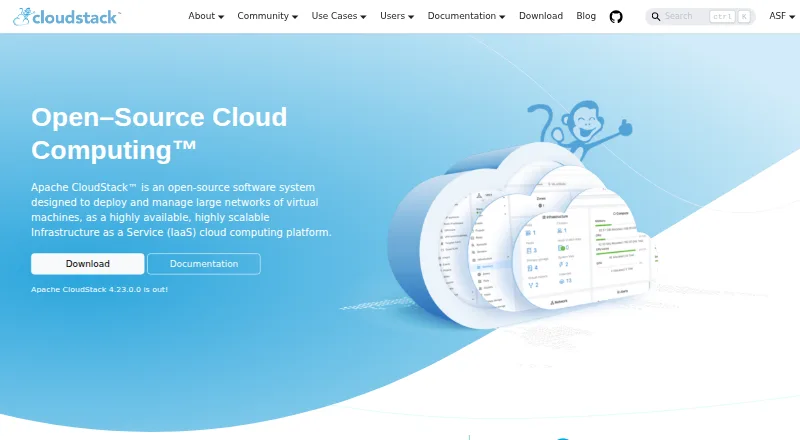
What Apache CloudStack is
Apache CloudStack is self-hosted software for building and managing public, private, or hybrid IaaS clouds. It orchestrates compute resources and provides network services, account management, resource accounting, a web interface, and an open API. Operators can manage deployments through the web UI, command-line tools, or REST API, with optional AWS EC2- and S3-compatible APIs. Supported hypervisors include KVM, Hyper-V, XenServer, Xen Project, and vSphere via vCenter. Storage options include iSCSI, NFS, Ceph RBD with KVM, snapshots, encryption, and storage tiering. Authentication options include OAuth2 single sign-on, two-factor authentication, TOTP, SAML, and LDAP. The project says CloudStack can manage tens of thousands of physical servers across distributed data centers. It is free, open-source software licensed under Apache License 2.0. Long Term Support releases receive bug and security fixes for 18 months after the main release. Operators remain responsible for protecting hosts and management components, monitoring, and defenses against DoS and brute-force attacks.
Who it suits
CloudStack is aimed at cloud solution providers, managed service providers, telcos, and enterprises building self-hosted cloud environments. It also suits teams that need API access and support for multiple hypervisors.
What it does well
- Free, open-source software
- Supports public, private, and hybrid clouds
- Offers web, command-line, and API management
- Supports multiple hypervisors
- LTS releases receive 18 months of fixes
What to know first
- Operators are responsible for key security protections
- LTS fix period is 18 months
Limits
The software is free, with no commercial plan pricing listed. Operators are responsible for securing and monitoring hosts, management servers, system VMs and routers, including DoS and brute-force defenses. Long Term Support releases receive bug and security fixes for 18 months after the main release.
Plans
| Plan | Billed and limits | Price |
|---|---|---|
| Apache CloudStack | Open-source IaaS cloud software · no commercial plan pricing listed | Free |
As cloudstack.apache.org lists them, read 29 Sept 2026. The maker's own page has the final word.
Getting started
- Visit the Apache CloudStack website.
- Plan a self-hosted deployment for a public, private or hybrid cloud.
- Select a supported hypervisor and storage approach.
- Manage the cloud through the web UI, command-line tools or RESTful API.
- Use the project mailing list for community help, or seek commercial support from a company offering it.
Apache CloudStack is self-hosted software for deploying and managing IaaS clouds built around virtual machines. It is best suited to cloud providers, managed service providers, telcos, and enterprises that can operate their own infrastructure. Its broad hypervisor and access options make it flexible, but the team running it also owns significant security and maintenance work.
Overview
CloudStack coordinates compute, networking, accounts, and resource use for public, private, and hybrid clouds. It is designed to manage tens of thousands of physical servers across geographically distributed data centers, which makes it more compelling for infrastructure operators than for teams looking for a hosted shortcut to cloud capacity.
Operators can manage environments through a web interface, command-line tools, or a RESTful API. Optional AWS EC2- and S3-compatible APIs can accommodate workflows built around those interfaces. The Apache License, Version 2.0 removes a software license charge, but not the cost of infrastructure, administration, or keeping the environment secure.
Key features
Compute and interoperability
CloudStack supports XenServer or XCP, KVM, Hyper-V, and VMware ESXi with vSphere; its supported hypervisors also include BareMetal, LXC, and Xen Project. That range helps organizations manage varied infrastructure with one platform, though it does not remove the expertise needed to run each environment. Live migration, high availability, and disaster recovery support are relevant strengths for operators who need to manage service continuity.
Its core combines compute orchestration with network services, account management, and resource accounting. Integrations include Terraform, Ansible, Kubernetes, Prometheus, VMware NSX, Ceph, MinIO, and billing portals, giving operators ways to connect CloudStack to adjacent infrastructure and management tools.
Storage, access, and security
Storage options include iSCSI and NFS, Ceph RBD with KVM, volume encryption, snapshots, and storage tiering. Multiple access methods—web UI, command line, and API—let teams use the interface that fits their operating practices, while optional EC2- and S3-compatible APIs can support compatible tooling.
Authentication options include OAuth2 single sign-on, two-factor authentication, TOTP, SAML, and LDAP. These controls are useful building blocks, not a substitute for operator security work: CloudStack assigns operators responsibility for DoS and brute-force defenses, monitoring, and securing hosts, management servers, system VMs, and routers. Long Term Support releases receive bug and security fixes for 18 months after the main release, so operators should account for that support window in their maintenance planning.
Pricing
Apache CloudStack
The Apache CloudStack plan costs nothing and provides open-source IaaS cloud software. There is no commercial plan price attached to the software, making it a practical option for organizations that want to avoid a platform license charge and can provide their own infrastructure and operations. The free price does not cover the work of deploying, maintaining, and securing a self-hosted cloud.
Community help is available through the project mailing list, and some companies offer commercial support. Potential vulnerabilities in a released version should be reported by email to the Apache Software Foundation security team.
Platforms
CloudStack supports API, Linux, self-hosted, and web access. Its self-hosted deployment model gives operators control over where the cloud runs, but also places responsibility for the underlying environment on them.
Who it's for
CloudStack is a strong fit for cloud solution providers, managed service providers, telcos, and enterprises that need to deploy and manage large VM-based clouds across data centers. Teams with mixed hypervisors or established automation and monitoring tools may value its compatibility options. It is a weaker fit for organizations that want a managed cloud service or cannot dedicate staff to infrastructure security, monitoring, and ongoing operations.
Pros and cons
- Pros: Supports a wide range of hypervisors, giving operators flexibility across different infrastructure environments.
- Pros: Web, command-line, and API management provide several ways to operate clouds, with optional EC2- and S3-compatible APIs for compatible workflows.
- Pros: Its scale, storage features, and integration options suit organizations building substantial IaaS environments.
- Cons: Operators must secure and monitor the hosts, management components, system VMs, and routers themselves.
- Cons: The 18-month post-release security and bug-fix window for LTS releases means teams need a release and upgrade plan.
- Cons: A free software license does not remove the staffing and infrastructure demands of running a self-hosted cloud.
Alternatives
Choose Kubermatic Kubernetes Platform if its free Community Edition and Kubernetes-focused platform better suit your needs. Consider Cloudify for its free, no-time-limit Community option, which requires Docker or a VM setup and access to a cloud provider to run workloads. KubeSphere is another free open-source Kubernetes container platform.
Qstack offers a free 基础版 and a 9,999 CNY a year 专业版, while its 运营版 has custom pricing. CloudBolt may suit readers seeking a free CMP plan capped at 100 resources. Google Config Sync is a free option included with Google Kubernetes Engine for clusters on a supported version that are registered to a fleet.
OpenNebula is a freemium alternative with a free Community Edition. SUSE Multi-Linux Manager is another alternative, with Lifecycle Management+ and Monitoring plans.
Compare CloudStack with Multi-Cloud Management Software, Virtualization Management Software, Cloud Management Software, Cloud Automation Software, and Cloud Orchestration Software.
Verdict
Choose Apache CloudStack if you need a self-hosted IaaS platform with broad hypervisor support, multiple management interfaces, and the capacity to manage infrastructure at scale. Its free, open-source software is a clear advantage; look elsewhere if your organization cannot take on the security and operational responsibility that comes with running the cloud itself.
Verdict
Apache CloudStack combines cloud deployment and management with broad hypervisor, storage, and access options. Its self-hosted model and operator security responsibilities are important considerations.
Questions
Is Apache CloudStack free?
Yes. The listed plan is free, and the project states that it is licensed under Apache License, Version 2.0.
Where does CloudStack run?
It is self-hosted and lists API, Linux, self-hosted and web platforms.
Which hypervisors does it support?
The project lists XenServer or XCP, KVM, Hyper-V, and VMware ESXi with vSphere.
Can CloudStack be managed through an API?
Yes. It has an open RESTful API, with optional AWS EC2 and S3 compatible APIs.
Who provides help with CloudStack?
Users can seek community help through the project mailing list. The project says some companies offer commercial support.
What security work remains the operator's responsibility?
Operators are responsible for protections including DoS and brute-force defenses, monitoring, and securing hosts, management servers, system VMs and routers.
Facts from Apache CloudStack's own pages
- Access
- Clouds can be managed through a web UI, command-line tools, or a RESTful API, with optional AWS EC2 and S3 compatible APIs. · cloudstack.apache.org, 29 Sept 2026
- API
- CloudStack exposes a documented, extensible REST-like API and supports Amazon EC2 and S3-compatible APIs. · cloudstack.apache.org, 15 Oct 2026
- API documentation
- API references are published for every major feature version from 4.0 through 4.23. · cloudstack.apache.org, 15 Oct 2026
- Authentication
- Security features include OAuth2, TOTP, two-factor authentication, SAML, LDAP and role-based accounts. · cloudstack.apache.org, 15 Oct 2026
- Automation integrations
- The integrations catalog lists Puppet, Terraform, Ansible and Chef automation integrations. · cloudstack.apache.org, 15 Oct 2026
- Backup integrations
- The project describes API-based backup and disaster-recovery integrations and lists Acronis, Dell, Backroll and CloudStack options. · cloudstack.apache.org, 15 Oct 2026
- CLI
- CloudMonkey is the project’s command-line and shell environment for interacting with CloudStack clouds. · cloudstack.apache.org, 15 Oct 2026
- Company founding
- The Apache Software Foundation was established in 1999 and is funded by individual donations and corporate sponsors. · crunchbase.com, 15 Oct 2026
- Company legal entity
- Crunchbase identifies the legal name as The Apache Software Foundation, an active nonprofit. · crunchbase.com, 15 Oct 2026
- Container integrations
- CloudStack provides a Container Service and lists Kubernetes and Cluster API Provider CloudStack integrations. · cloudstack.apache.org, 15 Oct 2026
- Core features
- The platform includes compute orchestration, network services, account management, resource accounting, a web interface, and an open API. · cloudstack.apache.org, 29 Sept 2026
- Core stack
- CloudStack includes compute orchestration, Network-as-a-Service, account management, resource accounting, a native API and a web interface. · cloudstack.apache.org, 15 Oct 2026
- Current release
- The downloads page identifies 4.23.0.0 as the latest regular release and 4.22.1.1 as the current LTS release. · cloudstack.apache.org, 15 Oct 2026
- Deployment
- Organizations use CloudStack to build public, private, and hybrid clouds. · cloudstack.apache.org, 29 Sept 2026
- Deployment models
- The project supports public, private, on-premises and hybrid cloud deployments. · cloudstack.apache.org, 15 Oct 2026
- Documentation depth
- Official documentation covers concepts, topology, quick installation, full installation, administration and complex configurations. · docs.cloudstack.apache.org, 15 Oct 2026
- Extensibility
- A pluggable adapter framework supports custom hypervisor, storage, network and authentication integrations. · cloudstack.apache.org, 15 Oct 2026
- Founded
- 2008 · cloudstack.apache.org, 23 Sept 2026
- High availability
- Management servers can run in a load-balanced multi-node installation and MySQL can use replication for failover. · docs.cloudstack.apache.org, 15 Oct 2026
- Hypervisors
- Supported technologies include BareMetal via IPMI, Hyper-V, KVM, LXC, vSphere, XenServer and Xen Project. · docs.cloudstack.apache.org, 15 Oct 2026
- Installation
- Management servers can be installed with RPM or DEB packages, while official mirrors distribute source releases. · docs.cloudstack.apache.org, 15 Oct 2026
- Integrations
- The integrations page lists Terraform, Ansible, Kubernetes, Prometheus, VMware NSX, Ceph, MinIO, and billing portal integrations. · cloudstack.apache.org, 29 Sept 2026
- Intended users
- The project identifies cloud solution providers, managed service providers, telcos, and enterprises as audiences for CloudStack. · cloudstack.apache.org, 29 Sept 2026
- Licence
- The project is open source under the Apache License 2.0. · github.com, 15 Oct 2026
Where Apache CloudStack stands on Freedom251
- Cloud Management Software#1 of 35
- Virtualization Management Software#1 of 34
- Cloud Automation Software#1 of 32
- Cloud Orchestration Software#1 of 27
- Multi-Cloud Management Software#1 of 25
- Cloud Infrastructure as a Service (Cloud IaaS) Software#1 of 24
- Data Center Automation#1 of 22
- Cloud Computing platform#1 of 22
- Infrastructure as a Service (IaaS) Software#1 of 18