Freedom251 › Cloud Management Software

Canonical OpenStack
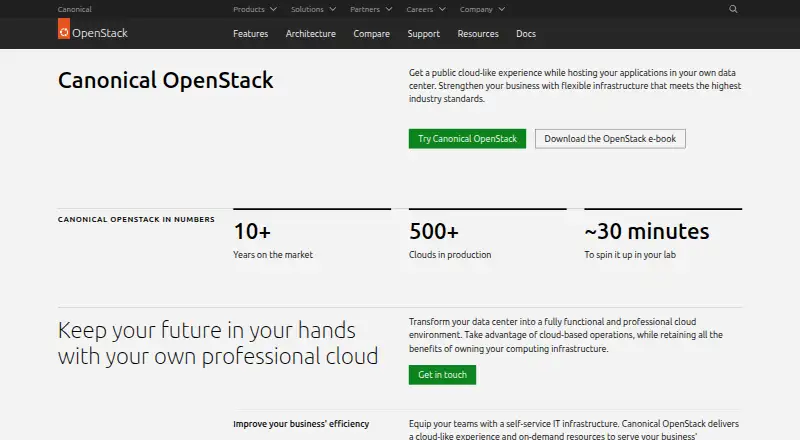
What Canonical OpenStack is
Canonical OpenStack is a self-hosted cloud platform for organizations that want to run applications in their own data centers and offer teams on-demand computing resources. It is based on upstream OpenStack code and described by Canonical as fully open source. Automation with MAAS and Juju spans bare-metal provisioning through applications. Its architecture uses Kubernetes, OCI images, and snaps; Canonical says this decouples OpenStack from the underlying Ubuntu operating system. Canonical Ceph is included by default and supports up to 128 TB of data per node. The wider stack includes observability, Landscape system management, MAAS bare-metal automation, and an expandable Kubernetes layer. Listed workloads include HPC and AI/ML, telco NFVI, sovereign clouds, regional or local public clouds, and edge infrastructure. Organizations can deploy the platform themselves or have Canonical design, build, test, and validate the cloud. The software plan has no license or subscription cost; commercial support and consulting are separate. On-demand Kubernetes is currently in beta.
Who it suits
Canonical OpenStack suits organizations that want self-service cloud infrastructure in their own data centers, including teams working on HPC and AI/ML, telco, sovereign cloud, or edge workloads. It can be deployed by the customer or with Canonical's help.
What it does well
- No license or subscription cost
- Automates bare-metal provisioning through applications
- Canonical Ceph included by default
- Offers customer-led or Canonical-led deployment
- Support includes 24/7 phone and ticket coverage
What to know first
- Commercial support and consulting cost extra
- On-demand Kubernetes is in beta
- Getting-started tutorial requires a dedicated physical machine
Limits
The free plan covers the software with no license or subscription cost; commercial support and consulting are separate. On-demand Kubernetes is currently in beta.
Plans
| Plan | Billed and limits | Price |
|---|---|---|
| Canonical OpenStack | No hidden license or subscription cost; commercial support and consulting are separate | Free |
| Private Cloud Build | fixed price · Cloud deployment · additional features and integrations via add-ons | $75,000, paid once |
| Private Cloud Build Plus | fixed price · Cloud deployment · additional features and integrations via add-ons | On request |
As canonical.com lists them, read 3 Oct 2026. The maker's own page has the final word.
Getting started
- Open Canonical's OpenStack website.
- Use the learning tutorial's dedicated physical machine with at least 4 amd64 cores, 16 GiB RAM, 100 GiB SSD storage and Ubuntu Desktop 24.04 LTS.
- Deploy Canonical OpenStack yourself, or arrange for Canonical to design, build, test and validate the cloud.
Overview
Canonical OpenStack is an open-source platform for delivering self-service cloud infrastructure from an organization’s own data center. It is aimed at teams running private, hybrid or specialized clouds that need control of hardware and operations. The central trade-off is clear: the software license is free, while the physical infrastructure and operational expertise remain your responsibility.
Key features
Based on upstream OpenStack code, the platform provides on-demand computing through a self-service catalog, giving internal teams a public-cloud-style experience on infrastructure they control. That is a strong fit for organizations with data-residency, sovereignty or customization requirements, but it is a substantial platform rather than a lightweight developer tool.
Automation runs from bare-metal provisioning through application operations. MAAS handles physical-machine automation and Juju coordinates services across the stack, making repeatable deployments practical for dedicated infrastructure teams. The architecture uses Kubernetes, OCI images and snaps; Canonical says this decouples OpenStack from the underlying Ubuntu operating system, which can make the cloud layer easier to standardize independently.
Canonical Ceph is included by default and supports up to 128 TB of data per node. That gives a built-in storage foundation for large deployments instead of requiring a separate storage product. An expandable Kubernetes layer, integrated observability, Landscape system management and MAAS extend the core IaaS capabilities. The on-demand Kubernetes service is currently in beta, so it should not be the deciding production dependency for a risk-averse team.
Security-conscious organizations can receive up to 15 years of security maintenance for artifacts used in Canonical OpenStack. CIS and DISA-STIG hardening profiles, along with claimed conformity for telco, federal and financial-services use cases, make the platform more relevant where controls and long support horizons matter. Canonical can also design, build, test and validate a cloud, rather than leaving every deployment decision to the customer.
Pricing
The Canonical OpenStack plan costs free. There is no hidden license or subscription cost, but commercial support and consulting are separate purchases. The free plan therefore suits organizations able to operate an open-source cloud themselves and budget for hardware, deployment work and ongoing administration.
Commercial support includes 24/7 phone and ticket coverage with a stated one-hour response time for Severity 1 issues. That option is more appropriate for production environments where downtime, compliance obligations or limited in-house expertise justify a paid service relationship. The free software does not remove those operational costs.
Platforms
Canonical OpenStack is delivered through an API and web interfaces on Linux, with a self-hosted deployment model. Its hybrid cloud coverage lets organizations combine controlled in-house infrastructure with other environments while retaining their own operating model. Getting started still requires real hardware: Canonical’s learning tutorial uses one dedicated physical machine with at least four amd64 cores, 16 GiB of RAM, 100 GiB of SSD storage and Ubuntu Desktop 24.04 LTS.
Who it's for
This is a strong choice for infrastructure teams building private or hybrid clouds, sovereign or regional public-cloud services, edge infrastructure, telco NFVI, or HPC and AI/ML environments. It also fits organizations that value upstream open-source code, long security maintenance and formal hardening profiles.
It is a poor fit for a small team seeking a hosted service with no hardware administration, or for buyers who need a mature, non-beta on-demand Kubernetes offering as a core requirement. The physical-machine setup and breadth of the stack demand platform-engineering capacity.
Pros and cons
Pros
- Free open-source core: the plan has no license or subscription charge and uses upstream OpenStack code.
- Broad automation: MAAS and Juju cover provisioning through application operations.
- Integrated storage: Ceph is included by default, with support for up to 128 TB per node.
- Long-term governance: up to 15 years of security maintenance and CIS/DISA-STIG profiles support regulated deployments.
- Optional implementation help: Canonical can design, build, test and validate the cloud, with 24/7 support available.
Cons
- Hardware responsibility: deployment starts with dedicated physical capacity and Linux administration.
- Operational complexity: the full-stack scope is better suited to experienced infrastructure teams than casual adopters.
- Kubernetes beta: on-demand Kubernetes is not yet a settled production feature.
- Paid services are separate: support and consulting are not included in the free plan.
Alternatives
Cloudforet is a free, open-source self-hosted platform if you want a broader multicloud management option across Linux, macOS and Windows rather than this OpenStack-centered stack.
Pulumi is the better starting point for infrastructure-as-code workflows: its free plan supports one user, unlimited projects, stacks, environments, updates and history, plus up to 500 workflow minutes.
Terraform suits teams wanting a managed infrastructure workflow with a free tier capped at 500 managed resources and one concurrent remote run.
Cloudify offers a no-time-limit community plan, provided you can supply Docker or a VM and access to a cloud provider.
Juju is the narrower free, open-source orchestration choice when you need Canonical’s orchestration engine without adopting the complete OpenStack cloud.
Apache CloudStack is another free, open-source IaaS option for Linux, self-hosted and web deployments.
Cloud 66 is better for smaller deployment workloads: its free plan covers one server, one static site and five deployments per 24 hours.
Cycloid is a paid platform with a free SaaS tier for up to five users and one workspace, including blueprints, forms, orchestration, RBAC, SSO and MFA.
See more options in Cloud Management Software.
Verdict
Choose Canonical OpenStack if you have the people and hardware to operate a self-hosted cloud and need open-source control, deep automation, integrated Ceph storage and long security maintenance. Look elsewhere if you want a turnkey hosted service, a smaller operational footprint or production-ready on-demand Kubernetes today.
Verdict
Canonical OpenStack provides an open-source, self-hosted cloud stack with automation, storage, and operational tools. Organizations should account for the physical-machine setup requirements and the beta status of on-demand Kubernetes.
Questions
How much does Canonical OpenStack cost?
The software plan is free, with no hidden license or subscription cost. Commercial support and consulting are separate.
Is Canonical OpenStack open source?
Yes. Canonical describes it as 100% open source and based on upstream OpenStack code.
Where can it run?
Its listed platforms are API, Linux, self-hosted and web. It is designed for hosting applications in an organization’s own data center.
What support is available?
Commercial support includes 24/7 phone and ticket coverage, with a stated one-hour response time for Severity 1 issues.
What is needed for the learning tutorial?
It calls for one dedicated physical machine with at least 4 amd64 cores, 16 GiB RAM, 100 GiB SSD storage and Ubuntu Desktop 24.04 LTS.
Does it include Kubernetes?
The stack includes an expandable Kubernetes layer. Canonical says its on-demand Kubernetes service is currently in beta.
Facts from Canonical OpenStack's own pages
- API compatibility
- Canonical states that its upstream OpenStack foundation guarantees API compatibility. · canonical.com, 15 Oct 2026
- Architecture
- Its cloud-native architecture is based on Kubernetes, OCI images and snaps, which Canonical says decouples OpenStack from the underlying Ubuntu OS. · canonical.com, 3 Oct 2026
- Automation
- It automates cloud operations from bare metal provisioning through applications, using MAAS and Juju across the stack. · canonical.com, 3 Oct 2026
- Bare-metal automation
- Canonical MAAS provides bare-metal provisioning and is included in Canonical consulting packages for OpenStack. · canonical.com, 15 Oct 2026
- Ceph storage
- Canonical Ceph is included by default and supports up to 128 TB of data per node without additional cost. · canonical.com, 15 Oct 2026
- CLI
- The OpenStack client command line interface supports bulk operations and administrative automation. · canonical.com, 15 Oct 2026
- Cloud-native architecture
- Sunbeam isolates OpenStack components and decouples them from the underlying operating system. · canonical.com, 15 Oct 2026
- Compliance
- Canonical support includes CIS and DISA-STIG hardening profiles and conformance for sectors such as telecom, government and financial services. · canonical.com, 15 Oct 2026
- Deployment model
- The platform supports single-node clouds and multi-node clouds for greater capacity and resilience. · canonical.com, 15 Oct 2026
- Deployment options
- Customers can deploy Canonical OpenStack themselves or have Canonical design, build, test and validate the cloud for them. · canonical.com, 3 Oct 2026
- Documentation depth
- Official documentation includes tutorials, step-by-step how-to guides, technical reference material and conceptual explanations. · canonical.com, 15 Oct 2026
- Extensibility
- Deployment and operation use Juju charms, Rocks OCI images and Snaps as extensible artifacts. · canonical.com, 15 Oct 2026
- Getting started
- Canonical's learning tutorial uses one dedicated physical machine with at least 4 amd64 cores, 16 GiB RAM, 100 GiB SSD storage and Ubuntu Desktop 24.04 LTS. · canonical.com, 3 Oct 2026
- GPU and acceleration
- The platform supports GPU virtualization and other acceleration technologies for HPC and AI/ML workloads. · canonical.com, 15 Oct 2026
- Integrations
- The product includes an expandable Kubernetes layer, an integrated observability stack, Landscape system management and MAAS bare metal automation. · canonical.com, 3 Oct 2026
- Kubernetes layer
- Canonical OpenStack can provide an expandable Kubernetes layer that users provision from the dashboard. · canonical.com, 15 Oct 2026
- Licence
- OpenStack software is fully open source and existing OpenStack software uses the Apache License 2.0. · docs.openstack.org, 15 Oct 2026
- Limit: complexity
- G2 reviewers report that setup and operation can be daunting or complex for inexperienced Linux and cloud users. · g2.com, 15 Oct 2026
- Limit: customization and migration
- TrustRadius reviewers request more VM configuration choices, stronger privilege controls and better VMware migration tooling. · trustradius.com, 15 Oct 2026
- Limit: storage and networking choices
- The reference design supports Ceph storage and OVN networking as the only supported options, with third-party storage integrations described as forthcoming. · canonical.com, 15 Oct 2026
- Limit: support
- G2 reviewers repeatedly mention limited or absent dedicated vendor support unless commercial services are purchased. · g2.com, 15 Oct 2026
- Limit: upgrades and HA
- Reviewers report challenging upgrades, a need for better high availability and incomplete GUI coverage compared with the CLI. · g2.com, 15 Oct 2026
- Maker headquarters
- Canonical lists its headquarters in London, England. · linkedin.com, 15 Oct 2026
- Maker legal name
- The maker identifies itself as Canonical Ltd. · canonical.com, 15 Oct 2026
Where Canonical OpenStack stands on Freedom251
- Cloud Management Software#2 of 35