Freedom251 › Cloud Automation Software
Juju
What Juju is
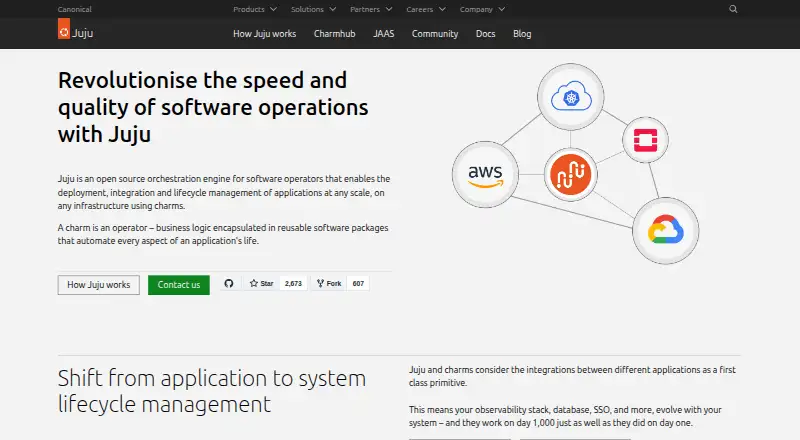
Juju is Canonical's open-source engine for deploying, connecting, and managing application lifecycles through charms. Each charm packages reusable business logic that automates parts of an application's life. Juju treats connections between applications as part of lifecycle management and can coordinate software across public clouds, Kubernetes, virtual machines, and bare metal. Integrations can also apply networking and configuration changes when connected applications run on different clouds.
Charmhub is a curated marketplace for charms, with options for tools such as PostgreSQL, MySQL, MongoDB, Kafka, Kubeflow, Apache Spark, Prometheus, Grafana, Loki, Vault, Traefik, and Landscape. For enterprise environments, JAAS provides a central control plane that can manage hundreds of Juju controllers. It adds fine-grained access controls and auditing, supports external identity providers through OIDC and single sign-on, and includes a graphical dashboard for administration and deployment monitoring. Administrators can use the Juju CLI and Terraform Provider for Juju. Juju is free and supports provisioning automation, infrastructure as code, cross-platform agents, and API and webhooks.
Who it suits
Juju suits teams managing application lifecycles across cloud, Kubernetes, virtual machine, and bare-metal infrastructure. JAAS adds centralized controls and administration for enterprise deployments.
What it does well
- Coordinates software across varied infrastructure
- Supports integrations across different clouds
- Charmhub offers a curated charm marketplace
- JAAS can manage hundreds of controllers
- Includes CLI and Terraform Provider access
What to know first
- No visual workflow builder
- Deployment model is self-hosted
Plans
| Plan | Billed and limits | Price |
|---|---|---|
| Juju | Open source orchestration engine; no paid plan or price listed on the Juju page | Free |
As canonical.com lists them, read 5 Oct 2026. The maker's own page has the final word.
Getting started
- Visit the Juju website.
- Choose a supported environment: Linux, macOS, Windows, API use, or self-hosted deployment.
- Use Juju’s charms to deploy and integrate applications across supported infrastructure.
- Browse Charmhub for charms relevant to your applications.
- For centralized enterprise administration, use JAAS with the Juju CLI or Terraform Provider for Juju.
Juju is an open-source engine for orchestrating application lifecycles through reusable charms. It suits teams coordinating connected applications across hybrid infrastructure. Its strength is treating integrations as part of operations; enterprise-wide administration is available through the separate JAAS control plane.
Overview
Juju brings deployment, integration, and ongoing application management into one orchestration model. Charms package reusable business logic for parts of an application's life, while integrations are treated as a core part of managing the system. That combination is useful when operating a connected stack, not merely deploying isolated services.
The model spans public clouds, Kubernetes, virtual machines, and bare metal. Charmhub offers a curated marketplace, with examples including databases such as PostgreSQL, MySQL, and MongoDB; data tools such as Kafka, Kubeflow, and Apache Spark; and operational software such as Prometheus, Grafana, Loki, Vault, Traefik, and Landscape. That breadth gives teams options for assembling varied environments, though the practical fit depends on the charms available for their applications.
Key features
Lifecycle-aware integrations
Juju can manage integrations as part of application lifecycles, including networking and configuration changes between applications deployed on different clouds. This is a meaningful advantage for hybrid estates, where connections can be as operationally important as the workloads themselves. Teams managing standalone deployments may not need this broader coordination model.
Infrastructure coverage and automation
Juju supports hybrid deployment across providers including Amazon EC2 and EKS, Google GCE and GKE, Microsoft Azure and AKS, OpenStack, Oracle OCI, VMware vSphere, Equinix Metal, MAAS, LXD, and Kubernetes options including Canonical Kubernetes and MicroK8s. Provisioning automation, infrastructure as code, cross-platform agents, and API and webhook support make it suited to teams managing infrastructure programmatically. It is self-hosted, so it is not the choice for organizations seeking a hosted orchestration service.
Enterprise administration with JAAS
JAAS adds a centralized control plane that can manage hundreds of Juju controllers. Fine-grained access controls, enhanced auditing, and support for external identity providers through OIDC and single sign-on on both the CLI and web dashboard address governance needs. Its graphical dashboard supports common administration and deployment-state monitoring, while administrators can also use the Juju CLI and Terraform Provider. Teams needing centralized controls should account for JAAS as a separate component of the Juju setup.
Pricing
Juju is free and open source. The Juju plan costs nothing and includes the open-source orchestration engine; no paid Juju plan or price is listed. This makes it a straightforward option for teams comfortable operating self-hosted software, rather than buyers looking for a packaged paid service or per-seat pricing model.
Platforms
Juju supports API, Linux, macOS, self-hosted, and Windows environments. Its hybrid deployment model and broad provider coverage suit teams working across more than one infrastructure type. There is no visual workflow builder, so teams that rely on building workflows through a graphical canvas should look elsewhere.
Who it's for
Juju is a strong fit for infrastructure and platform teams that need repeatable application operations across clouds, Kubernetes, virtual machines, or bare metal, especially when inter-application configuration must be coordinated. Its open-source licensing and infrastructure-as-code support also suit teams that want to manage orchestration within their own environments. It is less suited to users who want a hosted service, a visual workflow builder, or enterprise controls without adopting JAAS.
Pros and cons
Pros
- Integrations are part of lifecycle management, including cross-cloud networking and configuration changes.
- Charmhub and a broad provider range support deployments across databases, analytics, monitoring, security, and traffic-management tools.
- Free, open-source software with provisioning automation and infrastructure-as-code support.
- JAAS adds centralized management, access controls, auditing, and OIDC-based single sign-on for larger deployments.
Cons
- Self-hosting means teams must operate the orchestration environment themselves.
- There is no visual workflow builder for teams that prefer graphical workflow design.
- Centralized enterprise administration depends on JAAS rather than the core Juju engine alone.
Alternatives
For a free, open-source Kubernetes workflow engine, consider Argo Workflows. Kestra is another free option released under the Apache 2.0 license, with a free trial. Choose ONAP if you want an open-source software platform with a free plan and no free trial.
Windmill may fit teams seeking a freemium option with a free and open-source plan that includes 3 workspaces, 50 users, 10 GiB of workspace object storage, and 100 guest app users. AWS Step Functions offers a free tier that does not automatically expire after the 12-month AWS Free Tier term. Google Cloud Workflows has an Always Free tier with monthly limits of 5,000 internal steps and 2,000 external steps.
Orkes Conductor offers a free Developer Edition with all Conductor OSS features and enterprise features included. StackStorm is a free, open-source alternative with no paid products offered by the project. For broader category browsing, see IT Orchestration Software, IT Configuration Management Software, Cloud Management Software, Cloud Automation Software, and IT Automation Software.
Verdict
Choose Juju if your team needs open-source orchestration that manages application lifecycles and their integrations across hybrid infrastructure. Its reusable charms and cross-cloud coordination are the clearest reasons to adopt it. Look elsewhere if you need a hosted service or visual workflow builder, and consider JAAS when centralized enterprise governance is essential.
Verdict
Juju is an open-source orchestration option built around reusable charms and application integrations. Teams seeking centralized enterprise controls can use JAAS alongside it.
Questions
How much does Juju cost?
Juju is free and open source; the listed plan is free.
What platforms does Juju support?
Juju is listed for API use, Linux, macOS, self-hosted deployment, and Windows.
What is JAAS?
JAAS is a centralized enterprise control plane for Juju deployments. It can manage hundreds of controllers and provides access controls, auditing, and a graphical dashboard.
Can Juju manage applications across different clouds?
Yes. Juju supports hybrid cloud coverage, and its integrations can apply networking and configuration changes between applications deployed on different clouds.
Which applications have featured Juju charms?
Featured charms include PostgreSQL, MySQL, MongoDB, Kafka, Kubeflow, Apache Spark, Prometheus, Grafana, Loki, Vault, Traefik, and Landscape.
Who makes Juju?
Canonical identifies itself as the maker of Juju.
Facts from Juju's own pages
- Access and audit
- JAAS offers fine grained access controls and enhanced audit functionalities. · canonical.com, 5 Oct 2026
- Administration interface
- JAAS includes a graphical dashboard for common administrative operations and monitoring deployment state. · canonical.com, 4 Oct 2026
- Charm marketplace
- Charmhub is a curated marketplace for charms that can be integrated into infrastructure. · canonical.com, 4 Oct 2026
- Charms
- A charm is reusable software containing business logic that automates aspects of an application's life. · canonical.com, 5 Oct 2026
- Cross-cloud integrations
- Integrations can apply required networking and configuration changes between applications deployed on different clouds. · canonical.com, 4 Oct 2026
- Enterprise authentication
- JAAS supports external identity providers through OIDC and single sign-on on both the CLI and web dashboard. · canonical.com, 4 Oct 2026
- Enterprise control
- JAAS is described as a centralised enterprise control plane that can manage hundreds of Juju controllers. · canonical.com, 5 Oct 2026
- Enterprise control plane
- JAAS is a centralized enterprise control plane for Juju deployments that can manage hundreds of controllers. · canonical.com, 4 Oct 2026
- Example integrations
- The Juju page lists charms for PostgreSQL, MySQL, MongoDB, Kafka, Kubeflow, Apache Spark, Prometheus, Grafana, Loki, Vault, Traefik, and Landscape. · canonical.com, 4 Oct 2026
- Founded
- 2004 · canonical.com, 28 Sept 2026
- Infrastructure
- A single codebase can automate system lifecycle management across public clouds, Kubernetes, virtual machines, and bare metal. · canonical.com, 5 Oct 2026
- Integrations
- Featured charms include PostgreSQL, MySQL, MongoDB, Kafka, Kubeflow, Apache Spark, Prometheus, Grafana, Loki, Vault, Traefik, and Landscape. · canonical.com, 5 Oct 2026
- Maker
- Canonical identifies itself as the maker of Juju on its product page. · canonical.com, 4 Oct 2026
- Marketplace
- Charmhub is a curated marketplace for charms that can be integrated into infrastructure. · canonical.com, 5 Oct 2026
- Product
- Juju is an open source orchestration engine for deploying, integrating, and managing application lifecycles at any scale using charms. · canonical.com, 5 Oct 2026
- Purpose
- Juju is an open source orchestration engine for deploying, integrating, and managing application lifecycles at any scale using charms. · canonical.com, 4 Oct 2026
- Security
- Canonical says JAAS can protect deployments by providing a smaller attack area. · canonical.com, 5 Oct 2026
- Security and audit
- The Juju page says JAAS adds fine-grained access controls, enhanced auditing, and a smaller attack area for deployments. · canonical.com, 4 Oct 2026
- Support
- Juju's page links to a Matrix chat, a Discourse forum, and a form to talk to a Canonical expert. · canonical.com, 5 Oct 2026
- Support and community
- Juju's product page links to a Matrix chat, a Discourse forum, documentation, and a form to contact Canonical experts. · canonical.com, 4 Oct 2026
- System lifecycle
- Juju treats integrations between applications as a first class primitive, including observability, databases, and SSO. · canonical.com, 5 Oct 2026
- Tools and API
- JAAS users and administrators can interact through the Juju CLI and Terraform Provider for Juju. · canonical.com, 4 Oct 2026
- Users
- Canonical states that its products are trusted by 10,000+ engineers. · canonical.com, 5 Oct 2026
Where Juju stands on Freedom251
- Cloud Automation Software#7 of 32
- IT Automation Software#17 of 77
- Cloud Management Software#8 of 35
- IT Orchestration Software#7 of 28
- Orchestration / Provisioning Software#9 of 27
- IT Configuration Management Software#11 of 27