Freedom251 › Cloud Automation Software
Cloudpods
What Cloudpods is
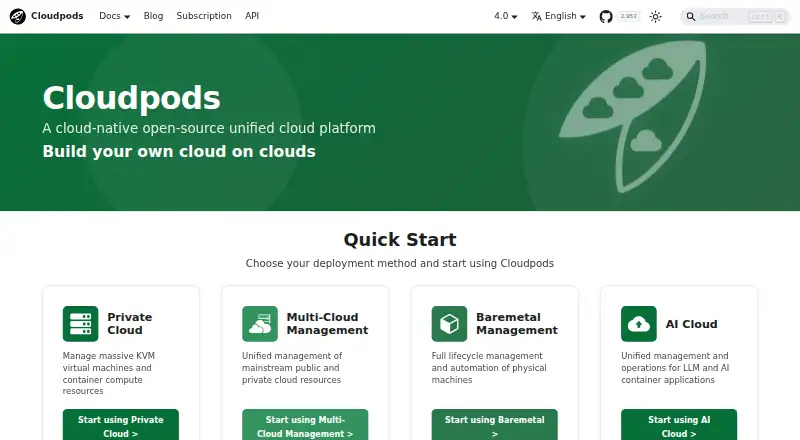
Cloudpods is open-source software for managing enterprise IaaS resources and varied cloud infrastructure from one place. It brings public and private cloud resources into a unified management platform through cloud accounts. Its KVM-based private cloud manages virtual machines, storage, networks, GPU cards and bare metal. Documented cloud connections include Alibaba Cloud, Azure, Tencent Cloud, AWS, Huawei Cloud, UCloud, Google Cloud, VMware, ZStack, DStack and OpenStack. Cloudpods supports self-built Kubernetes clusters and management of existing clusters, including synced clusters from AWS EKS, Alibaba Cloud ACK, Azure AKS and Tencent Cloud AKS. AI Cloud handles LLM inference and AI container applications with GPU scheduling, model libraries, templates and images; documented applications include Ollama, Dify, OpenClaw, HermesAgent and ComfyUI. Access features include multi-tenant IAM, multi-cloud SSO, the climc command-line tool and REST APIs. Deployment options include ocboot, Docker Compose and Kubernetes with Helm. Open-source features are free; paid enterprise editions have listed annual prices or pricing by quote.
Who it suits
It suits organizations managing infrastructure across public and private clouds, or operating Kubernetes and AI workloads. The open-source edition may suit teams seeking a self-hosted option with community support.
What it does well
- Unifies public and private cloud resources.
- KVM private cloud manages VMs, storage, networks and bare metal.
- Supports multiple documented cloud platforms and Kubernetes clusters.
- AI Cloud includes GPU scheduling, model libraries and templates.
- Open-source features are free.
What to know first
- Ollama inference and ComfyUI require a GPU.
- Enterprise editions include paid annual plans or quote-based pricing.
- Community support is listed as GitHub Issues and technical chat.
Limits
The free community edition provides open-source features. Basic enterprise cloud management is priced per 10 cloud resources, and private cloud is priced per host CPU socket; advanced enterprise pricing is tailored to resource quantity, CPU sockets, or customized modules.
Plans
| Plan | Billed and limits | Price |
|---|---|---|
| Open Source Community Edition | Cloudpods open-source features · GitHub Issues and technical group support | Free |
| Basic Enterprise Edition — private cloud | annual license per host CPU socket · 5×8 remote support · 7×24 emergency response | 1,999 CNY a year |
| Basic Enterprise Edition — cloud management | annual license per 10 billable cloud resources · 5×8 remote support · 7×24 emergency response | 999 CNY a year |
| Advanced Enterprise Edition | Pricing depends on resource quantity, CPU sockets or customized modules · 5×8 remote support · 7×24 emergency response | On request |
As cloudpods.org lists them, read 15 Oct 2026. The maker's own page has the final word.
Getting started
- Visit the Cloudpods website.
- Choose the open-source community edition or an enterprise edition.
- For private-cloud deployment, use ocboot.
- For multi-cloud deployment, use Docker Compose or Kubernetes with Helm.
- Use the web interface, Linux platform, climc, or REST APIs to access Cloudpods.
Verdict
Cloudpods covers multi-cloud management alongside private-cloud, Kubernetes and AI infrastructure functions. Its free open-source edition is available, while enterprise pricing and support differ by edition.
Questions
Is Cloudpods free?
Its Open Source Community Edition is free at 0.00 CNY. The open-source features are free.
What do the enterprise editions cost?
Basic Enterprise Edition cloud management costs 999 CNY a year per 10 cloud resources. Basic Enterprise Edition private cloud costs 1,999 CNY a year per host CPU socket. Advanced Enterprise Edition pricing is tailored.
Which cloud platforms does Cloudpods document?
Documented platforms include Alibaba Cloud, Azure, Tencent Cloud, AWS, Huawei Cloud, UCloud, Google Cloud, VMware, ZStack, DStack, and OpenStack.
Can it manage Kubernetes clusters?
Yes. It supports self-built clusters and existing clusters, including synced AWS EKS, Alibaba Cloud ACK, Azure AKS, and Tencent Cloud AKS clusters.
Can Cloudpods be self-hosted?
Yes. Its documentation describes private-cloud deployment with ocboot and multi-cloud deployment using Docker Compose or Kubernetes with Helm.
Which AI applications are documented?
AI Cloud documentation lists Ollama, Dify, OpenClaw, HermesAgent, and ComfyUI. Ollama inference and ComfyUI require a GPU.
Facts from Cloudpods's own pages
- Access and APIs
- Cloudpods provides multi-tenant IAM, multi-cloud SSO, a command-line tool called climc, and REST APIs and models. · cloudpods.org, 29 Sept 2026
- AI applications
- AI Cloud supports containerized applications including OpenClaw, Dify, ComfyUI and Hermes Agent. · github.com, 15 Oct 2026
- AI features
- AI Cloud manages LLM inference and AI container applications, with GPU scheduling, model libraries, templates, and images. · cloudpods.org, 29 Sept 2026
- AI inference
- AI Cloud can deploy Ollama, vLLM and SGLang inference services with GPU scheduling, model mounting and service-address allocation. · github.com, 15 Oct 2026
- AI integrations
- The AI Cloud documentation lists Ollama, Dify, OpenClaw, HermesAgent, and ComfyUI as supported applications or inference services. · cloudpods.org, 29 Sept 2026
- API surface
- Cloudpods exposes APIs through separate backend services, with internal Kubernetes endpoints and public NodePort endpoints. · cloudpods.org, 15 Oct 2026
- Bare metal
- Cloudpods manages bare-metal resources and supports operating-system installation workflows. · cloudpods.org, 15 Oct 2026
- Company headquarters
- The yunionio GitHub organization lists Beijing, China as its location. · github.com, 15 Oct 2026
- Company identity
- Cloudpods is developed by Beijing YunionCloud Technology Co., Ltd., whose commercial YunionCloud product began development in 2017 and whose Cloudpods code was open-sourced on GitHub in 2019. · yunion.cn, 15 Oct 2026
- Deployment
- The documentation describes private-cloud deployment with ocboot and multi-cloud deployment through Docker Compose or Kubernetes with Helm. · cloudpods.org, 29 Sept 2026
- Documentation depth
- The repository links separate getting-started, user, operations, development, API, Swagger, release-note and changelog documentation. · github.com, 15 Oct 2026
- Identity and access
- The platform provides multi-cloud single sign-on, RBAC and IAM. · cloudpods.org, 15 Oct 2026
- Install prerequisite
- The installer requires Ansible version 2.11.12 or later-compatible packages and Git. · cloudpods.org, 15 Oct 2026
- Integrations
- Documented cloud platforms include Alibaba Cloud, Azure, Tencent Cloud, AWS, Huawei Cloud, UCloud, Google Cloud, VMware, ZStack, DStack, and OpenStack. · cloudpods.org, 29 Sept 2026
- Kubernetes
- The feature set includes Kubernetes cluster management alongside database and infrastructure resources. · cloudpods.org, 15 Oct 2026
- License
- The main Cloudpods repository is released under the Apache License 2.0. · github.com, 15 Oct 2026
- Limit: deployment complexity
- The installer requires a clean operating system without preinstalled Kubernetes or Docker because it builds its own Kubernetes cluster and warns of conflicts otherwise. · cloudpods.org, 15 Oct 2026
- Limit: open issues
- The public issue tracker shows 176 open issues, including reports about CPU display, ARM startup, container-port mapping, Ceph permissions and failed installations. · github.com, 15 Oct 2026
- Limit: platform coverage
- The project’s own Ubuntu 22.04 support issue describes earlier deployment support as centered on CentOS 7, Debian 10 and Kylin, showing that OS compatibility has required separate adaptation work. · github.com, 15 Oct 2026
- MCP integration
- An MCP server connects Cloudpods to clients such as Cursor and Cline through SSE or stdio. · cloudpods.org, 15 Oct 2026
- MCP tools
- The MCP server documents 15 read and write tools for images, networks, regions, servers, storage, VPCs and monitoring. · cloudpods.org, 15 Oct 2026
- Model library
- The model library manages model sources, versions and caches and supports reuse across instances and offline distribution. · github.com, 15 Oct 2026
- Monitoring
- Monitoring and operations functions are included in the documented feature list. · cloudpods.org, 15 Oct 2026
- Multi-cloud
- The platform manages public and private cloud resources through cloud accounts and presents them in a unified management platform. · cloudpods.org, 29 Sept 2026
Where Cloudpods stands on Freedom251
- Cloud Automation Software#3 of 32