Freedom251 › Virtual machine software

Xen Project Hypervisor
What Xen Project Hypervisor is
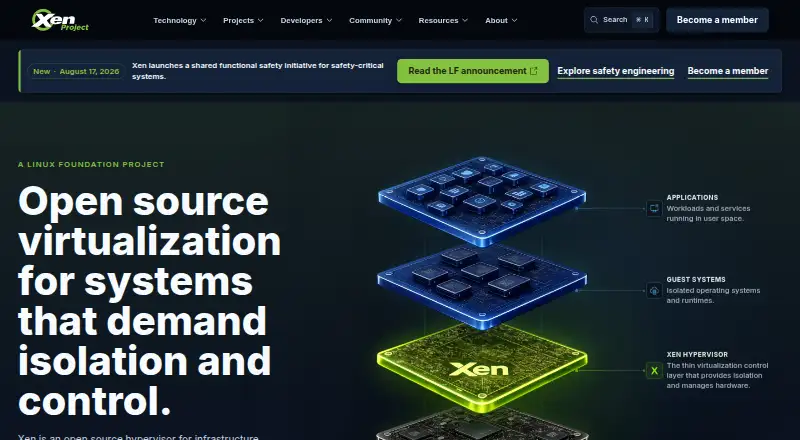
Xen Project Hypervisor is a free, open-source type-1 hypervisor for running multiple operating systems on one host. The project describes uses including server and desktop virtualization, IaaS, embedded systems, security applications, and hardware appliances. Linux is the most common control stack, while NetBSD and FreeBSD are also named as host options. Xen uses a microkernel design with a small memory footprint and a restricted interface to guest systems. It can isolate a system’s main device driver inside a VM, allowing that VM to be restarted after a driver crash or compromise without affecting the rest of the system. On x86, fully paravirtualized guests can run without virtualization extensions. Listed capabilities include snapshots, nested virtualization, and GPU acceleration. The separate XAPI toolstack provides multi-host management, VM snapshots and migration, resource pools, storage migration, event tracking, upgrades, patching, and monitoring. It includes built-in support and templates for Windows and Linux guests. Downloads are source releases for building, packaging, and platform integration. Xen is a Linux Foundation collaborative project with open governance, and software hosted on XenProject.org is licensed under GPL2.
Who it suits
Xen suits infrastructure, embedded, automotive, security-sensitive, and safety-critical environments. It is relevant to users who can build, package, and integrate hypervisor source releases for Linux or self-hosted systems.
What it does well
- Runs multiple operating systems on one host
- Supports VM snapshots, nested virtualization, and GPU acceleration
- XAPI supports multi-host management and VM migration
- Windows and Linux guest templates are available
- Software hosted on XenProject.org is licensed under GPL2
What to know first
- Downloads are source releases rather than ready-to-run packages
- Linux, NetBSD, and FreeBSD are the named host options
Limits
The listed downloads are source releases for building, packaging, and platform integration. The free plan is open-source hypervisor source releases.
Plans
| Plan | Billed and limits | Price |
|---|---|---|
| Xen Project Hypervisor | Open-source hypervisor source releases for building, packaging, and platform integration | Free |
As xenproject.org lists them, read 4 Oct 2026. The maker's own page has the final word.
Getting started
- Visit the Xen Project website.
- Get a Xen source release from the downloads page.
- Build, package, or integrate the source for your platform.
- Choose Linux, NetBSD, or FreeBSD as the host control stack.
- Use XAPI for management and its Windows or Linux guest templates.
Xen Project Hypervisor runs operating systems side by side on a physical host. It is best suited to infrastructure and systems teams that can build and integrate source releases. The payoff is a flexible foundation with isolation and multi-host management; the tradeoff is that it is not a ready-to-run virtualization package.
Overview
Xen is a type-1, bare-metal hypervisor used as a foundation for server and desktop virtualization, IaaS, security applications, embedded systems and hardware appliances. Its stated audience also includes infrastructure, automotive, security-sensitive and safety-critical systems. That breadth makes it adaptable to specialized deployments, but teams should expect to shape it around their own platform rather than treat it as a single-purpose desktop tool.
The project is a Linux Foundation collaborative project with open governance based on openness, transparency and meritocracy. Software hosted on XenProject.org is open source under GPL2. Xen 4.22.0 is offered as source for building, packaging and platform integration, a good fit for teams that control their software stack and a hurdle for users seeking a packaged installation.
Key features
Xen’s microkernel design is intended to keep its memory footprint small and limit the interface exposed to guests. It can also place a system’s main device driver inside a VM. If that driver crashes or is compromised, the VM can be restarted without affecting the rest of the system—an isolation strategy that is especially relevant to security-sensitive deployments.
On x86, Xen supports fully paravirtualized guests that can run without hardware virtualization extensions. It supports both guest architectures, as well as VM snapshots and nested virtualization. GPU acceleration is also supported, making the feature set useful beyond basic server consolidation.
Management is handled through the separate XAPI toolstack rather than the hypervisor alone. XAPI supports multiple hosts, VM snapshots and migration, resource pools, Open vSwitch, storage migration, event tracking, upgrades, patching and monitoring. Built-in support and templates for Windows and Linux guests help with common guest deployments; the separate toolstack, however, adds a component to select and operate.
Security reports go to [email protected]. The project describes a process of private notification to downstream parties followed by public disclosure. Xen 4.20 and later releases receive three years of full support followed by two additional years of security-only support, a defined lifecycle that helps teams plan maintenance.
Pricing
The Xen Project Hypervisor plan costs nothing. It provides open-source hypervisor source releases for building, packaging and platform integration. There is no free trial; Xen is free software rather than a time-limited evaluation. The source-release model gives engineering teams latitude, but readers who need a turnkey product should account for the work of building and integrating it.
Platforms
Xen is available for Linux and self-hosted deployments. Linux is the most common control stack; NetBSD and FreeBSD are also named as host operating systems. This range suits teams already operating those systems, while the source-first delivery makes it less direct for users looking for a desktop installer.
Who it's for
Xen is a strong candidate for infrastructure, embedded, automotive, security-sensitive and safety-critical systems where isolation, deployment flexibility and multi-host management matter. It is less suitable for casual desktop virtualization or teams that want a packaged application with minimal integration effort.
Pros and cons
- Strong isolation options: The microkernel design and ability to isolate a main device driver in a VM support deployments where faults or compromise must be contained.
- Broad management scope: XAPI covers multiple hosts, migration, resource pools, monitoring, upgrades and patching, which is useful for operating a larger virtualized environment.
- Flexible guest and host choices: Linux is the common control stack, with NetBSD and FreeBSD alternatives; Windows and Linux guests have built-in support and templates.
- Source-only release delivery: Xen 4.22.0 is provided as source for building and integration, which adds work for teams wanting a ready-to-run deployment.
- Separate management layer: XAPI brings substantial capabilities, but must be selected and operated alongside the hypervisor.
Alternatives
For a managed virtualization environment, Proxmox VE is a freemium alternative with a free plan and platforms spanning Linux, self-hosted, web, Windows and Android. Its Premium plan is €1,100 a year, billed for a one-year subscription from purchase per occupied physical CPU socket.
VMware Workstation Pro is a free alternative for 64-bit Intel or AMD PCs running Windows or Linux hosts; its plan requires no subscription or license key. Choose it when that desktop-host scope fits better than Xen’s source-oriented, self-hosted approach. QEMU is another free, GPLv2 open-source option for Linux, macOS and Windows.
KVM is free open-source software whose kernel component is in mainline Linux and userspace component is in mainline QEMU, making it a natural alternative for Linux-centered deployments. Multipass is free on Linux, macOS and Windows and focuses on launching local cloud prototypes. virt-manager is a free Linux and self-hosted option with no paid plans or usage limits stated.
Oracle VirtualBox offers a GPLv3-licensed base package for supported desktop and server hosts with core hypervisor features. GNOME Boxes is a free Linux desktop application for readers whose needs are limited to desktop virtualization.
Browse more options in Virtual machine software, Virtualization Management Software or Hypervisor Software.
Verdict
Choose Xen when you need a free, open-source hypervisor with guest isolation, flexible platform integration and a separate toolstack capable of managing multiple hosts. Its strongest case is infrastructure where control and containment outweigh convenience. Look elsewhere if you need a packaged desktop experience or want to avoid the work of building and integrating source releases.
Verdict
Xen offers a free hypervisor with guest isolation and a separate toolstack for managing virtual machines across hosts. Its downloads are source releases intended for building, packaging, and platform integration.
Questions
How much does Xen Project Hypervisor cost?
The listed plan is free.
Is Xen open source?
Yes. The project says software hosted on XenProject.org is open source and licensed under GPL2.
Which host platforms are named?
Linux is the most common control stack. NetBSD and FreeBSD are also named as alternatives.
Can Xen manage multiple hosts?
The separate XAPI toolstack supports management across multiple hosts, along with migration, resource pools, monitoring, and other operations.
Which guest systems does XAPI support?
XAPI provides built-in support and templates for Windows and Linux guests.
Where can I get Xen?
The downloads page lists Xen 4.22.0 source for building, packaging, and platform integration.
Facts from Xen Project Hypervisor's own pages
- Audience
- The project identifies infrastructure, embedded, automotive, security-sensitive, and safety-critical systems as areas Xen serves. · xenproject.org, 4 Oct 2026
- Downloads
- The downloads page lists Xen 4.22.0 source and describes the Xen artifacts as source releases for building, packaging, and platform integration. · xenproject.org, 4 Oct 2026
- Driver isolation
- Xen can run a system’s main device driver inside a VM so that VM can be restarted after a driver crash or compromise without affecting the rest of the system. · xenproject.org, 4 Oct 2026
- Free plan
- Yes · xenproject.org, 20 Sept 2026
- GPU acceleration
- Yes · xenproject.org, 20 Sept 2026
- Guest architecture
- both · xenproject.org, 20 Sept 2026
- Guest support
- XAPI provides built-in support and templates for Windows and Linux guests. · xenproject.org, 4 Oct 2026
- Host operating systems
- Linux is the most common control stack, and Xen also names NetBSD and FreeBSD as alternatives. · xenproject.org, 4 Oct 2026
- Host platforms
- Linux,NetBSD,FreeBSD · xenproject.org, 20 Sept 2026
- License
- The project says software hosted on XenProject.org is open source and licensed under GPL2. · xenproject.org, 4 Oct 2026
- Management
- The separate XAPI toolstack supports multiple hosts, VM snapshots and migration, resource pools, Open vSwitch, storage migration, event tracking, upgrades, patching, and monitoring. · xenproject.org, 4 Oct 2026
- Microkernel design
- Xen says its microkernel design has a small memory footprint and a restricted interface to guests. · xenproject.org, 4 Oct 2026
- Nested virtualization
- Yes · xenproject.org, 20 Sept 2026
- Paravirtualization
- On x86, Xen supports fully paravirtualized guests that can run on hardware without virtualization extensions. · xenproject.org, 4 Oct 2026
- Project governance
- Xen Project is a Linux Foundation collaborative project with an open governance process based on openness, transparency, and meritocracy. · xenproject.org, 4 Oct 2026
- Purpose
- Xen is a type-1 bare-metal hypervisor that runs multiple operating systems in parallel on one host. · xenproject.org, 4 Oct 2026
- Release support
- Xen 4.20 and later releases receive three years of full support and two additional years of security-only support. · xenproject.org, 4 Oct 2026
- Security reporting
- The security policy asks vulnerability reporters to contact [email protected] and describes private downstream notification followed by public disclosure. · xenproject.org, 4 Oct 2026
- VM snapshots
- Yes · xenproject.org, 20 Sept 2026
- Use cases
- The project describes Xen as a foundation for server virtualization, IaaS, desktop virtualization, security applications, embedded systems, and hardware appliances. · xenproject.org, 4 Oct 2026
Where Xen Project Hypervisor stands on Freedom251
- Virtual machine software#8 of 24
- Virtualization Management Software#15 of 34
- Server Virtualization Software#10 of 22
- Hypervisor Software#18 of 26