Freedom251 › AI Video Caption Generators

Whisper
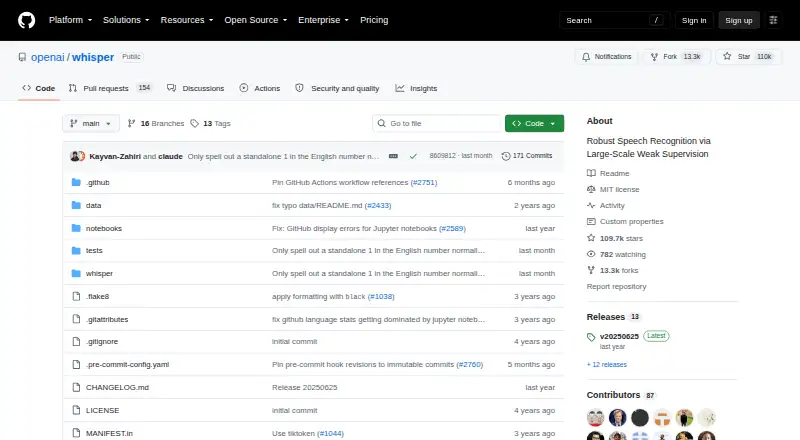
What Whisper is
Whisper is a general-purpose speech recognition model for multilingual transcription, speech translation, language identification and voice activity detection. Its documented command-line and Python interfaces can transcribe audio files, and it can translate speech from multiple languages into English. The repository lists six model sizes—tiny, base, small, medium, large and turbo—with different speed and memory tradeoffs; stated VRAM needs range from approximately 1 GB to 10 GB depending on size. Whisper runs on Linux, macOS, Windows and self-hosted deployments. Installation is documented through pip and requires the ffmpeg command-line tool; Rust may be needed if a prebuilt tiktoken wheel is unavailable. The code and model weights are released under the MIT License and can be installed locally with Python and ffmpeg. OpenAI says the model was trained using 680,000 hours of multilingual, multitask supervised data collected from the web. Performance varies widely by language, and Whisper does not outperform models specialized for LibriSpeech. Turbo is not trained for translation; the repository recommends multilingual models for translating non-English speech into English.
Who it suits
Whisper may suit developers and researchers building speech-processing applications or conducting further research. Users should consider the documented installation requirements and model-specific hardware needs.
What it does well
- Supports transcription, translation and language identification
- Includes six model sizes with different tradeoffs
- Code and weights are MIT-licensed
- Offers command-line and Python interfaces
- Exports TXT, VTT, SRT, TSV, JSON and JSONL
What to know first
- Requires ffmpeg for installation
- Rust may be needed if a prebuilt wheel is unavailable
- VRAM needs range from approximately 1 GB to 10 GB
- Turbo is not trained for translation
Limits
Model requirements range from approximately 1 GB to 10 GB of VRAM, depending on size. Turbo is not trained for translation, and performance varies widely by language.
Plans
| Plan | Billed and limits | Price |
|---|---|---|
| Whisper (open-source code and model weights) | MIT-licensed code and model weights · install locally with Python and ffmpeg | Free |
| Self-hosted Whisper | MIT-licensed code and model weights; local installation · Python 3.8–3.11 expected · ffmpeg required · approximately 1–10 GB VRAM depending on model | Free |
| Whisper API | $0.006 per minute of transcription · 25 MiB maximum upload for legacy whisper-1 · streaming unsupported · Free tier 3 RPM and 200 RPD | $0.01 a month |
As github.com lists them, read 7 Oct 2026. The maker's own page has the final word.
Getting started
- Install Whisper through pip.
- Install the ffmpeg command-line tool.
- Use the documented command-line or Python interface to transcribe audio files.
- Choose a model size based on its speed and memory tradeoffs.
- For translating non-English speech into English, use a multilingual model rather than turbo.
Overview
Whisper is a speech-processing model for transcription, translation into English, language identification, and voice activity detection. It is best suited to developers and researchers who want to run or build on locally installable code and weights. Its breadth and MIT license are compelling; language-dependent performance and hardware demands make it less universal than the task list suggests.
Key features
Whisper can transcribe multilingual audio with timestamps, identify the spoken language, detect voice activity, and translate speech from multiple languages into English. Outputs include TXT, VTT, SRT, TSV, JSON, and JSONL, so it can serve both readable transcripts and subtitle or structured-data workflows.
OpenAI says the model was trained on 680,000 hours of multilingual, multitask supervised data gathered from the web. That scale underpins its general-purpose reach, but performance varies widely by language, and Whisper does not outperform models specialized for LibriSpeech. It is a flexible starting point, not an automatic best choice for every language or a narrow speech-recognition benchmark.
Six model sizes—tiny, base, small, medium, large, and turbo—offer different speed and memory tradeoffs, requiring approximately 1 GB to 10 GB of VRAM depending on size. That range gives users room to match a model to available hardware, but the larger options carry a meaningful resource cost. Turbo is not trained for translation; choose a multilingual model to translate non-English speech into English.
The repository documents command-line and Python interfaces for audio-file transcription. Installation uses pip and requires ffmpeg; Rust may also be needed if a prebuilt tiktoken wheel is unavailable. Google Colab examples and community discussion of third-party extensions offer starting points, though the core package is oriented toward people comfortable with a technical workflow.
Pricing
Whisper (open-source code and model weights): free. The free plan includes MIT-licensed code and model weights for local installation with Python and ffmpeg. There are no paid tiers in this plan structure; in practice, users supply compatible hardware and handle setup themselves. The MIT license makes the code and weights usable as a foundation for applications and further research.
Platforms
Whisper supports Linux, macOS, and Windows, with self-hosted deployment also supported. Local installation gives developers control over where inference runs, while the VRAM range means the practical model choice depends on the machine.
Who it's for
Whisper is a strong fit for developers, researchers, and technically capable users who need multilingual transcription or want an MIT-licensed base for speech-processing applications. It is less suitable when translation is the primary task and only turbo is practical, or when a specific language demands performance that a general-purpose model may not deliver. The repository also positions Whisper for custom evaluation work, including custom metrics, LLM-as-a-judge, and safety evaluations.
Pros and cons
- Pros: MIT-licensed code and weights are free to install locally, making Whisper a useful foundation for applications and research.
- Pros: Transcription, language identification, voice activity detection, English translation, timestamps, and six export formats cover varied speech workflows.
- Cons: Model sizes need approximately 1 GB to 10 GB of VRAM, so hardware limits can constrain speed or model choice.
- Cons: Performance varies widely by language, and the model is not stronger than LibriSpeech-specialized models on that benchmark.
- Cons: Turbo is not intended for translation, while installation requires ffmpeg and may require Rust.
Alternatives
For a broader comparison of speech-to-text choices, browse Speech-to-Text Software, Speech Recognition Software, or Transcription Software. Video-focused readers can also compare AI Video Caption Generators, while evaluation workflows may call for LLM Evaluation Tools. For generated speech rather than recognition, see Text-to-Speech Software.
SmartSub is a free local option for transcription, translation, TTS, and subtitle rendering, with optional paid cloud services; choose it if that wider subtitle-oriented feature mix matters more than using Whisper's model directly. VideoCaptioner is another free MIT-licensed option for Linux, macOS, Windows, and self-hosted use, suitable when a video-captioning application is preferable.
Captions offers web, mobile, and API access, including AI video creation and editing in its Max plan at $24.99 a month; choose it for those creator tools rather than local model inference. SRTGen has a free web and API tier with SRT, VTT, and TXT export, but caps screen recordings at 5 minutes and storage at 2 GB, making it a more bounded option for localization trials.
CaptionRoom provides a free editor with manual captions, two styles, and exports up to 1080p with SRT; it suits users who want a caption editor and can work within its free-plan terms. Moonshot is web-based and offers 109 transcription languages, but its free tier limits uploads and previews to 5 minutes ever and does not include video export.
GetCaptions offers 60 minutes of transcription per month on its free Starter plan, with a 5-minute-per-video cap and 720p exports, so it fits users who prefer a managed web or API service with explicit monthly limits. Fluen AI Subtitle Generator has a free tier for up to three files of up to 90 minutes each and a free trial; consider it when those file-based terms and its web, extension, or desktop availability better fit the workflow.
Verdict
Choose Whisper if you want free, MIT-licensed speech-processing code and weights that can be installed locally and adapted for multilingual transcription or research. Its broad task coverage is the main reason to choose it; hardware requirements, uneven language performance, and turbo's translation limit are strong reasons to look elsewhere when a specific language, constrained machine, or translation-first workflow matters more.
Verdict
Whisper provides multilingual speech-processing capabilities as locally installable, MIT-licensed code and model weights. Performance varies by language, and the turbo model is not intended for translation.
Questions
How much does Whisper cost?
The listed plan is free. The code and model weights are open source under the MIT License.
Which platforms does Whisper support?
It supports Linux, macOS, Windows, and self-hosted deployment.
What can Whisper do?
It supports multilingual transcription, speech translation into English, spoken language identification, and voice activity detection.
What formats can it export?
Timestamped output is supported, with exports in TXT, VTT, SRT, TSV, JSON, and JSONL.
What is required to install it?
Installation is documented through pip and requires the ffmpeg command-line tool. Rust may be needed if a prebuilt tiktoken wheel is unavailable.
Can every model translate speech?
Turbo is not trained for translation. Multilingual models are recommended for translating non-English speech into English.
Facts from Whisper's own pages
- API endpoints
- The model documentation lists transcription and translation capabilities and OpenAI API endpoint families including audio transcription. · developers.openai.com, 21 Oct 2026
- API input handling
- The Audio API requires an uploaded file in a supported audio format and does not accept links to audio files. · help.openai.com, 21 Oct 2026
- API model
- OpenAI exposes whisper-1 as a general-purpose transcription model with audio input and text output. · developers.openai.com, 21 Oct 2026
- API rate limits
- The documented Free tier allows 3 requests per minute and 200 requests per day, while Build allows 2,500 requests per minute. · developers.openai.com, 21 Oct 2026
- API streaming limitation
- OpenAI states that streaming is not supported with the whisper-1 model. · help.openai.com, 21 Oct 2026
- API upload limit
- For legacy whisper-1 transcription uploads, the maximum request size is 25 MiB. · help.openai.com, 21 Oct 2026
- Automatic language identification
- Language identification is a built-in task alongside transcription and translation. · github.com, 21 Oct 2026
- Company business
- Crunchbase describes OpenAI as developing artificial-intelligence models and deploying machine-learning software tools. · crunchbase.com, 21 Oct 2026
- Company founding
- OpenAI was founded in December 2015. · en.wikipedia.org, 21 Oct 2026
- Company headquarters and size
- LinkedIn lists OpenAI headquarters in San Francisco, California and company size of 1,001–5,000 employees. · ai.linkedin.com, 21 Oct 2026
- Company legal name
- Crunchbase lists the legal name as OpenAI OpCo, LLC and also lists OpenAI LP and OpenAI Group PBC as alternate names. · crunchbase.com, 21 Oct 2026
- Developer extensibility
- The repository points users to third-party web demos, integrations, platform ports and other extensions through GitHub Discussions. · github.com, 21 Oct 2026
- Export formats
- txt,vtt,srt,tsv,json,jsonl · github.com, 20 Sept 2026
- Hallucination criticism
- TechCrunch reported October 26, 2024 concerns from researchers that Whisper can insert invented words or passages, including in medical contexts. · techcrunch.com, 21 Oct 2026
- Hardware
- The listed models require approximately 1 GB to 10 GB of VRAM, depending on model size. · github.com, 7 Oct 2026
- Hardware requirements
- Approximate required VRAM ranges from about 1 GB for tiny and base to about 10 GB for large. · github.com, 21 Oct 2026
- Independent accuracy test
- A September 2026 FreeTTS test measured 11.9% word error for large-v3 with voice-activity filtering and previous-text conditioning disabled, versus 14.8% on defaults. · freetts.org, 21 Oct 2026
- Independent forensic limitation
- A Frontiers study found Whisper best among tested systems on poor-quality forensic-like audio but with about 50% word error, making it unsuitable for forensic use. · frontiersin.org, 21 Oct 2026
- Installation
- The official installation command is pip install -U openai-whisper, with a Git installation option also documented. · github.com, 21 Oct 2026
- Installation requirements
- The repository documents installation through pip and requires the ffmpeg command-line tool; Rust may be needed if a prebuilt tiktoken wheel is unavailable. · github.com, 7 Oct 2026
- Integrations and examples
- The repository links a Google Colab example and invites users to share third-party extensions and integrations in GitHub Discussions. · github.com, 7 Oct 2026
- Intended users
- OpenAI describes the open-sourced models and inference code as a foundation for building applications and further research on robust speech processing. · openai.com, 7 Oct 2026
- Language support
- Whisper supports multilingual speech recognition and translation into English, with the repository tokenizer listing available languages. · github.com, 21 Oct 2026
- Licence
- Whisper code and model weights are released under the MIT License. · github.com, 21 Oct 2026
Where Whisper stands on Freedom251
- AI Video Caption Generators#1 of 99
- AI transcription tools#1 of 46
- Text-to-speech tools#6 of 232
- Speech-to-Text Software#1 of 35
- Text-to-Speech Software#7 of 223
- Transcription Software#2 of 46
- Speech Recognition Software#2 of 32