Freedom251 › Kubernetes Backup Software
Velero
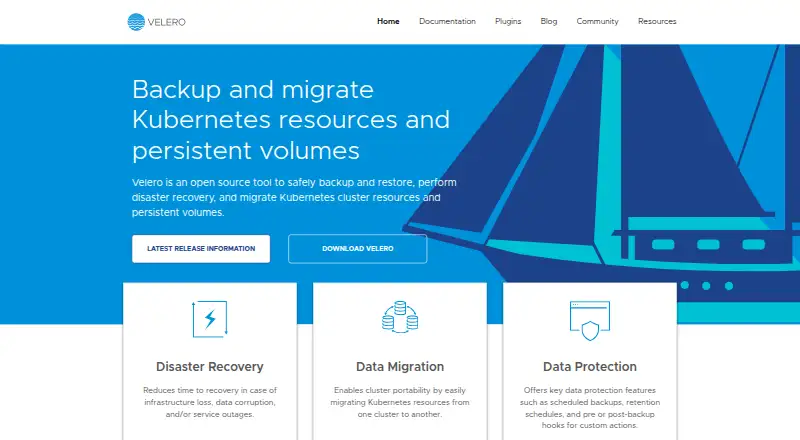
What Velero is
Velero is an open source tool for backing up and restoring Kubernetes resources and persistent volumes, as well as disaster recovery and cluster migration. Backups can cover an entire cluster or selected resources chosen by namespace or label, and recurring schedules and pre- and post-backup hooks support custom operations. Teams can restore after data loss or move resources between clusters, including replicating production clusters to development and test environments. Velero has a server that runs on a Kubernetes cluster and a command-line client that runs locally. Maintainer-supported provider plugins cover AWS, Google Cloud, Microsoft Azure, and VMware vSphere; community plugins are also listed. Its plugin architecture allows additional storage integrations and custom backup or restore functionality. Velero can run in cloud or on-premises environments with object storage and optionally supported block storage. Installation requires access to a Kubernetes cluster, kubectl, a compatible object storage provider, and at least one plugin; file system backup is not installed by default. Community support is available through GitHub and Kubernetes Slack.
Who it suits
Velero suits teams operating Kubernetes clusters that need backup, restore, disaster recovery, or migration. It can also support replication to development and testing clusters.
What it does well
- Backups can target whole clusters or selected resources.
- Recurring schedules and custom pre- and post-backup hooks are supported.
- Supports cloud and on-premises environments.
- Open source with community support through GitHub and Kubernetes Slack.
What to know first
- Requires a Kubernetes cluster, kubectl, and a compatible storage provider.
- Installation requires at least one plugin.
- File system backup is not installed by default.
- Some object-storage immutability settings may interfere with backups.
Limits
Velero requires a Kubernetes cluster, kubectl, compatible object storage, and at least one plugin, while file system backup is not installed by default. Backups may not work as expected with some object-storage immutability settings because Velero needs to update backup metadata.
Plans
| Plan | Billed and limits | Price |
|---|---|---|
| Velero | Open source tool; cloud or on-premises; requires Kubernetes and storage provider plugins | Free |
As velero.io lists them, read 5 Oct 2026. The maker's own page has the final word.
Getting started
- Visit the Velero website and review the installation guide.
- Prepare access to a Kubernetes cluster and kubectl.
- Choose a compatible object storage provider and install at least one plugin.
- Install the Velero server on the cluster and the command-line client locally.
- Configure backup scope, schedules, and any needed hooks.
Velero is a Kubernetes backup and recovery tool for teams responsible for keeping clusters and persistent volumes recoverable. It is strongest for operators who need control over backup scope, storage integrations, and cross-cluster moves. That flexibility comes with setup and maintenance work: a Kubernetes cluster, object storage, and at least one plugin are required.
Overview
Velero is open-source software for backup, restore, disaster recovery, and cluster migration. Its cluster-level and selective backup options make it useful both for broad recovery planning and for protecting chosen workloads. It is not a fit for teams seeking a standalone backup service independent of Kubernetes operations.
Key features
Backups can cover an entire cluster or target namespaces and label-matched resources. This supports broad recovery copies as well as narrower policies, but teams must decide which resources belong in each backup.
Recurring schedules and pre- and post-backup hooks allow routine backups and custom operations. Velero can restore after data loss and migrate resources between clusters, including copying production environments to development or test clusters. Those capabilities make it useful for both recovery and environment replication, though they depend on operators configuring the workflows.
Persistent-volume backup is supported, including CSI-backed volumes through Kubernetes CSI Snapshot APIs. CSI use depends on prerequisites in the cluster and its CSI driver, so teams should confirm that their environment is compatible before relying on it for recovery.
The architecture has a server running in a Kubernetes cluster and a command-line client running locally. Maintainer-supported plugins cover AWS, Google Cloud, Microsoft Azure, and VMware vSphere; community-maintained plugins extend the choices. The plugin architecture also permits custom storage integrations and backup or restore functions without changing the core binary. Velero works in cloud and on-premises environments with object storage and, optionally, supported block-storage systems.
Installation requires a Kubernetes cluster, kubectl, a compatible object storage provider, and at least one plugin. File system backup is not installed by default. Velero also warns that some object-storage immutability settings can interfere with backups because backup metadata needs to be updated. These are meaningful operational constraints for teams planning locked-down or immutable storage policies.
Pricing
Velero: free. The open-source tool can be used with cloud or on-premises environments, but requires Kubernetes and storage-provider plugins. It includes persistent-volume backup, application consistency, cross-cluster restore, scheduled backups, and custom retention options. Immutable backups are not supported, and object-storage immutability settings may cause backup problems.
There are no paid plan tiers or seat and quota terms in this plan. Velero receives community support through GitHub issues and the Kubernetes Slack #velero-users channel, rather than a paid support tier.
Platforms
The listed platforms are API, Linux, macOS, self-hosted, and Windows. The command-line client has macOS and Windows releases, but backing up Windows workloads still requires at least one Linux node for the Velero server. Velero is identified as a Cloud Native Computing Foundation Sandbox project.
Who it's for
Velero suits teams operating Kubernetes clusters that need disaster recovery, resource and volume backup, cluster migration, or replication into development and testing environments. Its plugin model is particularly useful where teams need to connect storage providers or add custom backup behavior. Teams without Kubernetes expertise, object storage, or the capacity to manage plugin and driver prerequisites should look for a more turnkey option.
Pros and cons
- Pros: Cluster-wide or selective backups, schedules, hooks, restores, and cross-cluster migration cover several operational needs in one open-source tool.
- Pros: Maintainer-supported and community plugins, plus custom extensions, offer flexibility across cloud and on-premises storage.
- Cons: Setup depends on Kubernetes, kubectl, compatible object storage, and at least one plugin; file system backup is not included by default.
- Cons: CSI volume recovery depends on cluster and driver prerequisites, and some object-storage immutability settings can disrupt backups.
- Cons: Support is community-based through GitHub and Slack.
Alternatives
Google Kubernetes Engine is worth comparing for readers seeking a paid Kubernetes service with a free tier and free trial; its free tier applies monthly credits to zonal and Autopilot clusters.
Afi Kubernetes Backup offers a paid alternative with free licenses available by request for environments protecting fewer than 10 nodes.
KubeSphere Backup may suit smaller deployments that can work within its free cap of two protected applications, three days of retention, and a 10 GB hosted repository.
Plakar is another freemium choice, with a free plan for up to 500 GB of managed data and a control plane deployed on infrastructure you own.
Storware Backup & Recovery has a free license without technical support and a separate 60-day trial for up to 20 virtual environments.
Veeam Agent for Mac is a macOS-focused alternative whose free edition is limited to one backup job and does not back up directly to object storage.
Vinchin Backup & Recovery offers a permanent free edition for up to three virtual machines.
KubeStash is another Kubernetes-oriented option, free to use on supported Kubernetes engines, with a 30-day free license to try.
For broader comparisons, browse Kubernetes Backup Software or Container Backup Software.
Verdict
Choose Velero if your team already runs Kubernetes and wants open-source backup, restore, and migration capabilities with flexible storage integrations. Its main advantage is combining selective or cluster-wide protection with scheduled workflows and cross-cluster recovery. Look elsewhere if you need immutable backups, a setup that avoids cluster and plugin administration, or support beyond community channels.
Verdict
Velero provides Kubernetes-focused backup, restore, and migration capabilities with extensible storage plugins. Setup requires a cluster and storage provider, and some immutability settings can complicate backups.
Questions
Does Velero cost anything?
Velero is listed as free and open source.
Which platforms does Velero support?
The listed platforms are API, Linux, macOS, self-hosted, and Windows. Windows workload backups still require at least one Linux node for the Velero server.
What does Velero back up?
It backs up Kubernetes resources and persistent volumes. Backups can cover an entire cluster or selected resources chosen by namespace or label.
Can Velero move resources between clusters?
Yes. It can restore and migrate resources between clusters, including replication from production to development and test clusters.
Which storage providers are supported?
Maintainer-supported plugins cover AWS, Google Cloud, Microsoft Azure, and VMware vSphere. The provider list also includes community-maintained plugins.
What is required to install Velero?
The basic setup requires access to a Kubernetes cluster, kubectl, a compatible object storage provider, and at least one plugin. File system backup is not installed by default.
Facts from Velero's own pages
- Backups
- Backups can cover an entire cluster or selected resources using namespaces or label selectors. · velero.io, 4 Oct 2026
- Backup scope
- Backups can cover an entire cluster or selected namespaces or label-matched resources. · velero.io, 5 Oct 2026
- CSI snapshots
- Velero can back up and restore CSI-backed volumes through Kubernetes CSI Snapshot APIs, subject to cluster and CSI driver prerequisites. · velero.io, 5 Oct 2026
- Deployment
- Velero can run with a cloud provider or on premises and consists of a server running in the cluster and a locally run command-line client. · velero.io, 5 Oct 2026
- Extensibility
- Velero’s plugin architecture lets users add storage integrations and custom backup or restore functionality without modifying the core binary. · velero.io, 4 Oct 2026
- Governance
- Velero identifies itself as a Cloud Native Computing Foundation Sandbox project. · velero.io, 4 Oct 2026
- Intended users
- Velero is suited to teams operating Kubernetes clusters that need backup, restore, disaster recovery, cluster migration, or replication to development and testing clusters. · velero.io, 5 Oct 2026
- Kubernetes prerequisite
- The basic installation guide requires access to a Kubernetes cluster, kubectl, and a compatible object storage provider. · velero.io, 5 Oct 2026
- Maker
- The site footer identifies the project as “Velero a Series of LF Projects, LLC.” · velero.io, 4 Oct 2026
- Notable setup requirement
- Installation requires at least one plugin, and file system backup is not installed by default. · velero.io, 5 Oct 2026
- On-premises use
- Velero supports on-premises clusters and requires an object storage backend for backup data; volume data backup uses a compatible snapshot provider or file system backup. · velero.io, 5 Oct 2026
- Open source and support
- Velero is released as open source software, with community support through its GitHub project, issues, and community channels. · velero.io, 5 Oct 2026
- Operating systems
- The CLI installation documentation lists macOS, Windows, and downloadable client platform releases; Windows workload backups still require at least one Linux node for the Velero server. · velero.io, 5 Oct 2026
- Platforms
- The install guide documents the CLI for macOS and Windows, and says the server runs on Linux nodes; it requires access to a Kubernetes cluster. · velero.io, 4 Oct 2026
- Purpose
- Velero backs up and restores Kubernetes cluster resources and persistent volumes, supports disaster recovery, and migrates resources between clusters. · velero.io, 5 Oct 2026
- Restore and migration
- Velero can restore a cluster after data loss and migrate resources between clusters, including replicating production clusters to development and test clusters. · velero.io, 4 Oct 2026
- Scheduling and hooks
- Velero supports recurring scheduled backups and pre- or post-backup hooks for custom operations. · velero.io, 5 Oct 2026
- Security configuration
- Velero documents use with storage providers secured by self-signed certificates and supports alternate identity mechanisms that do not require a credentials file. · velero.io, 5 Oct 2026
- Storage integrations
- Maintainer-supported provider plugins include AWS, Google Cloud Platform, Microsoft Azure, and VMware vSphere; community plugins cover additional providers. · velero.io, 5 Oct 2026
- Storage limitation
- Velero’s documentation says backups may not work as expected with some object-storage immutability settings because Velero needs to update backup metadata. · velero.io, 4 Oct 2026
- Support
- The project provides community support through GitHub issues and the Kubernetes Slack #velero-users channel. · velero.io, 4 Oct 2026
Where Velero stands on Freedom251
- Kubernetes Backup Software#8 of 31
- Container Backup Software#9 of 28