Freedom251 › Kubernetes Backup Software
KubeSphere Backup
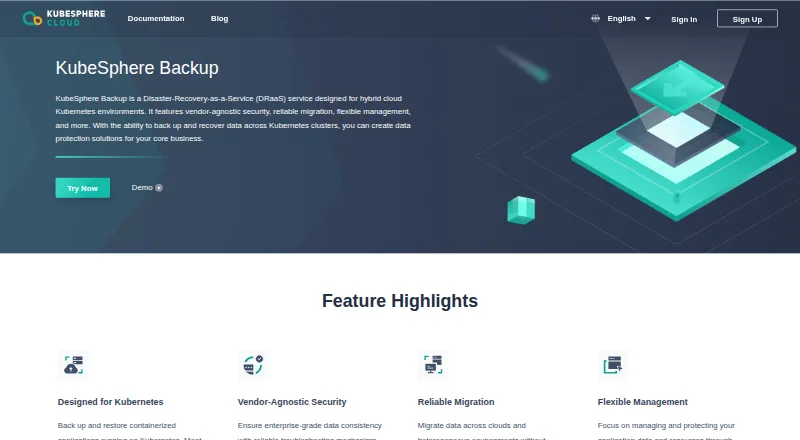
What KubeSphere Backup is
KubeSphere Backup is a cloud disaster-recovery service for hybrid-cloud Kubernetes environments. It backs up and recovers data across clusters, with support for different clouds, Kubernetes versions, distributions, and S3-standard object storage. CSI snapshot backup supports stateful applications such as MySQL, MongoDB, and Redis. Users can create and run protection tasks through a console without specialist knowledge of Kubernetes backup tools. Listed uses include recovery after hardware or system failures, configuration errors, and improper operations, along with multi-cluster protection and moving application data between clouds. The free plan covers 2 protected applications, 3 days of retention, and a 10 GB hosted repository. Basic costs $65 a month and includes 100 protected applications, 14 days of retention, and a 100 GB hosted repository. Direct cluster connection needs a publicly reachable Kubernetes API server address in kubeconfig; agent connection is an alternative. The object-storage repository domain must be compatible with AWS S3 standards. For Copy Volumes backups, the vendor advises disconnecting the database first to support data consistency.
Who it suits
It suits teams managing Kubernetes applications across clusters or clouds that need backup and recovery through a web console. Stateful applications can use CSI snapshot backup, subject to the service's connection and storage requirements.
What it does well
- Backs up and recovers data across Kubernetes clusters.
- Supports multiple clouds and Kubernetes versions.
- CSI snapshots support stateful applications.
- Free plan includes 2 protected applications.
- Agent connection is an alternative to direct cluster connection.
What to know first
- Free plan retains backups for 3 days.
- Basic plan costs $65 a month.
- Repository domain must be compatible with AWS S3 standards.
- Copy Volumes backups call for disconnecting the database first.
Limits
The Free plan covers 2 protected applications, 3 days of retention, and a 10 GB hosted repository. The Basic plan costs $65 a month and includes 100 protected applications, 14 days of retention, and a 100 GB hosted repository.
Plans
| Plan | Billed and limits | Price |
|---|---|---|
| Free | 2 protected applications · 3 days retention · 10 GB hosted repository | Free |
| Basic | USD 65/month · 100 protected applications · 14 days retention · 100 GB hosted repository · 3 resource templates | $65 a month |
| Standard | USD 200/month · 500 protected applications · 30 days retention · 500 GB hosted repository · 10 resource templates | $200 a month |
| Enterprise | USD 340/month · 1,500 protected applications · 90 days retention · 1 TB hosted repository · Unlimited resource templates | $340 a month |
| Free subscription | Long-term free subscription; first 30 days include Standard subscription functionality, 500 protected applications, and a 500 GB hosted storage repository. · 500 protected applications and 500 GB hosted storage during the first 30 days | Free |
| Exclusive | Customizable protected applications · Customizable retention · 24 x 7 support · Customizable hosted repository | On request |
As kubesphere.cloud lists them, read 21 Sept 2026. The maker's own page has the final word.
Getting started
- Open the KubeSphere Backup website.
- Use the web console to create and execute data-protection tasks.
- Connect a cluster directly with a publicly reachable Kubernetes API server address in kubeconfig, or use an agent connection.
- Choose an available plan, including the free plan or a paid plan from $65 a month.
- Use an object-storage repository whose access domain is compatible with AWS S3 standards.
Overview
KubeSphere Backup is a cloud disaster-recovery service for Kubernetes environments spanning clusters and clouds. It suits teams that want console-managed protection for cluster resources and stateful applications; the breadth is useful, but network access, S3-compatible storage, and backup-consistency requirements shape whether it fits.
Key features
The service backs up and recovers data across Kubernetes clusters, clouds, and Kubernetes versions. That supports multi-cluster protection and cloud-to-cloud application data migration, as well as recovery after hardware or system failures, configuration errors, or improper operations. For organizations operating across environments, this breadth can reduce the need to treat each cluster as a separate recovery problem.
It supports cluster resource and persistent-volume backup, including CSI snapshots for stateful applications such as MySQL, MongoDB, and Redis. App-consistent backup support is relevant when application data integrity matters, but Copy Volumes backups have a specific operational caveat: the vendor advises disconnecting the database first to protect consistency and integrity.
Protection tasks can be created and run through a console without requiring expertise in tools such as Velero. That is a practical fit for teams seeking a managed workflow rather than direct backup-tool operation. It does not remove infrastructure prerequisites: direct cluster connection requires the Kubernetes API server address in kubeconfig to be reachable over the public network, though agent connection is an alternative. The object-storage repository domain must be compatible with AWS S3 standards.
Pricing
KubeSphere Backup has a free plan and paid subscriptions starting at $65 a month. The Free plan costs nothing and covers 2 protected applications, 3 days of retention, and a 10 GB hosted repository. Its small application cap and short retention make it more suitable for limited protection needs than broader recovery requirements.
Basic costs $65 a month, billed USD 65/month, and raises the limits to 100 protected applications, 14 days of retention, 100 GB hosted repository, and 3 resource templates. Standard costs $200 a month, billed USD 200/month, with 500 protected applications, 30 days of retention, 500 GB hosted repository, and 10 templates. Enterprise costs $340 a month, billed USD 340/month, and includes 1,500 protected applications, 90 days of retention, 1 TB hosted repository, and unlimited templates. The step up from Basic to Standard or Enterprise chiefly buys more application capacity, repository space, retention, and templates; teams with longer recovery windows or larger estates will need to weigh those increments against the monthly cost.
A separate Free subscription costs nothing and is billed as a long-term free subscription. Its first 30 days include Standard subscription functionality, 500 protected applications, and 500 GB hosted storage; those first-month limits are distinct from the Free plan's 2 applications, 3 days, and 10 GB. Exclusive has custom pricing, with customizable protected applications, retention, and hosted repository, plus 24 x 7 support. A free trial is also offered.
Platforms
KubeSphere Backup is available on the web and uses a cloud deployment model. Kubernetes support includes persistent-volume backup and cluster resource backup.
Who it's for
It is a strong fit for teams protecting stateful Kubernetes workloads across multiple clusters or clouds, particularly when a console-based workflow is preferable to operating backup tools directly. Teams should look elsewhere if their API endpoint cannot be reached publicly and they cannot use an agent connection, or if their object-storage repository is not S3-standard compatible. Copy Volumes workflows also require planning around database disconnection.
Pros and cons
- Pros: Cross-cluster, cross-cloud, and cross-version protection addresses mixed Kubernetes estates.
- Pros: CSI snapshot support for MySQL, MongoDB, and Redis extends protection to stateful applications.
- Pros: Console-based task management avoids requiring direct expertise in tools such as Velero.
- Cons: Direct connection depends on public network reachability of the API server; agent connection is the alternative.
- Cons: Repository access must use a domain compatible with AWS S3 standards.
- Cons: Copy Volumes backup calls for database disconnection to ensure consistency and integrity.
Alternatives
For other options, browse Kubernetes Backup Software and Container Backup Software. Choose Google Kubernetes Engine when its Kubernetes platform and cluster-management offering is a better fit than a dedicated cross-cluster backup service. Afi Kubernetes Backup is another Kubernetes backup option, with free licenses available by request for environments protecting fewer than 10 nodes and a listed paid plan at $140 a month. Plakar may suit teams seeking a freemium backup product for Linux, macOS, or Windows, with a free tier for up to 500 GB of managed data and a Control Plane deployed on infrastructure they own.
Storware Backup & Recovery is another freemium backup option, with a free license that excludes technical support. Veeam Agent for Mac is a macOS-focused alternative whose free edition is limited to one backup job and does not back up directly to object storage. Vinchin Backup & Recovery offers a permanent free edition protecting up to 3 virtual machines. Stash is another freemium container-backup option. Veeam Kasten for Kubernetes has a free tier for 5 nodes; consider it when that node-based free allowance better matches the intended scope.
Verdict
KubeSphere Backup is a sensible choice for teams that need cross-cloud Kubernetes recovery, stateful-workload support, and a console-managed workflow. Its main advantage is broad cluster coverage without requiring direct expertise in backup tools; look elsewhere if its connection and S3-compatible storage requirements do not suit your environment, or if the Copy Volumes database-disconnection step is impractical.
Verdict
KubeSphere Backup offers cross-cluster protection with support for stateful workloads and a console-based workflow. Review retention, repository compatibility, and connection requirements before relying on it for recovery.
Questions
Is KubeSphere Backup free?
Yes. The Free plan costs nothing and includes 2 protected applications, 3 days of retention, and a 10 GB hosted repository.
How much do the paid plans cost?
Basic costs $65 a month, Standard costs $200 a month, and Enterprise costs $340 a month. Exclusive has a customizable configuration and no listed price.
Which platforms does it support?
KubeSphere Backup is available through the web and has a cloud deployment model.
What does KubeSphere Backup protect?
It backs up and recovers data across Kubernetes clusters. CSI snapshot backup supports stateful applications such as MySQL, MongoDB, and Redis.
What connection and storage requirements apply?
A direct cluster connection requires the Kubernetes API server address in kubeconfig to be reachable over the public network; an agent connection is an alternative. The object-storage repository access domain must be compatible with AWS S3 standards.
Who makes KubeSphere Backup?
The product page identifies QingCloud Technologies as the copyright holder. QingCloud lists its headquarters in Beijing, China, and was founded in 2012.
Facts from KubeSphere Backup's own pages
- Backup and recovery
- It backs up and recovers data across Kubernetes clusters. · kubesphere.cloud, 29 Sept 2026
- Backup caveat
- When using Copy Volumes, the vendor advises disconnecting the database before backup to ensure data consistency and integrity. · kubesphere.cloud, 29 Sept 2026
- Cluster connection
- Direct cluster connection requires the Kubernetes API server address in the kubeconfig to be reachable over the public network; agent connection is an alternative. · kubesphere.cloud, 29 Sept 2026
- Company
- The product page identifies QingCloud Technologies as the copyright holder. · kubesphere.cloud, 29 Sept 2026
- Company founded
- QingCloud was founded in 2012. · star.sse.com.cn, 29 Sept 2026
- Company headquarters
- QingCloud lists its headquarters in Beijing, China. · qingcloud.com, 29 Sept 2026
- Management
- Users can create and execute data-protection tasks through a console, without expertise in Kubernetes backup tools such as Velero. · kubesphere.cloud, 29 Sept 2026
- Multi-cloud protection
- It supports backup and disaster recovery across clouds and different Kubernetes versions. · kubesphere.cloud, 29 Sept 2026
- Product
- KubeSphere Backup is a disaster-recovery-as-a-service product for hybrid-cloud Kubernetes environments. · kubesphere.cloud, 29 Sept 2026
- Stateful applications
- CSI snapshot backup is supported for stateful applications such as MySQL, MongoDB, and Redis. · kubesphere.cloud, 29 Sept 2026
- Storage compatibility
- The service supports S3-standard object storage and various Kubernetes distributions. · kubesphere.cloud, 29 Sept 2026
- Storage requirement
- The object-storage repository access domain must be compatible with AWS S3 standards. · kubesphere.cloud, 29 Sept 2026
- Use cases
- The vendor lists hardware or system failures, configuration errors, improper operations, multi-cluster protection, and cloud-to-cloud application data migration as use cases. · kubesphere.cloud, 29 Sept 2026
Where KubeSphere Backup stands on Freedom251
- Kubernetes Backup Software#10 of 31
- Container Backup Software#12 of 28