Freedom251 › Kubernetes Backup Software

Afi Kubernetes Backup
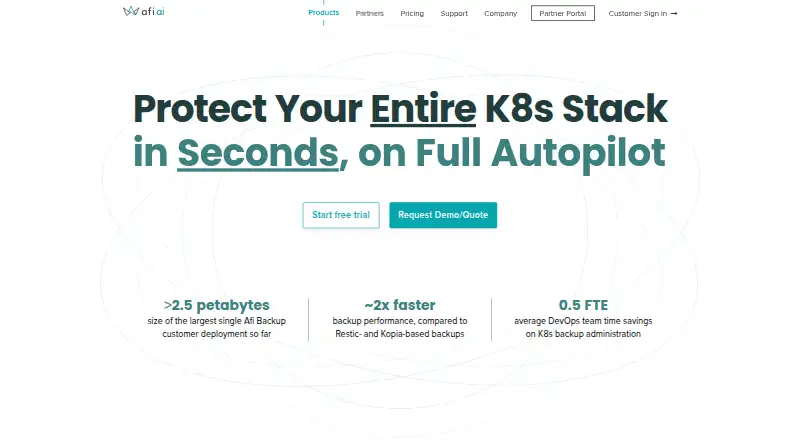
What Afi Kubernetes Backup is
Afi Kubernetes Backup automates backup and recovery for distributed Kubernetes applications. It can protect etcd, namespace metadata and dependencies, infrastructure configurations, persistent volumes, and databases. Users can restore or replicate a whole cluster or selected components to the same or a different target environment, and search backups in full text for recovery points or individual items. Afi says it automatically discovers Kubernetes resources and adapts protection settings as infrastructure and applications change. Deployment options include a hosted dashboard and on-premises-only or hybrid configurations for air-gapped environments. Customers can connect their own cloud, off-premise, or local storage, or use Afi storage with selectable regions and residency policies. Named integrations and identity options include Terraform, CircleCI, Jenkins, OpenID, Azure AD, GCP, AWS, and Okta. The product describes cyberattack and vulnerability detection, preemptive backups, alerts, and custom backup roles. Pricing is $140 a month, billed at $140 per protected node per month, with backup storage at $60 per one terabyte per month; there is no storage charge when using your own storage. Free licenses are available by request for environments protecting fewer than 10 nodes.
Who it suits
Afi Kubernetes Backup suits organizations that need scheduled, application-consistent protection and recovery across Kubernetes clusters. Its deployment and storage options may fit teams with air-gapped environments or particular data-residency needs.
What it does well
- Protects persistent volumes and databases
- Restores whole clusters or selected components across clusters
- Full-text search locates recovery points and items
- Customer-owned storage avoids storage charges
- Free licenses available by request under 10 nodes
What to know first
- Paid licensing is $140 per node per month
- Afi storage costs $60 per one terabyte per month
- Free licenses require a request
Limits
Free licenses are available by request only for environments protecting fewer than 10 nodes. The paid plan is $140 per protected node per month; Afi backup storage costs $60 per terabyte per month, while use of your own storage has no storage charge.
Plans
| Plan | Billed and limits | Price |
|---|---|---|
| Free licenses | Available by request for environments protecting less than 10 nodes | Free |
| Afi Kubernetes Backup | $140 per node per month; backup storage is $60 per one terabyte per month · License only protected nodes · No storage charge with your own storage · Custom pricing for large deployments | $140 a month |
As afi.ai lists them, read 4 Oct 2026. The maker's own page has the final word.
Getting started
- Visit the Afi Kubernetes Backup website.
- Request free licenses if protecting fewer than 10 nodes, or request a demo or quote for paid use.
- Choose the Afi-hosted dashboard, on-premises-only, or hybrid deployment option.
- Choose Afi storage or connect cloud, off-premise, or local storage.
- Arrange a proof of concept or use the Afi-hosted test lab.
Afi Kubernetes Backup is a data-protection service for teams running distributed Kubernetes applications. It suits operators who need to recover whole clusters or individual components across environments, including in air-gapped deployments. Its strongest case is broad coverage with adaptable protection; per-node licensing and storage charges call for a close cost check.
Overview
Afi can protect etcd, namespace metadata and dependencies, infrastructure configurations, persistent volumes, and databases. Scheduled, application-consistent backups with unlimited retention support flexible recovery policies, while full-text search helps locate a recovery point or a particular item. Teams can restore or replicate a cluster or selected application components to the same or a different target environment.
Automatic resource discovery and adapting protection settings help keep coverage aligned as applications and infrastructure change. Afi also describes cyberattack detection, preemptive backups, alerts, and vulnerability detection for cluster configurations and dependencies. That breadth is useful for teams with changing estates, but the security features do not replace a review of how the service fits the organization’s recovery requirements.
Key features
- Broad backup scope: Protection for volumes, databases, etcd, metadata, dependencies, and infrastructure configurations can reduce gaps when an application depends on more than persistent data alone.
- Flexible recovery: Whole-cluster and component-level restore or replication across target environments gives operators options for both full recovery and narrower fixes.
- Search and automation: Full-text search across backups makes recovery points and individual items easier to find; auto-discovery and changing protection settings help avoid a stale resource inventory.
- Deployment and storage choices: A cloud-hosted dashboard is available alongside on-premises-only and hybrid options for air-gapped environments. Customers can connect their own cloud, off-premise, or local storage, or use Afi storage with selectable regions and residency policies.
- Access and integrations: Custom backup roles and cloud IAM or identity-provider access controls support delegated administration. Named integrations and identity options include Terraform, CircleCI, Jenkins, OpenID, Azure AD, GCP, AWS, and Okta.
- Performance claim: Afi says true incremental backups can be up to 2–3 times faster than Velero-based options, especially in large environments. Teams should weigh that claim against their own workload and operational needs.
- Compliance: Afi states that it is SOC 2 Type II compliant and GDPR and HIPAA compliant.
Pricing
The Free licenses plan costs free and is available by request for environments protecting fewer than 10 nodes. It offers a way for smaller clusters to consider Afi without a license charge, but the node cap limits its fit as an environment grows.
The Afi Kubernetes Backup plan is $140 a month, billed at $140 per protected node per month. Backup storage costs $60 per one terabyte per month when using Afi storage; there is no storage charge when customers use their own storage. Large deployments have custom pricing. The 14-day trial lets teams evaluate the product before committing, and prospective customers can request a demo or quote, arrange a proof of concept, or access an Afi-hosted test lab.
Because licensing scales with protected nodes and Afi storage adds a separate capacity charge, budget against both the node count and expected backup volume. Bring-your-own-storage avoids Afi’s storage fee but means choosing and operating an external storage destination.
Platforms
Afi lists API, self-hosted, and web platforms. Its on-premises-only and hybrid deployment options are relevant to teams with air-gapped requirements, while the cloud-hosted dashboard suits teams that prefer a hosted management interface.
Who it's for
Afi is a strong fit for Kubernetes operators who need application-consistent protection across cluster data and configuration, searchable backups, and recovery to another environment. Its deployment and storage choices also suit organizations with residency or disconnected-environment constraints. It is less compelling for small teams seeking a low-cost option without per-node budgeting, or for environments that do not need its broader recovery and deployment capabilities.
Pros and cons
- Pro — Recovery spans data and configuration: Coverage includes persistent volumes, databases, etcd, metadata, dependencies, and infrastructure configuration, with whole-cluster or component-level recovery.
- Pro — Protection can follow changing clusters: Auto-discovery and adapting settings reduce manual upkeep as resources and applications change.
- Pro — Flexible deployment and storage: On-premises-only and hybrid options, plus customer-managed or Afi storage, give teams choices for air-gapped use and residency needs.
- Con — Costs scale across two dimensions: Per-node licensing and, when using Afi storage, a separate per-terabyte monthly charge make total spend sensitive to both cluster size and backup volume.
- Con — The free license is narrowly capped: It is by request and limited to environments protecting fewer than 10 nodes.
Alternatives
Velero is a free, open-source option for teams that prefer a cloud or on-premises tool and are comfortable with its stated deployment requirement. Afi is the more relevant choice when full-text search, adaptive protection, or its described deployment and recovery options matter.
Google Kubernetes Engine is worth considering for teams evaluating a managed Kubernetes service with a free tier and trial; its free tier uses $74.40 in monthly credits per billing account for zonal and Autopilot clusters. Afi is focused on backup and recovery rather than cluster service selection.
KubeSphere Backup offers a free plan limited to 2 protected applications, 3 days of retention, and a 10 GB hosted repository, with a Basic plan at $65.00 per month. It may suit teams with modest needs and those caps; Afi offers unlimited retention and broader cluster-level recovery.
Plakar has a free plan for up to 500 GB of managed data with no time limit and a Control Plane deployed on infrastructure you own, making it an alternative for teams prioritizing self-managed deployment within that capacity.
Storware Backup & Recovery offers a free license without technical support and a 60-day trial for up to 20 virtual environments, an alternative for teams comparing broader backup products and trial limits.
Veeam Agent for Mac is a macOS option with a free edition limited to one backup job and no direct backup to object storage; it is for Mac backup needs rather than Kubernetes cluster protection.
Vinchin Backup & Recovery has a permanent free edition protecting up to 3 virtual machines, for teams whose requirements fit that scope.
KubeStash is free to use on supported Kubernetes engines and offers a 30-day free license to try, making it another Kubernetes-focused option to compare.
For broader comparisons, browse Kubernetes Backup Software and Container Backup Software.
Verdict
Choose Afi Kubernetes Backup if your team needs application-consistent Kubernetes protection across data and configuration, searchable recovery points, and flexible cluster or component recovery, particularly in restricted deployment environments. Its automation and broad coverage are the main reasons to choose it; the per-node license and potential storage charges are the main reasons to look elsewhere if cost simplicity or a small free option matters more.
Verdict
Afi Kubernetes Backup covers application data and cluster configuration, with search, cross-cluster recovery, and multiple deployment and storage options. Confirm node licensing and storage costs for the intended environment, or ask about the limited free-license option.
Questions
Is Afi Kubernetes Backup free?
Free licenses are available by request for environments protecting fewer than 10 nodes. The paid plan is $140 per protected node per month.
How much does the paid plan cost?
The plan is $140 per protected node per month. Afi storage costs $60 per terabyte per month; there is no storage charge when using your own storage.
Which platforms does it support?
The listed platforms are API, self-hosted, and web.
Can it restore to another cluster?
Yes. It can restore or replicate whole clusters or selected application components to the same or a different target environment.
What deployment options are available?
Options include an Afi-hosted dashboard, on-premises-only deployment, and hybrid deployment for air-gapped environments.
Which integrations and identity options are named?
The product page names Terraform, CircleCI, Jenkins, OpenID, Azure AD, GCP, AWS, and Okta.
Facts from Afi Kubernetes Backup's own pages
- Access controls
- Users can create custom backup roles and use cloud IAM or identity providers to manage access. · afi.ai, 4 Oct 2026
- Automation
- Afi auto-discovers Kubernetes resources and adapts protection settings as infrastructure and applications change. · afi.ai, 4 Oct 2026
- Backup coverage
- Backups can include etcd, namespace metadata and dependencies, infrastructure configurations, persistent volumes, and databases. · afi.ai, 4 Oct 2026
- Company headquarters
- Afi says it is headquartered in Coral Springs, Florida. · afi.ai, 4 Oct 2026
- Compliance
- Afi's compliance page states that it is SOC 2 Type II compliant and GDPR and HIPAA compliant. · afi.ai, 4 Oct 2026
- Data residency
- Afi says customers can connect their own cloud, off-premise, or local storage, or use Afi storage with selectable regions and residency policies. · afi.ai, 4 Oct 2026
- Deployment options
- Afi describes a cloud-hosted dashboard and on-premises-only or hybrid deployment options for air-gapped environments. · afi.ai, 4 Oct 2026
- Headquarters
- Coral Springs, Florida, United States · afi.ai, 28 Sept 2026
- Integrations
- The product page names Terraform, CircleCI, Jenkins, OpenID, Azure AD, GCP, AWS, and Okta integrations or identity options. · afi.ai, 4 Oct 2026
- Performance
- Afi says its true incremental backups can be up to 2–3 times faster than Velero-based options, especially in large environments. · afi.ai, 4 Oct 2026
- Purpose
- Afi provides automated backup and recovery for distributed Kubernetes applications. · afi.ai, 4 Oct 2026
- Recovery
- Users can restore or replicate whole clusters or selected application components to the same or a different target environment. · afi.ai, 4 Oct 2026
- Search
- The product provides full-text search across backups to find recovery points or individual items. · afi.ai, 4 Oct 2026
- Security
- Afi describes cyberattack detection, preemptive backups, timely alerts, and vulnerability detection for cluster configurations and application dependencies. · afi.ai, 4 Oct 2026
- Support and sales
- The page invites prospective customers to request a demo or quote, arrange a proof of concept, or access an Afi-hosted test lab. · afi.ai, 4 Oct 2026
Where Afi Kubernetes Backup stands on Freedom251
- Kubernetes Backup Software#2 of 31
- Container Backup Software#2 of 28