Freedom251 › Kubernetes Backup Software
KubeStash
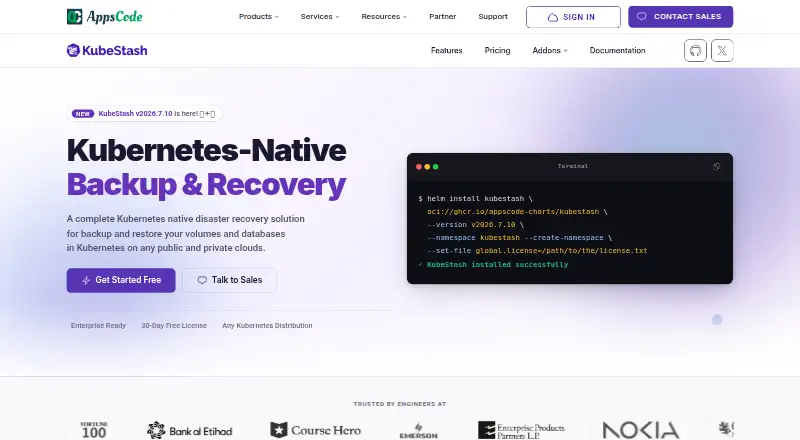
What KubeStash is
KubeStash backs up and restores Kubernetes workloads, databases and virtual machines running on Kubernetes across public and private clouds. It covers workload volumes, standalone persistent volume claims, and databases including MariaDB, Redis, PostgreSQL, MySQL, MongoDB, Elasticsearch, Percona XtraDB and etcd. Backups can be stored in services such as AWS S3, Google Cloud Storage and Azure Blob Storage, as well as other listed systems including Minio, Rook, OpenStack Swift and Kubernetes persistent volumes. Kubernetes custom resources define backup targets and behavior, with scheduled and policy-based backups. Recovery options include full, granular and point-in-time restores across namespaces and clusters. The maker says deduplication sends only modified data blobs after the first backup and that backed-up data is encrypted with AES-256. Prometheus monitoring and Grafana dashboards provide operational metrics. The operator is installed with Helm on EKS, GKE, AKS and on-premises Kubernetes clusters. KubeStash is available through API and self-hosted platforms. Its listed free plan costs nothing, and pricing is also available on request; the pricing note mentions a 30-day trial.
Who it suits
KubeStash suits teams operating Kubernetes clusters that need backups and recovery for volumes, databases or virtual machines. It may be useful where scheduled backups, cross-cluster recovery and monitoring are needed.
What it does well
- Supports scheduled and policy-based backups.
- Offers full, granular and point-in-time recovery.
- Supports cross-cluster restore.
- Uses AES-256 encryption for backed-up data.
- Free plan listed as free.
What to know first
- Monthly plans have a 30-day minimum term.
- Plans are product-specific.
- Pricing beyond the listed free plan is on request.
Limits
The free plan includes a 30-day free license to try. Paid monthly plans have a 30-day minimum term.
Plans
| Plan | Billed and limits | Price |
|---|---|---|
| KubeStash | Free to use on supported Kubernetes engines · 30-day free license to try | Free |
As kubestash.com lists them, read 5 Oct 2026. The maker's own page has the final word.
Getting started
- Visit the KubeStash website.
- Install the operator with Helm into a Kubernetes cluster, such as EKS, GKE, AKS or an on-premises cluster.
- Define backup targets and behavior with Kubernetes custom resources.
- Choose a backup backend and configure scheduled or policy-based backups.
- Use the free plan or 30-day trial to try KubeStash.
- Request pricing and choose a support coverage option.
Verdict
KubeStash offers a broad set of Kubernetes backup targets and recovery choices. Check product-specific plan terms and support coverage to see whether they fit your deployment.
Questions
Is KubeStash free?
A free plan is listed, with a 30-day free license to try.
How much does paid KubeStash cost?
Pricing is on request. The pricing page says monthly plans have a 30-day minimum term.
Where can KubeStash run?
Its operator can be installed with Helm into Kubernetes clusters, including EKS, GKE, AKS and on-premises clusters.
Which databases does it support?
Supported databases include MariaDB, Redis, PostgreSQL, MySQL, MongoDB, Elasticsearch, Percona XtraDB and etcd.
Can it restore across clusters?
Yes. KubeStash supports full, granular and point-in-time recovery across namespaces and clusters.
What support coverage is offered?
The pricing page lists self-service, 8x5 and 24x7 coverage options; the feature page advertises 24/7 expert support.
Facts from KubeStash's own pages
- Backup controls
- KubeStash uses Kubernetes custom resources to define backup targets and behaviors, and supports scheduled and policy-based backups. · kubestash.com, 5 Oct 2026
- Database integrations
- Supported databases include MariaDB, Redis, PostgreSQL, MySQL, MongoDB, Elasticsearch, Percona XtraDB, and etcd. · kubestash.com, 5 Oct 2026
- Efficiency
- Deduplication uses content-defined chunking and uploads only modified data blobs since the previous backup. · kubestash.com, 5 Oct 2026
- Encryption
- The maker says backed-up data is encrypted using AES-256. · kubestash.com, 5 Oct 2026
- Headquarters
- Las Vegas, Nevada, USA · kubestash.com, 28 Sept 2026
- Installation
- The operator can be installed with Helm into Kubernetes clusters including EKS, GKE, AKS, and on-premises clusters. · kubestash.com, 5 Oct 2026
- Limits
- The pricing page says plans are product-specific and monthly plans have a 30-day minimum term. · kubestash.com, 5 Oct 2026
- Monitoring
- KubeStash supports Prometheus monitoring and Grafana dashboards for operational metrics. · kubestash.com, 5 Oct 2026
- Purpose
- KubeStash is a Kubernetes-native disaster recovery solution for backing up and restoring volumes and databases across public and private clouds. · kubestash.com, 5 Oct 2026
- Recovery
- The product supports full, granular, and point-in-time recovery across namespaces and clusters. · kubestash.com, 5 Oct 2026
- Storage integrations
- Supported backup backends include AWS S3, Minio, Rook, Google Cloud Storage, Azure Blob Storage, OpenStack Swift, DigitalOcean Spaces, Backblaze B2, REST servers, and Kubernetes persistent volumes. · kubestash.com, 5 Oct 2026
- Support
- The pricing page lists self-service, 8x5, and 24x7 support coverage options; its feature page advertises 24/7 expert support. · kubestash.com, 5 Oct 2026
- Workloads
- It supports Kubernetes workload volumes, standalone PVCs, databases, and virtual machines running on Kubernetes. · kubestash.com, 5 Oct 2026
Where KubeStash stands on Freedom251
- Kubernetes Backup Software#5 of 31
- Container Backup Software#6 of 28