Freedom251 › Continuous Integration Software

Semaphore
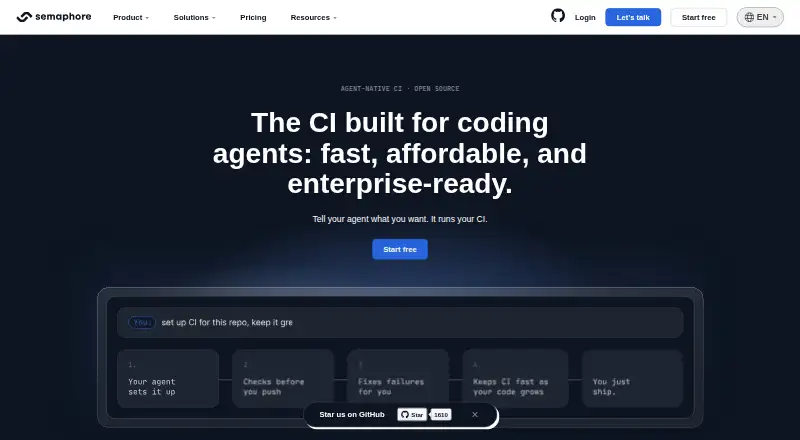
What Semaphore is
Semaphore is a CI/CD platform for building, testing, releasing and deploying code. A workflow groups one or more pipelines to automate development tasks. Its visual Workflow Builder represents pipelines, generates YAML configuration and provides visual performance feedback. Teams can connect GitHub, GitLab or Bitbucket repositories, run hosted jobs, or use self-hosted agents on Linux, macOS or Windows. Self-hosted agents can autoscale with Kubernetes or AWS. Semaphore is open source under the Apache 2.0 license and can be self-hosted. It includes 20 concurrent jobs by default, with higher limits available on request. Artifact use is free up to 20 GB per month of egress and 100 GB per month of storage; additional use is charged separately. Listed options include $15 monthly usage credits, self-hosted compute billed at $0.0025/min, and hosted runners billed according to machine type and minute. Free support covers account setup, projects and Git integration; advanced CI troubleshooting is offered through paid support plans, including Basic Support at $50 a month. Semaphore says it has SOC 2 Type 2 and ISO 27001:2022 certifications and encrypts data in transit and at rest.
Who it suits
Semaphore suits development teams automating build, test, release and deployment pipelines, from SMBs and startups to large companies. Teams can choose hosted jobs or self-hosted agents.
What it does well
- Connects GitHub, GitLab and Bitbucket repositories.
- Visual builder generates YAML pipeline configuration.
- Supports self-hosted agents on Linux, macOS and Windows.
- Open source under the Apache 2.0 license.
- Includes 20 concurrent jobs by default.
What to know first
- Artifact use above 20 GB egress or 100 GB storage is charged separately.
- Higher concurrent-job limits require a request.
- Advanced CI troubleshooting is through paid support plans.
Limits
Artifact usage is free up to 20 GB per month of egress and 100 GB per month of storage; extra use is charged separately. Semaphore includes 20 concurrent jobs by default, with higher limits available on request. Free support covers account setup, projects, and Git integration, while advanced CI troubleshooting is offered through paid plans.
Plans
| Plan | Billed and limits | Price |
|---|---|---|
| Free usage credits | $15 monthly credits | Free |
| Self-Hosted | $0.0025/min · Any machine | Free |
| Ubuntu ARM 2vCPU | $0.003/min · 2 vCPU | Free |
| Ubuntu ARM 4vCPU | $0.006/min · 4 vCPU | $0.01 a month |
| Ubuntu ARM 8vCPU | $0.012/min · 8 vCPU | $0.01 a month |
| Ubuntu x64 2vCPU | $0.0075/min · 2 vCPU | $0.01 a month |
| Ubuntu x64 4vCPU | $0.015/min · 4 vCPU | $0.02 a month |
| MacOS 4vCPU | $0.09/min · 4 vCPU | $0.09 a month |
The first 8 of 11 plans, as semaphore.io lists them, read 21 Sept 2026. The maker's own page has the final word. Every plan
Getting started
- Visit https://semaphore.io/.
- Connect a GitHub, GitLab, or Bitbucket repository.
- Create a workflow with one or more pipelines.
- Choose hosted jobs or configure self-hosted agents on Linux, macOS, or Windows.
- Review usage credits, runner rates, and support options for your needs.
Semaphore is a CI/CD platform for teams that need to build, test, release, and deploy code across hosted or self-managed runners. It stands out for combining visual pipeline design with YAML output and autoscaling self-hosted agents; artifact allowances and the cost of advanced support deserve close attention.
Overview
A workflow groups one or more pipelines to automate development work, from builds to releases and deployments. Semaphore’s visual builder models those pipelines, generates YAML, and provides visual performance feedback, giving teams a graphical way to shape automation without giving up configuration they can manage as code.
Repositories on GitHub, GitLab, and Bitbucket are supported, as are pull-request checks. Teams can choose hosted runners or self-hosted agents running Linux, macOS, or Windows. The latter can autoscale with Kubernetes or AWS, which is useful when build demand varies or infrastructure needs to stay under a team’s control. Semaphore says it is open source under Apache 2.0 and can be self-hosted.
Key features
Pipeline configuration and capacity
Visual and YAML configuration, plus artifact or dependency caching, make Semaphore adaptable to teams with different workflow preferences. The default allowance of 20 concurrent jobs is substantial for parallel work, while teams that outgrow it can request a higher limit. Self-hosted agents add flexibility, but require teams to manage their own runner environment.
Security and integrations
Semaphore says builds run in isolated sandbox virtual machines that are destroyed after each use, and that data is encrypted in transit with 256-bit encryption and at rest with AES-256. It also reports SOC 2 Type 2 and ISO 27001:2022 certifications, with reports or proof available on request. Slack and webhook notifications, SAML/SCIM, Okta, OpenID Connect, and GitHub SSO appear among its integrations, though some are edition-restricted.
Artifacts and support
Artifact usage is free up to 20 GB of monthly egress and 100 GB of monthly storage; additional use is charged separately. Teams with large artifacts or frequent downloads should include that exposure in their budget. Free support covers account setup, projects, and Git integration, but advanced CI troubleshooting is reserved for paid support plans.
Pricing
Semaphore has a free plan and no free trial. The pricing model is freemium, with usage-based runner charges and paid support tiers. Free usage credits are $15 monthly. Self-hosted execution is priced at $0.00 per month, billed $0.0025/min for any machine.
Hosted runner prices vary by machine. Ubuntu ARM 2vCPU is $0.00 per month, billed $0.003/min; Ubuntu ARM 4vCPU is $0.01 per month, billed $0.006/min; and Ubuntu ARM 8vCPU is $0.01 per month, billed $0.012/min. Ubuntu x64 2vCPU is $0.01 per month, billed $0.0075/min, while Ubuntu x64 4vCPU is $0.02 per month, billed $0.015/min. The macOS 4vCPU option is $0.09 per month, billed only for what you use. These listed monthly amounts are not a substitute for estimating actual usage at the per-minute rates.
Basic Support costs $50.00 per month for email support during business hours, without guaranteed response times. Priority Response Support costs $250.00 per month for email and Slack with best-effort accelerated responses 24/5. SLA Standard Support costs $500.00 per month and adds email, Slack, and a customer portal, with 24/5 coverage and response targets of P1 in 4 hours, P2 in 1 day, P3 in 3 days, and P4 in 1 week. Organizations that need predictable escalation have a clearer commitment at the top tier, while smaller teams can avoid that expense if their support needs are limited to setup and integration help.
The pricing page includes 20 concurrent jobs by default, with higher limits available on request. Free artifact allowances are capped at 20 GB monthly egress and 100 GB monthly storage, and excess usage is charged separately. Those quotas, alongside runner-minute charges, matter more to total cost than the low listed monthly runner amounts alone.
Platforms
Semaphore supports API, Linux, macOS, self-hosted, web, and Windows platforms. Self-hosted agents can run on Linux, macOS, or Windows; hosted runners include Ubuntu and macOS options.
Who it's for
Semaphore suits software teams that want a choice between hosted compute and self-managed runners, especially those that value visual workflow modeling but still want generated YAML. Its GitHub, GitLab, and Bitbucket connections make it a practical fit for teams on those repositories. The company says it serves SMBs, fast-growing startups, and Fortune 500 companies. Teams with substantial artifact traffic should forecast overage costs, and those needing advanced troubleshooting should account for paid support.
Pros and cons
- Flexible execution: Hosted runners and self-hosted agents that autoscale with Kubernetes or AWS suit teams with changing workloads or infrastructure requirements.
- Visual and code-based workflows: The builder generates YAML and provides performance feedback, supporting both graphical pipeline design and configuration-driven work.
- Meaningful default parallelism: Twenty concurrent jobs support parallel builds, with higher limits available by request.
- Artifact overages can add cost: Free use stops at 20 GB monthly egress and 100 GB monthly storage, with additional usage charged separately.
- Advanced support is paid: Free assistance covers setup and Git integration, while CI troubleshooting and stronger response commitments require monthly support fees.
Alternatives
Continuous Integration Software is a broader category to compare if you want to survey CI options beyond Semaphore. For a narrower workflow focus, browse Game Build Automation Software or Mobile CI/CD Software.
GitHub Codespaces is another freemium choice, with Android and iOS as well as desktop and web platforms; its listed 2-core and 4-core compute plans are $0.18 and $0.36 per month respectively. Choose it when those platform options and its compute plans fit better than Semaphore’s CI/CD workflow focus.
Bitrise has a free plan and free trial, and its Hobby plan is free forever for a team of one, with build credits for a small project a few times per month and community support. It may suit a solo user who needs only occasional builds.
Codemagic offers a free plan with one team member, 500 build minutes refilled monthly, one parallel build, and 30 days of build history and artifact storage. It is worth considering when those explicit free-plan limits match a small team’s needs.
GameCI is free and open source, though CI-provider build minutes may cost extra. It is the more focused option to consider when a game-oriented, open-source tool is the priority.
AppVeyor has an open-source plan with unlimited public projects, one concurrent job, five self-hosted jobs, and community support. Consider it if those project and job allowances are a better fit.
Argo Workflows is a free, open-source workflow engine for Kubernetes. It is an alternative to consider for Kubernetes workflow orchestration.
Azure Test Plans has a $52.00 per month Basic + Test Plans plan, billed $52 per user per month, with test planning and tracking. Consider it when test planning and tracking are the main need.
Bitbucket Pipelines offers a free plan for up to five users with unlimited public and private repositories, 1 GB of LFS storage, and 50 build minutes per month. It may suit small teams already using Bitbucket that can work within those free allowances.
Verdict
Choose Semaphore if you want visual pipeline design paired with YAML, multiple major repository integrations, and the option to scale self-hosted runners. Its 20-job default concurrency and broad execution choices are compelling, but artifact overages and paid advanced support are the key reasons to compare alternatives before committing.
Verdict
Semaphore offers hosted and self-hosted ways to automate software delivery, with a visual pipeline builder and multiple source-control connections. Review artifact limits and support options when estimating costs.
Questions
Is Semaphore open source?
Yes. The company says Semaphore is open source under the Apache 2.0 license and can be self-hosted.
Does Semaphore have a free plan?
Yes. It lists free usage credits of $0, with $15 monthly credits. Self-hosted usage is listed as free and billed at $0.0025/min.
Which source control services does Semaphore support?
Semaphore supports GitHub, GitLab, and Bitbucket repositories.
Can I run my own agents?
Yes. Self-hosted agents can run on Linux, macOS, or Windows and can autoscale with Kubernetes or AWS.
How many jobs can run concurrently?
The pricing page includes 20 concurrent jobs by default. Higher limits are available on request.
What paid support plans are listed?
Basic Support costs $50 a month. Priority Response Support costs $250 a month, and SLA Standard Support costs $500 a month.
Facts from Semaphore's own pages
- Additional integrations
- The feature comparison lists Slack notifications, webhook notifications, SAML/SCIM, Okta, OpenID Connect, and GitHub SSO integrations, with some edition restrictions. · docs.semaphore.io, 7 Oct 2026
- Agent scaling
- Self-hosted agents can run on Linux, macOS, or Windows and can autoscale with Kubernetes or AWS. · semaphore.io, 7 Oct 2026
- Artifacts limit
- Artifact usage is free up to 20 GB per month of egress and 100 GB per month of storage, with additional usage charged separately. · semaphore.io, 7 Oct 2026
- Build isolation
- Builds run in isolated sandbox virtual machines that are destroyed after each use. · semaphore.io, 7 Oct 2026
- Company location
- Semaphore Technologies doo lists its registered seat in Novi Sad, Republic of Serbia. · semaphore.io, 7 Oct 2026
- Concurrency limit
- The pricing page includes 20 concurrent jobs by default and says higher limits are available on request. · semaphore.io, 7 Oct 2026
- Encryption
- Semaphore says data is encrypted in transit with 256-bit encryption and at rest with AES-256. · semaphore.io, 7 Oct 2026
- Founded
- 2011 · semaphore.io, 28 Sept 2026
- Headquarters
- Novi Sad, Serbia · semaphore.io, 28 Sept 2026
- Intended customers
- Semaphore says it serves SMBs, fast-growing startups, and Fortune 500 companies. · semaphore.io, 7 Oct 2026
- Open source
- The company says Semaphore is open source under the Apache 2.0 license and can be self-hosted. · semaphore.io, 7 Oct 2026
- Product
- Semaphore is an AI-native CI/CD platform for building, testing, releasing, and deploying code. · semaphore.io, 7 Oct 2026
- Security certifications
- Semaphore says it has SOC 2 Type 2 and ISO 27001:2022 certifications, with reports or proof available on request. · semaphore.io, 7 Oct 2026
- Source control integrations
- Semaphore supports GitHub, GitLab, and Bitbucket repositories. · docs.semaphore.io, 7 Oct 2026
- Support
- Free support includes help with account setup, projects, and Git integration; advanced CI troubleshooting is offered through paid support plans. · semaphore.io, 7 Oct 2026
- Workflow builder
- Its visual Workflow Builder models pipelines, generates YAML configuration, and provides visual performance feedback. · semaphore.io, 7 Oct 2026
- Workflows
- A workflow consists of one or more pipelines that automate development tasks such as build, release, and deployment. · docs.semaphore.io, 7 Oct 2026
Where Semaphore stands on Freedom251
- Continuous Integration Software#28 of 58
- Mobile CI/CD Software#11 of 22
- Ci Cd Platforms#16 of 28
- Game Build Automation Software#26 of 43