Freedom251 › Game Build Automation Software

AppVeyor
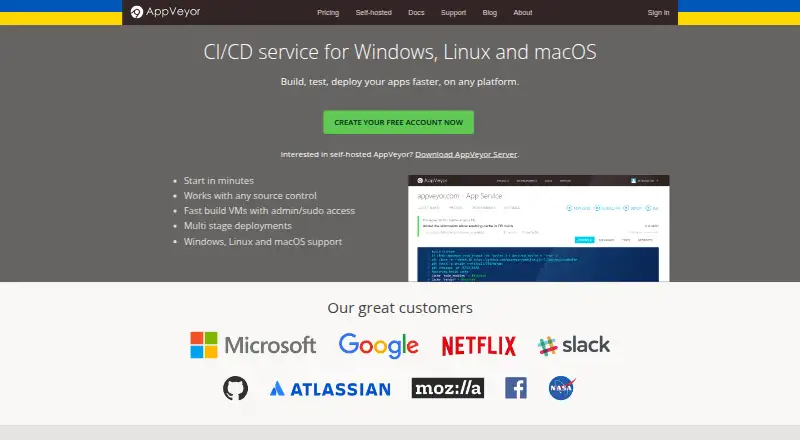
What AppVeyor is
AppVeyor provides continuous integration tools for Windows developers, with hosted service, self-hosted jobs, and an Enterprise installation option on customer premises. A pipeline can retrieve code, restore caches, install dependencies, build and test software, package artifacts, deploy, and run finalizer scripts. Projects can be configured through an appveyor.yml file or the user interface. Build matrices can produce multiple jobs across operating systems, variables, platforms, configurations, test categories, and build clouds. Listed source control providers include GitHub, Bitbucket, GitLab, Azure DevOps, Kiln, and Gitea. Deployments can use inline providers or environments triggered manually or through the API. The REST API covers teams, projects, builds, environments, and deployments, using bearer-token authentication. Account-specific keys can encrypt secure variables, which are not decoded during pull-request builds by default. Hosted builds use pristine virtual machines that are not shared between builds, and VM state does not persist. Every plan has a 60-minute maximum build-job execution time. The open-source plan is free; paid plans start at $29.00 per month.
Who it suits
AppVeyor suits Windows developers and teams that need automated build, test, packaging, and deployment workflows. It also offers options for open-source projects, private projects, and customer-premises installation.
What it does well
- Pipelines cover build, test, packaging, and deployment
- Supports configuration by YAML or interface
- Includes hosted and self-hosted options
- Secure variables are encrypted
What to know first
- Build jobs are limited to 60 minutes
- Basic includes one private project
- Basic costs $29.00 per month
Limits
All plans cap build-job execution at 60 minutes. The free Open-source plan is for unlimited public projects and includes 1 concurrent job and 5 self-hosted jobs.
Plans
| Plan | Billed and limits | Price |
|---|---|---|
| Open-source | Unlimited public projects · 1 concurrent job · 5 self-hosted jobs · Community support | Free |
| AppVeyor Server | Unlimited users · projects · jobs · clouds · agents · Runs on Windows, Linux, macOS, Docker or cloud | Free |
| Basic | monthly · 1 private project · 1 concurrent job · 5 self-hosted jobs · Priority technical support | $29 a month |
| Pro | monthly · Unlimited private projects · 1 concurrent job · 5 self-hosted jobs · Priority technical support | $59 a month |
| Pro | annual; 2 months free · Unlimited private projects · 1 concurrent job · 5 self-hosted jobs · Priority technical support | $590 a year |
| Premium | monthly · Unlimited private projects · 2 concurrent jobs · 5 self-hosted jobs · Priority technical support | $99 a month |
| Premium | annual; 2 months free · Unlimited private projects · 2 concurrent jobs · 5 self-hosted jobs · Priority technical support | $990 a year |
As appveyor.com lists them, read 14 Oct 2026. The maker's own page has the final word.
Getting started
- Open https://www.appveyor.com/.
- Choose the hosted service or consider AppVeyor Server on a customer server.
- Configure a project through an appveyor.yml file or the user interface.
- Connect a supported source control provider to retrieve the build configuration.
- Choose the Open-source plan for public projects or a paid plan for private projects.
- Set up build and deployment steps in the pipeline.
AppVeyor is a continuous integration service built around Windows development, with hosted builds and a customer-installed server option. It best suits teams that need configurable build matrices and deployment workflows; the 60-minute job limit is a meaningful constraint for longer builds.
Overview
AppVeyor can take a change from repository checkout through dependency installation, build, tests and artifact packaging to deployment, with finalizer scripts available at the end. Projects can be configured in an appveyor.yml file or through the interface, giving teams a choice between configuration in the repository and UI-based setup.
Hosted builds run on pristine virtual machines that are not shared between builds, and machine state is not preserved between jobs. That provides a clean environment for each run, but teams must restore what they need; caching is supported. Pull-request checks are also available.
Key features
Build matrices can combine operating systems, environment variables, platforms, configurations, test categories and build clouds into multiple jobs. This is useful for validating a wide range of build conditions in one pipeline, though the plan's concurrent-job allowance determines how quickly those jobs can run.
AppVeyor can retrieve configuration YAML from GitHub, Bitbucket, GitLab, Azure DevOps, Kiln and Gitea. Deployment options include inline providers and environment deployments that can be triggered manually or through the API. The REST API covers teams, projects, builds, environments and deployments, with bearer-token authentication.
Secure variables can be encrypted with account-specific keys and are not decoded during pull-request builds by default. This is a useful safeguard for CI workflows that handle credentials. Teams needing infrastructure control can install AppVeyor Server on their own server; it supports Windows, Linux and macOS.
Pricing
AppVeyor has a free plan, paid plans from $29 a month and a 14-day trial. All plans have a maximum build-job execution time of 60 minutes, so upgrading does not remove that ceiling.
| Plan | Price | Included | Best fit |
|---|---|---|---|
| Open-source | free | Unlimited public projects, 1 concurrent job, 5 self-hosted jobs, community support | Open-source projects that can work within one concurrent job |
| Basic | $29 a month | 1 private project, 1 concurrent job, 5 self-hosted jobs, priority technical support | A private project needing a low-cost entry point and priority support |
| Pro | $59 a month; $590/year - 2 months free | Unlimited private projects, 1 concurrent job, 5 self-hosted jobs, priority technical support | Teams with multiple private projects that can queue behind one job |
| Premium | $99 a month; $990/year - 2 months free | Unlimited private projects, 2 concurrent jobs, 5 self-hosted jobs, priority technical support | Teams that need a second simultaneous job |
The free plan is generous on public project count, but limits hosted concurrency to one job and includes community rather than priority support. Basic adds a private project and priority support, while Pro removes the private-project cap without increasing concurrency. Premium is the only listed tier with two concurrent jobs. The plans specify five self-hosted jobs, and the 60-minute ceiling still applies. Priority support aims to respond to email or forum inquiries within 24 hours, usually within 12, and includes project-setup help.
Platforms
AppVeyor is available through the web and API, and supports Linux, macOS, Windows and self-hosted use. Its cross-platform build options make it relevant beyond its Windows-development roots, while the server installation gives teams an on-premises route.
Who it's for
AppVeyor is a strong fit for Windows-focused developers and teams that need repository-configured CI, build matrices, pull-request checks and deployment controls. It also suits open-source projects that can use the free plan and teams that need a self-hosted installation. Look elsewhere if jobs may exceed 60 minutes or if a team needs more than two concurrent jobs among the listed plans.
Pros and cons
- Flexible configuration: YAML and UI options let teams choose how to manage project setup.
- Broad pipeline coverage: Jobs can proceed from checkout through packaging and deployment, with API-controlled environment deployments.
- Isolated hosted builds: Pristine, unshared virtual machines reduce reliance on another build's state, while caching helps restore needed files.
- Firm runtime cap: Every plan stops at a 60-minute maximum build-job execution time.
- Limited concurrency at lower tiers: Open-source, Basic and Pro each allow one concurrent job; parallel matrix work can therefore queue.
- Basic's narrow scope: At $29 a month it covers just one private project, while Pro costs $59 a month for unlimited private projects but still allows only one concurrent job.
Alternatives
For a more development-environment-oriented option, consider GitHub Codespaces: it has a free plan and listed 2-core and 4-core compute plans at $0.18 a month and 0.36 USD, respectively.
Bitrise is another freemium choice with a free Hobby plan for a one-person team and build credits suited to a small project a few times per month. Codemagic offers a free plan with one team member, 500 monthly-refilled build minutes and one parallel build, so it is worth comparing when those limits fit your workload.
GameCI is free and open source, though CI provider build minutes may cost extra. Semaphore is an alternative if an Apache 2.0-licensed, self-hostable CI option is important. Argo Workflows is a free, open-source workflow engine for Kubernetes.
Azure Test Plans is a freemium alternative with a Basic + Test Plans option at $52 a month per user for test-planning features. Bitbucket Pipelines offers a free plan with up to five users, unlimited public and private repositories, 1 GB of LFS storage and 50 build minutes per month.
Browse Game Build Automation Software or Continuous Integration Software for more options.
Verdict
Choose AppVeyor if Windows-focused CI, configurable matrices, deployment controls and the option to run an on-premises server match your workflow. Its clean hosted builds and free public-project plan are strong advantages, but the 60-minute job cap and one-job concurrency on three of its four plans make it a poor fit for long-running or highly parallel workloads.
Verdict
AppVeyor provides configurable CI pipelines, build matrices, and multiple deployment paths. The 60-minute job ceiling applies across plans and should be considered for longer builds.
Questions
Is AppVeyor free?
Yes. The Open-source plan costs nothing and includes unlimited public projects, 1 concurrent job, and 5 self-hosted jobs.
How much do paid plans cost?
Basic costs $29 a month, Pro costs $59 a month, and Premium costs $99 a month.
Does AppVeyor offer a free trial?
Yes. The pricing note lists a 14-day trial.
Which source control providers are supported?
The documentation lists GitHub, Bitbucket, GitLab, Azure DevOps, Kiln, and Gitea for retrieving build configuration YAML.
Can AppVeyor be self-hosted?
Yes. AppVeyor Server can be installed on a customer server and is described as supporting Windows, Linux, and macOS.
How long can a build job run?
All plans have a maximum build-job execution time of 60 minutes.
Facts from AppVeyor's own pages
- API formats
- The REST API returns JSON by default and can return XML when an Accept header requests it. · appveyor.com, 14 Oct 2026
- Build clouds
- Hosted builds run on Hyper-V and Google Compute Engine, with private clouds available on Hyper-V, Docker, Azure, AWS and GCE. · appveyor.com, 14 Oct 2026
- Build isolation
- Each build runs on a fresh virtual machine that is not shared with other builds and is decommissioned afterward. · appveyor.com, 14 Oct 2026
- Build limits
- Every hosted plan limits a build job to 60 minutes unless a longer duration is arranged with AppVeyor. · appveyor.com, 14 Oct 2026
- Build matrix
- Build matrices can combine operating system, environment variables, platform, configuration, test categories, and build cloud into multiple jobs. · appveyor.com, 2 Oct 2026
- Build pipeline
- Its build pipeline can clone a repository, restore cache, install dependencies, build, test, package artifacts, deploy, and run finalizer scripts. · appveyor.com, 2 Oct 2026
- Build Worker API
- The Build Worker API exposes REST endpoints for messages, compilation messages, tests, variables, artifacts and build details. · appveyor.com, 14 Oct 2026
- Build workflow
- Branch and pull-request builds are supported for development workflows. · appveyor.com, 14 Oct 2026
- CLI and PowerShell
- AppVeyor supplies an appveyor.exe command-line utility and PowerShell module for Build Worker API access. · appveyor.com, 14 Oct 2026
- Company
- AppVeyor says it is a privately held Canadian corporation founded in 2011 and lists its address in Vancouver, British Columbia, Canada. · appveyor.com, 2 Oct 2026
- Company facts
- AppVeyor Systems Inc. is described by the company as a privately held Canadian corporation founded in 2011. · appveyor.com, 14 Oct 2026
- Company ownership
- AppVeyor states that it is profitable and self-funded. · appveyor.com, 14 Oct 2026
- Company scale
- AppVeyor says its service has been used by more than 50,000 developers and has run over 10 million builds. · appveyor.com, 14 Oct 2026
- Concurrent jobs
- Additional concurrent jobs cost $50 per month and additional self-hosted jobs cost $10 per month, with lower FOSS rates listed. · appveyor.com, 14 Oct 2026
- Configuration
- Builds can be configured in a web interface or in version-controlled appveyor.yml YAML files. · appveyor.com, 14 Oct 2026
- Data retention
- The policy lists six-month build retention for free accounts and 18 months for paid accounts, while artifacts are retained one month free and three months paid. · appveyor.com, 14 Oct 2026
- Deployment and packages
- AppVeyor includes deployment functions and a built-in NuGet server. · appveyor.com, 14 Oct 2026
- Deployments
- Deployment options include inline deployment providers and environment deployments that can be triggered manually or through the API. · appveyor.com, 2 Oct 2026
- Execution limit
- All plans have a maximum build-job execution time of 60 minutes. · appveyor.com, 2 Oct 2026
- Founded
- 2011 · appveyor.com, 28 Sept 2026
- Headquarters
- Vancouver, British Columbia, Canada · appveyor.com, 28 Sept 2026
- Image updates
- AppVeyor updates worker images about every two to three weeks and keeps previous images available for rollback. · appveyor.com, 14 Oct 2026
- Independent company data
- GetLatka lists Vancouver headquarters, an estimated two-person team, zero reported funding and estimated 2025 revenue of $220,000; it labels the figures estimates. · getlatka.com, 14 Oct 2026
- Independent product description
- Wikipedia describes AppVeyor as a hosted distributed CI service configured through a web UI or appveyor.yml and supporting GitHub, GitLab, Bitbucket, Windows and Ubuntu. · en.wikipedia.org, 14 Oct 2026
Where AppVeyor stands on Freedom251
- Game Build Automation Software#1 of 43
- Ci Cd Platforms#1 of 28
- Continuous Integration Software#4 of 58