Freedom251 › Game Build Automation Software

GameCI
What GameCI is
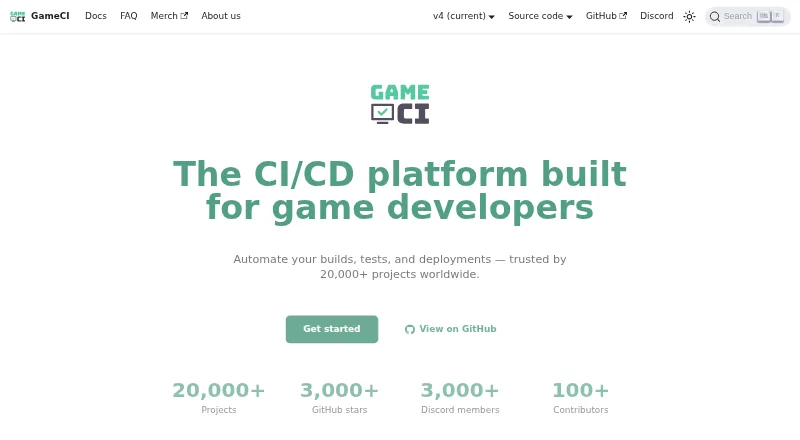
GameCI provides free, open-source tools for automating game project builds, tests, and deployments. Unity is its primary maintained engine package, supported by official containers, GitHub Actions, licensing flows, build targets, and documentation. Its CLI detects Unreal Engine and Godot projects and includes build commands for both; a plugin API can connect additional engines. Officially supported CI/CD platforms are GitHub Actions, GitLab CI, and CircleCI. Listed build targets include iOS, Android, Windows, macOS, Linux, and WebGL. For Unity, the Test Runner supports All, PlayMode, EditMode, and Standalone modes. Results can appear as GitHub status checks when workflows have write permissions and a GitHub token, or be uploaded as artifacts. GameCI says it does not acquire or store Unity credentials supplied for activation during build and test steps. Users can self-host on physical or virtual machines, but handle operating-system configuration and lifecycle management. The project is maintained by volunteers and offers best-effort community support, not premium support. Third-party CI build minutes may cost extra.
Who it suits
It suits game teams automating builds and tests, particularly those using Unity and one of GameCI's officially supported CI services. Teams can also self-host, provided they are prepared to manage the machines and their operating systems.
What it does well
- Free, open-source software under the MIT license.
- Unity package includes official containers and documentation.
- CLI includes build commands for Godot and Unreal Engine.
- Supports six listed build targets.
- Unity test results can be uploaded as artifacts.
What to know first
- CI provider build minutes may cost extra.
- Premium support is not offered.
- Self-hosting requires users to manage system configuration and lifecycle.
- Some other Docker-based CI services may be unofficial.
Limits
The GameCI software is free, but CI provider build minutes may cost extra. Self-hosting requires users to manage operating-system configuration and machine lifecycle.
Plans
| Plan | Billed and limits | Price |
|---|---|---|
| GameCI | GameCI says its software is free and open source; CI provider build minutes may cost extra. · Third-party CI charges may apply · use your own machines to build and test | Free |
As game.ci lists them, read 29 Sept 2026. The maker's own page has the final word.
Getting started
- Visit https://game.ci/ to review the project and documentation.
- Choose GitHub Actions, GitLab CI, or CircleCI for an officially supported workflow.
- Use the Unity package and its documented containers, licensing flows, and build targets, or use the CLI for Unreal Engine or Godot.
- Select a listed build target and configure the workflow for the project.
- For self-hosting, use a physical machine, virtual machine, or Orchestrator and manage its system configuration and lifecycle.
Overview
GameCI is an open-source toolkit for automating game builds and tests in CI pipelines, with its deepest maintained support aimed at Unity projects. It is a strong fit for developers who want game-specific workflows in GitHub Actions, GitLab CI, or CircleCI; teams needing paid support or a managed build service should look elsewhere.
The MIT-licensed software is free, but CI-provider build minutes can add cost. GameCI is maintained by volunteers and offers best-effort community support, so teams should be comfortable owning their pipeline and troubleshooting.
For more options, see our Game Build Automation Software guide.
Key features
Unity build and test workflows
Unity is the primary maintained engine package, with official containers, GitHub Actions, licensing flows, build targets, and documentation. Targets cover iOS, Android, Windows, macOS, Linux, and WebGL, making the tooling relevant across desktop, mobile, and browser game releases. The Unity Test Runner supports All, PlayMode, EditMode, and Standalone modes, giving teams several ways to integrate tests into builds.
Test results can be uploaded as artifacts, or surfaced as GitHub status checks when the workflow has a GitHub token and write permissions. The latter is useful for teams that want test outcomes visible in pull requests, but it depends on configuring those credentials and permissions. GameCI says it does not acquire or store Unity email, password, or license contents supplied for activation during build and test steps.
Other engines and CI systems
The CLI detects engines and includes build commands for Godot and Unreal Engine; its plugin API can integrate additional engines. That broadens its reach beyond Unity, though Unity remains the main maintained package. GitHub Actions, GitLab CI, and CircleCI are officially supported. Other Docker-capable CI services may work, but relying on them means accepting a less formal support path.
Self-hosted runners
Teams can use bare-metal machines, virtual machines, or Orchestrator for self-hosting. This can make sense when a team wants to build on its own machines, but GameCI leaves operating-system configuration and lifecycle management to the user. Its self-hosting guidance targets on-premises machines without public IP addresses and advises a separate security review before production or public use.
Pricing
GameCI costs nothing, and the software is free and open source under MIT. There is no free-trial distinction because the free plan is the product’s stated pricing model. The practical cost is infrastructure: CI-provider build minutes may be billed separately, while self-hosting means supplying and operating your own machines.
There are no published seat or build-minute allowances for GameCI itself. It is therefore a good fit for teams that want game-focused automation without a software subscription, but not a promise of cost-free builds. Free best-effort community support is included; premium support is not offered.
Platforms
GameCI supports GitHub Actions, GitLab CI, and CircleCI, and can also be used with Docker-capable CI services that may not be officially supported. Its build targets are iOS, Android, Windows, macOS, Linux, and WebGL. The platform listings also include API, web, and self-hosted use, reflecting its role as pipeline tooling rather than a standalone game editor.
Who it's for
GameCI suits Unity developers who want repeatable builds and tests inside an established CI workflow, particularly teams comfortable managing credentials, permissions, and runner infrastructure. Godot and Unreal Engine users can use the CLI build commands, but should weigh that against Unity being the primary maintained package. It is less suitable for organizations that need guaranteed response times, premium support, or someone else to own the build environment.
Pros and cons
- Pro: Free, MIT-licensed software keeps the tool itself out of the subscription budget.
- Pro: Unity build targets span mobile, desktop, and WebGL, while the Test Runner covers four modes.
- Pro: CLI support for Godot and Unreal Engine provides a route beyond the primary Unity workflow.
- Con: CI-provider minutes and third-party charges may still apply, so free software does not guarantee free builds.
- Con: Volunteer maintenance and best-effort community support may not meet teams that require premium assistance.
- Con: Self-hosting transfers OS configuration, lifecycle management, and security review to the user.
Alternatives
Codemagic is worth comparing for teams that prefer a free CI tier with explicit allowances: its Free plan includes one team member, 500 build minutes refilled monthly, one parallel build, and 30 days of history and artifact storage. Bitrise offers a free Hobby plan for a team of one with build credits aimed at a small project a few times per month, plus community support; its free trial may help teams evaluate its paid offering.
Bitbucket Pipelines may suit teams whose needs fit its Free plan of up to five users and 50 build minutes per month. AppVeyor offers an Open-source plan with unlimited public projects, one concurrent job, and five self-hosted jobs, which is a more specific fit for public-project workloads.
Semaphore is another freemium CI option, and its company says it can be self-hosted under Apache 2.0. Argo Workflows is a free, open-source workflow engine for Kubernetes, a relevant alternative when Kubernetes workflow orchestration is the priority. GitHub Codespaces is a freemium development environment with 2-core compute priced at $0.18 a month and 4-core compute at 0.36 USD; it is a different option for teams seeking hosted development environments rather than game-specific build automation. Buddy is another freemium CI/CD option.
Verdict
Choose GameCI if you want free, game-focused automation—especially for Unity—and are prepared to supply or manage the CI runners yourself. Its breadth of Unity targets and test modes is the central reason to choose it; its volunteer, best-effort support model and possible infrastructure charges are the clearest reasons to look elsewhere.
Verdict
GameCI brings game build and test automation to supported CI workflows, with Unity as its main maintained engine package and CLI support for Godot and Unreal Engine. Account for possible third-party CI charges and the volunteer project's best-effort support model.
Questions
How much does GameCI cost?
GameCI is free and open source under the MIT license. CI provider build minutes may cost extra.
Which game engines does it support?
Unity is the primary maintained engine package. The CLI has engine detection and build commands for Unreal Engine and Godot, and a plugin API can connect additional engines.
Which CI platforms are officially supported?
GameCI lists GitHub Actions, GitLab CI, and CircleCI as officially supported. Other Docker-capable services may work.
Which platforms can projects target?
Listed targets are iOS, Android, Windows, macOS, Linux, and WebGL.
Can test results be reported in GitHub?
Results can appear as GitHub status checks when the workflow has write permissions and a GitHub token. They can also be uploaded as artifacts.
Can teams self-host GameCI?
Yes. The self-hosting guide describes physical machines, virtual machines, and Orchestrator. Users are responsible for operating-system configuration and lifecycle management.
Facts from GameCI's own pages
- Build targets
- The homepage lists iOS, Android, Windows, macOS, Linux, and WebGL build targets. · game.ci, 29 Sept 2026
- CI integrations
- GameCI lists GitHub Actions, GitLab CI, and CircleCI as officially supported CI/CD platforms. · game.ci, 29 Sept 2026
- Credential handling
- GameCI says it does not acquire or store Unity email, password, or license contents supplied for activation during build and test steps. · game.ci, 29 Sept 2026
- License
- GameCI says its software is free, open source, and licensed under MIT. · game.ci, 29 Sept 2026
- Other engines
- The GameCI CLI has built-in engine detection and build commands for Unreal Engine and Godot, and its plugin API can integrate additional engines. · game.ci, 29 Sept 2026
- Purpose
- GameCI provides tools to automate building, testing, and deploying game projects. · game.ci, 29 Sept 2026
- Self-hosting
- The self-hosting guide describes using bare-metal machines, virtual machines, or Orchestrator, and says users take responsibility for operating-system configuration and lifecycle management. · game.ci, 29 Sept 2026
- Self-hosting security
- The self-hosting guide says its examples target on-premises machines without public IP addresses and advises users to conduct their own security review before production or public use. · game.ci, 29 Sept 2026
- Support
- GameCI offers free best-effort community support and says it does not offer premium support. · game.ci, 29 Sept 2026
- Team
- GameCI says it is maintained entirely by volunteers. · game.ci, 29 Sept 2026
- Testing
- The Unity Test Runner supports All, PlayMode, EditMode, and Standalone test modes. · game.ci, 29 Sept 2026
- Test reporting
- Test results can appear as GitHub status checks when the workflow has write permissions and a GitHub token; results can also be uploaded as artifacts. · game.ci, 29 Sept 2026
- Unity
- Unity is GameCI’s primary maintained engine package, with official containers, GitHub Actions, licensing flows, build targets, and documentation. · game.ci, 29 Sept 2026
- Unofficial CI support
- The FAQ says other CI services that support Docker may work, but may not be officially supported. · game.ci, 29 Sept 2026
Where GameCI stands on Freedom251
- Game Build Automation Software#20 of 43