Freedom251 › Source Code Management

Forgejo Actions
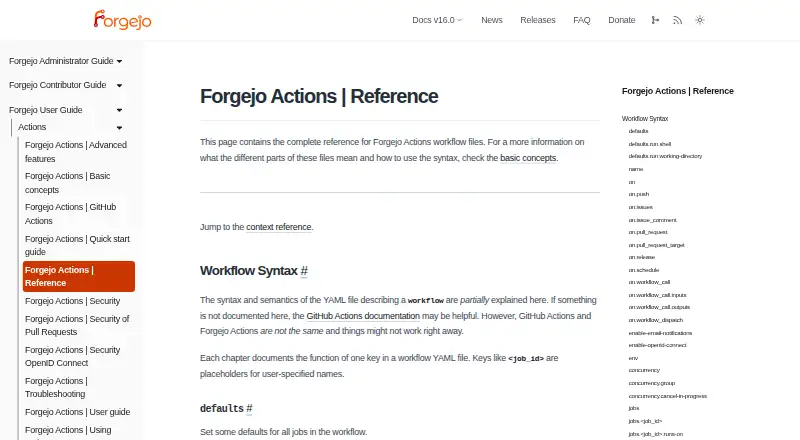
What Forgejo Actions is
Forgejo Actions provides continuous integration through workflow files kept in a repository’s `.forgejo/workflows` directory. Workflows can respond to pushes, issues, pull requests, releases, schedules, and manual dispatches. One workflow can call another, while reusable actions provide procedures for CI workflows. Forgejo does not execute jobs itself: a separately installed and configured Forgejo Runner fetches and runs them. Administrators can connect multiple runners to distribute jobs across available compute resources.
Repository, user, and organization secrets are encrypted in the Forgejo database and supplied to workflows. Each workflow also receives a unique token, limited to its repository and destroyed when the workflow ends. The system aims to feel familiar to GitHub Actions users, but does not promise full compatibility, so workflows may need changes. Actions is enabled by default as of Forgejo v1.21, though an instance administrator can disable it. It is open source and costs nothing; using it requires a Forgejo instance and a separately installed and configured runner.
Who it suits
Forgejo Actions suits teams using a Forgejo instance that want repository-based CI workflows. It is intended for people who host their own projects and control their development platform.
What it does well
- Supports push, issue, pull request, and scheduled triggers
- Workflows can call other workflows
- Encrypted repository, user, and organization secrets
- Multiple runners can distribute jobs
What to know first
- Requires a separately installed and configured runner
- Workflows may need changes for compatibility
- Instance administrators can disable Actions
Limits
The free plan requires a Forgejo instance and a separately installed, configured runner. Job logs default to 365-day retention, with configurable log expiration, and artifacts default to 90 days; an administrator can also disable Actions.
Plans
| Plan | Billed and limits | Price |
|---|---|---|
| Forgejo Actions | Requires a Forgejo instance and a separately installed and configured runner | Free |
As forgejo.org lists them, read 11 Oct 2026. The maker's own page has the final word.
Getting started
- Open the Forgejo Actions documentation website
- Run or obtain a Forgejo instance
- Create workflow YAML files in the repository’s `.forgejo/workflows` directory
- Install and configure one or more Forgejo Runners
- Connect runners to the Forgejo instance
- Configure triggers, actions, and secrets
Verdict
Forgejo Actions offers CI workflows with configurable triggers, secrets, and runner choice. It is free, but requires a Forgejo instance and a separately configured runner; GitHub Actions compatibility is not guaranteed.
Questions
What does Forgejo Actions cost?
The Forgejo Actions plan is free and is open source.
Is Forgejo Actions hosted?
No hosted option is listed. It runs with a Forgejo instance and separately configured Forgejo Runners.
Which platforms are supported?
The listed platforms are API, Linux, self-hosted, and web.
Can it run GitHub Actions workflows unchanged?
It is designed to feel familiar to GitHub Actions users, but full compatibility is not promised and workflows may need changes.
How are workflow secrets handled?
Repository, user, and organization secrets are stored encrypted in the Forgejo database and supplied to workflows.
What happens to the workflow token?
Each workflow receives a unique token limited to its repository, and that token is destroyed when the workflow finishes.
Facts from Forgejo Actions's own pages
- Automatic token
- Each workflow receives a unique token that is destroyed when the workflow finishes and is limited to interactions with its repository. · forgejo.org, 11 Oct 2026
- Execution
- Forgejo does not run workflow jobs; a separately installed and configured Forgejo Runner fetches and executes them. · forgejo.org, 11 Oct 2026
- Feature availability
- Actions is enabled by default as of Forgejo v1.21, but an instance administrator can disable it. · forgejo.org, 11 Oct 2026
- Founded
- 2022 · forgejo.org, 28 Sept 2026
- GitHub Actions
- Forgejo Actions is designed to feel familiar to GitHub Actions users, but it does not claim full compatibility and workflows may need changes. · forgejo.org, 11 Oct 2026
- Headquarters
- Berlin, Germany · forgejo.org, 28 Sept 2026
- Integrations
- Actions can use actions hosted on Forgejo, including actions served from a configurable default actions URL. · forgejo.org, 11 Oct 2026
- Intended users
- Forgejo describes itself as a self-hosted lightweight software forge for people who want to host their own projects and control their development platform. · forgejo.org, 11 Oct 2026
- Purpose
- Forgejo Actions provides continuous integration driven by workflow files in a repository’s `.forgejo/workflows` directory. · forgejo.org, 11 Oct 2026
- Reusable workflows
- A workflow can call another workflow, and actions are reusable procedures used in CI workflows. · forgejo.org, 11 Oct 2026
- Runner choice
- Administrators can connect multiple runners to one Forgejo instance to distribute jobs across available compute resources. · forgejo.org, 11 Oct 2026
- Runner security
- Container runners provide isolation, but misconfiguration can allow escape; host runners have no real isolation. · forgejo.org, 11 Oct 2026
- Secrets
- Repository, user, and organization secrets are stored encrypted in the Forgejo database and made available to workflows. · forgejo.org, 11 Oct 2026
- Storage limits
- Job logs expire after a configurable delay that defaults to 365 days, and artifacts default to 90 days. · forgejo.org, 11 Oct 2026
- Triggers
- Workflows can be triggered by events including pushes, issues, pull requests, releases, schedules, and manual dispatches. · forgejo.org, 11 Oct 2026
Where Forgejo Actions stands on Freedom251
- Source Code Management#6 of 30
- Repository Management Software#6 of 22
- Game Version Control Software#8 of 28
- Git Platforms#6 of 21
- Continuous Integration Software#17 of 58
- Game Build Automation Software#19 of 43