Freedom251 › Continuous Delivery Software
GoCD
What GoCD is
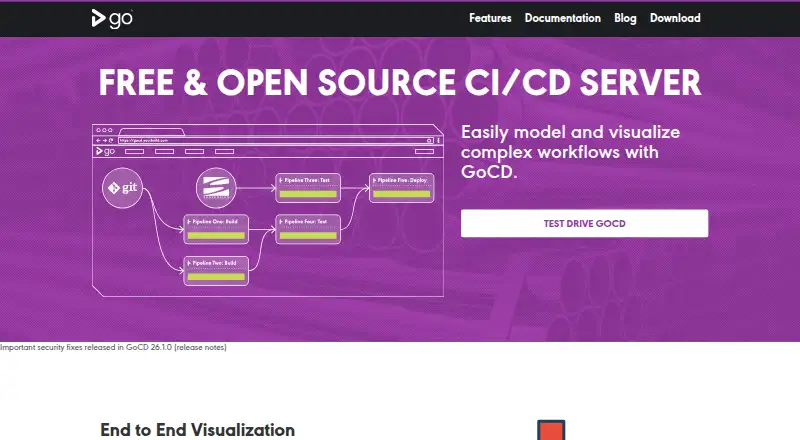
GoCD is an open-source continuous delivery and release automation server for managing software delivery from code changes through deployment. Its value stream map follows changes to production, links upstream causes with downstream effects, and helps users inspect jobs and find inefficiencies. Pipelines can coordinate dependencies and parallel work, and teams can promote a single built binary between stages. Its agent grid supports parallel testing across platforms, with reports showing the changeset and platform where a failure began. GoCD supports workflows for Kubernetes, Docker, AWS, and other cloud environments; Kubernetes users can use a Helm chart or official Docker images and dynamically scale agents. Plugins connect external services, with catalog options for Docker Registry, S3 artifacts, Kubernetes agents, and secrets managers. GoCD is self-hosted, free, sponsored by Thoughtworks, and licensed under Apache License 2.0. A new installation has no required authentication, so security settings need attention; some community plugins may be unmaintained. GoCD 26.1.0 requires Java 21 or later.
Who it suits
GoCD suits teams managing delivery pipelines that need dependency management, parallel work, artifact promotion, or deployment workflows across cloud environments. It is aimed at teams able to host the server and configure security and plugins.
What it does well
- Free and licensed under Apache License 2.0
- Value stream map follows changes toward production
- Supports parallel pipeline execution and dependency management
- Offers Kubernetes, Docker, and AWS workflows
- Agent grid supports cross-platform parallel testing
What to know first
- Self-hosted deployment requires users to host the server
- New installations do not require authentication
- Some community plugins may be unmaintained
- GoCD 26.1.0 requires Java 21 or later
Plans
| Plan | Billed and limits | Price |
|---|---|---|
| GoCD | Open-source continuous delivery server · Downloadable for free | Free |
As gocd.org lists them, read 4 Oct 2026. The maker's own page has the final word.
Getting started
- Visit the GoCD website.
- Choose a listed download or deployment route, such as a platform package, Docker, or Kubernetes/Helm.
- For GoCD 26.1.0, use at least Java 21.
- Configure authentication, since a new installation does not require it.
- Set user or role restrictions after security is configured.
Overview
GoCD is an open-source continuous delivery server that teams install and operate themselves. It is a strong fit for organizations managing multi-stage releases that need to trace changes and control artifact promotion; teams should be ready to configure security and maintain their integrations.
Key features
GoCD models complex pipelines with dependencies and parallel execution. Its value stream map follows a change from commit to deployment, showing upstream causes and downstream effects while helping teams navigate jobs and spot inefficiencies. That visibility is useful when a release has many moving parts, though it does not remove the work of designing and maintaining the pipeline.
Change tracking lets teams compare files and commit messages across builds. GoCD can pass a once-built binary through pipeline stages, helping ensure that the artifact verified in testing is the one deployed. Manual triggers can deploy a known-good version to a chosen environment, with deployment described as securable and auditable. These controls suit teams that want deliberate release decisions rather than an automatic handoff.
The agent grid supports parallel testing across platforms, and test reporting identifies the changeset and platform where a failure began. GoCD supports workflows for Kubernetes, Docker, AWS, and other cloud environments; Kubernetes installations can use its Helm chart and official Docker images, with agents that scale dynamically. Pipeline-as-code and approval gates are supported.
Plugins connect GoCD to external tools and services, and teams can build custom integrations through its plugin API. The catalog includes options for Docker Registry, S3 artifacts, Kubernetes agents, and secrets managers. Some community plugins may be unmaintained, so teams that depend on one should assess its upkeep before making it central to a release process.
Pricing
GoCD is free and open source under the Apache License, Version 2.0. The GoCD plan costs nothing and is downloadable at no charge. There is no free trial because the software is free to use. The trade-off is operational responsibility: GoCD is self-hosted, so teams manage its environment, security configuration, and plugin choices.
Platforms
GoCD is self-hosted and offers downloads for Windows, macOS, Debian/APT, RPM/YUM/DNF, and ZIP, as well as Docker and Kubernetes/Helm options. Java 21 is the minimum supported version for GoCD 26.1.0. Its platform coverage makes it adaptable to varied infrastructure, but teams need to account for the Java requirement and their own deployment setup.
Who it's for
GoCD suits teams that need visibility across complex delivery pipelines, want to promote verified artifacts between stages, or require explicit deployment controls. It is less suitable for teams seeking a managed service or those unwilling to configure access and take responsibility for plugin maintenance. A new installation does not require authentication; documented options include password-file and LDAP/Active Directory, with other methods available through plugins. Access can be restricted to users or roles after security is configured.
Pros and cons
- Pros: A value stream map and change comparisons help connect commits, builds, and deployments.
- Pros: Artifact promotion, approval gates, and manual deployment triggers support controlled releases.
- Pros: Parallel, cross-platform test execution and Kubernetes deployment options cover varied delivery workflows.
- Cons: Authentication is not required by default, so teams must configure security before relying on role-based restrictions.
- Cons: Community plugins may be unmaintained, creating upkeep risks for integrations that a pipeline depends on.
- Cons: Self-hosting and the Java 21 minimum for version 26.1.0 add infrastructure and runtime requirements.
Alternatives
For mobile build workflows with explicit monthly limits, consider Codemagic: its free plan includes one team member, 500 build minutes refilled monthly, one parallel build, and 30 days of build history and artifact storage. Appcircle is another option when a capped mobile build plan fits, with one concurrent build, a 30-minute maximum per build, and 20 builds per month on its free Starter plan.
Bitrise offers a free Hobby plan for a one-person team with build credits for a small project a few times per month and community support. Choose Argo CD for declarative GitOps delivery for Kubernetes with a self-managed installation, or Argo Rollouts for a self-hosted Kubernetes controller and CRDs. CDS (Continuous Delivery Service) is another free, open-source self-hosted platform. Flux CD is a free open-source Kubernetes delivery project that requires a Kubernetes cluster. KintoHub may suit teams preferring a free hosted-services allowance: its free plan includes three services with 256 MB each, up to 1 GB persistent data, and up to three shared vCPU.
Browse more options in Continuous Delivery Software or Game Build Automation Software.
Verdict
Choose GoCD if your team wants a free, self-hosted delivery server with pipeline visibility, artifact traceability, and controlled deployments. Its main advantage is the connection between a change, the tested artifact, and its path to production; look elsewhere if you need a managed service or do not want to own security setup and plugin upkeep.
Verdict
GoCD combines pipeline modeling, change traceability, artifact promotion, and deployment controls in a self-hosted server. Account for initial security configuration, Java requirements, and the maintenance status of community plugins.
Questions
How much does GoCD cost?
The GoCD plan is free to download, priced at $0.
Which platforms and installation options are available?
Downloads include Windows, macOS, Debian/APT, RPM/YUM/DNF, ZIP, Docker, and Kubernetes/Helm options. The listed platforms also include Linux, self-hosted, web, and API.
Is GoCD open source?
Yes. GoCD is licensed under the Apache License, Version 2.0.
Who sponsors GoCD?
GoCD is sponsored by Thoughtworks.
Does GoCD include integrations?
It uses plugins to connect external tools and services and has a plugin API for custom integrations. Catalog examples include Docker Registry, S3 artifacts, Kubernetes agents, and secrets managers.
Does a new GoCD installation require authentication?
No. A new installation does not require authentication. Documented options include password-file and LDAP/Active Directory, with other methods available through plugins.
Facts from GoCD's own pages
- Access control
- After security is configured, GoCD supports restricting operations to specific users or roles. · docs.gocd.org, 3 Oct 2026
- Artifact promotion
- GoCD can pass once-built binaries between pipeline stages so teams can verify which tested binary is being deployed. · gocd.org, 4 Oct 2026
- Cloud deployments
- GoCD supports delivery workflows on Kubernetes, Docker, and AWS. · gocd.org, 3 Oct 2026
- Cloud support
- The official site describes workflows for Kubernetes, Docker, AWS, and other cloud environments. · gocd.org, 4 Oct 2026
- Deployment controls
- Manual triggers let users deploy a known-good version to a chosen environment, with deployment described as securable and auditable. · gocd.org, 4 Oct 2026
- Download platforms
- The download page lists Windows, macOS, Debian/APT, RPM/YUM/DNF, ZIP, Docker, and Kubernetes/Helm options. · gocd.org, 4 Oct 2026
- Downloads
- The download page lists Windows, macOS, Debian/APT, RPM/YUM/DNF, and ZIP packages, plus Docker and Kubernetes/Helm options. · gocd.org, 3 Oct 2026
- Founded
- 2007 · gocd.org, 28 Sept 2026
- Integrations
- GoCD has a plugin architecture and its plugin catalog includes integrations for Docker, AWS S3, Kubernetes, LDAP/AD, GitHub, Slack, and other tools. · gocd.org, 4 Oct 2026
- Java requirement
- GoCD 26.1.0 makes Java 21 the minimum supported version. · gocd.org, 4 Oct 2026
- Kubernetes
- GoCD can run on Kubernetes using its Helm chart and official Docker images, and can dynamically scale Kubernetes agents. · gocd.org, 3 Oct 2026
- License
- GoCD is licensed under the Apache License, Version 2.0. · gocd.org, 4 Oct 2026
- License and sponsor
- GoCD is sponsored by Thoughtworks and distributed under the Apache License, Version 2.0. · gocd.org, 3 Oct 2026
- Maker history
- Thoughtworks says it was founded in Chicago in 1993. · thoughtworks.com, 3 Oct 2026
- Plugin ecosystem
- The plugin catalog includes options for Docker Registry, S3 artifacts, Kubernetes agents, and secrets managers; some plugins are community maintained and may be unmaintained. · gocd.org, 3 Oct 2026
- Plugin maintenance
- The plugin catalog says community-written plugins may be unmaintained and advises users to proceed carefully. · gocd.org, 4 Oct 2026
- Purpose
- GoCD is an open-source continuous delivery and release automation server. · gocd.org, 4 Oct 2026
- Security
- The 26.1.0 release notes describe fixes for API authorization bypasses and cross-site scripting, and recommend upgrading to that version. · gocd.org, 4 Oct 2026
- Support
- A GoCD project status post says commercial support ended in December 2020 and that there has been no commercial or enterprise support offering since January 2021. · gocd.org, 4 Oct 2026
- Testing
- Its agent grid supports parallel, cross-platform test execution, and test reporting identifies the changeset and platform where a test began failing. · gocd.org, 4 Oct 2026
- Traceability
- GoCD tracks changes from commit to deploy and lets users compare files and commit messages across builds. · gocd.org, 3 Oct 2026
- Value stream map
- Its Value Stream Map tracks a change from commit to deployment and shows upstream causes and downstream effects. · gocd.org, 4 Oct 2026
- Visualization
- Its value stream map shows the path to production and lets users navigate jobs and spot inefficiencies. · gocd.org, 3 Oct 2026
- Workflow modeling
- It supports parallel and sequential pipeline execution, dependency management, and fan-in/fan-out workflows. · gocd.org, 4 Oct 2026
Where GoCD stands on Freedom251
- Continuous Delivery Software#11 of 32
- Ci Cd Platforms#12 of 28
- Game Build Automation Software#21 of 43