Freedom251 › Application Deployment Software
KintoHub
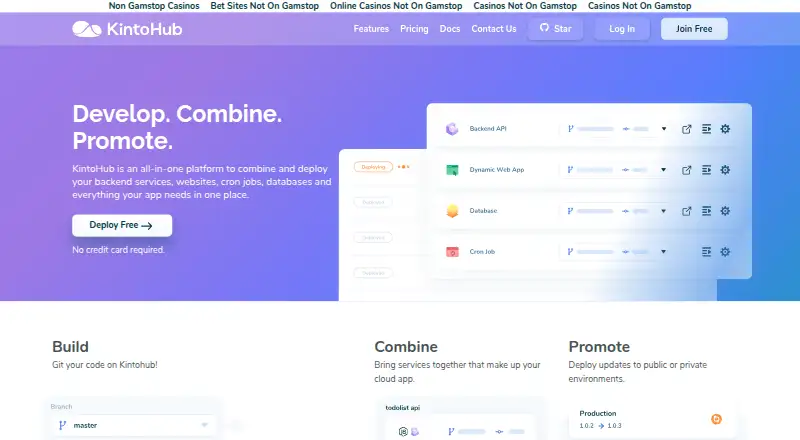
What KintoHub is
KintoHub is an open-source platform for building from Git repositories and deploying to Kubernetes. It supports websites, APIs, jobs, and databases. Its workflow turns source code into KintoBlocks, combines them into a project, then deploys the project so the app can be accessed through APIs. Users can deploy from public or private GitHub, Bitbucket, and GitLab repositories using a valid Git URL. CI/CD uses GitHub Workflows and a custom GitHub Action; deployment options include DockerHub images, Dockerfiles, Helm charts, multiple environments, and release rollbacks. Web app features listed in the documentation include custom domains, environment variables, metrics, autoscaling, and support for server-side rendering or always-running servers. The service catalog names MongoDB, MySQL, PostgreSQL, Minio, RabbitMQ, NATS, Redis, Elasticsearch, and InfluxDB. KintoHub advertises free Let’s Encrypt SSL for custom domains and password protection for websites. Its free plan includes three services with 256 MB each, up to 1 GB persistent data, and up to three shared vCPU, with no credit card required. Paid access is listed from $1/mo.
Who it suits
KintoHub suits developers who want to build from Git repositories and deploy websites, APIs, jobs, or databases to Kubernetes. The free plan may suit smaller deployments within its service, memory, storage, and shared-vCPU limits.
What it does well
- Deploys from GitHub, Bitbucket, and GitLab
- Supports Dockerfiles and Helm charts
- Includes release rollbacks and multiple environments
- Free plan requires no credit card
- Free plan includes up to three shared vCPU
What to know first
- Free plan limits each of three services to 256 MB
- Free plan includes up to 1 GB persistent data
- Self-hosting requires an external registry
Plans
| Plan | Billed and limits | Price |
|---|---|---|
| Free | 3 services with 256 MB each · up to 1 GB persistent data · up to 3 shared vCPU · no credit card required | Free |
| Pay-as-you-go | Accounts are billed monthly · $2 per gb month memory · dedicated vCPU starting at $1.5 USD /month · $0.28 per GB/month storage | On request |
As kintohub.com lists them, read 7 Oct 2026. The maker's own page has the final word.
KintoHub is an open-source platform for turning Git repositories into applications that run on Kubernetes. It is best suited to developers and small teams that already work with containers and Kubernetes, while its metered pricing is less suitable when a fixed monthly hosting bill is essential.
Overview
KintoHub's workflow converts source code into KintoBlocks, combines those blocks into a project, and deploys the result so applications can be reached through APIs. You can use public or private repositories from GitHub, Bitbucket, or GitLab by supplying a valid Git URL. The platform covers websites, APIs, scheduled jobs, and databases, making it broader than a single-purpose web host.
The approach rewards teams that want deployment to remain close to their repositories and Kubernetes environment. It is a weaker fit for users who want a conventional managed service with one all-inclusive price and no infrastructure decisions.
Key features
Build and deployment workflow
- Git-based CI/CD: KintoHub uses GitHub Workflows and a custom GitHub Action. This gives GitHub-centered teams a repository-driven automation path, although the documented automation layer is GitHub-specific even when source code is hosted elsewhere.
- Multiple deployment inputs: DockerHub images, Dockerfiles, and Helm charts are supported. Teams can also configure multiple environments and roll back releases, useful when the same project needs controlled staging and production changes.
- Application coverage: Websites, APIs, jobs, and databases can be deployed through the same project model, so a mixed application stack does not require separate deployment products.
Web and data services
- Web controls: Custom domains, environment variables, metrics, and autoscaling are available for web applications. The web documentation also covers server-side-rendered applications and services that must keep a server running.
- Service catalog: MongoDB, MySQL, PostgreSQL, Minio, RabbitMQ, NATS, Redis, Elasticsearch, and InfluxDB are listed as services. This gives teams common data and messaging building blocks alongside their application deployments.
- Security basics: Custom domains can use free Let's Encrypt SSL, and websites can be password protected. These are practical safeguards for public or restricted web deployments, but they do not replace a wider security program.
Support and self-hosting
The team says it usually responds within 24 hours and points users to Discord and GitHub for help and discussion. Self-hosting uses Helm on Kubernetes and requires Kubernetes 1.15 or newer, kubectl, and Helm 3.5 or newer. KintoHub's private Docker registry is not supported in this installation, so a self-hosted deployment must use an external registry.
Pricing
| Plan | Price and terms | What you get |
|---|---|---|
| Free | free | Three services, each with 256 MB; up to 1 GB persistent data; up to three shared vCPU; no credit card required. |
| Pay-as-you-go | Custom pricing; billed monthly | Memory at $2 per GB-month, dedicated vCPU starting at $1.5 USD/month, and storage at $0.28 per GB/month. |
The free plan is a sensible way to run a small proof of concept or low-resource project without entering payment details. Its three-service, 256 MB-per-service and 1 GB storage ceilings will constrain larger databases and production workloads. Pay-as-you-go removes those fixed free-tier caps but makes the monthly total depend on memory, compute, and storage consumption; the published pricing model is resource-based rather than a single predictable subscription. KintoHub is described as paid from $1/mo, while the usage rates above determine actual charges.
Platforms
KintoHub is offered through web, API, Linux, macOS, and Windows interfaces, with self-hosted deployment also supported.
Who it's for
Choose KintoHub if your team wants Git-driven builds, Kubernetes deployment, several environment options, and a built-in catalog of databases and messaging services. It is particularly practical for small projects that fit the free limits or for Kubernetes users prepared to manage resource-based billing. Look elsewhere if you need a self-hosted registry included, a non-Kubernetes deployment model, or a fixed bill that does not vary with consumption.
Pros and cons
Pros
- Broad workload support: One platform handles websites, APIs, jobs, and databases.
- Flexible deployment inputs: DockerHub images, Dockerfiles, and Helm charts accommodate different build practices.
- Useful web operations: Custom domains, SSL, metrics, autoscaling, environment variables, and rollback support cover common operational needs.
- Accessible starting point: The free plan needs no credit card and includes three small services.
Cons
- Free-tier ceilings are low: Three services, 256 MB per service, 1 GB persistent data, and three shared vCPU limit production-scale use.
- Variable costs: Pay-as-you-go billing depends on memory, CPU, and storage consumption.
- Self-hosting dependency: An external Docker registry is mandatory because KintoHub's private registry is unsupported.
- Kubernetes prerequisite: Self-hosting requires a compatible Kubernetes cluster plus kubectl and Helm.
Alternatives
If you are comparing broader device and endpoint management products rather than Kubernetes application deployment, consider FileWave, which offers a free Community Edition for up to 15 computers, 15 tablets, and 15 Chrome devices. Fleet is a freemium, open-source option whose free version is intended to remain free. ManageEngine Patch Manager Plus suits patch management, with a free edition for up to 20 workstations and five servers. Open Computer Orchestration offers a free tier for 20 managed devices. OPSI provides a community edition with unlimited devices and one worker process. Patch My PC has a free, non-commercial Home Updater for Windows desktops and servers. Pckgr RMM is priced from $10 per month for 10 devices. Pushlink offers a free tier for up to five installations.
For category-level comparisons, browse Application Deployment Software and Continuous Delivery Software.
Verdict
KintoHub is a strong choice for Kubernetes-oriented teams that want Git-based application delivery plus ready-made data services and a no-card free tier. Its main reasons to look elsewhere are the small free-plan resource envelope, usage-dependent paid bills, and the external registry requirement for self-hosting.
Verdict
KintoHub combines Git-based builds with Kubernetes deployment options and a catalog of data services. The free plan has defined service and resource limits, while self-hosting requires an external registry.
Facts from KintoHub's own pages
- Application types
- The platform supports deploying websites, APIs, jobs, and databases. · kintohub.com, 7 Oct 2026
- CI/CD
- KintoHub says its CI/CD functionality uses GitHub Workflows and a custom GitHub Action. · kintohub.com, 7 Oct 2026
- Deployment features
- The homepage says users can deploy DockerHub images, use Dockerfiles and Helm charts, configure multiple environments, and roll back releases. · kintohub.com, 7 Oct 2026
- Headquarters
- The contact page lists KintoHub headquarters at 9/F, 1 Des Voeux Road West, Sheung Wan, Hong Kong. · kintohub.com, 7 Oct 2026
- Repository integrations
- The docs say users can deploy from public or private GitHub, Bitbucket, and GitLab repositories using a valid Git URL. · kintohub.com, 7 Oct 2026
- Security
- The homepage advertises free Let’s Encrypt SSL for custom domains and password protection for websites. · kintohub.com, 7 Oct 2026
- Self-hosting
- The installation docs describe installing KintoHub with Helm on Kubernetes and list Kubernetes 1.15+, kubectl, and Helm v3.5+ as prerequisites. · kintohub.com, 7 Oct 2026
- Self-hosting limitation
- The installation docs say KintoHub does not support its private Docker registry and requires an external registry. · kintohub.com, 7 Oct 2026
- Service catalog
- The homepage lists MongoDB, MySQL, PostgreSQL, Minio, RabbitMQ, NATS, Redis, Elasticsearch, and InfluxDB in its catalog. · kintohub.com, 7 Oct 2026
- Support
- The contact page says the team usually responds within 24 hours and links to Discord and GitHub for help and discussions. · kintohub.com, 7 Oct 2026
- Web hosting
- The web app docs list custom domains, environment variables, metrics, autoscaling, and support for apps requiring server-side rendering or an always-running server. · kintohub.com, 7 Oct 2026
- What it does
- KintoHub describes itself as an open source build and deployment platform for building from Git repositories and deploying to Kubernetes. · kintohub.com, 7 Oct 2026
- Workflow
- Its documented workflow builds source code into KintoBlocks, combines them into a project, deploys the project, and makes the app accessible through APIs. · kintohub.com, 7 Oct 2026
Where KintoHub stands on Freedom251
- Application Deployment Software#10 of 44
- Continuous Delivery Software#13 of 32