Freedom251 › Game Engine Software

Ren'Py
by Ren'Py
What Ren'Py is
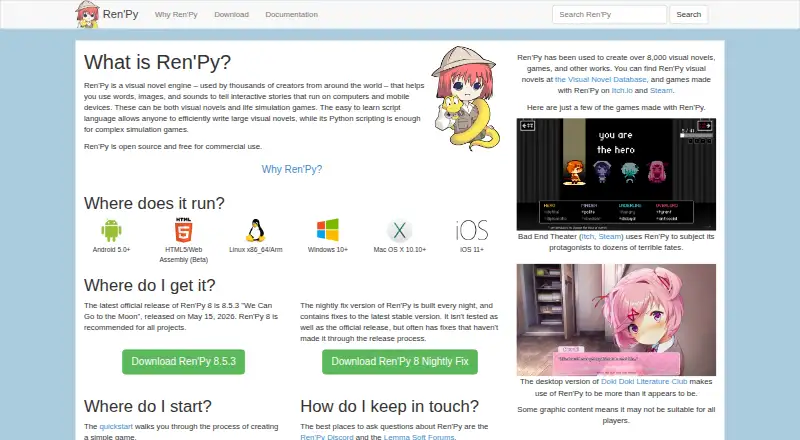
Ren'Py is a free, open-source engine for creating visual novels and life simulation games with words, images, and sounds. Its own scripting language supports visual-novel writing, while Python scripting can add complex game logic. Default games include menus, automatic saves, rollback, predictive image loading, and mouse, keyboard, or gamepad controls. Creators can customize interface screens and styles with the screen language and Python. The launcher can build games for Windows, Mac, and Linux from any of those desktop platforms. Ren'Py also supports Android and iOS, as well as WebAssembly browser packaging; web support is beta, and that port lacks networking and multithreading. Target platforms include Windows 10+, macOS 10.10+, Linux x86_64 or Arm, Android 5.0+, and iOS 11+. iOS builds require a Mac and Xcode, and iOS support is described as a work in progress. The software is free for commercial and non-commercial use. Most of Ren'Py is MIT-licensed, but some components are LGPL-licensed and distributors must follow those terms.
Who it suits
Ren'Py suits creators making visual novels or life simulation games who want scripting, interface customization, and desktop or mobile export. Web and iOS targets require attention to their stated limitations and requirements.
What it does well
- Free for commercial and non-commercial use.
- Python scripting supports complex game logic.
- Launcher builds desktop games from Windows, Mac, or Linux.
- Supports many languages, including Arabic and Japanese.
What to know first
- Web support is beta and lacks networking and multithreading.
- iOS builds require a Mac and Xcode.
- Some components require distributors to comply with LGPL terms.
- Mobile functionality may need modification.
Limits
The free plan is free for commercial and non-commercial use. The browser port is beta and does not support networking or multithreading; iOS support is a work in progress and requires a Mac and Xcode to build.
Plans
| Plan | Billed and limits | Price |
|---|---|---|
| Ren'Py | commercial and non-commercial use · downloadable SDK · no per-game distribution fee | Free |
As renpy.org lists them, read 14 Oct 2026. The maker's own page has the final word.
Getting started
- Visit the Ren’Py website.
- Download and use Ren’Py for free.
- Use the launcher on Windows, Mac, or Linux to build desktop games.
- Use the Visual Studio Code integration with its Ren’Py Language extension if desired.
- Choose Android, iOS, or beta WebAssembly as a target, observing the requirements for that platform.
Overview
Ren'Py is a free, open-source engine for making visual novels and life-simulation games with words, images and sound. It suits writers and developers building story-led games who want a dedicated narrative scripting language with Python available for more complex logic. Its built-in story-game tools and desktop publishing support make it a strong starting point, but mobile and browser releases involve meaningful constraints.
Key features
Ren'Py's own script language is designed for visual novels, while Python scripting supports more involved game logic. That pairing gives narrative creators a focused way to write interactive stories without closing off deeper customization for programmers. It is a less natural choice for anyone who wants a strictly no-code authoring workflow.
Default games include menus, automatic saves, rollback, predictive image loading, and mouse, keyboard, or gamepad controls. These cover common story-game needs without requiring creators to build them themselves. Creators can also customize interface screens and styles through screen language and Python, a useful degree of control for distinct presentations that assumes comfort working with code.
Ren'Py supports many languages, including Arabic, Brazilian Portuguese, Japanese, and Spanish. Languages that do not require ligatures can also be supported with suitable fonts, which gives localization some breadth while leaving typography requirements relevant for other languages.
The launcher builds games for Windows, Mac, and Linux from any of those three desktop platforms. It also supports Visual Studio Code through a Ren'Py Language extension, a practical fit for creators who want an editor integration alongside the launcher.
Pricing
Ren'Py is free to download and use for commercial and non-commercial purposes. There is no trial to outgrow or paid tier to budget for, making it accessible to hobbyists and commercial creators alike. The trade-off is not a subscription cap but license obligations: most of the engine is MIT-licensed, while some components are LGPL-licensed and distributors must meet the LGPL terms when distributing games.
Ren'Py: free. The plan covers use for commercial and non-commercial projects; distribution still requires attention to the LGPL terms for the applicable components.
Platforms
Ren'Py targets Windows 10+, macOS 10.10+, Linux x86_64/Arm, Android 5.0+, iOS 11+, and HTML5/WebAssembly browsers. The desktop launcher can build for Windows, Mac, and Linux from any of those desktop systems, so desktop creators do not need a separate operating system for each of those builds.
Android support starts at version 5.0, though some functionality may need modification for mobile devices. iOS is a more qualified target: building an app requires a Mac and Xcode, and Ren'Py describes iOS support as a work in progress. Browser packaging is also beta, and the web port does not support networking or multithreading. These are important constraints for projects that depend on those platforms or capabilities.
Who it's for
Ren'Py is best suited to writers, indie developers, and small teams making visual novels or life-simulation games who value story-specific tools, built-in interaction basics, and freedom to distribute commercial work. Python and interface customization give programmers room to shape more complex behavior and presentation. Creators who need a no-code workflow, dependable iOS production, or a web build requiring networking or multithreading should look elsewhere.
Questions can be directed to Ren'Py's Discord and Lemma Soft Forums, while bug reports go to GitHub. One security caveat matters for teams and players alike: games can perform harmful actions, and loading untrusted save or persistent files can run arbitrary code.
Pros and cons
- Purpose-built story scripting plus Python: writers get a dedicated visual-novel language, with code available when game logic needs to go further.
- Useful defaults: menus, saves, rollback, image loading, and common input controls reduce the need to implement basic story-game behavior from scratch.
- Free commercial use: creators can publish commercial and non-commercial games without a software charge, subject to LGPL obligations for some components.
- Desktop builds from any supported desktop platform: the launcher handles Windows, Mac, and Linux output from Windows, Mac, or Linux.
- Mobile and web caveats: mobile functionality may need changes, iOS needs a Mac and Xcode and remains a work in progress, and beta web builds lack networking and multithreading.
- Not a no-code tool: deeper logic and interface customization rely on Python or screen language.
Alternatives
ChatMapper is worth considering when a project is centered on branching narrative design and a capped free tier is acceptable: its free plan allows one editor, three projects, and 300 nodes per project, with core exports and commercial use permitted.
Godot Asset Library is the more relevant choice when the need is a free source of game assets rather than a story-engine workflow; all assets are free, and paid assets cannot be uploaded to the official library.
ink and Inky is another free, MIT-licensed option for creators focused on interactive narrative writing, including those seeking an ink-Unity integration plugin.
Narrat suits creators who want a free, open-source option with no restrictions on personal or commercial use; enterprise support and consulting is offered at custom pricing.
Quest Viva is a free, MIT-licensed alternative for creators who want to make and sell games, modify source code, or use it in closed-source commercial applications.
Yarn Spinner is a fit for teams working across Unity, Godot, or Unreal that want integrations for those engines and a VS Code extension in a free, open-source offering.
articy:draft X may suit users who prefer a freemium narrative-design tool with a free tier limited to 700 objects per project and unlimited projects; it also offers a free trial for its paid option.
Narratyr is another freemium alternative for creators comparing free visual-editor options.
Browse more options in Game Narrative Design Software, Game Engine Software, and Game Development Software.
Verdict
Choose Ren'Py if you are making a visual novel or life-simulation game and want a free engine with narrative-focused scripting, Python extensibility, and built-in story-game essentials. Its main advantage is that it combines a focused writing workflow with room for custom logic and commercial distribution. Look elsewhere if your project depends on polished iOS support, web networking or multithreading, or a no-code workflow.
Verdict
Ren'Py offers a free engine with its own story-focused scripting and Python support, plus broad desktop and mobile targets. Check the beta web status and iOS requirements if those are key platforms.
Questions
How much does Ren’Py cost?
The Ren’Py plan is free. It is free to download and use for commercial and non-commercial purposes.
Which platforms can projects target?
Targets include Windows 10+, macOS 10.10+, Linux x86_64 or Arm, Android 5.0+, iOS 11+, and beta HTML5/WebAssembly.
Is Ren’Py open source?
Yes. Most of Ren’Py is MIT-licensed, while some components use LGPL terms that distributors must satisfy.
Can it build mobile games?
It supports Android 5.0 and later, though some functionality may need modification for mobile. Building an iOS app requires a Mac and Xcode, and iOS support is a work in progress.
What languages and tools can creators use?
Ren’Py has its own scripting language and supports Python. Its launcher supports Visual Studio Code with a Ren’Py Language extension.
Facts from Ren'Py's own pages
- Animation
- Animation and Transformation Language supports moving, rotating, scaling, fading and changing image opacity over time. · renpy.org, 14 Oct 2026
- API
- The documented API includes functions such as renpy.fetch for HTTP or JSON requests. · nightly.renpy.org, 14 Oct 2026
- Asset formats
- Supported assets include JPEG, PNG, WEBP, BMP, GIF, OGG, OPUS, FLAC, WAV, MP3, WEBM, OGG Theora, MPEG and TrueType fonts. · renpy.org, 14 Oct 2026
- Author
- Wikipedia identifies Tom “PyTom” Rothamel as Ren'Py's author and developer. · en.wikipedia.org, 14 Oct 2026
- Browser support
- Ren'Py can package games for WebAssembly browsers, but web support is marked beta and the web port does not support networking or multithreading. · renpy.org, 7 Oct 2026
- Build dependencies
- The public repository says building modules requires Cython, C dependencies and SDL_image 2.6 or newer. · github.com, 14 Oct 2026
- Built-in features
- Default games include menus, automatic saves, rollback, predictive image loading, and mouse, keyboard, or gamepad controls. · renpy.org, 7 Oct 2026
- Commercial use
- The project states that Ren'Py can be used for commercial games without paying a fee to Ren'Py. · renpy.org, 14 Oct 2026
- Customization
- Creators can customize interface screens and styles using Ren'Py's screen language and Python. · renpy.org, 7 Oct 2026
- Custom statements
- Developers can register new script statements and screen-language statements through documented Ren'Py functions. · renpy.org, 14 Oct 2026
- Default game systems
- New projects include menus, saving, loading, automatic saves, rollback, skip and auto-forward controls, preferences and multiple input methods. · renpy.org, 14 Oct 2026
- Desktop publishing
- The launcher can build games for Windows, Mac, and Linux from any of those three desktop platforms. · renpy.org, 7 Oct 2026
- Developer repository
- The public GitHub repository says documentation is built from reStructuredText and generated from function docstrings. · github.com, 14 Oct 2026
- Documentation depth
- The documentation covers language basics, Python, screens, displayables, translation, launcher tools, automated testing, Android, iOS, web and API reference material. · renpy.org, 14 Oct 2026
- Editor integration
- The launcher supports Visual Studio Code and provides a Ren'Py Language extension for it. · renpy.org, 7 Oct 2026
- Founded
- 2004 · renpy.org, 19 Oct 2026
- Free plan
- Yes · renpy.org, 24 Sept 2026
- Graphics requirement
- Ren'Py requires functioning graphics acceleration and supports OpenGL, ANGLE or OpenGL ES renderers; the software renderer was removed. · renpy.org, 14 Oct 2026
- Independent compatibility listing
- NeonRoof lists Windows, macOS and Linux as operating systems, with exports to desktop, Android, iOS and web. · neonroof.com, 14 Oct 2026
- Independent license summary
- NeonRoof summarizes Ren'Py as MIT for most code with LGPL and other licenses for included components. · neonroof.com, 14 Oct 2026
- Independent requirements summary
- NeonRoof recommends a 64-bit desktop, 8 GB RAM and current graphics drivers. · neonroof.com, 14 Oct 2026
- iOS limitation
- Building iOS apps requires a Mac and Xcode, and Ren'Py describes its iOS support as a work in progress. · renpy.org, 7 Oct 2026
- Launcher
- The launcher creates, manages, edits and runs Ren'Py projects. · renpy.org, 14 Oct 2026
- License
- Most Ren'Py code is MIT licensed, while bundled components include LGPL and other licenses. · renpy.org, 14 Oct 2026
Where Ren'Py stands on Freedom251
- Game Engine Software#1 of 92
- Game Development Software#1 of 43
- Game Narrative Design Software#1 of 25