Freedom251 › Customer-to-Customer (C2C) Community Marketing Software

RefRef
What RefRef is
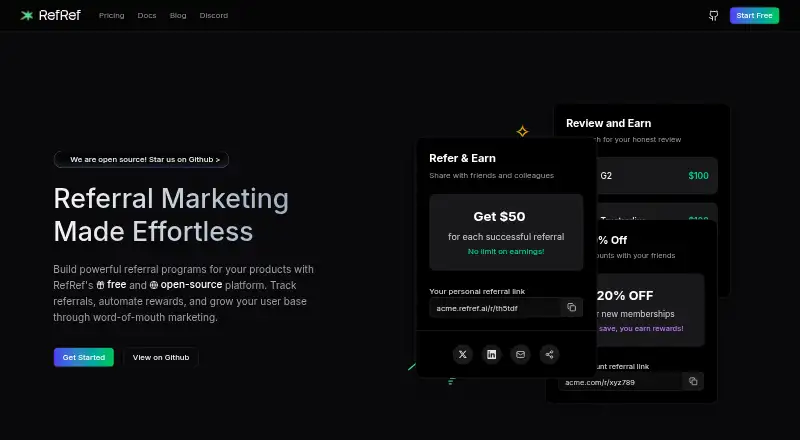
RefRef is an open-source platform for building referral programs, affiliate networks, and partner programs. It can be self-hosted on your infrastructure or used through managed cloud hosting. Referral credit can follow first-touch, last-touch, or multi-touch attribution, while reward rules can use fixed amounts, percentages, cash, credits, discounts, or other types. An embeddable widget lets participants access referral links, share them through social media or email, and track performance and rewards. Documented integrations include Stripe, Paddle, LemonSqueezy, Chargebee, PayPal, and Tango Card. RefRef also provides a REST API, webhook events, JWT authentication, organization-scoped data isolation, and configurable qualifying events and reward rules. Both Cloud and Open Source plans are free and include unlimited programs and participants; Cloud includes email support, while Open Source includes community support. The project is in alpha and may have bugs or breaking changes. Self-hosting requires specified server capacity and software, including PostgreSQL, Redis, Node.js, and Docker when containerized. The repository uses the AGPLv3 license.
Who it suits
RefRef may suit organizations in B2B SaaS, ecommerce, B2C subscriptions, financial services, or education that need referral or partner programs. Self-hosting requires the listed infrastructure and technical setup.
What it does well
- Free cloud and self-hosted plans
- Unlimited programs and participants
- First-, last-, and multi-touch attribution
- REST API and webhook events
- Supports multiple reward types
What to know first
- Project is still in alpha
- Self-hosting has specific server requirements
- Open Source plan support is community-based
Limits
Both free plans include unlimited programs and participants, reward automation, and affiliate management. Cloud provides email support, while the self-hosted Open Source plan provides community support.
Plans
| Plan | Billed and limits | Price |
|---|---|---|
| Cloud | Cloud-hosted · Unlimited Programs · Unlimited Participants · Reward automation · Affiliate management · Email Support | Free |
| Open Source | Self-hosted · Unlimited Programs · Unlimited Participants · Reward automation · Affiliate management · Community Support | Free |
| Enterprise | Cloud-hosted or Self-hosted · Managed infrastructure · We do the integration · Custom development · Custom branding · Priority chat and Zoom support | On request |
As refref.ai lists them, read 1 Oct 2026. The maker's own page has the final word.
Getting started
- Choose the Cloud plan for managed hosting or the Open Source plan for self-hosting
- For self-hosting, prepare 2 CPU cores, 4GB RAM, 20GB SSD, PostgreSQL 13 or newer, Redis, and Node.js 16 or newer
- Use Docker 20.10 or newer if deploying with containers
- Configure SSL/TLS behind a reverse proxy and follow the guide's security recommendations
- Set qualifying events and reward rules, then connect documented integrations as needed
- Embed the referral widget so participants can access and share referral links
RefRef is an open-source platform for running referral, affiliate, and partner programs. It is best suited to teams that need configurable attribution and rewards and can choose between managed hosting and operating the stack themselves. The range is strong, but alpha-stage software and self-hosting responsibilities make risk assessment essential.
Overview
RefRef combines referral tracking, affiliate management, program administration, and reward automation. Its embeddable participant widget displays referral links, supports sharing through social media or email, and shows referral performance and rewards. Link-based capture uses a referral-code cookie retained for 90 days, giving programs a clear attribution window.
Teams can select first-touch, last-touch, or multi-touch attribution, rather than being locked to one crediting policy. Reward rules cover fixed amounts, percentages, cash, credits, discounts, and other custom types. Documented use cases include B2B SaaS, ecommerce, B2C subscriptions, financial services, and education.
Key features
- Program logic: Custom qualifying events and reward rules allow referral conditions to reflect a business's own conversion steps instead of a single standard event.
- Integration layer: A REST API, webhook events, JWT authentication, and organization-scoped data isolation support connections to existing applications and separate organizational data appropriately.
- Commerce integrations: Documented integrations include Stripe, Paddle, LemonSqueezy, Chargebee, PayPal, and Tango Card, covering payment, subscription, and reward-delivery workflows.
- Participant experience: The widget gives referred participants one place to share links and monitor results, reducing the need to build those views from scratch.
- Controls and payouts: RefRef supports fraud controls and payout management, useful when a program must review activity and manage rewards rather than only count clicks.
- Deployment choice: Managed cloud hosting removes infrastructure operations; self-hosting provides control but requires the documented server stack and ongoing security work.
Pricing
RefRef uses a freemium model with two free plans. Cloud is cloud-hosted and includes unlimited programs, unlimited participants, reward automation, affiliate management, and email support. It fits teams wanting to start without infrastructure work, while email support is the stated service level.
Open Source is also free, with self-hosting, unlimited programs, unlimited participants, reward automation, affiliate management, and community support. It suits organizations with technical staff and a preference for controlling deployment; the trade-off is operating the environment and relying on community rather than email support.
Enterprise has custom pricing and can be cloud-hosted or self-hosted. It adds managed infrastructure, integration work by the provider, custom development, custom branding, and priority chat and Zoom support. This is the practical route for organizations that need implementation help or higher-touch support, but there is no published price to compare against the free tiers.
Platforms
RefRef is offered as a web application, API, and self-hosted deployment. The minimum self-hosting setup is 2 CPU cores, 4GB RAM, 20GB SSD, PostgreSQL 13 or newer, Redis, Node.js 16 or newer, and Docker 20.10 or newer when containerized. The self-hosting guidance calls for SSL/TLS behind a reverse proxy, network segmentation, strong database credentials, updates, backups, and consideration of a web application firewall. Those requirements favor teams able to maintain production infrastructure.
Who it's for
RefRef fits SaaS, ecommerce, subscription, financial-services, and education organizations that need more than basic referral links, especially when attribution policy or reward design varies by program. The Cloud plan is the straightforward starting point for teams that want hosted operations at no subscription cost. Open Source is better for organizations comfortable administering PostgreSQL, Redis, application updates, and security controls. Teams that cannot absorb alpha-stage change or infrastructure ownership should consider a more mature managed product.
Pros and cons
- Pro: First-touch, last-touch, and multi-touch attribution support different referral-credit policies.
- Pro: Multiple reward forms, custom rules, fraud controls, and payout management cover complex incentive programs.
- Pro: Both free cloud hosting and free self-hosting are available, with unlimited programs and participants on each plan.
- Con: The project is in alpha and may contain bugs or introduce breaking changes, which raises operational risk for critical revenue programs.
- Con: Self-hosting requires a specific application stack plus security, backup, and maintenance responsibilities.
- Con: Free-plan support is email on Cloud and community on Open Source; priority chat and Zoom are reserved for Enterprise.
Alternatives
For a broader directory of options, see Referral Management Software and Referral Marketing Software.
- Fieldified is a better fit when scheduling, invoicing, CRM, and reporting matter more than dedicated referral-program infrastructure; its free plan has usage limits and its Basic plan is $49 a month for five users.
- GrowSurf suits affiliate programs that prefer a success-fee model: its free plan charges 3% per success and allows up to 1,000,000 participants and five affiliate programs.
- ReferralHero is preferable for a tightly capped free start, with up to 25 subscribers and ReferralHero branding; its PRO plan is $199.00 USD.
- Mention Me is an alternative for organizations seeking AI-powered, multi-channel referral experiences and customer acquisition capabilities.
- Referral OS is another open-source, self-hosted option, but its free plan is capped at 100 tracked referrals and five programs.
- RQ is aimed at ICAEW member firms needing referral management and related fee-sharing workflows.
- Extole may suit current Extole customers or merchants below $10 million in revenue; its free plan is restricted to current customers.
- PartnerPortal.io fits teams wanting explicit partner, lead, resource, and team-member caps, starting free at five partners and 10 leads, with Professional at $249 a month.
Verdict
Choose RefRef if you need open-source flexibility, multiple attribution models, and configurable rewards with unlimited programs and participants on a free cloud or self-hosted plan. Look elsewhere if alpha-stage change, infrastructure maintenance, or community-level support is unacceptable for a production-critical referral operation.
Verdict
RefRef offers both hosted and self-hosted referral program options, with multiple attribution models and reward types. Its alpha status and infrastructure requirements are important considerations, particularly for self-hosting.
Questions
Does RefRef have a free plan?
Yes. Cloud and Open Source each cost nothing.
What is the difference between Cloud and Open Source?
Cloud is hosted by RefRef and includes email support. Open Source is self-hosted and includes community support.
What platforms does RefRef support?
RefRef is available on web and through an API, and it supports self-hosted deployment.
Is RefRef open source?
Yes. The repository is released under the AGPLv3 license.
Which integrations are documented?
Stripe, Paddle, LemonSqueezy, Chargebee, PayPal, and Tango Card.
What should I know about the project's maturity?
RefRef is in alpha and may have bugs and breaking changes.
Facts from RefRef's own pages
- Architecture
- RefRef provides a REST API, webhook events, JWT authentication, organization-scoped data isolation, and custom qualifying events and reward rules. · refref.ai, 1 Oct 2026
- Attribution
- The platform supports first-touch, last-touch, and multi-touch referral attribution models. · refref.ai, 1 Oct 2026
- Attribution cookie
- The attribution script stores a referral code in a refref-refcode cookie for 90 days. · refref.ai, 1 Oct 2026
- Deployment
- RefRef supports self-hosting on your own infrastructure and managed cloud hosting. · refref.ai, 1 Oct 2026
- Integrations
- Documented integrations include Stripe, Paddle, LemonSqueezy, Chargebee, PayPal, and Tango Card. · refref.ai, 1 Oct 2026
- License
- The RefRef repository is released under the AGPLv3 license. · github.com, 1 Oct 2026
- Product purpose
- RefRef is an open source referral marketing platform for building referral programs, affiliate networks, and partner programs. · refref.ai, 1 Oct 2026
- Project maturity
- The project repository warns that RefRef is still in alpha and may have bugs and breaking changes. · github.com, 1 Oct 2026
- Referral widget
- The embeddable widget lets participants view referral links, share through social media or email, and track referral performance and rewards. · refref.ai, 1 Oct 2026
- Rewards
- RefRef supports fixed amounts, percentages, cash, credits, discounts, and other reward types. · refref.ai, 1 Oct 2026
- Security guidance
- The self-hosting guide recommends SSL/TLS behind a reverse proxy, network segmentation, strong database credentials, security updates, backups, and considering a web application firewall. · refref.ai, 1 Oct 2026
- Self-hosting requirements
- The documented minimum self-hosting requirements are 2 CPU cores, 4GB RAM, 20GB SSD, PostgreSQL 13 or newer, Redis, Node.js 16 or newer, and Docker 20.10 or newer when containerized. · refref.ai, 1 Oct 2026
- Support
- Support varies by plan from community support or email support to priority chat and Zoom support for Enterprise. · refref.ai, 1 Oct 2026
- Supported industries
- RefRef documents use cases for B2B SaaS, ecommerce, B2C subscriptions, financial services, and education. · refref.ai, 1 Oct 2026