Freedom251 › Game Audio Middleware
Reactional Engine
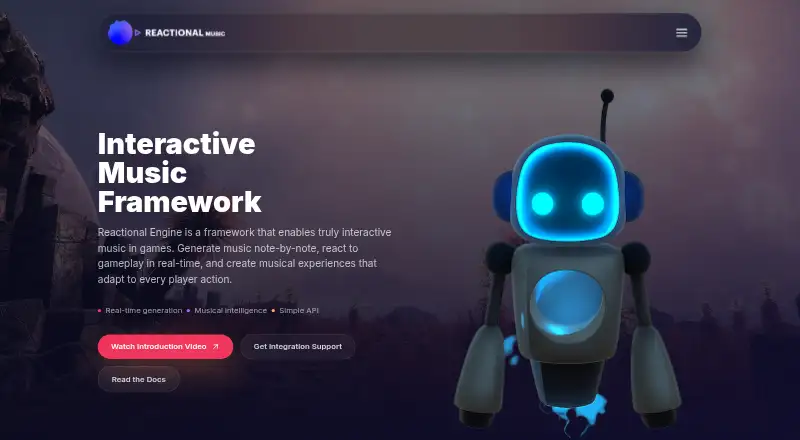
What Reactional Engine is
Reactional Engine is a framework for creating game music that changes as gameplay unfolds. It generates notes with virtual instruments, then lets developers adjust key, scale, tempo, and instrumentation in real time. Musical material can also be interpolated, modulated, improvised, or randomized, giving games ways to shift their music dynamically. The engine can analyze commercial tracks for tempo and harmony, helping generated music synchronize with them and transition between commercial and generated material.
Unity and Unreal Engine are supported game engines. The engine page also describes Wwise and FMOD integrations, with Godot marked as coming soon. Runtime targets listed include Windows, macOS, Linux, iOS, Android, WebGL, PlayStation 4/5, Xbox, and Nintendo Switch. API examples cover transport controls, musical parameter changes, stinger triggers, and callbacks for bars, beats, and notes. Windows and macOS binaries are available through the Reactional Platform. Developers can prototype with any track for free and pay on release. Commercial music licensing is described as including worldwide perpetual rights; interactive themes start at $75 per track. The Free plan is $0.00 per free and requires a Reactional splash screen. Studio pricing is on request.
Who it suits
Reactional Engine suits game developers and composers who want music to respond to play, with real-time control over musical elements. It may also suit music rights holders working with game music, and teams using Unity or Unreal Engine.
What it does well
- Generates music note by note with virtual instruments.
- Changes key, scale, tempo, and instrumentation in real time.
- Supports Windows, macOS, Linux, mobile, web, and console targets.
- Free prototyping lets developers test any track.
- API includes stingers and bar, beat, and note callbacks.
What to know first
- Free plan requires a Reactional splash screen.
- Studio pricing is available on request.
- Godot is listed as coming soon.
Limits
The Free plan requires a Reactional splash screen and includes Forum + Discord support. Studio pricing is on request; its splash screen is optional and curated music assistance is included. Interactive themes start at $75 per track.
Plans
| Plan | Billed and limits | Price |
|---|---|---|
| Free | Forum + Discord support · Reactional splash-screen required | Free |
| Studio | Dedicated contact · Curated music assistance included · Reactional splash-screen optional | On request |
As reactionalmusic.com lists them, read 7 Oct 2026. The maker's own page has the final word.
Getting started
- Visit the Reactional Engine website.
- Choose the Free plan for $0.00 per free, or contact Reactional about Studio pricing.
- Use the Reactional Platform to access Windows or macOS binaries.
- Integrate with Unity or Unreal Engine, or use the API examples and engine documentation.
- Prototype with any track for free; pay on release.
Reactional Engine is a framework for generating game music that responds to gameplay in real time. It suits developers and composers who want to direct a score’s musical behavior, rather than rely on looping tracks. Its appeal is unusually fine-grained musical control; the free tier’s splash-screen requirement and Studio’s custom pricing are meaningful trade-offs.
Overview
Reactional builds music note by note with virtual instruments, then can adjust key, scale, tempo and instrumentation as gameplay changes. It can also interpolate, modulate, improvise and randomize musical elements. That makes it a specialized choice for interactive scoring, not a general-purpose audio framework.
For games that mix licensed tracks with generated material, the engine analyzes commercial tracks’ tempo and harmony to help synchronize music and make transitions between the two. Developers can test any track for free and pay on release. Reactional describes commercial music licensing with worldwide perpetual rights, and interactive themes start at $75 per track.
Key features
Musical direction and game integration
API examples cover transport controls, musical parameters, stingers, and callbacks for bars, beats and notes. These controls let a team connect game events to musical changes at several levels, from a triggered accent to a shift in tempo or instrumentation. Unity and Unreal integrations are available; Godot is coming soon. Wwise and FMOD integrations are also described, making the engine relevant to teams working with established game-audio middleware.
That breadth is useful when music needs to follow the game’s state, but the product is most compelling when a project can take advantage of its compositional controls. A team looking only for a conventional sound-effects or 3D-audio layer may find its central capability beside the point.
Track synchronization and licensing
Analysis of commercial music can help generated passages sit alongside licensed tracks, rather than forcing a soundtrack to choose between them. Free track testing and payment on release can suit developers evaluating music before a game ships. The worldwide perpetual-rights model and per-track starting price give composers and rights holders a basis for planning, though the cost of a project’s full music use will depend on its needs.
Pricing
Reactional has a free plan and a Studio plan with custom pricing. The free plan costs nothing and includes Forum + Discord support, but requires a Reactional splash screen. That is a workable starting point for prototyping, especially since developers can test any track for free and pay on release, but the branding requirement may rule it out for a finished game.
Studio includes dedicated contact and curated music assistance, with the splash screen optional. It is the better fit for teams seeking a more supported music workflow or needing to remove the required branding; its custom pricing means teams must request a quote to assess fit. Interactive themes start at $75 per track. Reactional describes a free trial, but no trial length or renewal terms are given.
Platforms
The engine targets Windows, macOS, Linux, iOS, Android, WebGL, PlayStation 4/5, Xbox and Nintendo Switch. These targets cover desktop, mobile, web and major console releases. Binaries for Windows and macOS are available through the Reactional Platform. The product also lists Android, API, iOS, Linux, macOS, web and Windows as platforms.
Who it's for
Reactional is a strong candidate for game developers and composers building scores that should react to play, particularly when they want direct control over musical structure or need to blend generated passages with commercial tracks. Music rights holders may also find the licensing approach relevant. It is less suited to teams seeking a low-cost, fully branded production tier with a published Studio price, or those whose game depends on a Godot integration being ready now.
Pros and cons
- Pros: Note-by-note generation and controls for key, scale, tempo and instrumentation support music that can change with gameplay.
- Pros: Commercial-track analysis can help coordinate licensed music with generated passages; developers can test tracks free and pay on release.
- Pros: Unity and Unreal support, plus described Wwise and FMOD integrations, gives teams several routes into an existing game-audio setup.
- Cons: The free plan requires a Reactional splash screen, which may not suit a finished release.
- Cons: Studio has custom pricing, so teams cannot compare its cost without contacting Reactional.
- Cons: Godot is coming soon rather than currently available, limiting its fit for projects committed to that engine.
Alternatives
Game Audio Middleware is a useful place to compare options if Reactional’s focus on interactive music is narrower than your project requires.
Choose Audiokinetic Wwise if you want a freemium audio middleware option with a free Indie plan for games below a $250K production budget. Consider Amplitude Audio SDK if free, open-source software under the Apache-2.0 license better fits your needs. OpenAL Soft is a free implementation of the OpenAL 3D audio API for teams seeking that approach.
psai offers a free engine through the Unity Asset Store, with use across Unity projects without further costs or royalties. SoLoud may suit teams that need a free audio engine with commercial use, modification and redistribution permitted under its ZLib/LibPNG license. Steam Audio SDK is another free option for developers who want its audio SDK.
Unity Version Control is a version-control product rather than a direct alternative for interactive music. FMOD Studio is worth considering if its free Indie plan fits a game with a development budget under $600k and a company revenue under $200k/year.
Verdict
Choose Reactional Engine when a game’s score needs to respond musically to play and the team wants control over how that response is composed. Its note-level generation, musical parameters and commercial-track transitions make a focused case for interactive scoring. Look elsewhere if a required free-plan splash screen, custom Studio pricing or the absence of a currently available Godot integration conflicts with the project.
Verdict
Choose Reactional Engine if your game needs music that can change with gameplay and you want controls over its musical structure. Look elsewhere if you need a stated Studio price or a currently available Godot integration.
Questions
Is Reactional Engine free?
A Free plan is listed at $0.00 per free. Developers can also test any track for free and pay on release.
What does Studio cost?
Studio pricing is on request. It includes dedicated contact and curated music assistance.
Which game engines does it support?
Unity and Unreal Engine are listed as supported. The engine page also describes Wwise and FMOD integrations, while Godot is marked as coming soon.
Which platforms can games target?
Listed runtime targets include Windows, macOS, Linux, iOS, Android, WebGL, PlayStation 4/5, Xbox, and Nintendo Switch.
What is the music licensing offer?
The maker describes commercial music licensing with worldwide perpetual rights. Interactive themes start at $75 per track.
Facts from Reactional Engine's own pages
- API
- The page gives examples for transport controls, setting musical parameters, triggering stingers, and receiving bar, beat, and note callbacks. · reactionalmusic.com, 7 Oct 2026
- Commercial tracks
- The system analyzes commercial tracks’ tempo and harmony to synchronize generated music and support transitions between commercial and generated music. · reactionalmusic.com, 7 Oct 2026
- Downloads
- Binaries for Windows and macOS are available through the Reactional Platform. · reactionalmusic.com, 7 Oct 2026
- Free prototyping
- The maker says developers can test any track for free and pay on release. · reactionalmusic.com, 7 Oct 2026
- Generation
- It generates music note by note using virtual instruments rather than relying on loop-based systems. · reactionalmusic.com, 7 Oct 2026
- Headquarters
- Stockholm, Sweden · reactionalmusic.com, 28 Sept 2026
- Integrations
- Unity and Unreal are available now, Godot is listed as coming soon, and Wwise and FMOD integrations are described on the engine page. · reactionalmusic.com, 7 Oct 2026
- Intended users
- The platform documentation describes its tools for game developers, composers, and music rights holders. · docs.reactionalmusic.com, 7 Oct 2026
- Musical controls
- The engine can change key, scale, tempo, and instrumentation in real time and can interpolate, modulate, improvise, and randomize musical elements. · reactionalmusic.com, 7 Oct 2026
- Music licensing
- The maker describes commercial music licensing with worldwide perpetual rights and says interactive themes start at $75 per track. · reactionalmusic.com, 7 Oct 2026
- Purpose
- Reactional Engine is a framework for generating interactive music note by note in games and reacting to gameplay in real time. · reactionalmusic.com, 7 Oct 2026
- Security and compliance
- The pages opened describe globally licensed or rights-cleared music and link to a privacy policy, but state no security certification or compliance standard. · reactionalmusic.com, 7 Oct 2026
- Support
- The engine page links to integration support and documentation; the pricing table lists Forum + Discord for Free and dedicated contact for Studio. · reactionalmusic.com, 7 Oct 2026
- Targets
- The engine page lists Windows, Mac, Linux, iOS, Android, WebGL, PS4/PS5, Xbox, and Switch as platform targets. · reactionalmusic.com, 7 Oct 2026
Where Reactional Engine stands on Freedom251
- Game Audio Middleware#9 of 24