Freedom251 › Game Audio Middleware
Steam Audio SDK
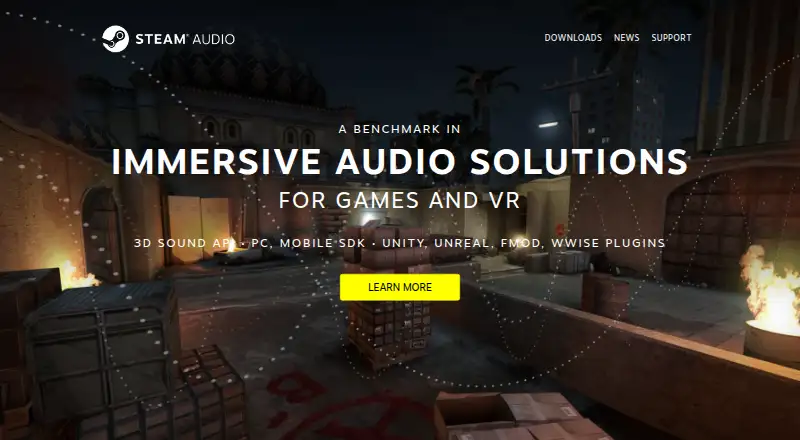
What Steam Audio SDK is
Steam Audio SDK is a toolkit for adding spatial sound to games and VR or AR applications. It renders positional audio binaurally with HRTFs to represent sound direction relative to the listener. Environmental simulation includes sound propagation, occlusion, reflections, and reverb. The SDK can spatialize Ambisonics audio and rotate it with listener orientation, and developers can provide custom HRTFs in AES SOFA format. It can use multicore CPUs and supported GPUs to accelerate environmental simulation and rendering. Listed integrations include Unity, Unreal Engine, FMOD Studio, Wwise, and a C API. The C API is intended for custom game engines, audio middleware, and digital audio workstations, and can be called from languages that use external libraries. Supported systems include Windows, Linux, macOS, Android, and iOS; runtime platforms also list SteamOS. Integrations have minimum version requirements: Wwise 2023.1.0 or later, FMOD Studio 2.00 or later, Unity 2017.3 or later, and Unreal Engine 4.27 or later. Steam Audio is free to developers, subject to a license agreement, and its development tools are described as being in Beta.
Who it suits
It suits developers adding spatial audio to games and VR or AR applications. The C API may also suit teams building custom engines, audio middleware, or digital audio workstations.
What it does well
- Free to developers, subject to a license agreement.
- Supports multiple game engine and audio integrations.
- Includes occlusion, reflections, and reverb simulation.
- Accepts custom HRTFs in AES SOFA format.
- Supports Windows, Linux, macOS, Android, and iOS.
What to know first
- Development tools are described as being in Beta.
- Integrations have minimum version requirements.
- Use is subject to a license agreement.
Plans
| Plan | Billed and limits | Price |
|---|---|---|
| Steam Audio SDK | Available for free to all developers · Free to all developers · License agreement applies | Free |
As valvesoftware.github.io lists them, read 3 Oct 2026. The maker's own page has the final word.
Getting started
- Visit the Steam Audio website.
- Choose an integration: Unity, Unreal Engine, FMOD Studio, Wwise, or the C API.
- Confirm that your chosen integration meets its minimum version requirement.
- Use the SDK under its license agreement.
Steam Audio SDK is a free toolkit for developers building positional audio into games and VR/AR applications. It is best suited to teams that want environmental acoustics, custom HRTFs, and several engine or middleware integration routes. Its broad platform coverage and zero price are compelling, while the Beta status and integration version requirements call for technical oversight.
Overview
Steam Audio renders positional sound binaurally with head-related transfer functions (HRTFs), modelling direction relative to the listener. That makes it useful for gameplay cues, spatial interfaces, and immersive VR or AR scenes where convincing placement matters more than a conventional stereo mix.
It also models how an environment changes sound. Physics-based propagation, occlusion, reflections, and reverb can represent obstructions and room character rather than merely moving a sound between channels. The homepage describes Steam Audio and its development tools as Beta and invites feedback, so it is a better fit for teams able to manage an evolving technology than for projects demanding a fixed, fully managed audio service.
Key features
Spatial and environmental simulation
HRTF binaural rendering gives listeners a directional cue tied to their position. Propagation, occlusion, reflections, and reverb extend that cue into an acoustic model, helping a corridor, room, or barrier sound different from open space. These capabilities are valuable for games and immersive applications whose design depends on audibly understanding distance and obstruction, but they require more implementation decisions than a basic 3D panner.
Ambisonics and HRTF control
Steam Audio can spatialize Ambisonics material and rotate it as the listener turns, which suits environments built around 360-degree or scene-based audio. Developers can also provide HRTFs in AES SOFA format, allowing a project to use its own measured or selected listener models instead of relying on a single fixed set.
Acceleration and integrations
Multicore CPUs and supported GPUs can accelerate environmental simulation and rendering. The official integration paths cover Unity, Unreal Engine, FMOD Studio, Wwise, and a C API. The C API is aimed at custom engines, custom audio middleware, and digital audio workstations, and it can be called from languages that use external libraries. This range lets a team stay at engine level or work closer to its audio stack.
Pricing
Steam Audio SDK — free (available for free to all developers; license agreement applies). There are no paid tiers, seat charges, quotas, or trial conversion terms stated for this plan. The trade-off is not a cheaper feature set but responsibility for meeting the license terms and the technical work of integrating and maintaining the SDK.
Platforms
The runtime platform list includes Windows, Linux, macOS, Android, iOS, and SteamOS. The C API documentation covers Windows, Linux, macOS, Android, and iOS, with platform and version requirements. Integration prerequisites matter: Unity requires 2017.3 or later, Unreal Engine requires 4.27 or later, FMOD Studio requires 2.00 or later, and Wwise requires 2023.1.0 or later.
Who it's for
Choose Steam Audio for a game or VR/AR team that needs physically informed environmental sound, Ambisonics handling, custom SOFA HRTFs, and freedom to integrate through a major engine, middleware package, or C API. It is particularly attractive when cross-platform deployment and a free developer license are central constraints. Teams that cannot accommodate Beta software, required engine versions, or lower-level integration work should evaluate a more established or more specialized production option.
Pros and cons
- Pros: Free for all developers under a license agreement; broad Windows, Linux, macOS, Android, iOS, and SteamOS runtime coverage; propagation, occlusion, reflections, and reverb go beyond simple positional panning; AES SOFA HRTF input supports tailored listener models; Unity, Unreal, FMOD Studio, Wwise, and C API routes cover varied stacks; CPU and supported-GPU acceleration can reduce simulation and rendering load.
- Cons: Beta development status introduces ongoing-change risk; each integration has a minimum version requirement; the C API route is intended for teams prepared to work with custom engines, middleware, or external-library bindings.
Alternatives
For a broader game-audio middleware workflow with a freemium model and an Indie plan for productions under a $250K budget, consider Audiokinetic Wwise. Reactional Engine is another freemium option, with a free tier requiring a Reactional splash screen and forum plus Discord support. Choose Amplitude Audio SDK when free, open-source distribution under Apache-2.0 is the priority; its Amplitude Studio Free plan is for non-commercial use.
OpenAL Soft is a free LGPL implementation of the OpenAL 3D audio API. psai offers a free Unity Asset Store engine usable across Unity projects without further costs or royalties. SoLoud permits free and commercial use, modification, and redistribution under the ZLib/LibPNG license. Unity Version Control is a freemium version-control choice rather than an audio toolkit. FMOD Studio suits teams wanting a freemium, per-game licensing model, including an Indie plan tied to development budget and company revenue.
Verdict
Steam Audio SDK is a strong choice for developers who want sophisticated spatial and environmental audio across major engines, middleware, and mobile or desktop platforms without a software charge. Its main reason to look elsewhere is the Beta status and the integration work imposed by version prerequisites and a technical C API.
Verdict
Steam Audio SDK provides spatial audio and environmental simulation features across several listed integrations and platforms. Check the applicable integration requirements and license terms before choosing it.
Questions
How much does Steam Audio SDK cost?
It is available free to all developers, subject to a license agreement.
Which platforms does it support?
Listed runtime platforms are Windows, Linux, macOS, Android, iOS, and SteamOS.
Which engines and middleware does it integrate with?
The listed integrations are Unity, Unreal Engine, FMOD Studio, Wwise, and the C API.
Are there minimum version requirements?
Yes. The listed minimums are Unity 2017.3, Unreal Engine 4.27, FMOD Studio 2.00, and Wwise 2023.1.0.
Can developers use custom HRTFs?
Yes. Developers can provide HRTFs in AES SOFA format.
Who makes Steam Audio SDK?
The listed website is hosted at valvesoftware.github.io/steam-audio. The facts do not name a maker.
Facts from Steam Audio SDK's own pages
- Ambisonics
- It can spatialize Ambisonics audio and rotate it according to listener orientation. · valvesoftware.github.io, 3 Oct 2026
- Custom HRTFs
- Users can supply HRTFs in AES SOFA format. · valvesoftware.github.io, 3 Oct 2026
- Environmental effects
- Its features include physics-based sound propagation, occlusion, reflections, and reverb. · valvesoftware.github.io, 3 Oct 2026
- FMOD requirement
- The FMOD Studio integration requires FMOD Studio 2.00 or later. · valvesoftware.github.io, 3 Oct 2026
- Integrations
- The official site lists Unity, Unreal Engine, a C API, FMOD Studio, and Wwise integrations. · valvesoftware.github.io, 3 Oct 2026
- Intended users
- The C API is intended for custom game engines, custom audio middleware, and digital audio workstations, and can be called from languages that use external libraries. · valvesoftware.github.io, 3 Oct 2026
- Performance
- Steam Audio can use multicore CPUs and supported GPUs to accelerate environmental simulation and rendering. · valvesoftware.github.io, 3 Oct 2026
- Purpose
- Steam Audio is a cross-platform toolkit for adding spatial audio to games and VR/AR apps. · valvesoftware.github.io, 3 Oct 2026
- Spatial audio
- It renders positional audio binaurally using HRTFs to model sound direction relative to the listener. · valvesoftware.github.io, 3 Oct 2026
- Supported systems
- The C API documentation lists Windows, Linux, macOS, Android, and iOS support, with platform and version requirements. · valvesoftware.github.io, 3 Oct 2026
- Support status
- The official homepage invites feedback on Steam Audio and its development tools, which it describes as being in Beta. · valvesoftware.github.io, 3 Oct 2026
- Unity requirement
- The Unity integration requires Unity 2017.3 or later. · valvesoftware.github.io, 3 Oct 2026
- Unreal requirement
- The Unreal Engine integration requires Unreal Engine 4.27 or later. · valvesoftware.github.io, 3 Oct 2026
- Wwise requirement
- The Wwise integration requires Wwise 2023.1.0 or later. · valvesoftware.github.io, 3 Oct 2026
Where Steam Audio SDK stands on Freedom251
- Game Audio Middleware#12 of 24