Freedom251 › Game Audio Middleware
OpenAL Soft
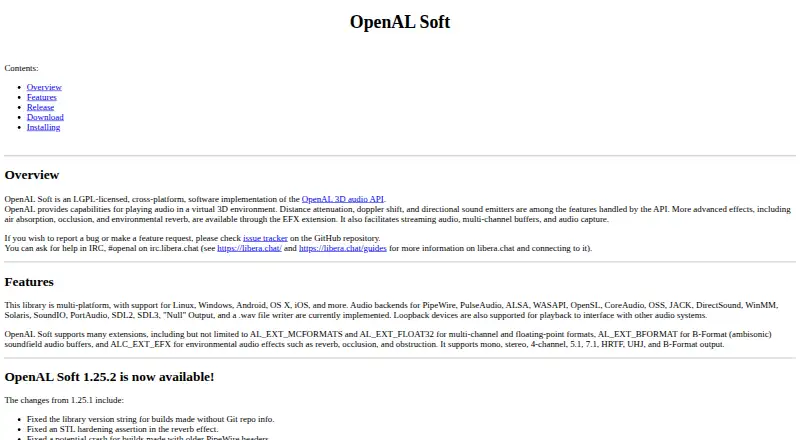
What OpenAL Soft is
OpenAL Soft is a free software implementation of the OpenAL 3D audio API for applications that play sound in virtual environments. It handles spatial audio behavior such as distance attenuation, Doppler shift and directional emitters. Its EFX extension adds effects including air absorption, occlusion and environmental reverb. The library supports streaming, multichannel buffers and audio capture, with output formats ranging from mono and stereo to 5.1, 7.1, HRTF, UHJ and B-Format. Available backends include PipeWire, PulseAudio, ALSA, WASAPI, CoreAudio, JACK, SDL2 and SDL3. Developers can incorporate it into projects, and loopback devices can route playback to other audio systems. The project is LGPL-licensed. The site identifies version 1.25.2 as the latest release and offers source code as well as Win32 and Win64 binaries. Building requires CMake 3.13 or newer and a compiler supporting C++20; Autotools is not supported. Bug reports and feature requests go to the GitHub issue tracker, with help also available through the #openal IRC channel.
Who it suits
OpenAL Soft suits developers building applications that need 3D audio playback and a reusable audio library. It is also relevant to projects requiring streaming, multichannel audio or capture.
What it does well
- Free, LGPL-licensed software
- Supports spatial audio and environmental effects
- Offers multiple output formats and backends
- Supports streaming, multichannel buffers and capture
What to know first
- Building requires CMake 3.13 or newer
- Autotools is not supported
- Latest listed release is version 1.25.2
Plans
| Plan | Billed and limits | Price |
|---|---|---|
| OpenAL Soft | LGPL-licensed software implementation of the OpenAL 3D audio API | Free |
As openal-soft.org lists them, read 3 Oct 2026. The maker's own page has the final word.
Getting started
- Visit the OpenAL Soft website.
- Choose source form or a Win32 or Win64 binary for version 1.25.2.
- For a source build, use CMake 3.13 or newer and a compiler supporting C++20.
- Incorporate the reusable library into your project.
- Use the GitHub issue tracker for bugs or feature requests, or #openal IRC for help.
OpenAL Soft is a free, LGPL-licensed audio library for developers adding sound to applications and games. It is strongest for projects that need spatial audio controls and varied output paths without a software fee; it is a less natural fit for teams seeking a complete audio-authoring workflow.
Overview
OpenAL Soft implements the OpenAL 3D audio API, providing an audio layer that developers can incorporate into their own projects. Its focus is practical building blocks rather than a finished production environment: the API handles spatial behavior, playback and capture, while the application supplies the surrounding experience. That makes it a sensible choice when a team wants to embed audio behavior in its software and can work with the library’s build and licensing terms.
Key features
Position-aware audio and effects
Distance attenuation, Doppler shift and directional emitters let sound respond to virtual position and movement. The EFX extension adds air absorption, occlusion and environmental reverb, giving developers further controls for shaping playback around an environment. These are useful foundations for spatial scenes, but they are not a turnkey authoring workflow: the application still needs to decide how its world drives audio.
Playback choices
Streaming, multichannel buffers and audio capture support needs beyond basic playback. Output options span mono and stereo, 4-channel, 5.1 and 7.1, along with HRTF, UHJ and B-Format. That range gives developers flexibility to target different audio arrangements, though a project must still choose and integrate the appropriate output path.
Backend integration
Implemented backends include PipeWire, PulseAudio, ALSA, WASAPI, CoreAudio, JACK, SDL2 and SDL3, among others. Loopback devices can also send playback to other audio systems. Together these options make the library adaptable across supported environments, while requiring developers to account for the backend choices and integration their own project needs.
Pricing
OpenAL Soft costs free under its free plan. The plan is the LGPL-licensed software implementation of the OpenAL 3D audio API; there is no free trial because the software is free. There are no paid tiers or seat and quota terms to weigh, but the LGPL license remains relevant when incorporating the library into a project. Teams should check that license against their distribution and licensing requirements.
Platforms
Runtime platforms are Windows, macOS, Linux and Android. The broader platform listing also includes iOS, API and self-hosted. The project provides the latest release, version 1.25.2, in source form and as Win32 and Win64 binaries. Building requires CMake 3.13 or newer and should work with most compilers that support C++20; Autotools is not supported. These requirements favor developers comfortable with a modern C++ build setup, rather than teams depending on Autotools.
Who it's for
OpenAL Soft fits developers who want a reusable audio library with spatial controls, effects and multiple output options, and who are prepared to integrate it into their own application. It is less appropriate for teams looking for a packaged authoring or middleware workflow, or for projects whose build environment cannot meet the stated requirements.
Pros and cons
- Pros: Position-aware audio controls and EFX provide concrete tools for spatial scenes.
- Pros: Streaming, capture, varied output formats and numerous implemented backends give projects multiple ways to handle audio.
- Pros: The free plan avoids a software charge, and source plus Windows binaries are provided for the latest release.
- Cons: CMake 3.13 or newer and C++20-supporting compilers are expected for builds; Autotools is not supported.
- Cons: The LGPL license calls for a compatibility check before adopting it in a distributed project.
- Cons: As a library to incorporate, it does not replace a complete production workflow.
Alternatives
Consider Game Audio Middleware if you want to compare tools in that category. Audiokinetic Wwise offers a free Indie plan for game production budgets under $250K, so it may suit qualifying game projects considering a middleware option. Reactional Engine has a free tier that requires a splash screen and a Studio tier with custom pricing. Amplitude Audio SDK is another free, open-source SDK, under the Apache-2.0 license. psai offers a free engine through the Unity Asset Store for use across Unity projects without further costs or royalties. SoLoud is free for commercial use, with modification and redistribution permitted under its ZLib/LibPNG license. Steam Audio SDK is available free to all developers, subject to its license agreement. Unity Version Control is a version-control option with a free tier, rather than an audio library. FMOD Studio offers an Indie plan that is free under stated budget and revenue conditions, making it another option for qualifying game projects.
Verdict
Choose OpenAL Soft when you need a free, reusable library for spatial audio and value its broad backend and output choices. Its central advantage is the range of audio building blocks without a software fee; look elsewhere if your team needs a packaged production workflow or cannot work within the LGPL and build requirements.
Verdict
OpenAL Soft provides spatial audio behavior, effects and varied output options in a reusable library. Developers should account for its stated build requirements and lack of Autotools support.
Questions
How much does OpenAL Soft cost?
The listed plan is free.
Which platforms does it support?
The platform list includes Android, iOS, Linux, macOS, self-hosted use, and Windows. Runtime platforms are listed as Windows, macOS, Linux, and Android.
Is OpenAL Soft open source?
It is LGPL-licensed, and the latest release is available in source form.
What are the build requirements?
Building requires CMake 3.13 or newer and should work with most compilers supporting C++20. Autotools is not supported.
Where can users get help?
The project directs bug reports and feature requests to its GitHub issue tracker and offers help through the #openal IRC channel.
What audio capabilities does it provide?
It supports spatial audio, EFX effects, streaming, multichannel buffers, audio capture, and output formats including stereo, 5.1, 7.1, HRTF, UHJ, and B-Format.
Facts from OpenAL Soft's own pages
- Audio backends
- Implemented backends include PipeWire, PulseAudio, ALSA, WASAPI, CoreAudio, JACK, SDL2, SDL3, and others. · openal-soft.org, 3 Oct 2026
- Audio capabilities
- It supports streaming audio, multichannel buffers, and audio capture. · openal-soft.org, 3 Oct 2026
- Build requirements
- Building requires CMake 3.13 or newer and should work with most compilers supporting C++20; Autotools is not supported. · openal-soft.org, 3 Oct 2026
- Effects
- Its EFX extension provides effects including air absorption, occlusion, and environmental reverb. · openal-soft.org, 3 Oct 2026
- Integrations
- The site says loopback devices can be used for playback to interface with other audio systems. · openal-soft.org, 3 Oct 2026
- Intended users
- The site describes a reusable audio library and provides CMake build instructions for incorporating it into projects. · openal-soft.org, 3 Oct 2026
- Latest release
- The site identifies version 1.25.2 as the latest release and provides it in source form and as Win32 and Win64 binaries. · openal-soft.org, 3 Oct 2026
- License
- OpenAL Soft is LGPL-licensed. · openal-soft.org, 3 Oct 2026
- Output formats
- Supported output includes mono, stereo, 4-channel, 5.1, 7.1, HRTF, UHJ, and B-Format. · openal-soft.org, 3 Oct 2026
- Platforms
- The library supports Linux, Windows, Android, OS X, iOS, and other platforms. · openal-soft.org, 3 Oct 2026
- Purpose
- OpenAL Soft is a software implementation of the OpenAL 3D audio API for playing audio in a virtual 3D environment. · openal-soft.org, 3 Oct 2026
- Security
- The opened official page does not state security certifications or compliance claims. · openal-soft.org, 3 Oct 2026
- Spatial audio
- The API handles distance attenuation, Doppler shift, and directional sound emitters. · openal-soft.org, 3 Oct 2026
- Support
- The project directs users to its GitHub issue tracker for bugs and feature requests and to the #openal IRC channel for help. · openal-soft.org, 3 Oct 2026
Where OpenAL Soft stands on Freedom251
- Game Audio Middleware#6 of 24