Freedom251 › Container Backup Software
Rancher
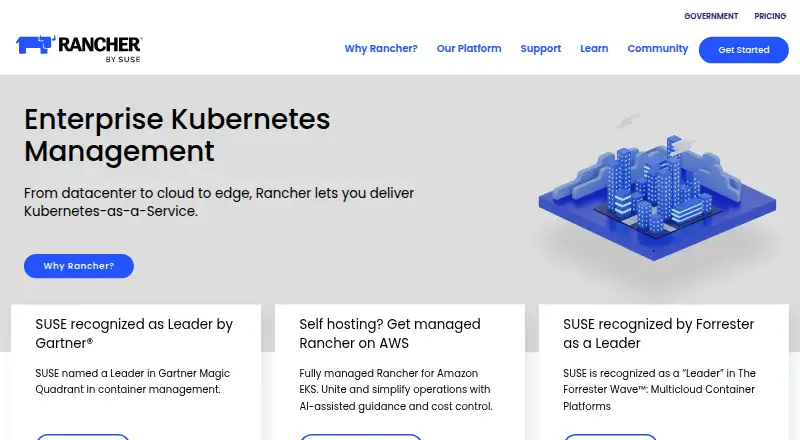
What Rancher is
Rancher is a Kubernetes management platform for operating multiple clusters and managing containerized workloads. It provides cluster provisioning and version management, plus visibility, diagnostics, monitoring, alerting, and centralized audit. Supported Kubernetes distributions include EKS, AKS, GKE, RKE, and K3s. Teams can apply consistent user-access and security policies across managed clusters, and connect external authentication providers such as Active Directory, GitHub, Azure AD, Okta, Google OAuth, and generic OIDC. Rancher can run kube-bench compliance scans that report test results and remediation steps for failed tests. Documented integrations include Harvester, Longhorn, NeuVector, Kubewarden, Elemental, Fleet, SUSE Observability, and Rancher Desktop. The free Rancher edition is open source and includes community support; Rancher Prime editions include enterprise support, professional services, and a trusted private container registry. Quick-start installation instructions call for a Linux host with at least 4 GB of memory and a supported Docker version. Rancher began in 2014 and became part of SUSE in 2020.
Who it suits
Rancher suits teams that need to operate multiple Kubernetes clusters and apply shared access or security policies. Its free edition is an option for users comfortable with community support.
What it does well
- Manages multiple clusters and Kubernetes versions.
- Supports EKS, AKS, GKE, RKE, and K3s.
- Integrates with several external authentication providers.
- Compliance scans report failures and remediation steps.
- Free open-source edition includes community support.
What to know first
- Quick-start requires a Linux host with at least 4 GB memory.
- Quick-start also requires a supported Docker version.
- Does not provide active-session limits or geolocation restrictions out of the box.
Plans
| Plan | Billed and limits | Price |
|---|---|---|
| Rancher | 100% open source · Full Rancher Platform Experience · Community Support | Free |
| Rancher Prime | Full Rancher Platform Experience · Enterprise Support · Professional Services · Trusted private container registry | On request |
| Rancher Prime Hosted | Expert-managed Rancher Prime control plane · Enterprise Support · Professional Services · Trusted private container registry | On request |
As rancher.com lists them, read 30 Sept 2026. The maker's own page has the final word.
Getting started
- Visit https://www.rancher.com/.
- Choose the Rancher edition or a Rancher Prime edition.
- For quick-start installation, prepare a Linux host with at least 4 GB of memory and a supported Docker version.
- Install Rancher on the Linux host using its quick-start instructions.
- Connect the Kubernetes clusters and identity providers you want to manage.
Rancher is a Kubernetes management platform for teams operating clusters across distributions and environments. It is best suited to organizations that need shared oversight of several clusters. Its broad operational and policy toolkit is compelling, though enterprise support and services require a paid Prime edition.
Overview
Rancher brings cluster provisioning, version management, monitoring, alerting, diagnostics, visibility, and audit into a central management layer. It supports certified distributions including EKS, AKS, GKE, RKE, and K3s, and has a hybrid deployment model. For teams running Kubernetes across different environments, this can reduce the burden of handling each cluster as a separate operation. A single, uncomplicated cluster may not justify another management layer.
Rancher manages Kubernetes clusters rather than replacing the distributions underneath them. The project began in 2014 and became part of SUSE in 2020.
Key features
Cluster operations
Multi-cluster management, autoscaling, and rolling updates complement provisioning and version management. Together with visibility, diagnostics, monitoring, alerts, and centralized audit, these capabilities support teams that need to coordinate day-to-day operations across clusters. Their breadth is less consequential for teams with limited cluster-management needs.
Access and security
Rancher can apply consistent user-access and security policies across managed clusters. It supports external identity providers including Active Directory, GitHub, Azure AD, Okta, Google OAuth, and generic OIDC, offering flexibility for teams already using those systems. It does not provide concurrent active-session limits or geolocation-based session restrictions out of the box, which may matter to organizations with those access-control requirements.
Its kube-bench compliance scans report test results and remediation steps for failed tests, giving operators a practical route from findings to follow-up. Rancher also supports responsible disclosure and publishes advisories and CVEs for resolved issues. Rancher Prime's Application Collection adds hardened images with signatures and SBOMs and is described as SLSA Level 3 compliant.
Integrations and setup
Rancher documents integrations with Harvester, Longhorn, NeuVector, Kubewarden, Elemental, Fleet, SUSE Observability, and Rancher Desktop. The quick-start installation requires a Linux host with at least 4 GB of memory and a supported Docker version. That is a concrete starting point for Linux-based deployments, but not a minimal setup for every team.
Pricing
| Plan | Price | Includes |
|---|---|---|
| Rancher | free | 100% open source, full Rancher Platform Experience, community support |
| Rancher Prime | Custom pricing | Full Rancher Platform Experience, enterprise support, professional services, trusted private container registry |
| Rancher Prime Hosted | Custom pricing | Expert-managed Rancher Prime control plane, enterprise support, professional services, trusted private container registry |
The free Rancher plan preserves the full platform experience and suits teams able to rely on community support. Prime is the step up for organizations that need enterprise support, professional services, and a trusted private registry. Prime Hosted adds an expert-managed control plane, making it the option for teams that want that element managed for them. Both Prime editions use custom pricing.
Platforms
Rancher supports API, Linux, self-hosted, and web platforms. Its hybrid deployment model and support for Kubernetes distributions across managed and self-hosted environments suit teams working across more than one kind of infrastructure.
Who it's for
Rancher is a strong fit for teams responsible for multiple Kubernetes clusters that want centralized operations, consistent access and security policies, and compliance scanning. It is less compelling for a small deployment that does not need a separate management layer, or for organizations that require built-in concurrent-session or geolocation restrictions.
Pros and cons
- Pros: The free plan includes the full Rancher Platform Experience, making the platform's core capabilities accessible to teams that can work with community support.
- Pros: Support for EKS, AKS, GKE, RKE, and K3s gives multi-cluster teams options across several Kubernetes distributions.
- Pros: Centralized operations, policy controls, and kube-bench results with remediation steps bring management and security tasks together.
- Cons: Enterprise support and professional services require custom-priced Prime editions.
- Cons: The quick-start path requires a Linux host with at least 4 GB of memory and a supported Docker version.
- Cons: Concurrent active-session limits and geolocation-based session restrictions are not built in.
Alternatives
For cluster backup rather than broad Kubernetes management, Velero is a free, open-source tool for cloud or on-premises use. If you want a managed Kubernetes service instead of a management layer spanning distributions, Google Kubernetes Engine is a paid service with a free tier and trial; its free tier provides $74.40 in monthly credits per billing account, applicable to zonal and Autopilot clusters.
Plakar, KubeSphere Backup, Storware Backup & Recovery, Veeam Agent for Mac, Vinchin Backup & Recovery, and Afi Kubernetes Backup are other alternatives to consider.
Explore related categories: Container Backup Software, Container Orchestration Software, Kubernetes Management Platforms, Cloud Orchestration Software, Container Management Software, and Container Development Environments.
Verdict
Choose Rancher if your team needs one operational and policy layer for multiple Kubernetes clusters: its distribution support, diagnostics, audit, and security scanning make that a credible case, and the core platform is free. Look elsewhere if you need built-in session restrictions, a lighter setup, or enterprise support without moving to custom-priced Prime.
Verdict
Rancher combines multi-cluster operations with policy controls, diagnostics, and compliance scans. The free edition includes community support, while enterprise support is listed for Prime editions.
Questions
Is Rancher free?
Yes. The Rancher plan costs nothing and is 100% open source, with community support.
What do Rancher Prime editions add?
Rancher Prime includes enterprise support, professional services, and a trusted private container registry. Rancher Prime Hosted also provides an expert-managed Rancher Prime control plane.
Which Kubernetes distributions does Rancher support?
Rancher supports certified distributions including EKS, AKS, GKE, RKE, and K3s.
Which platforms can I use Rancher on?
The listed platforms are API, Linux, self-hosted, and web. The quick-start installation instructions use a Linux host.
Which identity providers can Rancher connect to?
External authentication options include Active Directory, GitHub, Azure AD, Okta, Google OAuth, and generic OIDC.
Who makes Rancher?
Rancher says it started in 2014 and became part of SUSE in 2020.
Facts from Rancher's own pages
- Authentication
- Rancher supports external authentication providers including Active Directory, GitHub, Azure AD, Okta, Google OAuth, and generic OIDC. · ranchermanager.docs.rancher.com, 30 Sept 2026
- Cluster operations
- Rancher provides cluster provisioning, version management, visibility and diagnostics, monitoring, alerting, and centralized audit. · rancher.com, 30 Sept 2026
- Company history
- Rancher says it started in 2014 and became part of SUSE in 2020. · rancher.com, 30 Sept 2026
- Founded
- 2014 · rancher.com, 23 Sept 2026
- Installation
- The quick-start instructions install Rancher on a Linux host with at least 4 GB of memory and a supported Docker version. · rancher.com, 30 Sept 2026
- Integrations
- Rancher documents integrations including Harvester, Longhorn, NeuVector, Kubewarden, Elemental, Fleet, SUSE Observability, and Rancher Desktop. · ranchermanager.docs.rancher.com, 30 Sept 2026
- Kubernetes support
- Rancher supports certified Kubernetes distributions, including EKS, AKS, GKE, RKE, and K3s. · rancher.com, 30 Sept 2026
- Notable limit
- Rancher does not support concurrent active-session limits or session restrictions by geolocation out of the box. · ranchermanager.docs.rancher.com, 30 Sept 2026
- Prime security
- Rancher Prime's Application Collection provides hardened images with signatures and SBOMs and is described as SLSA Level 3 compliant. · rancher.com, 30 Sept 2026
- Purpose
- Rancher is a Kubernetes management platform for managing multiple clusters and providing tools for containerized workloads. · rancher.com, 30 Sept 2026
- Security and policy
- Rancher can apply consistent user access and security policies across managed clusters. · rancher.com, 30 Sept 2026
- Security assessment
- Rancher can run kube-bench compliance scans that report test results and remediation steps for failed tests. · ranchermanager.docs.rancher.com, 30 Sept 2026
- Security disclosure
- Rancher supports responsible disclosure and publishes security advisories and CVEs for resolved product issues. · ranchermanager.docs.rancher.com, 30 Sept 2026
- Support
- The free Rancher edition includes community support; Rancher Prime editions include enterprise support. · rancher.com, 30 Sept 2026
Where Rancher stands on Freedom251
- Container Backup Software#5 of 28
- Container Orchestration Software#14 of 32
- Kubernetes Management Platforms#13 of 29
- Cloud Orchestration Software#14 of 27
- Container Development Environments#21 of 40
- Container Management Software#17 of 28