Freedom251 › Package Registries
R-universe
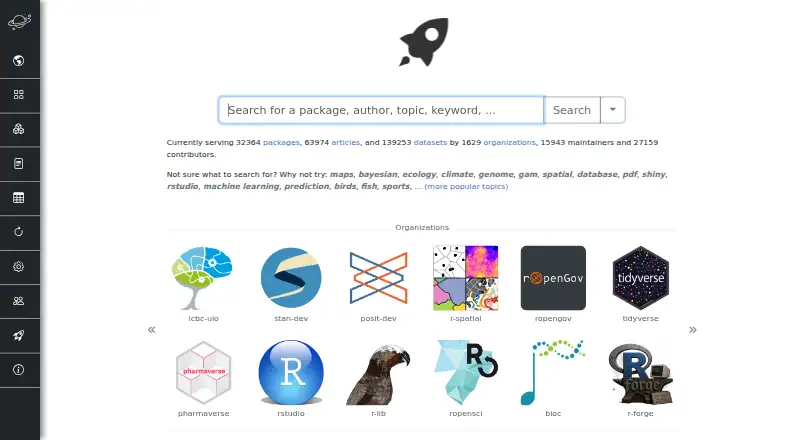
What R-universe is
R-universe is rOpenSci’s free platform for publishing and discovering research software in R. Its searchable catalogue covers R software, articles, and datasets, with entries indexed and ranked using R-specific features. Package and universe pages provide detailed information and rendered material. Users and developers can run personal CRAN-like repositories whether or not they also publish packages on CRAN. R-universe builds and deploys packages from Git repositories into installation repositories, and offers a continuous integration environment that needs no configuration to help identify potential breakage before release. WebAssembly binary support is experimental. Publishing a packages.json registry requires a GitHub account and the R-universe GitHub app, although repositories may be hosted on other public Git servers such as GitLab. Unauthenticated APIs support listing universes and packages, retrieving package information, and searching. R-universe is available on the web, through an API, and on Linux, macOS, and Windows. It does not vet packages; each universe owner is responsible for policies and quality control.
Who it suits
It suits R users looking for packages, articles, or datasets, as well as developers publishing packages or running repositories. It is also relevant to people interested in contributing to its infrastructure or documentation.
What it does well
- Searches R software, articles, and datasets.
- Supports personal CRAN-like repositories with or without CRAN publishing.
- Builds and deploys packages from Git repositories.
- Provides unauthenticated APIs for search and package information.
- Free to use.
What to know first
- Publishing a packages.json registry requires a GitHub account and app.
- WebAssembly binary support is experimental.
- R-universe does not vet packages.
- Each universe owner is responsible for quality control.
Limits
The free plan is a public publishing platform, and publishing a packages.json registry requires a GitHub account. R-universe does not vet packages, and WebAssembly binary support is experimental.
Plans
| Plan | Billed and limits | Price |
|---|---|---|
| Free | Free of charge; public publishing platform; GitHub account required to publish a packages.json registry | Free |
As r-universe.dev lists them, read 4 Oct 2026. The maker's own page has the final word.
Getting started
- Visit https://r-universe.dev/.
- Use the searchable catalogue to find software, articles, or datasets.
- Use the unauthenticated APIs to list or search universes and packages, or retrieve package information.
- To publish a packages.json registry, use a GitHub account and the R-universe GitHub app.
- Host package repositories on GitHub or another public Git server such as GitLab.
R-universe is a free publishing and discovery service for R research software, aimed at R users, package developers, and teams building their own package ecosystems. It is the strongest fit when you need R-specific search, Git-based builds, and a public repository in one place; it is a weaker choice when independent package vetting or a registry setup without GitHub is essential.
Overview
The service brings a searchable catalogue of R software, articles, and datasets together with package hosting and installation repositories. Search indexing and ranking use R-specific characteristics, while package and universe pages provide detailed descriptions and rendered material for evaluating a dependency before adoption. Developers can operate personal CRAN-like repositories whether or not they also publish on CRAN, making R-universe practical for research groups, experimental projects, and independent maintainers.
R-universe builds and deploys packages from Git repositories into repositories that R users can install from. The platform is governed by rOpenSci, and documentation routes bug reports and suggestions to GitHub. Its website runs on a self-hosted server in New York City, with traffic routed through Cloudflare’s CDN.
Key features
- R-focused discovery: The catalogue spans packages, articles, and datasets, with ranking tuned to R. This is more useful to R practitioners than a generic code-search service when the goal is finding research software and its surrounding material.
- Package context: Universe and package pages include detailed information and rendered content. That extra context helps users judge fit and documentation before installing, although it does not amount to an independent quality review.
- Personal repositories: Developers can maintain CRAN-like repositories without making CRAN publication a prerequisite. This suits projects that need controlled distribution or an interim home before a formal CRAN release.
- Git-based builds: R-universe turns Git repository packages into deployable installation repositories, reducing the need to assemble build and distribution infrastructure yourself.
- Continuous integration: A zero-configuration development environment can expose likely breakage before release. It is valuable for maintainers who want an automated early warning without designing their own CI setup.
- Unauthenticated API: APIs can list universes and packages, return package information, and perform searches. Because access is unauthenticated, it is suitable for public catalogue integrations rather than private registry administration.
- WebAssembly: WebAssembly binaries are supported experimentally, so this is an emerging capability rather than a dependable foundation for production distribution.
- Integration requirements: Creating a universe requires a GitHub account and the R-universe GitHub app. Package repositories may also be hosted on other public Git servers, including GitLab, but that does not remove the GitHub requirement for universe setup.
- Owner-led quality control: R-universe does not vet packages. Each universe owner sets policies and is responsible for quality, so users must assess provenance and maintenance themselves.
Pricing
R-universe has one published plan: Free at free. It is a public publishing platform with no free trial because the service is already free. The plan uses a single package ecosystem and requires a GitHub account to publish a packages.json registry. There are no paid tiers, seat charges, renewal terms, or stated usage quotas in the published plan. That makes it a straightforward choice for public R projects, while teams needing private distribution, contractual support, or independently enforced quality controls should look elsewhere.
Platforms
R-universe is available through web, API, Linux, macOS, and Windows environments. The API and web catalogue support discovery and automation, while the cross-platform package repositories serve R users on the major desktop operating systems.
Who it's for
Choose R-universe for R users searching across packages, articles, and datasets; package developers who want Git-driven builds and a personal CRAN-like repository; and universe developers or contributors interested in infrastructure and documentation. It is especially appropriate for open research software that benefits from a public catalogue and automated pre-release checks. It is not the right fit for users who require packages to be centrally audited, or for organizations that cannot use GitHub when registering a universe.
Pros and cons
Pros
- Free public publishing: There is no paid tier or renewal cost for hosting a public R package ecosystem.
- R-native discovery: Search and ranking are tailored to R and cover related articles and datasets.
- Integrated build workflow: Git-based builds, installation repositories, and zero-configuration CI reduce operational work for maintainers.
- Open automation surface: Unauthenticated APIs make public catalogue data usable in scripts and integrations.
Cons
- No platform vetting: Owners, not R-universe, set quality policies, leaving adoption risk with the user.
- GitHub-dependent setup: Publishing a registry requires both a GitHub account and the R-universe app.
- Experimental WebAssembly: Binary support is not yet a dependable reason to select the platform.
- Public-facing model: The free plan is described as a public publishing platform, so it is a poor match for private package distribution requirements.
Alternatives
Browse Package Registries when you want to compare registry services across ecosystems. Choose Bioconductor for a free, open-source R and Bioconductor-focused environment available on Linux, macOS, Windows, web, and self-hosted deployments. CPAN is the better fit for Perl software and documentation. Pick Inedo ProGet when you need a freemium, self-hosted package server with unlimited feeds for private packages and Docker on its free edition. LuaRocks serves Lua package management and module hosting. Use npm for JavaScript’s public registry and its free public-package publishing plan. pypiserver is a minimal, self-hosted PyPI-compatible server. aptly suits Debian repository management through a CLI and HTTP REST service. CocoaPods is intended for iOS and macOS dependency distribution.
Verdict
R-universe is a strong recommendation for R developers and research users who want free public discovery, Git-backed package builds, and a personal CRAN-like repository with built-in pre-release checks. Its decisive advantages are R-specific context and an integrated publishing workflow. Look elsewhere if you need centrally enforced package quality, private-first hosting, or a registry onboarding process that does not depend on GitHub.
Verdict
R-universe combines package discovery, repository publishing, builds, and APIs for R software. Package quality control rests with each universe owner, and publishing a registry requires a GitHub account and app.
Questions
How much does R-universe cost?
The Free plan costs nothing; it is free of charge.
Is there a free plan or free trial?
There is a free plan. There is no free trial.
What platforms does R-universe support?
It is available on web, API, Linux, macOS, and Windows.
Does publishing require GitHub?
Publishing a packages.json registry requires a GitHub account and the R-universe GitHub app. Package repositories may be hosted on other public Git servers, such as GitLab.
Does R-universe check package quality?
No. Each universe owner is responsible for policies and quality control.
Who governs R-universe?
rOpenSci initiated and governs R-universe.
Facts from R-universe's own pages
- API
- R-universe provides unauthenticated APIs to list universes and packages, retrieve package information, and search. · docs.r-universe.dev, 4 Oct 2026
- Builds
- R-universe builds and deploys R packages from Git repositories into installation repositories. · docs.r-universe.dev, 4 Oct 2026
- Continuous integration
- The platform provides a zero-configuration development environment for continuous integration to identify upcoming breakage before release. · ropensci.org, 4 Oct 2026
- Discovery
- It provides a searchable catalogue of R software, articles, and datasets, indexed and ranked using R-specific features. · docs.r-universe.dev, 4 Oct 2026
- Governance and support
- rOpenSci initiated and governs R-universe, and the documentation directs bug reports and suggestions to GitHub. · docs.r-universe.dev, 4 Oct 2026
- Infrastructure
- The website runs on a self-hosted server in New York City, with traffic routed through Cloudflare CDN. · docs.r-universe.dev, 4 Oct 2026
- Integrations
- Setting up a universe requires a GitHub account and the R-universe GitHub app, while package repositories may be hosted on other public Git servers such as GitLab. · docs.r-universe.dev, 4 Oct 2026
- Intended users
- The documentation is for R users, package developers, universe developers, and people interested in contributing to the infrastructure or documentation. · docs.r-universe.dev, 4 Oct 2026
- Limit
- R-universe does not vet packages; each universe owner is responsible for policies and quality control. · docs.r-universe.dev, 4 Oct 2026
- Package information
- Package and universe pages provide detailed information and rendered material to help users learn about packages. · docs.r-universe.dev, 4 Oct 2026
- Platforms
- Linux binaries are built and checked for Ubuntu on x86_64 and arm64; the documentation also describes Mac and Windows build runners. · docs.r-universe.dev, 4 Oct 2026
- Publishing
- Users and developers can run personal CRAN-like package repositories, with or without publishing on CRAN. · docs.r-universe.dev, 4 Oct 2026
- Purpose
- R-universe is rOpenSci’s platform for publishing and discovering research software in R. · docs.r-universe.dev, 4 Oct 2026
- WebAssembly
- WebAssembly binary support is described as experimental. · docs.r-universe.dev, 4 Oct 2026
Where R-universe stands on Freedom251
- Package Registries#19 of 28