Freedom251 › Package Registries
Bioconductor
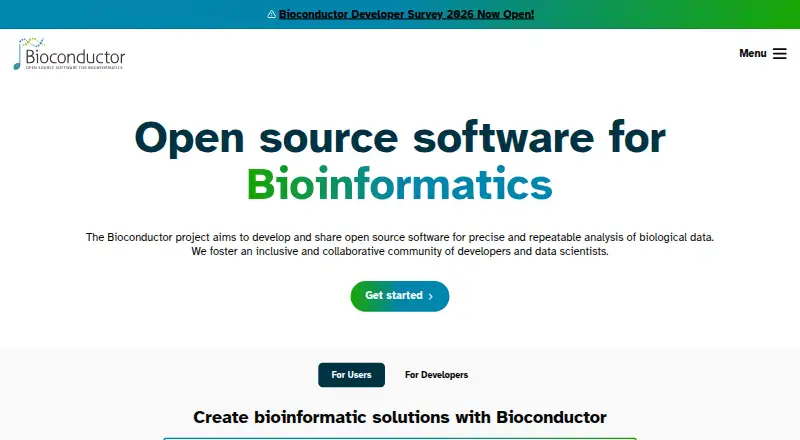
What Bioconductor is
Bioconductor is a free, open-source software project for analyzing biological and genomic data with R. Most of its tools are distributed as R packages, with methods for DNA microarray, sequence, flow, SNP, and other genetic or genomic data. It also provides ways to associate genomic results with biological metadata from resources such as GenBank, Entrez genes, and PubMed.
The project supports reproducible research through task-focused vignettes included with each package. Users can choose the stable release, updated twice a year, or a development version that includes new features and packages. Releases are built for specific R versions; the current release page lists Bioconductor 3.23 with R 4.6.0. Docker containers with R and Bioconductor preinstalled support reproducible environments. Deployment guidance covers Amazon ECS, Google Kubernetes Engine, Microsoft Azure Container Instances, Docker Desktop, and Docker Engine. The project began in 2001 and is overseen by a core team. Researchers and data scientists can get help through the Bioconductor Support site and community chat.
Who it suits
Bioconductor suits researchers and data scientists working with biological or genomic data who use R. It is relevant to analyses involving microarray, sequence, flow, SNP, or other genetic data, especially when reproducibility matters.
What it does well
- Free open-source software with no paid plans stated
- R packages cover several types of genetic and genomic analysis
- Tools connect genomic data with biological metadata
- Package vignettes support reproducible research
- Docker containers provide preinstalled R and Bioconductor versions
- Support site and community chat offer help
What to know first
- Each release is designed for a specific R version
- Private packages are not supported
- Package size limit is 10 MB
Limits
The listed package size limit is 10 MB, and private packages are not supported. Each release is designed for a specific R version.
Plans
| Plan | Billed and limits | Price |
|---|---|---|
| Bioconductor | Free open-source software; no paid plans or usage limits stated | Free |
| Free | Free · open-source bioinformatics software · R packages · Docker containers | Free |
As bioconductor.org lists them, read 7 Oct 2026. The maker's own page has the final word.
Getting started
- Visit https://bioconductor.org/.
- Choose the stable release or development version.
- Match the release to its supported R version.
- Use the R-based package ecosystem for biological data analysis.
- Consider the provided Docker containers for a reproducible environment.
- Consult the Support site or community chat for help.
Bioconductor is a free, open-source ecosystem of R packages for biological data analysis. It is aimed at researchers and data scientists working with genomic and related data. Its specialist methods and reproducibility tools make it a strong fit for that work, though release-to-R compatibility can constrain upgrades.
Overview
Founded in 2001 and overseen by a core team, Bioconductor develops software for rigorous analysis of biological data. Rather than serving as a general-purpose package registry, it concentrates on methods for DNA microarray, sequence, flow, SNP and other genetic or genomic data. That focus is valuable when the work is biological; it makes Bioconductor a poor fit for teams looking for a language-neutral package ecosystem.
Most components are R packages, so users need to be comfortable working in R. The ecosystem is free, with no paid plans or usage limits stated, but it does not support private packages and has a 10 MB package size limit. Those constraints matter to organizations that need private distribution or larger packages.
Key features
Analysis and biological metadata
Packages cover several kinds of genetic and genomic analysis, while metadata tools associate genomic data with biological resources including GenBank, Entrez genes and PubMed. That combination helps researchers place results in biological context rather than treating data as files to process in isolation.
Reproducibility and release cadence
Each package includes one or more task-oriented vignettes, and reproducible research is a project goal. Bioconductor maintains a stable release updated twice a year alongside a development version for new features and packages. The cadence gives users a maintained path for established work and a route to newer additions, but adopting a release requires checking its R compatibility: each release is designed for a particular R version. The current release page pairs Bioconductor 3.23 with R 4.6.0.
Containerized environments and support
Docker containers with preinstalled R and Bioconductor versions support reproducible environments. The project documents container deployment on Amazon ECS, Google Kubernetes Engine and Microsoft Azure Container Instances, as well as Docker Desktop or Docker Engine. Users can seek help through the Bioconductor Support site and community chat. The project publishes a community Code of Conduct; it does not state a security certification or compliance standard.
Pricing
Bioconductor: free. The plan is free open-source software, with no paid plans or usage limits stated. There is no free trial because the software is free. The practical limits are not a subscription quota: private packages are not supported, and packages are capped at 10 MB.
Platforms
Bioconductor is listed for Linux, macOS, Windows, web and self-hosted use. The R-version requirement and container options are important practical considerations for teams managing consistent environments across those platforms.
Who it's for
Researchers and data scientists who analyze biological or genomic data in R are the natural audience, particularly when they need methods for multiple data types, biological metadata, and reproducible workflows. It is less suitable for teams centered on another programming language, private package distribution or packages larger than 10 MB.
Pros and cons
Pros
- Specialist analysis: Packages address DNA microarray, sequence, flow, SNP and other genetic or genomic data.
- Biological context: Metadata tools connect genomic data with resources such as GenBank, Entrez genes and PubMed.
- Reproducibility support: Task-oriented vignettes and versioned Docker containers support repeatable work.
- No software charge: The free plan has no paid tier.
Cons
- R-centered ecosystem: Most components are R packages, limiting its appeal to teams using other languages.
- Version coupling: Each release targets a specific R version, so upgrades need compatibility planning.
- Distribution limits: Private packages are unsupported and package size is limited to 10 MB.
- No stated security standard: The project publishes a conduct policy but does not state a security certification or compliance standard.
Alternatives
Browse Package Registries for other package distribution options. Choose CPAN instead for a free Perl software and documentation archive, or Inedo ProGet if you need private packages and Docker feeds, accepting that its free edition has limited security and compliance features. LuaRocks is the free package manager and module hosting service for Lua-oriented needs. For public package authors who want unlimited public packages, npm offers a free plan. pypiserver is a self-hosted, open-source package server with a minimal PyPI-compatible API, while R-universe is a free public publishing platform that requires a GitHub account to publish a packages.json registry. Choose aptly for its free CLI tool and HTTP REST service, or CocoaPods as another free package tool.
Verdict
Bioconductor is the right choice for R-based biological and genomic analysis when specialized methods and reproducibility matter more than broad package management. Its free access, biological metadata tools and versioned environment support are compelling; look elsewhere if you need another language, private packages, larger packages or more formal security assurances.
Verdict
Choose Bioconductor if you work with biological or genomic data in R and need a broad set of analysis packages with reproducibility support. Check release and R compatibility before choosing a version; users needing private packages or packages over 10 MB should look elsewhere.
Questions
Is Bioconductor free?
Yes. The listed plan is free, and no paid plans are stated.
What does Bioconductor analyze?
Its packages support DNA microarray, sequence, flow, SNP, and other genetic or genomic data analysis.
Which programming language does it use?
Bioconductor uses R, and most components are distributed as R packages.
Which R version works with a release?
Each release is designed for a specific R version. The current release page lists Bioconductor 3.23 with R 4.6.0.
Does Bioconductor provide Docker containers?
Yes. It provides containers with preinstalled R and Bioconductor versions.
Where can users get help?
Users can seek help through the Bioconductor Support site and community chat.
Facts from Bioconductor's own pages
- Analysis methods
- Its packages support analysis of DNA microarray, sequence, flow, SNP, and other genetic or genomic data. · bioconductor.org, 7 Oct 2026
- Biological annotation
- Annotation tools connect genomic results with resources including GenBank, Entrez Genes, PubMed, Gene Ontology and UCSC data. · bioconductor.org, 15 Oct 2026
- Common platform
- The project aims to provide extensible, scalable and interoperable software through shared data structures and package conventions. · bioconductor.org, 15 Oct 2026
- Company founding
- Bioconductor started in 2001. · bioconductor.org, 15 Oct 2026
- Company location
- SourceForge lists Bioconductor's company information location as the United States. · sourceforge.net, 15 Oct 2026
- Compatibility limit
- Each Bioconductor release is designed for a specific R version; the current release page lists Bioconductor 3.23 with R 4.6.0. · bioconductor.org, 7 Oct 2026
- Current release
- Release 3.23 was published April 29, 2026 with 2,418 software packages and R 4.6 compatibility. · bioconductor.org, 15 Oct 2026
- Dependencies
- The project warns that its structured releases create extensive inter-package dependencies and require packages to stay within a compatible release. · bioconductor.org, 15 Oct 2026
- Developer extensibility
- Developers can submit R packages that undergo open review and are expected to meet documentation, interoperability and build-check requirements. · journals.plos.org, 15 Oct 2026
- Docker
- Official Docker images are provided for every supported Bioconductor release plus a development image. · bioconductor.org, 15 Oct 2026
- Documentation
- Each package contains one or more task-oriented vignettes, including tutorials and workflow explanations. · bioconductor.org, 15 Oct 2026
- Founded
- 2001 · bioconductor.org, 28 Sept 2026
- Genomic analysis
- Its packages cover DNA microarray, sequence, flow-cytometry, SNP and other genomic-data analyses. · bioconductor.org, 15 Oct 2026
- Installation
- The recommended installer is BiocManager, which selects repositories matching the installed R and Bioconductor versions. · bioconductor.org, 15 Oct 2026
- Integrations
- SourceForge lists integrations with R and Docker. · sourceforge.net, 15 Oct 2026
- Intended users
- The project serves researchers and data scientists working with biological and genomic data. · bioconductor.org, 7 Oct 2026
- Licence
- Core Bioconductor packages are typically licensed under Artistic-2.0, while individual packages may use other open-source licences. · contributions.bioconductor.org, 15 Oct 2026
- Limit: compatibility
- Respondents reported friction with tidyverse compatibility, duplicate packages, namespace collisions and some packages that install dependencies unexpectedly. · sa-lee.github.io, 15 Oct 2026
- Limit: learning curve
- Survey respondents reported a steep learning curve because the ecosystem contains many packages and choices. · sa-lee.github.io, 15 Oct 2026
- Limit: outages
- The public status history records incidents including a package-stats failure lasting 26 hours 58 minutes and an archive outage lasting 24 hours 3 minutes. · dev.status.bioconductor.org, 15 Oct 2026
- Limit: release cycle
- Survey respondents said the six-month development and release cycle can be inconvenient and that non-Bioconductor dependencies can be difficult to identify. · sa-lee.github.io, 15 Oct 2026
- Limit: website usability
- Survey respondents criticized the website as difficult for new users and developer information as redundant or scattered. · sa-lee.github.io, 15 Oct 2026
- LinkedIn founding fact
- LinkedIn describes Bioconductor as an open-source project founded in 2001 and used in bioinformatics and biomedical research. · linkedin.com, 15 Oct 2026
- Metadata
- Bioconductor provides tools for associating genomic data with biological metadata from resources including GenBank, Entrez genes, and PubMed. · bioconductor.org, 7 Oct 2026
Where Bioconductor stands on Freedom251
- Package Registries#1 of 28
- Data Science and Machine Learning Platforms#1 of 26