Freedom251 › Container Registries

Inedo ProGet
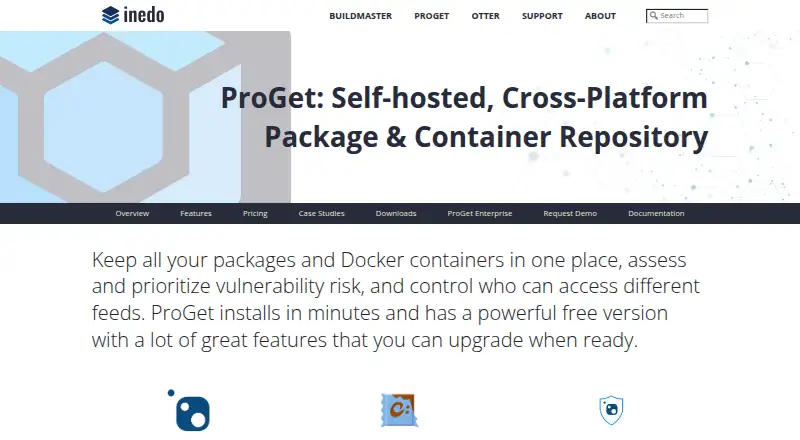
What Inedo ProGet is
Inedo ProGet is a package and container repository that teams can self-host or deploy in cloud environments. It keeps package feeds and Docker containers together, with controls for access and tools to scan vulnerabilities. Supported package formats include NuGet, PyPI, Conda, npm, Ruby Gems, Maven, Chocolatey, PowerShell/DSC, RPM/Yum, Debian/apt, and Alpine/APK. Teams can cache packages locally, create approval workflows, detect licenses, and block packages that do not meet requirements. ProGet can host private Docker registries and scan container packages to help control which images reach production. It integrates with CI/CD tools and provides a CLI and HTTP API for identifying components and publishing SBOMs. Windows installation is managed through Inedo Hub; Linux hosting uses Docker, and cloud VM or container deployment is also supported. Identity and scale features include LDAP, SAML, load balancing, high availability, and feed replication for disaster recovery. The Free Edition allows commercial use and unlimited feeds, but has limited security and compliance features. Paid plans start at $2,395/year; licensing is annual per server, and test or development installations need separate licenses.
Who it suits
ProGet suits teams managing packages and containers across development workflows, including organizations that need self-hosted or cloud deployment. Its plans span small teams through enterprise, though licensing is per server.
What it does well
- Free Edition permits commercial use.
- Supports numerous package formats and Docker containers.
- Can create approval workflows and detect licenses.
- Offers LDAP, SAML, and high availability.
- Provides a CLI and HTTP API.
What to know first
- Free Edition has limited security and compliance features.
- Licenses are annual per server.
- Test or development installations require separate licenses.
Limits
The Free Edition has limited security and compliance features. Test and development installations require separate licenses.
Plans
| Plan | Billed and limits | Price |
|---|---|---|
| ProGet Free Edition | limited security and compliance features · unlimited feeds for private packages and Docker | Free |
| Enterprise Essentials | $11,995/year · enterprise-level security · protection · compliance features | $11,995 a year |
| ISV Edition | Starting from $11,995/yr · customer download center · licensed products · maintainable by your team | $11,995 a year |
| Basic | $2,395/year · small teams · basic security needs | $2,395 a year |
| Enterprise Complete | Starting From $29,995/year · multiple licenses · production and sandbox · dedicated support | $29,995 a year |
| Cloud Edition | Starting from $4,895/yr · managed services · proactive monitoring · 20TB bandwidth · 400GB storage | $4,895 a year |
| Edge Edition | Starting at $59,995/yr · ProGet Enterprise features · scalable pricing · edge nodes · dashboards | $59,995 a year |
As inedo.com lists them, read 28 Sept 2026. The maker's own page has the final word.
Getting started
- Choose Windows installation through Inedo Hub, Linux hosting through Docker, or a cloud VM or container deployment.
- Select the Free Edition or a paid plan for your needs.
- Connect package sources such as NuGet.org, Azure DevOps Packages, or Artifactory feeds.
- Connect your CI/CD tools using ProGet's integrations, CLI, or HTTP API.
- Configure feed access and package approval workflows.
Inedo ProGet is a package and container repository for organizations managing software across multiple ecosystems. It suits teams that need private feeds, security controls and deployment options; its breadth is strongest when those controls matter across more than one package format.
Overview
ProGet brings package feeds and Docker containers into a shared repository, with self-hosted and cloud deployment options. It supports 22 formats, including NuGet, PyPI, Conda, npm, Ruby Gems, Maven, Chocolatey and Linux distribution packages. That range can reduce the need to manage separate repositories, though a team centered on one public registry may not need ProGet's wider governance features.
Teams can cache upstream packages locally, route them through approval workflows, detect licenses and block noncompliant packages. Fine-grained feed access and retention rules add control over what is stored and who can retrieve it. The Free Edition is usable commercially, but its reduced security and compliance features make it a weaker fit where governance is central.
Key features
Package and container controls
ProGet can create private Docker registries, scan container contents for vulnerabilities and help ensure that only approved images reach production. These controls are useful for teams that want package and container review in the same workflow rather than treating images as a separate repository problem.
It integrates with nearly any CI/CD tool and offers a CLI and HTTP API for component identification and SBOM publishing. Connectors can aggregate feeds from ProGet, NuGet.org, Azure DevOps Packages and Artifactory. This flexibility supports mixed toolchains, while teams should account for the additional setup that comes with consolidating several sources.
Security, identity and storage
Inedo says its Security Labs maintains vulnerability data and dedicates 10% of its resources to cybersecurity research. ProGet also supports LDAP, SAML, load balancing and high availability; feed replication can support disaster recovery. Asset Directories can store or replicate assets across S3, Google Cloud, Azure, local storage and cloud storage. Together, these options suit organizations with infrastructure and identity requirements beyond a basic private package feed.
Pricing
ProGet is freemium, with a free trial and annual per-server licensing for paid editions. Every edition supports unlimited users and feeds, but separate licenses are required for test or development installations. That per-server rule can matter to teams that maintain separate production and nonproduction environments.
- ProGet Free Edition: free. It allows unlimited feeds for private packages and Docker, making it a practical starting point for commercial use when limited security and compliance features are acceptable.
- Basic: $2,395 a year, billed $2,395/year. Aimed at small teams with basic security needs; it is the lower-cost paid option, but is not positioned for enterprise-level security and compliance.
- Cloud Edition: $4,895 a year, starting from $4,895/yr. It includes managed services, proactive monitoring, 20TB bandwidth and 400GB storage, fitting teams that want cloud operations rather than self-hosting.
- Enterprise Essentials: $11,995 a year, billed $11,995/year. It targets organizations seeking enterprise-level security, protection and compliance features.
- ISV Edition: $11,995 a year, starting from $11,995/yr. Its customer download center and licensed-product focus suit software vendors maintaining their own distribution service.
- Enterprise Complete: $29,995 a year, starting from $29,995/year. It includes multiple licenses, production and sandbox, and dedicated support for organizations needing those capabilities.
- Edge Edition: $59,995 a year, starting at $59,995/yr. It combines ProGet Enterprise features with scalable pricing, edge nodes and dashboards for edge deployments.
All paid plans use annual server licensing. The free tier's unlimited feeds and users do not remove its security and compliance trade-off, while teams with multiple test or development servers should include their separate licenses in the decision.
Platforms
ProGet supports Windows, Linux, web and API use. Windows installation is managed through Inedo Hub; Linux hosting uses Docker. Cloud VM and container deployment are supported alongside self-hosting. The installation guide recommends at least 2 vCPU and 2 GB RAM for Linux containers, and ProGet itself uses less than 1GB of disk space. This gives infrastructure teams concrete minimums for a Linux deployment without implying that every workload will need only those resources.
Who it's for
ProGet is a good fit for small teams through enterprises that need to centralize packages and containers while applying access, vulnerability, license and approval controls. Its support for SAML and LDAP, high availability and feed replication is relevant to organizations with identity and resilience needs. Teams seeking only public package publishing, or those unwilling to license separate development and test servers, may prefer a narrower service.
Pros and cons
- Pros: 22 supported formats and connectors for several major package sources help consolidate mixed-language feeds.
- Pros: Approval workflows, vulnerability and license checks, and controls over Docker images support policy enforcement before production.
- Pros: Unlimited users and feeds across editions avoid seat and feed caps as teams grow.
- Cons: The Free Edition has limited security and compliance features, so it may not satisfy teams whose main need is governance.
- Cons: Annual per-server licensing and separate test or development licenses can raise the cost of multi-environment use.
- Cons: Higher-tier plans reach custom-scale annual commitments, making them a substantial choice for teams that need only a basic registry.
Alternatives
npm is a freemium choice for public package authors, with a free plan for public package publishing and registry access; choose it when that public npm workflow is the priority rather than centralized multi-format package and container controls.
Hex offers a free Open Source plan for public packages. It is the more focused option when public package hosting is the need.
Maven Central provides free community open-source publishing with monthly file, release-size and release-count limits; choose it for that publishing purpose rather than an organization-wide repository.
PyPI has a free community organization plan and a company organization plan priced at $5 a month; it fits teams focused on Python package distribution.
Conan is a free and open-source option for C and C++ package, dependency and binary management.
NuGet is a free alternative for teams working in its package ecosystem.
RubyGems.org is a free alternative for Ruby package distribution.
R is free software for users seeking an R environment rather than a general package and container repository.
For broader comparisons, see Package Registries, Container Registries and Artifact repository software.
Verdict
Choose ProGet if your organization needs one repository for packages and containers, with controls to review components, manage access and govern production images. Its format coverage and deployment choices are compelling for mixed toolchains; look elsewhere if you need only a public single-ecosystem registry or cannot justify annual per-server licensing across separate environments.
Verdict
ProGet combines package and container management with controls for vulnerabilities, licenses, and access. Consider its edition limits and per-server licensing, especially if separate test or development installations are needed.
Questions
Is Inedo ProGet free?
Yes. The Free Edition is $0.00 per free and can be used commercially, with unlimited feeds for private packages and Docker.
How much do paid plans cost?
Basic is $2,395 per year. Other listed plans range from $4,895 per year for Cloud Edition to $59,995 per year for Edge Edition.
Which platforms and deployment options does ProGet support?
It supports API, Linux, self-hosted, web, and Windows platforms, with cloud and self-hosted deployment. Windows installation uses Inedo Hub; Linux hosting is provided through Docker.
Which package formats does ProGet support?
It supports formats including NuGet, PyPI, Conda, npm, Ruby Gems, Maven, Chocolatey, PowerShell/DSC, RPM/Yum, Debian/apt, and Alpine/APK.
Which integrations are available?
Named integrations include NuGet.org, npmjs.org, Azure DevOps Packages, JFrog Artifactory, AWS, Azure, Google Cloud, LDAP, Active Directory, SAML, and CI/CD tools.
How is ProGet licensed?
Licenses are annual per server. All editions support unlimited users and feeds, and separate licenses are required for test or development installations.
Facts from Inedo ProGet's own pages
- CI/CD integration
- ProGet integrates with nearly any CI/CD tool and provides a CLI and HTTP API for identifying components and publishing SBOMs. · inedo.com, 28 Sept 2026
- Company size fit
- small, mid market, enterprise · inedo.com, 22 Sept 2026
- Compliance
- sso saml · inedo.com, 22 Sept 2026
- Containers
- ProGet can create private Docker registries, scan vulnerable packages within containers, and ensure only approved images reach production. · inedo.com, 28 Sept 2026
- Deployment
- cloud, self hosted · inedo.com, 22 Sept 2026
- Free-edition limit
- The Free Edition can be used commercially but has limited security and compliance features. · inedo.com, 28 Sept 2026
- Headquarters
- Berea, Ohio, United States; Tokyo, Japan · inedo.com, 23 Sept 2026
- Identity and scale
- ProGet supports load balancing, high availability, LDAP, and SAML, and feed replication can support disaster recovery. · inedo.com, 28 Sept 2026
- Installation platforms
- Windows installation is managed by Inedo Hub, while Linux hosting is provided through Docker; cloud VM or container deployment is also supported. · inedo.com, 28 Sept 2026
- Integrations
- NuGet.org, npmjs.org, Azure DevOps Packages, JFrog Artifactory, AWS, Azure, Google Cloud, LDAP, Active Directory, SAML, CI/CD tools · inedo.com, 22 Sept 2026
- Licensing limits
- ProGet is licensed annually per server, all editions support unlimited users and feeds, and separate licenses are required for test or development installations. · inedo.com, 28 Sept 2026
- Linux requirements
- The installation guide lists 2 vCPU and 2 GB RAM as minimum recommended container resources and says ProGet itself uses less than 1GB of disk space. · docs.inedo.com, 28 Sept 2026
- Named integrations
- Its connectors can aggregate packages from ProGet, NuGet.org, Azure DevOps Packages, and Artifactory feeds. · docs.inedo.com, 28 Sept 2026
- Open-source curation
- It can cache packages locally, create approval workflows, scan vulnerabilities, detect licenses, and block noncompliant packages. · inedo.com, 28 Sept 2026
- Package formats
- ProGet supports NuGet, PyPI, Conda, npm, Ruby Gems, Maven, Chocolatey, PowerShell/DSC, RPM/Yum, Debian/apt, and Alpine/APK packages. · inedo.com, 28 Sept 2026
- Security ownership
- Inedo says it has its own security analysts and vulnerability database through Inedo Security Labs, which dedicates 10% of resources to cybersecurity research. · inedo.com, 28 Sept 2026
- Storage options
- Asset Directories can store or replicate assets between S3, Google Cloud, Azure, local storage, and the cloud. · inedo.com, 28 Sept 2026
- Support
- Inedo provides engineer-led forum support, private support tickets for paid users, and professional services for training, maintenance, and custom scripts or plug-ins. · inedo.com, 28 Sept 2026
- Support channels
- community, ticket, docs · inedo.com, 22 Sept 2026
- What it does
- ProGet is a self-hosted, cross-platform package and container repository for keeping packages and Docker containers in one place, scanning vulnerabilities, and controlling feed access. · docs.inedo.com, 28 Sept 2026
Where Inedo ProGet stands on Freedom251
- Container Registries#9 of 60
- Package Registries#7 of 28
- Artifact repository software#17 of 64