Freedom251 › Test Analytics Software

Qualflare
What Qualflare is
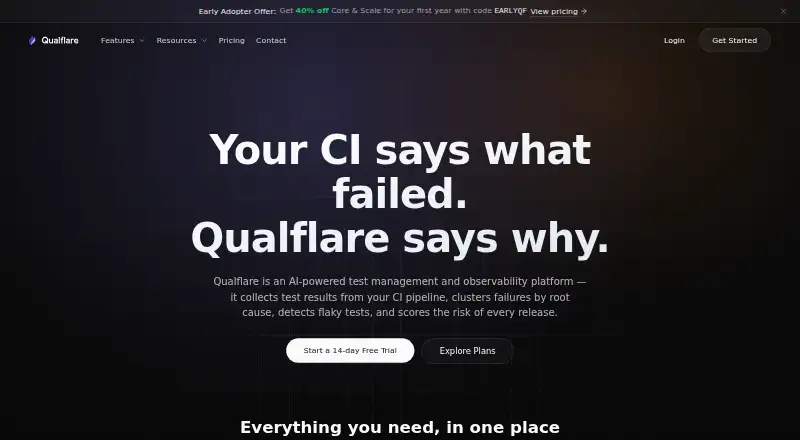
Qualflare is an AI-powered test management and observability platform that collects CI results, groups failures, detects flaky tests, and scores release risk. Teams can manage manual tests in the web application or use the CLI to upload automated results from 23 testing frameworks, including JUnit, pytest, Jest, Playwright, Cypress, Newman, k6, and security tools. Its assistant, Quo, analyzes coverage gaps, suggests test cases, generates test steps, and answers questions about test-management data. AI Failure Clusters group similar failures and provide root-cause summaries, fix suggestions, and severity information. Integrations include GitHub, GitLab, Jira, Slack, Discord, Jenkins, and custom webhooks; a REST API uses project-scoped access tokens. The free Starter plan includes one project, one active user, 200 test cases, and 100 reports. Core is listed at $16 a month, with a 40% early-adopter discount of $9.60/user/mo for the first 12 months. Qualflare ingests mobile test results but does not provision devices or run mobile tests.
Who it suits
Qualflare suits teams that manage manual tests and collect automated CI results across supported frameworks. It can also suit teams that want to track failures, flaky tests, and release risk, while mobile teams should note its limited testing scope.
What it does well
- Free Starter plan available.
- CLI supports results from 23 testing frameworks.
- Detects flaky tests and groups similar failures.
- REST API offers project-scoped access tokens.
- Customer data is stored in the European Union.
What to know first
- Does not provision devices or run mobile tests.
- Does not currently hold SOC 2 Type II or ISO 27001 certification.
- Starter is limited to one project and one active user.
Limits
Starter includes one project, one active user, 200 test cases, and 100 test reports, with 30-day project retention. Core is listed at $16.00 per month and includes three projects, 10 active users, 1,000 test cases, and 2,000 reports; its listed early-adopter rate is $9.60/user/mo for the first 12 months. The 14-day trial is available.
Plans
| Plan | Billed and limits | Price |
|---|---|---|
| Starter | $0 / user / mo · 1 project · 1 active user · 200 test cases · 100 test reports · API access · basic analytics · CI/CD integrations · community support | Free |
| Open source plan | Free for eligible public GitHub projects · Public OSI-licensed repository · public report page · README badge/banner · higher usage limits than Starter | Free |
| Core | $9.60 / user / mo for first 12 months with 40% early-adopter discount, then $16 · 3 projects · 10 active users · 1,000 test cases · 2,000 test reports · shared steps and plans · unlimited AI analysis and RCA · priority email support | $16 a month |
| Scale | $28.80 / user / mo for first 12 months with 40% early-adopter discount, then $48 · 10 projects · 30 active users · 5,000 test cases · 10,000 test reports · advanced analytics · AI suite optimization · priority email support | $48 a month |
| Enterprise | Custom · Unlimited projects and users · unlimited test cases and reports · SSO · custom branding · 99.9% SLA · 24/7 support | On request |
As qualflare.com lists them, read 15 Oct 2026. The maker's own page has the final word.
Getting started
- Open https://qualflare.com/.
- Choose the free Starter plan or review the Core, Scale, and Enterprise plans.
- Use the web application to manage manual tests.
- Use the CLI to upload automated test results.
- Connect the integrations your team uses, or use the REST API with a project-scoped access token.
Qualflare combines test management with automated test-result analysis for engineering and QA teams working across multiple frameworks. It is most compelling when teams want shared failure triage and release-risk signals; it is a weaker fit for teams that need mobile test execution or certified compliance.
Overview
Manual cases live in Qualflare’s web app, while its CLI collects automated results from 23 frameworks. That lets teams bring varied test suites into a single workflow rather than organizing around one framework. The product also scores release risk and reports execution trends, giving teams context for interpreting results rather than only pass-or-fail records.
Quo, the AI assistant, can identify coverage gaps, suggest test cases, generate test steps, and answer questions about test-management data. AI Failure Clusters group similar failures and offer root-cause summaries, suggested fixes, and severity information. These tools can help prioritize investigation, but they do not replace engineering judgment about causes or release readiness.
Key features
- Framework-wide result collection: The CLI supports tools including JUnit, pytest, Jest, Playwright, Cypress, Newman, k6, OWASP ZAP, and Trivy. Its range spans application, performance, and security testing, useful for teams with mixed pipelines.
- Failure and flakiness analysis: Clusters, flaky-test detection, and trend reports help teams spot recurring problems and changes over time. They add triage context, not a substitute for fixing unstable tests.
- Integrations and API: GitHub, GitLab, Jira, Slack, Discord, Jenkins, and webhooks support CI/CD workflows, notifications, and defect synchronization. A REST API with project-scoped tokens supports test cases, results, launches, and other test data.
- Security and data location: Qualflare states that it uses TLS 1.2+ in transit, AES-256 at rest, role-based access controls, and immutable employee-access audit logs; staff access requires SSO and MFA. Customer data is stored in the EU. The company does not hold SOC 2 Type II or ISO 27001 certification, which may rule it out for organizations requiring either certification.
Pricing
Qualflare is freemium, with a free Starter plan, paid plans from $16/user/mo (annual), and a 14-day trial. The plan limits make project and report volume important factors in choosing a tier.
| Plan | Price | Limits and support |
|---|---|---|
| Starter | free (billed monthly) | 1 project, 1 active user, 200 test cases, 100 test reports; 30-day default retention; community support. |
| Core | $16 a month; billed 40% early-adopter discount: $9.60/user/mo for first 12 months | 3 projects, 10 active users, 1,000 test cases, 2,000 test reports; 90-day default retention; priority email support. |
| Scale | $48 a month; billed 40% early-adopter discount: $28.80/user/mo for first 12 months | 10 projects, 30 active users, 5,000 test cases, 10,000 test reports; one-year default retention; priority email support. |
| Enterprise | Custom pricing | Unlimited projects, users, cases, and reports; custom retention; 24/7 support and a 99.9% SLA. |
Starter is a narrow entry point for an individual or small evaluation: one active user and 100 reports constrain collaboration and ongoing result history. Core raises the ceilings for small teams, while Scale suits larger programs that need more projects, users, and retained history. The paid plan figures include a first-year early-adopter discount; the discount is stated for the first 12 months, so teams should account for that term when budgeting. Public OSI-licensed GitHub projects can apply for a free Open Source plan with higher limits, public reports, and README badges or banners.
Platforms
Qualflare supports web, API, Linux, macOS, and Windows. It can ingest Android, iOS, and cross-platform mobile test results, but it does not provision devices or execute mobile tests. Mobile teams needing a platform to run tests themselves should look elsewhere.
Who it's for
Qualflare fits development and QA teams that need manual case management alongside CI results from varied frameworks, especially when failure clustering, flakiness detection, and release-risk scoring are valuable. The Starter tier can support an individual trial, while growing teams will need paid capacity for more users, projects, cases, and reports. It is less suitable for teams requiring built-in mobile execution, self-hosted deployment, or SOC 2 Type II or ISO 27001 certification.
Pros and cons
- Pro: Broad framework coverage and integrations let teams consolidate results across different test stacks and CI/CD services.
- Pro: Failure clusters, flaky-test detection, trend reports, and release-risk scoring provide several signals for prioritizing triage.
- Pro: EU data storage and stated encryption and access controls address important security considerations.
- Con: Starter is limited to one active user, one project, and 100 reports, so it is better for evaluation than shared team use.
- Con: Mobile results are accepted, but tests must be run and devices provisioned elsewhere.
- Con: No self-hosted option or SOC 2 Type II and ISO 27001 certifications may conflict with deployment or procurement requirements.
Alternatives
ReportPortal is worth considering when self-hosting matters: its free community edition is open-source, self-hosted, and supports Docker, Kubernetes, or Google Cloud Marketplace deployment. TestBeats is another freemium option, with Pro 200 at $18 a month and up to 400 test runs, for buyers comparing credit-based test-run plans.
Allure Report is a free, Apache-licensed open-source test reporting tool for teams seeking that narrower reporting option. Buildkite may suit teams focused on CI capacity: its free plan includes up to 5 users, 10 concurrent jobs, and 2,000 Linux vCPU minutes per month.
Testspace, Tesults, Argos, and BrowserStack Test Reporting & Analytics are other options to compare.
For broader comparisons, see Test Analytics Software and Test Flakiness Management Software.
Verdict
Choose Qualflare if your team wants one place for manual test management, results from a broad set of frameworks, and AI-assisted failure triage. Its Starter caps and paid-plan quotas deserve careful consideration, and teams needing mobile execution, self-hosting, or formal SOC 2 or ISO certification should choose a different fit.
Verdict
Qualflare brings manual test management, automated result collection, and AI-assisted failure analysis into one platform. Its Starter limits and lack of mobile test execution are important considerations for teams evaluating its fit.
Questions
Is there a free plan?
Yes. Starter costs nothing and includes one project, one active user, 200 test cases, and 100 test reports.
How much do paid plans cost?
Core is listed at $16.00 per month, with a billed early-adopter rate of $9.60/user/mo for the first 12 months. Scale is listed at $48.00 per month, with a billed early-adopter rate of $28.80/user/mo for the first 12 months. Enterprise uses custom pricing.
Is there a free trial?
Yes, Qualflare offers a 14-day trial.
Which platforms does it support?
Qualflare supports API, Linux, macOS, web, and Windows.
Which tools and services does it integrate with?
Integrations include GitHub, GitLab, Jira, Slack, Discord, Jenkins, and custom webhooks. CI/CD integrations also include GitHub Actions, GitLab CI, CircleCI, Travis CI, and Azure DevOps.
Where is customer data stored, and what certifications does Qualflare hold?
Customer data is stored in the European Union. Qualflare states that it does not currently hold SOC 2 Type II or ISO 27001 certification.
Facts from Qualflare's own pages
- AI analysis
- Its Quo Agent can identify coverage gaps, suggest test cases, and help investigate flaky suites. · qualflare.com, 15 Oct 2026
- AI assistant
- Quo analyzes coverage gaps, suggests test cases, generates test steps, and answers questions about test-management data. · qualflare.com, 1 Oct 2026
- API
- Qualflare provides a REST API for managing test cases, uploading results, querying launches, and accessing other test data with project-scoped access tokens. · docs.qualflare.com, 1 Oct 2026
- Browser support
- The service supports current Chrome, Firefox, Safari, and Edge browsers. · docs.qualflare.com, 15 Oct 2026
- Certification limitation
- The GDPR page says Qualflare itself does not hold SOC 2 Type II, ISO 27001, or GDPR certification. · qualflare.com, 15 Oct 2026
- CLI installation
- The qf CLI is distributed through Homebrew, a curl installer, Chocolatey, Docker, and downloadable binaries. · docs.qualflare.com, 15 Oct 2026
- CLI licence
- The published @qualflare/cli package is Apache-2.0 licensed, has no runtime dependencies, and provides macOS, Linux, and Windows binaries. · npmjs.com, 15 Oct 2026
- CLI query features
- CLI commands can validate files, upload collections, and query suites, cases, plans, launches, defects, clusters, and milestones with JSON output. · docs.qualflare.com, 15 Oct 2026
- Company founding
- G2 lists Qualflare as serving customers since 2026. · g2.com, 15 Oct 2026
- Company legal identity
- Crunchbase lists the active private company as Qualflare OÜ and names İbrahim Süren as founder. · crunchbase.com, 15 Oct 2026
- Company location
- Company listings place Qualflare in Tallinn, Harjumaa, Estonia. · crunchbase.com, 15 Oct 2026
- Company size
- Crunchbase places Qualflare in the 1–10 employee range. · crunchbase.com, 15 Oct 2026
- Compliance
- Qualflare stores customer data in the European Union and states that it does not currently hold SOC 2 Type II or ISO 27001 certification. · qualflare.com, 1 Oct 2026
- Data retention
- Project retention defaults are 30 days for Starter, 90 days for Core, one year for Scale, and custom retention for Enterprise. · docs.qualflare.com, 1 Oct 2026
- Defect automation
- Core and higher plans can automatically create defects from failed test results. · qualflare.com, 15 Oct 2026
- Documentation and support
- Qualflare provides a searchable documentation site, FAQ, troubleshooting guides, GitHub discussions/issues, status page, and direct support channels. · docs.qualflare.com, 15 Oct 2026
- Failure analysis
- AI Failure Clusters group similar failures and provide root-cause summaries, fix suggestions, and severity information. · qualflare.com, 1 Oct 2026
- Failure clustering
- Qualflare groups related failures and provides root-cause analysis for paid Core features and above. · qualflare.com, 15 Oct 2026
- Flaky detection
- All listed plans include flaky-test detection for identifying unstable tests. · qualflare.com, 15 Oct 2026
- Framework coverage
- The CLI accepts results from frameworks and tools including JUnit, pytest, Jest, Playwright, Cypress, Selenium, Appium, Newman, k6, OWASP ZAP, Trivy, Snyk, and SonarQube. · qualflare.com, 15 Oct 2026
- Framework support
- The Qualflare CLI parses and uploads results from 23 testing frameworks, including JUnit, pytest, Jest, Playwright, Cypress, Newman, k6, and security tools. · docs.qualflare.com, 1 Oct 2026
- GDPR posture
- Qualflare says EU customer data is stored in Google Cloud Warsaw with EU routing, uses TLS 1.2+, AES-256 at rest, staff MFA, access auditing, and SCC-based contractual protections. · qualflare.com, 15 Oct 2026
- Go SDK limitation
- The qualflare-go reporter is Apache-2.0 and has documented limitations involving pre-1.24 Go builds, goroutine metadata, and retry handling. · pkg.go.dev, 15 Oct 2026
- Headquarters
- Tallinn, Estonia · qualflare.com, 28 Sept 2026
Where Qualflare stands on Freedom251
- Test Analytics Software#10 of 30
- CI Failure Analysis And Flaky Test Tools#7 of 21
- Test Flakiness Management Software#12 of 31