Freedom251 › Test Analytics Software

Allure Report
What Allure Report is
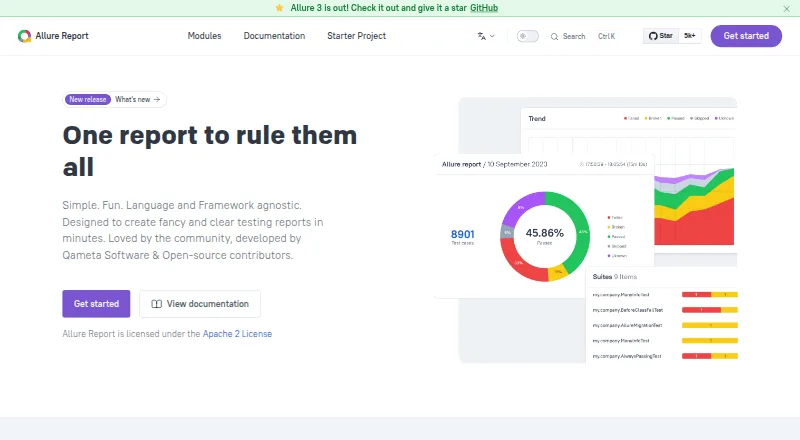
Allure Report converts test execution data into interactive HTML reports for reviewing unit, API, and end-to-end test results. Reports can include test steps, attachments, timings, metadata, logs, and screenshots. The tool identifies unstable tests, groups flaky failures, and tracks historical results. Allure 3 adds rerun grouping, reporting across multiple environments, real-time reporting, and project-wide quality gates. Its integrations directory lists more than 50 testing tools and frameworks, while documentation describes integrations with Jenkins, GitHub Actions, Azure DevOps, JetBrains IDEs, and Visual Studio Code. Test collection and report generation can run locally without sending data over a network. The resulting static HTML sites can be opened in a browser or hosted on a web server. Allure Report is free, open-source software under Apache License 2.0, developed by Qameta Software with community contributions. The separate free Allure Report Storage service can run as a Docker container or Cloudflare Worker. The site describes use by automation QA, manual QA, developers, and project managers.
Who it suits
Allure Report suits QA professionals and developers who need to review test outcomes, including flaky failures and historical results. Project managers may also use its reports to view test results.
What it does well
- Supports unit, API, and end-to-end test reporting.
- Reports can include logs, screenshots, and timings.
- Test collection and reporting can run locally.
- Static HTML reports can be hosted or opened in a browser.
- Free and licensed under Apache License 2.0.
What to know first
- Report generation produces static HTML websites.
- Historical tracking depends on test results being available.
Plans
| Plan | Billed and limits | Price |
|---|---|---|
| Allure Report | open-source test-report generation · self-hosted/local operation · Allure TestOps is separate paid product | Free |
As allurereport.org lists them, read 14 Oct 2026. The maker's own page has the final word.
Getting started
- Visit the Allure Report website.
- Choose a supported testing framework or tool for your test suite.
- Run test collection and report generation locally, or use a documented CI/CD integration.
- Open the generated static HTML report in a browser or host it on a web server.
- If shared storage is needed, run Allure Report Storage as a Docker container or Cloudflare Worker.
Allure Report is an open-source test-reporting tool for QA teams and developers who need detailed context around test results. It is most compelling for teams that want a free, self-managed workflow; teams seeking a hosted analytics service should look elsewhere.
Overview
Allure turns unit, API, and end-to-end test runs into interactive HTML reports. Steps, attachments, timings, metadata, logs, and screenshots give failures useful context for investigation, rather than reducing a run to pass or fail. Support for more than 50 testing tools and frameworks makes it relevant to teams with varied test stacks.
Reports are static HTML sites that open in a browser or can be hosted on a web server. Test collection and report generation can run locally without sending data over the network, which suits teams with strict data-handling needs. The trade-off is operational: teams are responsible for generating reports and arranging access to them.
Key features
Flaky-test and failure analysis
Allure identifies unstable tests, categorizes flaky failures, and tracks historical results. Failure analysis and execution trends can help teams distinguish a recurring problem from an isolated break. Allure 3 adds rerun grouping, reports spanning multiple environments, real-time reporting, and project-wide quality gates, which are useful for teams that need to compare repeated runs or enforce shared quality thresholds.
Framework and workflow integrations
Supported frameworks include pytest, JUnit 4 and 5, NUnit, Cypress, Playwright, Jest, and Mocha, among many others. CI/CD integrations include Azure DevOps, Bamboo, GitHub Actions, Jenkins, and TeamCity; documentation also covers JetBrains IDEs and Visual Studio Code. This breadth makes Allure a practical fit when a team wants reporting across an established toolchain, though a specific framework should be checked against its supported integrations before adoption.
Storage and report access
Allure Report Storage is a free, Apache-2.0-licensed service that can run as a Docker container or Cloudflare Worker. It gives teams a self-hosted option for report storage without requiring a hosted Allure service. Reports themselves remain static sites, so teams still need a way to generate and serve them to their intended readers.
Pricing
Allure Report costs nothing and is an open-source test reporting tool under the Apache License 2.0. There is no free trial because the product has a free plan. No paid plan is described; this makes it suitable for teams that want to avoid a reporting subscription, but it does not provide a priced hosted-service tier for teams that prefer someone else to manage report access.
Platforms
Allure supports API, Linux, macOS, self-hosted, web, and Windows platforms. Its local collection and generation flow and self-hosted storage make it a strong option for teams that want control over where test data and reports reside.
Who it's for
Automation QA, manual QA, developers, and project managers can use Allure reports to inspect test outcomes. It suits teams that value detailed failure evidence, flaky-test tracking, and broad framework support, especially when they can handle report generation and hosting themselves. Teams that need a managed reporting workspace rather than static reports will likely prefer another product.
Pros and cons
- Pro: Detailed steps, logs, attachments, timings, and screenshots provide evidence to investigate failures.
- Pro: Flaky-test categorization and historical results help teams track instability over time.
- Pro: Local generation and free self-hosted storage support teams that want to keep report handling under their control.
- Con: Static HTML reports require teams to manage generation and access rather than relying on a hosted reporting service.
- Con: The workflow is a less natural fit for teams that want a managed analytics workspace.
Alternatives
Test Analytics Software is a useful place to compare reporting tools across the category.
ReportPortal is another free, self-hosted open-source option, with Docker, Kubernetes, and Google Cloud Marketplace deployment choices, plus a free trial. Choose it if those deployment options or its freemium model better fit your team.
TestBeats offers freemium plans including Pro 200 at $18 a month, with 200 credits, up to 400 test runs, and up to 4,000 test cases. It may suit teams that prefer a paid plan with stated run and case allowances.
Buildkite has a free plan for up to 5 users, 10 concurrent jobs, and 2,000 Linux vCPU minutes per month. Choose it if those CI job and user limits align better with your needs.
Qualflare offers a free Starter plan capped at 1 project, 1 active user, 200 test cases, and 100 test reports. It is a clearer fit for teams whose work fits those small project and usage limits.
Testspace has a Basic plan at $32 a month for 4 users, 2 private projects, unlimited public projects, and 200 sessions. It may fit teams that need defined user and project allowances.
Tesults offers a lifetime free plan with limits including 100 test cases per run and 5 targets. Consider it if those caps suit your reporting needs.
Argos has a free Hobby plan covering up to 5,000 screenshots. It may be relevant when that screenshot allowance matches your needs.
BrowserStack Test Reporting & Analytics offers a free plan with 60 days of test-run history and assertion failure logs, alongside stated retention periods for video and debug logs. Choose it if those history and log-retention terms are a better match.
Verdict
Choose Allure Report if your QA or development team wants rich test context, flaky-test analysis, and a free workflow that can run locally or use self-hosted storage. Its broad integrations are a strong reason to consider it for an existing test stack. Look elsewhere if you want a managed analytics service or do not want to own report generation and access.
Verdict
Allure Report provides free HTML reporting with test detail, flaky-test analysis, and broad listed integrations. Its local data flow and self-hosted storage option may suit teams that want control over report handling.
Questions
How much does Allure Report cost?
The Allure Report plan is free at 0.00 USD. Allure Report Storage is also free.
Is Allure Report open source?
Yes. It is licensed under Apache License 2.0, and Qameta Software develops it with open-source community contributions.
Which tests does it support?
It supports unit, API, and end-to-end tests, with a directory listing more than 50 testing tools and frameworks.
Can reports be generated locally?
Yes. Test collection and report generation can run locally without sending data over the network.
How can reports be viewed or hosted?
Generated reports are static HTML websites that can be opened in a browser or hosted on a web server.
Can Allure Report be self-hosted?
Yes. Allure Report Storage is a free service that can run as a Docker container or Cloudflare Worker.
Facts from Allure Report's own pages
- Allure 3 features
- Allure 3 adds rerun grouping, multiple-environment reports, real-time reporting, and project-wide quality gates. · allurereport.org, 29 Sept 2026
- Architecture
- The product combines framework integrations with an Allure command-line utility that reads structured result files and generates reports. · allurereport.org, 14 Oct 2026
- Attachments
- Test results can include screenshots, logs, videos and other attachments. · allurereport.org, 14 Oct 2026
- CI and IDE integrations
- The documentation lists integrations for Jenkins, GitHub Actions, Azure DevOps, JetBrains IDEs, and Visual Studio Code. · allurereport.org, 29 Sept 2026
- Company listing discrepancy
- SourceForge lists Qameta Software as founded in 2017 and based in the United States. · sourceforge.net, 14 Oct 2026
- Company size and origin
- LinkedIn lists Qameta Software as a privately held software-development company founded in 2020 with 11–50 employees and headquarters in Fairfax, Virginia. · linkedin.com, 14 Oct 2026
- CSV export
- Allure 3 provides a CSV plugin and CLI command for exporting report data to spreadsheets or other analysis tools. · allurereport.org, 14 Oct 2026
- Documentation depth
- The official documentation includes feature references, installation guides, framework integrations, migration guides, configuration, API-oriented examples and deployment guides. · allurereport.org, 14 Oct 2026
- Extensibility
- Allure 3 advanced capabilities are implemented as configurable plugins, and users can install additional npm plugins. · allurereport.org, 14 Oct 2026
- Filtering and sorting
- Users can filter and sort test results to focus on selected failures or categories. · allurereport.org, 14 Oct 2026
- Flaky-test analysis
- The report identifies unstable tests by comparing status changes across runs. · allurereport.org, 14 Oct 2026
- Framework coverage
- The documentation provides setup guides for more than 30 frameworks across JavaScript, Java, Python, .NET and other languages. · allurereport.org, 14 Oct 2026
- Global errors
- Allure 3 can capture process-level output, exit codes and errors through the allure run wrapper. · allurereport.org, 14 Oct 2026
- Gradle requirements
- The Gradle integration requires Gradle 8.11 or newer and Java 17 or newer. · allurereport.org, 14 Oct 2026
- Headquarters
- Fairfax, Virginia, United States · allurereport.org, 23 Sept 2026
- History and retries
- Allure links results from repeated launches, displays prior statuses and shows retry attempts. · allurereport.org, 14 Oct 2026
- Installation systems
- Official installation instructions cover Windows, macOS, Linux and Node.js on any system. · allurereport.org, 14 Oct 2026
- Integrations
- Official integrations cover Azure DevOps, Bamboo, GitHub Actions, Jenkins, TeamCity, Gradle, Maven, JetBrains IDEs and Visual Studio Code. · allurereport.org, 14 Oct 2026
- Intended users
- The site describes use by automation QA, manual QA, developers, and project managers. · allurereport.org, 29 Sept 2026
- Java 3 requirements
- Allure Java 3 requires Java 17 or newer, while its Karate and jOOQ modules require Java 21 or newer. · allurereport.org, 14 Oct 2026
- Licence
- The main Allure Report repository is distributed under the Apache-2.0 licence. · github.com, 14 Oct 2026
- Limit: collaboration
- An independent comparison says Allure Report does not provide real-time collaboration among testers inside the product. · testomat.io, 14 Oct 2026
- Limit: large suites
- An independent comparison warns that exceptionally large or complex test suites may need additional handling and optimization. · testomat.io, 14 Oct 2026
- Limit: maintenance
- Independent reviewers say self-hosted deployments require ongoing maintenance, especially for custom steps and labels. · dev.to, 14 Oct 2026
Where Allure Report stands on Freedom251
- Test Analytics Software#1 of 30