Freedom251 › Test Analytics Software

ReportPortal
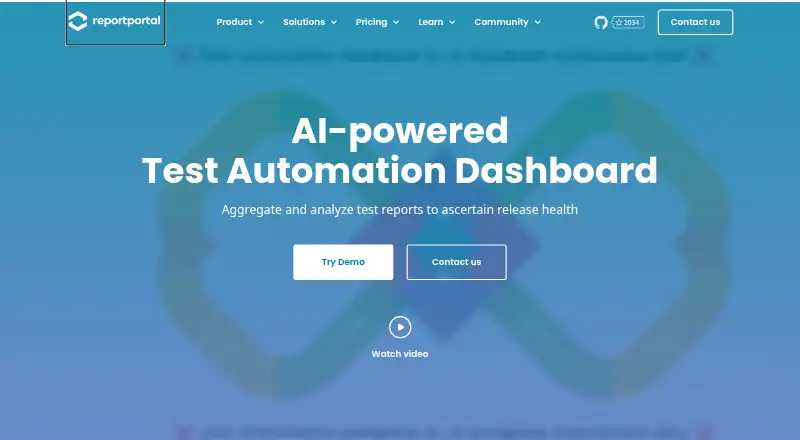
What ReportPortal is
ReportPortal brings automated test reports together to help teams assess release health. It provides real-time reporting and dashboards for test results, trends, and metrics. Its Auto-Analyzer uses machine-learning algorithms trained on investigated failure history to help triage failed reports. Quality Gates apply rules to test report attributes and can feed pass-or-fail decisions into CI/CD tools. Plugins cover bug tracking, notifications, authorization, and test-data import; the open API can exchange data with tools such as Power BI and Grafana and support custom reports. The free community edition is open source, self-hosted, and licensed under Apache v2.0, with Docker, Kubernetes, and Google Cloud Marketplace deployment paths. The 30-day trial runs on a shared SaaS instance with Startup-tier storage and retention limits. Startup costs $569 a month, billed quarterly, with 100 GB of storage and up to 12 months of retention. Business costs $2,659 a month, billed quarterly, with 1 TB and up to five years of retention. Both paid tiers include unlimited users.
Who it suits
ReportPortal suits teams that need centralized automated test reporting, failure triage, and quality decisions connected to CI/CD tools. It offers a self-hosted community edition as well as paid SaaS tiers.
What it does well
- Real-time reporting and unified test reports.
- Auto-Analyzer helps triage failed reports.
- Quality Gates feed decisions into CI/CD tools.
- Open API supports third-party data exchange.
- Free community edition is self-hosted and open source.
What to know first
- Startup storage is limited to 100 GB.
- Startup retention is limited to 12 months.
- The 30-day trial uses a shared SaaS instance.
- Startup costs $569 a month, billed quarterly.
Limits
The free community edition is self-hosted and includes community support. The Startup SaaS tier includes 100 GB of storage and up to 12 months of retention; its 30-day trial uses these same storage and retention limits. Business raises those limits to 1 TB and up to 5 years of retention.
Plans
| Plan | Billed and limits | Price |
|---|---|---|
| Free community edition | Open-source · self-hosted · community support · Docker, Kubernetes, or Google Cloud Marketplace deployment | Free |
| Silver service package | annual · 50 support hours · premium features · unlimited email support · response SLA up to 24 hours | $10,000 a year |
| Gold service package | annual · 150 support hours · premium features · unlimited email support · response SLA up to 24 hours | $20,000 a year |
| Business | quarterly · dedicated instance · 1 TB · 5-year retention · multiple projects · unlimited users · 99% SLA · 10 support points · Quality Gates | $2,659 a month |
| Platinum service package | annual · 600 support hours · premium features · unlimited email support · response SLA up to 24 hours | $50,000 a year |
| Startup | quarterly · shared instance · 100 GB · 12-month retention · 1 project space · unlimited users · 95% SLA · 5 support points · Quality Gates · 30-day trial | $569 a month |
| Enterprise | individual instance plus services · extended storage and retention · unlimited users · Quality Gates | On request |
As reportportal.io lists them, read 30 Sept 2026. The maker's own page has the final word.
Getting started
- Open https://reportportal.io/ to choose a deployment route.
- For the free community edition, select a self-hosted deployment using Docker, Kubernetes, or Google Cloud Marketplace.
- For SaaS, choose a paid plan or use the 30-day trial on a shared instance.
- Connect test reports using a supported framework and CI/CD integration.
- Use the reporting API or documented plugins to connect additional tools.
ReportPortal is a test analytics platform for teams that need to interpret automated test results and connect them to release decisions. It suits established test suites and CI/CD workflows best; teams seeking a simple report viewer may not need its broader triage and quality-gate tools.
Overview
ReportPortal combines unified, real-time test reporting with dashboards for results, trends, and metrics. Its Auto-Analyzer uses machine-learning algorithms trained on investigated failure history to help triage failed reports. That can make recurring failures easier to sort, especially for teams with a meaningful history of investigated results, but it supports rather than replaces investigation.
Quality Gates apply rules to test-report attributes and feed pass-or-fail decisions into CI/CD tools. This extends the product from post-run analysis into release control, though teams must decide which attributes and rules should affect a release.
Key features
- Failure triage: Auto-Analyzer draws on investigated failure history to help teams classify failed reports, making it most relevant where test runs produce recurring failures.
- Reporting and dashboards: Unified, real-time reporting and widgets gather results, trends, and metrics in one place. This is useful for teams tracking test health across repeated runs.
- Quality Gates: Rules evaluate report attributes and send pass-or-fail decisions to CI/CD tools, giving teams a way to tie test outcomes to release decisions.
- Integrations and API: Documented plugins cover bug tracking, notifications, authorization, test data import, and Sauce Labs; notification examples include Slack, Telegram, and email. The open API can push and pull data for tools such as Power BI and Grafana, and support custom reports.
- Framework and CI/CD coverage: Supported frameworks include TestNG, Pytest, Playwright, Cypress, Jest, and many others. CI/CD integrations include Azure DevOps, CircleCI, GitHub Actions, GitLab CI, and Jenkins. Flaky-test detection and execution trend reports are also supported.
- Deployment and access: Teams can deploy through Docker, Kubernetes, or Google Cloud Marketplace; Docker support spans Linux, macOS, and Windows. SaaS access controls include SSO through Okta SAML and Azure SAML, and authentication through LDAP or Active Directory.
Pricing
The free Community Edition costs nothing and is open source, self-hosted, and supported by the community. Docker, Kubernetes, and Google Cloud Marketplace deployment paths make it a practical no-cost choice for teams able to manage their own installation, but it does not include the paid service packages.
Startup costs $569 a month, billed Quarterly. It provides 100 GB of storage, up to 12 months of retention, unlimited users, a shared instance, one project space, and a 30-day trial. This is the lower-cost SaaS option for a team that can work within one project space and the storage and retention caps. The trial runs on a shared SaaS instance with Startup-tier limits and includes all ReportPortal features.
Business costs $2,659 a month, billed Quarterly. It raises storage to 1 TB and retention to up to five years, while adding a dedicated instance and multiple project spaces; users remain unlimited. This is better suited to organizations with greater retention needs or multiple projects, but its price is a substantial step up from Startup. Its trial uses Startup-tier limits.
Enterprise has custom pricing and offers a dedicated instance and services, extended storage and retention, unlimited users, and unlimited project spaces. It is the option for requirements beyond the stated Business limits.
Silver Service Package costs $10,000 a year and includes 50 support hours; Gold costs $20,000 a year for 150 hours; Platinum costs $50,000 a year for 600 hours. Each includes all premium features, unlimited email support, and a response SLA of up to 24 hours. These are annual support packages rather than substitutes for choosing a deployment tier.
The pricing page displays SOC 2, ISAE 3402, ISO 9001, and ISO 27001 certification badges. The product is open source, sponsored by EPAM, and licensed under Apache v2.0.
Platforms
ReportPortal supports API, Linux, macOS, self-hosted deployment, web, and Windows. The range gives teams both hosted and self-managed deployment routes, with Docker support specifically spanning the three desktop operating systems named above.
Who it's for
ReportPortal is a strong fit for teams with established automated test suites that need shared reporting, failure triage, and CI/CD quality decisions. Its framework and pipeline integrations, API, and deployment choices suit organizations that want to connect test analysis to existing workflows. Teams with limited reporting needs, little failure history to draw on, or a requirement for more economical SaaS storage may prefer a narrower tool.
Pros and cons
- Pro: Reporting, failure triage, dashboards, and CI/CD quality gates work together, so teams can connect test results with release decisions.
- Pro: A free self-hosted edition and several deployment paths give technically equipped teams a way to avoid SaaS tier costs.
- Pro: Broad framework and CI/CD integration coverage, plus an open API, supports varied test workflows.
- Con: Startup limits SaaS users to one project space, 100 GB, and up to 12 months of retention; teams exceeding those constraints must consider the much higher-priced Business tier or custom Enterprise offering.
- Con: The free edition relies on self-hosting and community support, while the stated paid service packages are annual commitments.
Alternatives
For a wider comparison, browse Test Analytics Software.
- TestBeats is worth comparing for teams looking at a freemium test analytics option with a Pro 200 plan at $18 a month and stated credit, run, and test-case limits.
- Allure Report is the simpler choice to consider when free, open-source test reporting under Apache License 2.0 matters more than ReportPortal's paid SaaS tiers.
- Buildkite may suit readers prioritizing a CI/CD platform with a free tier capped at five users and ten concurrent jobs.
- Qualflare offers a free Starter tier capped at one project, one active user, 200 test cases, and 100 test reports, making it an option to consider for tightly bounded usage.
- Testspace is another freemium test-related option, with a Basic plan at $32 a month for four users and two private projects.
- Argos is an alternative to consider for visual and snapshot testing, with a free Hobby plan capped at 5,000 screenshots.
- BrowserStack Test Reporting & Analytics may fit teams focused on test-run history and logs, with its free plan retaining test-run history for up to 60 days.
- Flakiness.io is another freemium option for readers comparing self-hosted or web-based choices.
Verdict
Choose ReportPortal if your team runs substantial automated test suites and wants to join reporting, failure triage, and rule-based CI/CD decisions in one system, with self-hosting as a no-cost route. Look elsewhere if you need only basic reports or if Startup's storage and retention limits do not fit and Business pricing is difficult to justify.
Verdict
ReportPortal combines test reporting, failure triage, and CI/CD quality decisions, with both self-hosted and SaaS options. Compare storage and retention limits against your reporting needs before selecting a paid tier.
Questions
Is ReportPortal open source?
Yes. ReportPortal describes its community edition as open source under Apache v2.0 and sponsored by EPAM.
Is there a free plan?
Yes. The Free community edition costs nothing and is self-hosted, with community support.
How much does the SaaS plan cost?
Startup costs $569 a month, billed Quarterly. Business costs $2,659 a month, billed Quarterly.
Does ReportPortal offer a trial?
Yes. The 30-day trial provides all ReportPortal features on a shared SaaS instance, with Startup-tier storage and retention limits.
Which platforms and deployment routes are supported?
Listed platforms include API, Linux, macOS, self-hosted, web, and Windows. Deployment paths include Docker, Kubernetes, and Google Cloud Marketplace.
What integrations are available?
Documented plugins cover bug tracking, notifications, authorization, test data import, and Sauce Labs. CI/CD integrations include Azure DevOps, Bitrise CI/CD, CircleCI, GitHub Actions, GitLab CI, and Jenkins.
Facts from ReportPortal's own pages
- Access control
- The SaaS comparison describes SSO through Okta SAML and Azure SAML and authentication through LDAP or Active Directory. · reportportal.io, 30 Sept 2026
- AI triage
- Its Auto-Analyzer uses historical execution data and machine-learning analysis to flag likely failure causes. · reportportal.io, 14 Oct 2026
- API
- The open reporting API can push and pull data for third-party tools such as Power BI and Grafana and support custom reports. · reportportal.io, 30 Sept 2026
- API authentication
- Agents use API keys while the user interface uses JWT tokens, with bearer authentication documented for API requests. · developers.reportportal.io, 14 Oct 2026
- Company profile
- LinkedIn lists ReportPortal as privately held, founded in 2013, headquartered in Hoboken, New Jersey, with 11–50 employees. · linkedin.com, 14 Oct 2026
- Company scale claim
- The company LinkedIn page claims more than 23,000 companies, over 40 Fortune 500 customers, 40 million launches per year and 1.8 million downloads. · linkedin.com, 14 Oct 2026
- Dashboards
- Dashboards and widgets visualize test results, trends, and metrics. · reportportal.io, 30 Sept 2026
- Dashboards and widgets
- Users can build interactive QA dashboards with widgets such as overall statistics, unique bugs and passing-rate summaries. · reportportal.io, 14 Oct 2026
- Data residency
- On-premises deployments keep test data inside the customer instance; documented outbound calls check version status and optionally send anonymized Google Analytics data. · reportportal.io, 14 Oct 2026
- Deployment
- The installation guide provides Docker, Kubernetes, and Google Cloud Marketplace deployment paths and lists Linux, macOS, and Windows Docker support. · reportportal.io, 30 Sept 2026
- Deployment requirements
- The Docker guide supports Ubuntu 20.04+, macOS Intel or Apple Silicon and 64-bit Windows 11 Pro+, with Docker Compose 2.2 or newer, at least 2 CPU cores, 6 GB RAM and 20 GB free disk. · reportportal.io, 14 Oct 2026
- Documentation depth
- Documentation includes installation, configuration, developer guides, REST API material, plugins, troubleshooting, dashboards, quality gates and release notes. · reportportal.io, 14 Oct 2026
- Failure analysis
- Its Auto-Analyzer uses machine-learning algorithms trained on investigated failure history to help triage failed reports. · reportportal.io, 30 Sept 2026
- Failure categorization
- Failures can be classified as product bugs, automation issues, system issues or custom categories for collaborative triage. · reportportal.io, 14 Oct 2026
- Integrations
- Documented integrations include Jira Server and Cloud, Azure DevOps, Rally, GitLab, Monday, Sauce Labs, Slack, Telegram, LDAP, Active Directory, SAML, JUnit and Robot Framework. · reportportal.io, 14 Oct 2026
- License
- ReportPortal is distributed under Apache License 2.0 and the documentation says it may be used and modified commercially. · reportportal.io, 14 Oct 2026
- Limit: performance testing
- The FAQ says ReportPortal has no direct integration with performance-testing frameworks; users can import performance results in JUnit format as a workaround. · reportportal.io, 14 Oct 2026
- Limits
- The SaaS Startup tier includes 100 GB storage and up to 12 months of retention, while Business includes 1 TB and up to 5 years. · reportportal.io, 30 Sept 2026
- Limit: scale and imports
- G2 reviewers report performance degradation during prolonged parallel testing and crashes when importing very large Cucumber reports. · g2.com, 14 Oct 2026
- Limit: setup and support
- G2 feedback reports difficult troubleshooting, sparse documentation and slow or limited customer support during setup and customization. · g2.com, 14 Oct 2026
- Limit: trial migration
- The SaaS pricing page states that data cannot be transferred from the shared-instance trial to a dedicated instance. · reportportal.io, 14 Oct 2026
- Maker relationship
- The product site identifies EPAM as sponsor, while legal terms identify Test IO, Inc. as the platform provider. · reportportal.io, 14 Oct 2026
- Notable news
- A ReportPortal blog post dated April 2, 2026 says the project is refocusing on core test-automation reporting and analytics, with some identity features moving to paid subscriptions in version 26.1. · reportportal.io, 14 Oct 2026
- Praise: live analysis
- G2 reviewers highlight real-time dashboards, quick result visibility and automated bug tagging as useful for triage. · g2.com, 14 Oct 2026
Where ReportPortal stands on Freedom251
- Test Analytics Software#2 of 30