Freedom251 › CI Failure Analysis And Flaky Test Tools

Flakiness.io
What Flakiness.io is
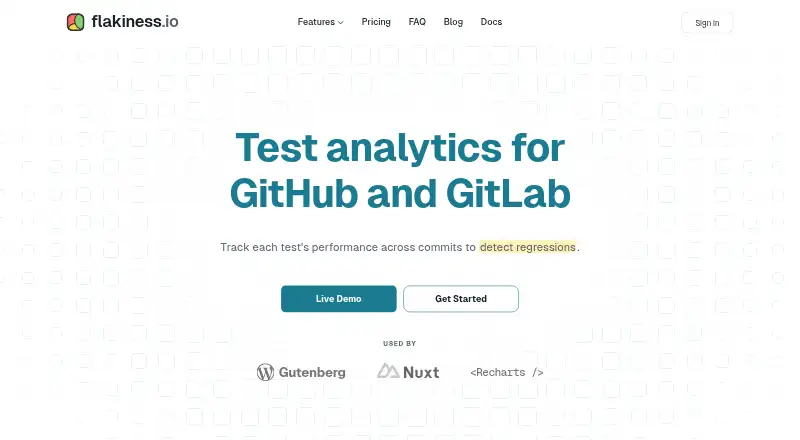
Flakiness.io provides test analytics for GitHub and GitLab, tracking results across commits to help teams distinguish flaky tests from regressions. It classifies a test that switches between passing and failing on the same commit as a flake; a persistent outcome change at a commit is treated as a regression. Listed runners include Playwright, Pytest, Vitest, Jest, CucumberJS, Bun, Rust and a JUnit XML bridge, with a Node.js SDK for custom integrations. The service says it works with any CI provider, merges shards, and separates staging and production histories. Reports include test history, grouped errors, system telemetry and a test waterfall; artifacts can include logs, screenshots, videos, traces and HTML files. Playwright can balance shards using recorded test durations. The Free plan lists 1 GB of artifact storage and 90 days of data retention. Startup costs $49 a month and includes 10 GB and 180 days of retention. Self-hosting is also available, using PostgreSQL and S3-compatible storage.
Who it suits
Flakiness.io suits software teams tracking test behavior across commits in GitHub or GitLab. It also offers a self-hosted option for teams that want to deploy the application themselves.
What it does well
- Identifies flakes and persistent test regressions.
- Supports a range of test runners.
- Separates staging and production histories.
- Reports include errors, telemetry and test waterfalls.
- Free plan includes unlimited test runs and users.
What to know first
- Free plan retention is 90 days.
- Free plan includes 1 GB artifact storage.
- Self-hosted licensing details require contacting the maker.
Limits
The Free plan has 1 GB of artifact storage and 90 days of data retention. Startup costs $49 a month and includes 10 GB of artifact storage and 180 days of retention.
Plans
| Plan | Billed and limits | Price |
|---|---|---|
| Growth | billed monthly · 100 GB artifacts storage · 365 days data retention · Unlimited test runs · Unlimited users · Priority support | $199 a month |
| Startup | billed monthly · 10 GB artifacts storage · 180 days data retention · Unlimited test runs · Unlimited users · Standard support | $49 a month |
| Free | 1 GB artifacts storage · 90 days data retention · Unlimited test runs · Unlimited users · Standard support | On request |
| Enterprise | contract pricing · Custom artifacts storage · Custom data retention · Unlimited test runs · Unlimited users · Priority support | On request |
As flakiness.io lists them, read 2 Oct 2026. The maker's own page has the final word.
Getting started
- Visit https://flakiness.io/.
- Choose the hosted web service or a self-hosted deployment.
- Connect a GitHub or GitLab repository and use its repository permissions for analytics access.
- Send test results through a listed runner or the Node.js SDK; the service accepts results from any CI provider.
- Choose Free or Startup, or contact the maker about self-hosted licensing details.
Verdict
Flakiness.io combines cross-commit test analysis with reports and uploaded run artifacts. Consider its storage and retention limits, or ask the maker about self-hosted licensing.
Questions
Is there a free plan?
Yes. Free includes unlimited test runs and users, 1 GB of artifact storage, 90 days of data retention, and standard support.
How much does Startup cost?
Startup costs $49 a month, billed monthly. It includes 10 GB of artifact storage, 180 days of data retention, unlimited test runs and users, and standard support.
Which platforms and test runners are supported?
The listed platforms are web and self-hosted. Listed runners and formats include Playwright, Pytest, Vitest, Jest, CucumberJS, Bun, Rust, and a JUnit XML bridge.
Does it work with my CI provider?
The service says it works with any CI provider. GitHub Actions and GitLab CI/CD are listed integrations.
Can I run it myself?
Yes. A self-hosted deployment uses one application container backed by PostgreSQL and an S3-compatible object store. Licensing details are available by contacting the maker.
Who makes Flakiness.io?
The site identifies Andrey Lushnikov as the creator and displays Degu Labs Inc in its copyright notice.
Facts from Flakiness.io's own pages
- AI agents
- The site describes compact failed-run context for coding agents and shows Claude Code, Codex, and Cursor. · flakiness.io, 2 Oct 2026
- CI
- It says it works with any CI provider, ingests results as they arrive, merges shards, and keeps staging and production histories separate. · flakiness.io, 2 Oct 2026
- Data limits
- The privacy policy says customers must not upload HIPAA-regulated health information, payment card data, children's data under 13, or classified or export-controlled government information. · flakiness.io, 2 Oct 2026
- Flake detection
- It classifies tests that flip between passing and failing on the same commit as flakes, and persistent outcome changes at a commit as regressions. · flakiness.io, 2 Oct 2026
- Maker
- The site identifies Andrey Lushnikov as the creator and displays Degu Labs Inc in its copyright notice. · flakiness.io, 2 Oct 2026
- Pricing model
- The site says pricing is based on stored data rather than test runs or user seats. · flakiness.io, 2 Oct 2026
- Purpose
- Flakiness.io provides test analytics for GitHub and GitLab and tracks test performance across commits to detect regressions. · flakiness.io, 2 Oct 2026
- Reports and artifacts
- Reports include test history, error grouping, system telemetry, and a test waterfall; uploaded artifacts can include logs, screenshots, videos, traces, and HTML files. · flakiness.io, 2 Oct 2026
- Repository access
- The product follows connected GitHub or GitLab repository permissions for access to test analytics. · flakiness.io, 2 Oct 2026
- Security
- The privacy policy lists encryption in transit, Cloudflare network protection, access controls, environment isolation, and monitoring; customers are responsible for securing self-hosted deployments and credentials. · flakiness.io, 2 Oct 2026
- Self-hosting
- A self-hosted deployment uses one application container backed by PostgreSQL and an S3-compatible object store; licensing details are available by contacting the maker. · flakiness.io, 2 Oct 2026
- Sharding
- It records test durations so compatible runners can balance shards using historical runtime; Playwright is the listed supported runner for this feature. · flakiness.io, 2 Oct 2026
- Support
- The pricing page lists standard support for Free and Startup plans and priority support for Growth and Enterprise plans. · flakiness.io, 2 Oct 2026
- Test runners
- The site lists Playwright, Pytest, Vitest, Jest, CucumberJS, Bun, Rust, and a JUnit XML bridge, plus a Node.js SDK for custom integrations. · flakiness.io, 2 Oct 2026
Where Flakiness.io stands on Freedom251
- CI Failure Analysis And Flaky Test Tools#5 of 21
- Test Analytics Software#8 of 30
- Test Flakiness Management Software#10 of 31