Freedom251 › Knowledge base software
PmWiki
by PmWiki
What PmWiki is
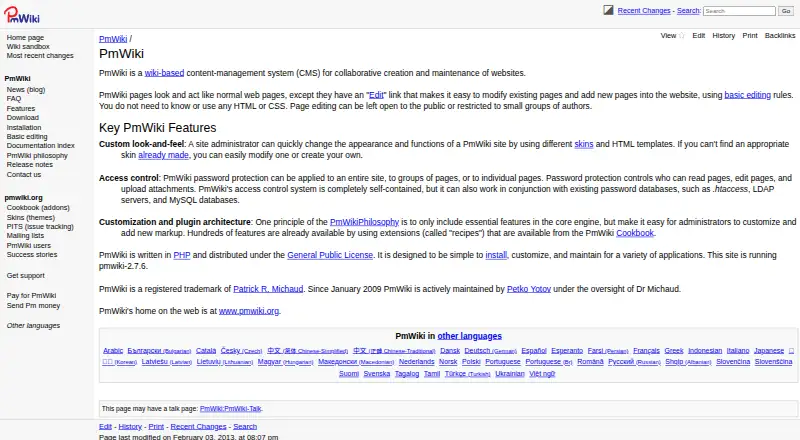
PmWiki is a wiki-based content-management system for creating and maintaining websites with multiple contributors. People can add and edit pages through a web browser without knowing HTML or CSS. Administrators can set password controls for a whole site, a group of pages, or individual pages, and specify whether they govern reading, editing, or uploads. The access system can work with existing password databases such as .htaccess, LDAP, and MySQL. Pages are kept as flat files, so a database is not required; the project says the software can handle thousands of pages. Administrators can alter site appearance and functions with skins, HTML templates, and extensions called recipes. Page histories have restore links, and administrators can configure how many days and revisions to retain. PmWiki is free, open-source software for self-hosting that requires PHP, and it supports Linux, macOS, Windows, and web use. Free support resources include a FAQ, troubleshooting guide, error descriptions, and mailing lists. Paid support and development are available at 60€ per hour, with an invoice provided.
Who it suits
PmWiki suits people building collaboratively edited websites who want to self-host and manage access to pages. It may also suit administrators who want to customize site behavior with recipes, skins, and templates.
What it does well
- Web editing does not require HTML or CSS knowledge.
- Access rules can cover sites, page groups, or individual pages.
- Flat-file storage does not require a database.
- Page histories include restore links.
- Free support resources include guides and mailing lists.
What to know first
- Self-hosting requires PHP.
- Paid technical support and development cost 60€ per hour.
- Version 2.7.5 addressed a Windows-server vulnerability in earlier versions.
Limits
The PmWiki plan is free and open source, and requires PHP for self-hosting. Paid technical support and development is billed at 60€ per hour.
Plans
| Plan | Billed and limits | Price |
|---|---|---|
| PmWiki | Free of charge; open source software · Self-hosted · requires PHP | Free |
| Paid technical support and development | 60€ / hour · Hourly support or development payment · invoice provided | €60, paid once |
As pmwiki.org lists them, read 4 Oct 2026. The maker's own page has the final word.
Getting started
- Visit the PmWiki website.
- Set up a self-hosted environment that supports PHP.
- Install PmWiki for Linux, macOS, or Windows.
- Use the project FAQ, troubleshooting guide, error descriptions, or mailing lists for free support.
PmWiki is a wiki-based content-management system for teams building and maintaining websites together. It suits administrators who need fine-grained page permissions and a database-free installation more than a managed, ready-to-use service. The trade-off is operational: contributors edit in a browser, but the owner must run and maintain the PHP environment.
Overview
Users can create and edit pages through the web without learning HTML or CSS, making PmWiki practical for community sites, internal documentation, and other shared content that changes over time. Pages are stored as flat files rather than in a database, and the project says this approach can handle thousands of pages. That can simplify deployment and backups for a technically capable administrator, while organizations that expect a hosted control panel will find the self-hosted model less convenient.
PmWiki has been developed since 2001 and supports custom domains, version history, API access, and self-hosting. Its current 2.7.6 release, dated September 18, 2026, includes updates for recent PHP versions. Release 2.7.5 addressed a vulnerability affecting versions 2.0.0 through 2.7.4 on Windows servers under certain editing and read-protection conditions; administrators should therefore keep installations current.
Key features
Granular permissions and authentication
Password protection can cover the complete site, a page group, or one page, with independent controls for reading, editing, and uploads. That granularity fits projects combining public material with restricted work areas. PmWiki can also use existing .htaccess, LDAP, and MySQL password databases, which is useful when access should align with credentials already managed elsewhere. The flexibility brings administration work: someone must design, review, and maintain the permission rules.
History, privacy, and recovery
Page histories provide restore links, and administrators can set how many days and revisions to keep. In version 2.7.6, edit IP addresses in histories are visible only to administrators, a narrower exposure for sites where contributor privacy matters. Retention is configurable, so owners can balance recovery options against storage and privacy requirements.
Customization and extensions
Skins and HTML templates can change the site's appearance and structure. Administrators can also alter markup and add functions through Cookbook recipes. This is a strong fit for teams willing to customize a wiki to their workflow; it is less suitable when a polished, standardized interface with vendor-managed extensions is the priority.
Pricing
| Plan | Price | What it means |
|---|---|---|
| PmWiki | free | Free of charge, open-source, self-hosted software requiring PHP. |
| Paid technical support and development | €60, paid once | Hourly support or development at 60€ per hour; an invoice is provided. |
The software itself has no subscription charge, seat fee, or stated usage quota. The free plan is appropriate for anyone able to supply hosting and PHP administration. Paid help is an optional service for owners who need implementation, troubleshooting, or bespoke development but do not want to handle all technical work themselves. Hosting and infrastructure costs are separate from these prices.
Platforms
PmWiki runs as self-hosted software on Linux, macOS, or Windows servers and is used through the web. PHP is required for the installation. This gives the owner control over domain, deployment, and data location, but it also means responsibility for server maintenance and upgrades.
Who it's for
Choose PmWiki for collaborative websites, documentation, or knowledge collections where page-level permissions, configurable history, flat-file storage, and extensive customization are important. It is particularly well matched to administrators comfortable with PHP hosting and authentication integration. Look elsewhere if you need a fully hosted product with no server upkeep or a fixed, vendor-managed feature set.
Pros and cons
Pros
- Granular access control: Site, group, and page protection can separately govern reading, editing, and uploads.
- Database-free storage: Flat files avoid a database dependency and are intended to scale to thousands of pages.
- Deep customization: Skins, templates, markup changes, and Cookbook recipes let administrators shape appearance and behavior.
- Recoverable editing: Configurable revision retention and restore links support rollback.
- No software license fee: The open-source, self-hosted plan costs nothing.
Cons
- Self-hosting is mandatory: The owner must provide PHP hosting and handle operational maintenance.
- Customization requires administration: Permissions, templates, markup, and recipes offer control but demand ongoing technical decisions.
- Support beyond community resources costs extra: Paid maintainer assistance is billed at 60€ per hour.
Alternatives
Browse Wiki Software or Knowledge base software for a wider shortlist.
- TiddlyWiki is another free, open-source option spanning mobile, desktop, web, and self-hosted platforms, with donations supporting development.
- Confluence is the better fit for a hosted freemium service, offering a free-forever tier for 10 users with 2 GB of file storage and three active whiteboards per user.
- Foswiki is a community-supported, free self-hosted alternative with API support.
- ikiwiki is free software for Linux, macOS, self-hosted, and web deployments.
- MediaWiki is free, GPL-licensed, self-hosted software with API support.
- MoinMoin is free GPL software for self-hosted deployments and multiple operating systems.
- Tiki Wiki CMS Groupware is free/libre open-source software for self-hosted Linux, macOS, Windows, and web use.
- TWiki is free GPL software requiring web-server administration.
Verdict
PmWiki is a strong choice for technically capable owners who want a free collaborative wiki with page-level security, flat-file storage, and broad customization. Its central advantage is control without a database or license cost. Choose a hosted alternative instead when avoiding PHP hosting and administrator responsibility matters more than that control.
Verdict
PmWiki combines browser-based collaborative editing with configurable access controls and flat-file storage. It is free to use, but self-hosting requires PHP; paid support and development are available separately.
Questions
Is PmWiki free?
Yes. The PmWiki plan is free of charge and the software is open source.
Does PmWiki require a database?
No. It stores pages as flat files.
Which platforms does PmWiki support?
It supports Linux, macOS, Windows, web use, and self-hosting.
Can administrators control who reads or edits pages?
Yes. Password protection can apply to a whole site, page groups, or individual pages, and can govern reading, editing, and uploads.
Does PmWiki have paid support?
Maintainer Petko Yotov offers technical support and development at 60€ per hour, with an invoice provided.
Who makes PmWiki?
The maker is PmWiki. Its maintainer address is listed in La Ferté-sous-Jouarre, France.
Facts from PmWiki's own pages
- Access control
- Password protection can be set for an entire site, page groups, or individual pages, and can control reading, editing, and uploads. · pmwiki.org, 4 Oct 2026
- Authentication integrations
- The access control system can work with existing password databases such as .htaccess, LDAP, and MySQL. · pmwiki.org, 4 Oct 2026
- Current release
- The release notes list version 2.7.6, dated 2026-09-18, and say it includes updates for recent PHP versions. · pmwiki.org, 4 Oct 2026
- Custom domain
- Yes · pmwiki.org, 20 Sept 2026
- Customization
- Site administrators can change appearance and functions using skins and HTML templates. · pmwiki.org, 4 Oct 2026
- Editing
- Pages can be edited and added through the web without requiring users to know HTML or CSS. · pmwiki.org, 4 Oct 2026
- Extensibility
- Administrators can customize markup and add features through extensions called recipes in the PmWiki Cookbook. · pmwiki.org, 4 Oct 2026
- Founded
- 2001 · pmwiki.org, 28 Sept 2026
- Free plan
- Yes · pmwiki.org, 20 Sept 2026
- History
- Page histories include restore links, and the number of history days and revisions can be configured. · pmwiki.org, 4 Oct 2026
- Maintainer location
- The support page lists Petko Yotov's address in La Ferté-sous-Jouarre, France. · pmwiki.org, 4 Oct 2026
- Paid services
- PmWiki maintainer Petko Yotov offers paid technical support and development at 60€ per hour and says an invoice will be provided. · pmwiki.org, 4 Oct 2026
- Privacy update
- In version 2.7.6, page histories reveal edit IP addresses only to administrators. · pmwiki.org, 4 Oct 2026
- Purpose
- PmWiki is a wiki-based content-management system for collaboratively creating and maintaining websites. · pmwiki.org, 4 Oct 2026
- Security update
- Release 2.7.5 closed a vulnerability affecting PmWiki versions 2.0.0 through 2.7.4 on Windows servers under certain editing and read-protection conditions. · pmwiki.org, 4 Oct 2026
- Storage
- PmWiki stores pages as flat files and does not require a database; its features page says it can handle thousands of pages. · pmwiki.org, 4 Oct 2026
- Support
- The project lists a FAQ, troubleshooting guide, error-message descriptions, and mailing lists as free user-support resources. · pmwiki.org, 4 Oct 2026
- Version history
- Yes · pmwiki.org, 20 Sept 2026
Where PmWiki stands on Freedom251
- Knowledge base software#23 of 138
- Wiki Software#14 of 33