
OSDial
by OSDial
What OSDial is
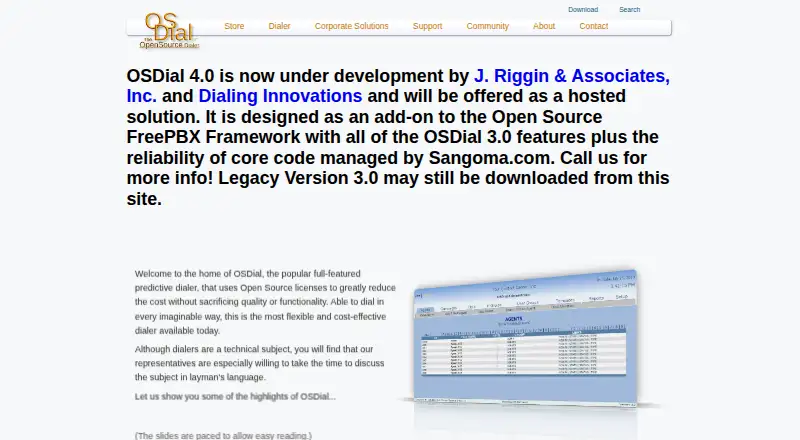
OSDial is a call-center dialer for inbound, outbound, and blended calling, including IVR. It supports predictive, power, manual, adaptive, and broadcast dialing, along with custom dialplans, carrier failover, call recording, answering-machine detection, and skill routing. Campaign tools handle lead loading and export, external databases, custom fields, lead search, list mixing, and custom disposition codes. Real-time and summary reports cover calls, agents, leads, lists, and server performance. Agents can log in remotely using a phone and web browser; APIs include external webpage lead loading and basic admin and agent functions. OSDial is AGPL-licensed, with no license fees or required support hours, although several listed modules are non-free. Its downloadable legacy version 3.0 installer erases the target drive and installs a CentOS-based operating system. Version 4.0 is under development as a hosted solution. The maker describes OSDial as suitable for call and contact centers, with capacity depending on server capability.
Who it suits
OSDial suits call and contact centers that need inbound, outbound, or blended dialing, campaign tools, and reporting. Its listed uses include financial services, healthcare, retail, fundraising, and political campaigns.
What it does well
- Supports five dialing modes, including predictive and broadcast.
- Includes lead search, list mixing, and external database support.
- Offers real-time and summary reporting.
- AGPL-licensed with no license fees or required support hours.
What to know first
- The installer erases the target drive.
- Several add-on modules are non-free.
- Version 4.0 is still under development.
Limits
The free AGPL product has no license fees or required support hours, but OSDial Cluster, SQL Cluster, Multi-tenant, Archive, and E-mail Template are non-free modules. The downloadable installer erases its target drive; hosted version 4.0 is under development.
Getting started
- Visit the OSDial website.
- Choose the downloadable legacy version 3.0 if installing locally.
- Use a Linux-based installation image that matches the intended 32-bit or 64-bit system.
- Install on a target drive that can be erased; the installer adds a CentOS-based operating system.
- For hosted version 4.0, note that it is under development.
OSDial is a self-hosted Linux call-center platform for inbound, outbound, and blended operations. It fits teams that need extensive dialing and campaign controls without core license fees and can manage their own server. The main trade-offs are a destructive installer and extra charges for several advanced modules.
Overview
OSDial combines predictive, power, manual, adaptive, and broadcast dialing with inbound and outbound IVR. The maker describes it for call and contact centers in financial services, healthcare, retail, fundraising, and political campaigns, scaling from a few agents to several hundred depending on server capacity. Its sizing guide covers deployments up to 480 seats; larger installations require direct planning with the maker.
Version choice affects deployment. OSDial 4.0 is being developed as a hosted solution, while downloadable OSDial 3.0.2 is the legacy installable release. The core is AGPL-licensed, with no license fees or required support hours. OSDial Cluster, SQL Cluster, Multi-tenant, Archive, and E-mail Template are paid modules, so a supposedly free rollout may still need a module budget.
Key features
Dialing and campaign control
Predictive, power, and manual modes cover automated, agent-led, and controlled calling; adaptive and broadcast modes extend that range. Custom dialplans, carrier failover, local presence, skill routing, and IVR let administrators shape how calls are presented and escalated. Call recording, answering-machine detection, and custom disposition codes support campaign follow-up and quality workflows. This breadth suits centers running several campaign types, although it also implies more administration than a narrowly focused dialer.
Leads, integrations, and APIs
Teams can import and export leads, mix lists, search records, add custom fields, and connect an external database. An API can load leads from an external webpage, and basic administrator and agent APIs provide an integration starting point. Remote website insertion is useful for routing new inquiries into campaigns. These tools favor organizations with existing data systems; they are less compelling if you want a fully managed, preconfigured service.
Reporting and access
Real-time and summary reports cover calls, leads, agents, lists, and server performance, including agent and lead activity. Agents can log in remotely with a phone and web browser, supporting distributed teams without requiring a local workstation installation. International calling is disabled by default, and Asterisk is configured according to security best practices, sensible safeguards for a system handling outbound traffic.
Pricing
OSDial has a free plan built around its AGPL core, with no license fee and no mandatory support-hour purchase. That is the right starting point for a technically capable center prepared to provide hosting, operations, and maintenance itself. Free does not include every listed capability: Cluster, SQL Cluster, Multi-tenant, Archive, and E-mail Template are non-free modules.
The maker also sells an Annual Support Agreement. It includes upgrades, five support hours and one training hour per month, after-hours support availability, and priority over hourly customers. It is most relevant to centers that need a formal escalation path; smaller teams may prefer to operate without it, accepting responsibility for upkeep.
Platforms
OSDial is available through API, Linux, self-hosted, and web access. The downloadable installer provides 32-bit and 64-bit Linux-based images and installs a CentOS-based operating system. It erases the target drive, so it should be placed on a dedicated machine rather than over an existing system. The hosted 4.0 direction may eventually reduce that infrastructure burden, but the downloadable legacy release remains the practical self-hosting route.
Who it's for
OSDial is a strong fit for call and contact centers that need varied dialing modes, IVR, detailed campaign controls, external-database connectivity, and reporting while avoiding core license fees. It can serve small teams through large deployments when server capacity and administration are available. It is a poor match for organizations that cannot dedicate hardware, accept a drive-wiping installation, or want predictable all-in-one pricing with every module included.
Pros and cons
Pros
- Broad dialing coverage: predictive, power, manual, adaptive, and broadcast modes address different campaign operating styles.
- Strong campaign and lead tooling: list mixing, custom fields, advanced search, import/export, recording, and disposition codes support complex operations.
- Useful integration surface: external databases, webpage lead loading, and basic admin and agent APIs connect OSDial to existing workflows.
- No core license fee: AGPL licensing leaves budget for infrastructure and staffing rather than recurring seat licenses.
Cons
- Destructive installation: the installer wipes the target drive and replaces it with CentOS-based Linux, demanding dedicated hardware and careful preparation.
- Paid extensions: clustering, multi-tenancy, archiving, and email templates are not part of the free core.
- Legacy downloadable release: the installable option is version 3.0.2 while version 4.0 is still under development as hosted software.
- Operational responsibility: self-hosting means the customer owns server capacity, maintenance, and security decisions.
Alternatives
For a wider comparison, browse Predictive Dialer Software and Call Center Software.
- CallHub is a paid, web-oriented option with Android, iOS, macOS, Windows, and API access, plus a free plan and trial; choose it when cross-platform access and a managed service matter more than self-hosting.
- Voicent offers freemium web, Windows, API, and self-hosted deployment, including a free tier with 100 minutes/texts and a $179.00-per-month Starter plan; it suits teams that prefer published usage allowances.
- CloudTalk AI Voice Agent is a paid, trial-supported multi-platform service with AI receptionist and specialist plans; consider it for an AI-led voice workflow.
- VICIdial is another free, self-hosted call-center platform, with optional VICIhost hosting at $400 per server per month after the first month plus a $1,000 initial provisioning fee; choose it when hosted VICIdial is preferable.
- CallTools is a paid web and desktop contact-center service with month-to-month or annual billing; it is an alternative for teams seeking a commercial managed deployment.
- Newfies-Dialer is a paid self-hosted/API/web dialer with a 25 Ports plan at $299.00 per month and a 100 Ports plan at $499.00 per month; pick it when port-based quotas and pricing are a better fit.
- Convoso sells customized primarily annual plans with no free trial; it suits buyers ready for a sales-led deployment.
- FrontSpin offers custom pricing for a web service with unlimited minutes; consider it when that commercial model matches your requirements.
Verdict
Choose OSDial if your center has Linux and telephony expertise and wants unusually broad dialing, campaign, lead, API, and reporting controls without core license fees. Look elsewhere if drive-erasing installation, self-managed infrastructure, legacy downloadable software, or paid modules create too much operational or budget risk.
Verdict
OSDial combines multiple dialing modes with campaign, lead-management, API, and reporting features for contact centers. Check the installer’s drive-erasing behavior and the cost of any non-free modules before choosing a deployment.
Questions
Is OSDial free?
OSDial is available under the AGPL, with no license fees or required support hours. Several listed modules are non-free.
What dialing modes does OSDial support?
It supports predictive, power, manual, adaptive, and broadcast dialing, as well as inbound and outbound IVR.
What platforms are listed for OSDial?
The listed platforms are API, Linux, self-hosted, and web.
Can agents work remotely?
Agents can log in remotely using a phone and a web browser.
What does the downloadable installer do?
It erases the target drive and installs a new operating system based on CentOS Linux.
Who makes OSDial?
The maker is OSDial, headquartered in Safety Harbor, Florida, United States. The maker was founded in 2007.
Facts from OSDial's own pages
- API
- The maker says OSDial includes an API for loading leads from an external webpage and lists a basic admin and agent API. · osdial.com, 4 Oct 2026
- APIs
- The maker says OSDial has an API for loading leads from an external web page and lists a basic admin and agent API among its features. · osdial.com, 4 Oct 2026
- Browser and remote access
- The feature page says agents can log in remotely using a phone and a web browser. · osdial.com, 4 Oct 2026
- Campaign and lead tools
- Campaign tools include lead loading and export, external database support, custom fields, lead search, and list mixing. · osdial.com, 4 Oct 2026
- Campaigns
- Campaign tools include custom dialplans, list mixing, call recording, answering machine detection, and custom disposition codes. · osdial.com, 4 Oct 2026
- Current version
- OSDial 4.0 is under development as a hosted solution, while legacy version 3.0 remains available to download. · osdial.com, 4 Oct 2026
- Deployment
- The downloadable OSDial 3.0.2 images are 32-bit and 64-bit Linux-based installs, and installation erases the target drive to install a CentOS-based operating system. · osdial.com, 4 Oct 2026
- Deployment limit
- The downloadable installer erases the target drive and installs a new operating system based on CentOS Linux; the maker advises against installing OSDial over another system. · osdial.com, 4 Oct 2026
- Dialing
- It supports predictive, power, and manual dialing, plus inbound and outbound IVR. · osdial.com, 4 Oct 2026
- Dialing features
- The product supports predictive, power, and manual dialing, custom dialplans, carrier failover, call recording, answering-machine detection, and skill routing. · osdial.com, 4 Oct 2026
- Founded
- 2007 · osdial.com, 28 Sept 2026
- Free plan
- Yes · osdial.com, 20 Sept 2026
- Headquarters
- Safety Harbor, Florida, United States · osdial.com, 28 Sept 2026
- Integrations
- OSDial supports external databases and remote website lead insertion, and its corporate page recommends Binfone and WSS Communications as carriers. · osdial.com, 4 Oct 2026
- Intended users
- The maker says OSDial can scale from a couple of agents to several hundred and lists call and contact centers among its target users. · osdial.com, 4 Oct 2026
- Lead management
- The product supports lead import and export, advanced lead search, custom fields, and external database access. · osdial.com, 4 Oct 2026
- License
- The maker says OSDial is available under the Affero General Public License (AGPL). · osdial.com, 4 Oct 2026
- License and fees
- The maker says OSDial is AGPL-licensed and has no license fees or required support hours; it identifies several add-on modules as non-free. · osdial.com, 4 Oct 2026
- Maker
- OSDial says it is developed and maintained by Call Center Service Group, LC., which opened in January 2007. · osdial.com, 4 Oct 2026
- Paid modules
- The feature page lists OSDial Cluster, SQL Cluster, Multi-tenant, Archive, and E-mail Template as non-free modules. · osdial.com, 4 Oct 2026
- Product
- OSDial is an open-source predictive dialer for inbound, outbound, and blended calling. · osdial.com, 4 Oct 2026
- Reporting
- Its reports include real-time and summary views, agent performance, call activity, lead performance, and server performance. · osdial.com, 4 Oct 2026
- Reports
- OSDial offers real-time and summary reports covering calls, leads, agents, lists, and server performance. · osdial.com, 4 Oct 2026
- Scale
- The maker says user capacity depends on server capability and provides a server-sizing guide for deployments up to 480 seats, with larger deployments directed to contact them. · osdial.com, 4 Oct 2026
Where OSDial stands on Freedom251
- Telemarketing#2 of 23
- Call Center Software#12 of 122
- Predictive Dialer Software#3 of 28