Freedom251 › Process Mapping Software
Open-BPMN
What Open-BPMN is
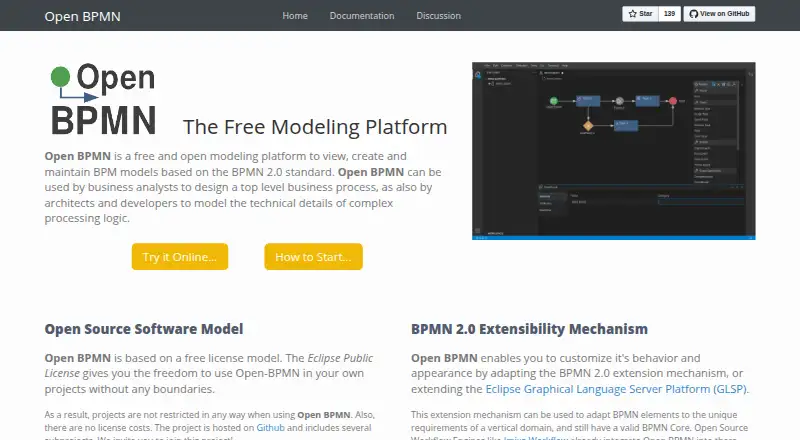
Open-BPMN is a free, open platform for creating and maintaining business process models using BPMN 2.0. Its editor displays diagrams and lets users create, change, or remove BPMN elements. It is intended both for analysts designing high-level processes and for architects and developers modeling technical processing logic. The project uses the Eclipse Public License and states that it has no license costs. Open-BPMN can run in Visual Studio Code, Eclipse IDE, Eclipse Theia, or standalone web applications. Projects can adapt the editor’s appearance and behavior through BPMN 2.0 extensions or Eclipse GLSP. Its Java metamodel supports programmatic model generation and importing or exporting .bpmn files. Diagrams can also be exported as lossless SVG, depending on the tooling platform. Installation documentation covers running it as a Docker web application and deploying it in Kubernetes. The VS Code extension requires Java 17 or higher. The project directs users to a GitHub discussion forum for questions and bug reports.
Who it suits
It suits business analysts mapping top-level processes, as well as architects and developers modeling technical process logic. It may also fit teams that want to embed or adapt a BPMN editor in supported environments.
What it does well
- Supports BPMN 2.0 modeling
- No license costs
- Java metamodel can generate models programmatically
- SVG export is available depending on tooling
What to know first
- VS Code extension requires Java 17 or higher
- SVG export depends on the tooling platform
Limits
The free Open-BPMN plan is listed as free, with no license costs. The VS Code extension requires Java 17 or higher, and SVG export depends on the tooling platform.
Plans
| Plan | Billed and limits | Price |
|---|---|---|
| Open-BPMN | Free and open platform · no license costs | Free |
As open-bpmn.org lists them, read 2 Oct 2026. The maker's own page has the final word.
Getting started
- Visit the Open-BPMN website.
- Choose an environment: Visual Studio Code, Eclipse IDE, Eclipse Theia, or a standalone web application.
- For the VS Code extension, make sure Java 17 or higher is available.
- Use the documented Docker or Kubernetes deployment route if running the web application that way.
- Use the GitHub discussion forum for questions or bug reports.
Open-BPMN is a free BPMN 2.0 modeling platform for analysts mapping business processes and technical teams modeling processing logic. It is most compelling when a team wants to adapt its editor or work across development environments; it is less suited to users who need VS Code editing without Java 17 or higher.
Overview
Open-BPMN supports creating and maintaining business process models, with tools to add, change, and remove BPMN elements. Process documentation, version history, and BPMN and SVG exports make it more than a basic diagram canvas. Its Eclipse Public License carries no license costs, so the main trade-off is not a software fee but whether its environment and extension options fit the way a team works.
The editor can be adapted through BPMN 2.0 extensions or Eclipse GLSP. That is useful for projects with specific modeling requirements, but it favors teams prepared to shape their tooling over individuals seeking a fixed, turnkey workflow.
Key features
Model editing and code
The Java metamodel can generate BPMN models programmatically and import or export .bpmn files. Developers can therefore handle models through code as well as the editor. The Imixs-Workflow extension adds attributes to BPMN tasks and catch events for execution by the Imixs-Workflow engine; its value is specific to teams using that engine, rather than a general execution capability.
Environments and deployment
Open-BPMN runs in Visual Studio Code, Eclipse IDE, Eclipse Theia, and standalone web applications. The VS Code extension requires Java 17 or higher, an important prerequisite for teams that do not already use that runtime. The installation guide also documents Docker-based web application deployment and Kubernetes deployment, giving teams deployment options beyond an IDE extension.
Export and support
Diagrams can be exported as lossless SVG, but the export depends on the tooling platform. That caveat matters if SVG is part of a required publishing workflow: confirm the chosen environment supports it. The project points users to a GitHub discussion forum for questions and bug reports.
Pricing
Open-BPMN — free. The free plan is an open platform with no license costs. It is the natural fit for individual modelers and teams that can work within the supported environments without a paid tier. There is no paid plan to weigh against it in the plan structure.
Platforms
Open-BPMN is offered as an extension and for Linux, macOS, Windows, self-hosted use, and the web. Its documented integrations include Visual Studio Code, Eclipse IDE, Eclipse Theia, and standalone web applications. This range gives teams flexibility in where to run the editor, though the Java requirement applies to the VS Code extension and SVG export depends on the tooling platform.
Who it's for
Business analysts can use it to shape top-level processes, while architects and developers can model technical processing logic and use the Java metamodel for programmatic generation. It is especially relevant to teams extending BPMN editors or deploying a web application themselves. Users who want a packaged process-engine workflow unrelated to Imixs, or an SVG workflow guaranteed across environments, should consider other options.
Pros and cons
- Pro: No license costs under the Eclipse Public License, making it accessible for teams without a software budget.
- Pro: The Java metamodel supports programmatic model generation and .bpmn import and export, useful for developer-led workflows.
- Pro: BPMN 2.0 extensions and Eclipse GLSP can tailor editor behavior and appearance to project needs.
- Con: VS Code use requires Java 17 or higher, adding a setup prerequisite for some users.
- Con: Lossless SVG export depends on the tooling platform, so it is not a uniform guarantee across environments.
- Con: The Imixs-Workflow execution extension is specifically useful to teams using that engine.
Alternatives
For a broader directory of process-mapping options, browse Process Mapping Software.
- Bonita is worth considering if a freemium option with a free tier capped at 150 process instances per month, no time limit, and no credit card requirement better fits your needs.
- Camunda may suit teams prioritizing a free self-managed development and testing plan, with production usage also listed.
- HEFLO is an alternative for readers who want Android or iOS access alongside web use; its Academic plan includes cloud-stored diagrams, image downloads, and import/export.
- Bizagi Modeler may fit a single user who wants unlimited processes and models with local storage on its free plan.
- Crismo is another free BPMN 2.0 modeling option, with diagram versioning and PNG and PDF exports on its Individual plan.
- ProcessMind may appeal to a solo user who wants unlimited models and 20 AI credits per month on its free plan.
- bpmn.io is a free alternative offering open-source toolkits for BPMN, DMN, CMMN, and forms.
- Flowable is an alternative with Apache 2.0-licensed engines written in Java.
Verdict
Choose Open-BPMN if you need free BPMN 2.0 modeling that can be extended, integrated into development environments, or deployed as a web application. Its strongest reason to choose it is the combination of adaptable editing and programmatic model handling without license costs. Look elsewhere if Java 17 is a barrier for your VS Code setup or if your work depends on SVG export being consistent across tooling platforms.
Verdict
Open-BPMN provides BPMN 2.0 editing across several development environments, with extension and model-generation options. Check the Java prerequisite and tooling-dependent SVG export if those matter to your setup.
Questions
How much does Open-BPMN cost?
Its listed plan is free, and the project says there are no license costs.
What can I use Open-BPMN for?
It creates and maintains BPMN 2.0 business process models, including top-level processes and technical processing logic.
Which environments can run it?
The listed environments include Visual Studio Code, Eclipse IDE, Eclipse Theia, and standalone web applications. Documentation also covers Docker and Kubernetes deployment.
Can it import and export BPMN models?
The Java metamodel can import and export .bpmn files. Diagrams can also be exported as lossless SVG, depending on the tooling platform.
What license does Open-BPMN use?
The project says it uses the Eclipse Public License.
Where can I get help?
The project points users to its GitHub discussion forum for discussions and bug reports.
Facts from Open-BPMN's own pages
- Deployment
- The installation guide documents running Open-BPMN as a web application in Docker and deploying it in Kubernetes. · open-bpmn.org, 2 Oct 2026
- Diagram editing
- The client displays BPMN models and provides tools to create, modify, and delete BPMN elements. · open-bpmn.org, 2 Oct 2026
- Export
- The documentation says diagrams can be exported as lossless SVG graphics, depending on the tooling platform. · open-bpmn.org, 2 Oct 2026
- Extensibility
- Its extension mechanism lets projects adapt the editor’s behavior and appearance using BPMN 2.0 extensions or Eclipse GLSP. · open-bpmn.org, 2 Oct 2026
- Headquarters
- Munich, Germany · open-bpmn.org, 28 Sept 2026
- Imixs-Workflow
- The Imixs-Workflow extension adds attributes to BPMN tasks and catch events so models can be executed by the Imixs-Workflow engine. · open-bpmn.org, 2 Oct 2026
- Integrations
- The documentation lists Visual Studio Code, Eclipse IDE, Eclipse Theia, and standalone web applications as environments for running Open-BPMN. · open-bpmn.org, 2 Oct 2026
- Intended users
- The site describes it for business analysts designing top-level processes and for architects and developers modeling technical processing logic. · open-bpmn.org, 2 Oct 2026
- License
- The project says it uses the Eclipse Public License and has no license costs. · open-bpmn.org, 2 Oct 2026
- Maker
- The project says it is led by Imixs, a software company located in Munich, Germany, specializing in business process management solutions. · open-bpmn.org, 2 Oct 2026
- Model library
- The Java metamodel can generate BPMN models programmatically and import or export models from .bpmn files. · open-bpmn.org, 2 Oct 2026
- Prerequisite
- The VS Code extension is based on JDK 17 and requires Java 17 or higher. · open-bpmn.org, 2 Oct 2026
- Purpose
- Open-BPMN is a free, open modeling platform for creating and maintaining business process models based on BPMN 2.0. · open-bpmn.org, 2 Oct 2026
- Support
- The site directs users to its GitHub discussion forum and says users can report bugs or start discussions. · open-bpmn.org, 2 Oct 2026
Where Open-BPMN stands on Freedom251
- Process Mapping Software#9 of 27