Freedom251 › Bandwidth Monitoring Software

ntopng
What ntopng is
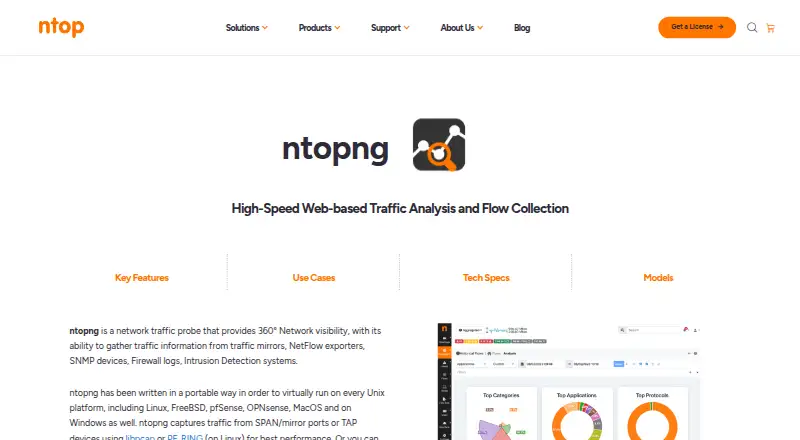
ntopng is a network traffic probe that gathers information from traffic mirrors, NetFlow exporters, SNMP devices, firewall logs and intrusion detection systems. Its encrypted web interface supports real-time and historical traffic exploration. Protocol detection powered by nDPI identifies more than 450 Layer-7 application protocols. Available metrics include application latency, round-trip time, throughput, TCP retransmissions, packet loss, and VoIP jitter and MOS. ntopng captures packets using libpcap or PF_RING and collects flows from nProbe, NetFlow and sFlow exporters. It offers an HTTP-based REST API and Lua scripting. Listed platforms include Linux, FreeBSD, Windows x64, macOS and RaspbianOS; the product page also names pfSense and OPNsense among supported Unix platforms. The free Community edition is described for smaller networks, with suggested maximums of 256 live local hosts, 128K live flows and eight monitored interfaces. Paid licenses are perpetual and include one year of maintenance; Pro is listed at €299, paid once.
Who it suits
The free Community edition is described for home and network practitioners with smaller networks. Paid editions are positioned for offices, small enterprises and larger enterprise networks.
What it does well
- Explores traffic in real time and historically
- Detects more than 450 Layer-7 protocols
- Includes latency, throughput and packet-loss metrics
- Offers an HTTP-based REST API and Lua scripting
- Free Community edition is available
What to know first
- Community edition suggests a maximum of eight interfaces
- Community edition suggests a maximum of 256 live local hosts
- Pro costs €299, paid once
- Paid license includes one year of maintenance
Limits
The free Community edition suggests a maximum of 256 live local hosts, 128K live flows, and eight monitored interfaces. Pro suggests up to 256 live local hosts, 1M live flows, and eight interfaces; higher Enterprise tiers list progressively larger suggested capacities.
Plans
| Plan | Billed and limits | Price |
|---|---|---|
| Community (Open Source) | Designed for home and network practitioners · Network size: Small · Suggested maximum 256 live local hosts · Suggested maximum 128K live flows · Maximum 8 monitored interfaces | Free |
| Community | real-time visibility · Layer-7 detection · historical host timeseries · alerts · active monitoring · network discovery | Free |
| Enterprise XL | perpetual license; one year of updates included · Linux/Windows/FreeBSD x64 · higher host, SNMP-device and flow-collector limits | €1,499.95, paid once |
| Pro | perpetual license; one year of updates included · Linux/Windows/FreeBSD x64 · interface aggregation · LDAP · extended alerts · network-matrix timeseries | €299.95, paid once |
| Enterprise M | perpetual license; one year of updates included · Linux/Windows/FreeBSD x64 · SNMP · advanced alerts · nAnalyst | €699.95, paid once |
| Enterprise L | perpetual license; one year of updates included · Linux/Windows/FreeBSD x64 · enterprise features · extended capacity | €899.95, paid once |
As ntop.org lists them, read 3 Oct 2026. The maker's own page has the final word.
Getting started
- Open the ntopng product website.
- Choose a listed deployment platform such as Linux, Windows, or macOS.
- Select the free Community edition or a paid license.
- Install the software on a supported platform and configure traffic or flow sources.
ntopng is a self-hosted network traffic probe for administrators who need to examine activity across a network. It suits home practitioners through enterprise teams, provided they choose an edition sized for their hosts, flows, and interfaces. Its strength is the breadth of traffic sources and metrics; its main trade-off is that larger networks and several useful controls require paid licenses.
Overview
The probe gathers information from traffic mirrors, NetFlow exporters, SNMP devices, firewall logs, and intrusion detection systems, then provides real-time and historical exploration through an encrypted web interface. It can capture packets with libpcap or PF_RING and collect flows from nProbe, NetFlow, and sFlow exporters. That mix gives administrators options for bringing together packet and flow visibility rather than relying on a single collection method.
ntopng’s open-source project dates to 1998. Its traffic analysis spans bandwidth monitoring and wider network operations, making it relevant to Network Traffic Analysis Software, Bandwidth Monitoring Software, and Network Monitoring.
Key features
Protocol and performance visibility
Its nDPI-powered detection supports more than 450 Layer-7 application protocols. That is useful when administrators need to distinguish application activity, not just observe aggregate traffic. Metrics include application latency, round-trip time, throughput, TCP retransmissions, packet loss, and VoIP jitter and MOS, giving teams a way to investigate both traffic patterns and service performance.
Integration and extensibility
An HTTP-based RESTful API and Lua scriptability make ntopng more adaptable to custom workflows. It can export to Elasticsearch and big-data systems. Pro and higher editions add LDAP and OpenID Connect login, aggregation across multiple interfaces, and alert delivery to Elasticsearch, Microsoft Teams, or Fail2Ban. Those additions make the paid editions more suitable where centralized access and alert routing matter; the Community edition does not include those paid-edition capabilities.
ntopng also supports synthetic checks and topology maps. Its packages are digitally signed with a PGP key, which users can use to verify package integrity. For support, ntop offers paid consultancy, commercial-grade phone, email, or on-site support, training, and customization; community support is best-efforts.
Pricing
The Community edition is free and aimed at home and network practitioners. Its suggested maximums are 256 live local hosts and 128K live flows, with up to 8 monitored interfaces. Those ceilings can be enough for a small environment, but they make it a poor fit for larger deployments.
Pro costs €299, paid once as a perpetual license with one year of maintenance. Designed for offices and small enterprises, it retains the 256-host and 8-interface suggested limits while raising the suggested live-flow maximum to 1M. Its value is less about scaling hosts than gaining the Pro-tier features, including identity integrations, interface aggregation, and alert integrations.
Enterprise editions are also perpetual licenses with one year of maintenance:
- Enterprise M: €699.95, paid once; suggested maximum 1K live local hosts, 4M live flows, and 16 interfaces.
- Enterprise L: €899.95, paid once; suggested maximum 4K live local hosts, 8M live flows, and 32 interfaces.
- Enterprise XL: €1,499.95, paid once; suggested maximum 32K live local hosts, 16M live flows, and 64 interfaces.
The M, L, and XL plans offer the enterprise feature set with progressively larger suggested capacity. Licenses are perpetual and include installation support, updates, and support for the duration of maintenance; the included maintenance period is one year. Buyers who need ongoing maintenance beyond that period should factor the renewal terms into their decision.
Platforms
ntopng is self-hosted and supports Linux, FreeBSD, Windows x64, macOS, and RaspbianOS; pfSense and OPNsense are also named among supported Unix platforms. Its web interface and API support operational access beyond the machine running the probe.
Who it's for
Community is the sensible starting point for home users and practitioners with small networks within its suggested caps. Pro fits an office or small enterprise that wants paid-edition integrations but can stay within the same 256-host and 8-interface limits. Enterprise M, L, and XL are the better fit for organizations whose live-host, flow, or interface counts exceed those boundaries. If all that is needed is a narrowly scoped single-host monitor, ntopng’s wider collection and analysis capabilities may be more than necessary.
Pros and cons
- Pro: Collects from packet, flow, device, firewall, and intrusion-detection sources, offering flexibility for mixed network environments.
- Pro: More than 450 detected Layer-7 protocols plus latency, loss, retransmission, and VoIP metrics support deeper diagnosis than traffic volume alone.
- Pro: Perpetual paid licenses include one year of maintenance, installation support, updates, and support during maintenance.
- Con: Community has suggested ceilings of 256 local hosts, 128K flows, and 8 interfaces, which can constrain even some modest deployments.
- Con: LDAP/OpenID Connect, multiple-interface aggregation, and named alert integrations require Pro or higher, so the free edition lacks these operational features.
- Con: Community support is best-efforts; commercial-grade support, consultancy, training, and customization are paid services.
Alternatives
- sFlowTrend is worth comparing for readers seeking a paid traffic-monitoring product with a free plan and support for Linux, macOS, Windows, web, and self-hosted use.
- SoftPerfect Bandwidth Manager is an option for readers focused on bandwidth rules and usage monitoring, with a free Lite plan capped at 5 rules/streams and a paid Standard plan.
- GlassWire may suit readers who want a freemium tool on Android, web, or Windows; its free plan includes one day of bandwidth usage, 24 hours of network history, and current-day alert logs.
- ManageEngine NetFlow Analyzer is a candidate for readers who prefer a freemium product with a free edition capped at 2 interfaces and paid monthly editions.
- Sniffnet is a free, open-source option for readers who prioritize a no-cost Linux, macOS, or Windows tool.
- Akvorado is another free, self-hosted option, developed by French ISP Free.
- bwmon is a free, self-hosted alternative for monitoring a single Linux host under the MIT license.
- MRTG is a free option for readers focused on monitoring SNMP devices and other data sources.
Verdict
Choose ntopng if you need self-hosted visibility across varied traffic sources, detailed protocol identification, and performance metrics, with editions that scale from a small network to enterprise capacities. Its clearest reason to look elsewhere is the combination of Community caps and paid-tier gates: larger or centrally managed deployments need a paid license, while teams that only need a simpler single-purpose monitor may not need ntopng’s breadth.
Verdict
ntopng combines traffic collection, protocol identification and performance metrics in a web interface. The Community edition has stated suggested network limits, while paid options are perpetual licenses with maintenance included.
Questions
Is ntopng free?
Yes. The Community (Open Source) plan is listed as free.
What does the Community plan include?
It is designed for home and network practitioners and suggests a maximum of 256 live local hosts, 128K live flows, and eight monitored interfaces.
What does a paid license cost?
Pro is listed at €299, paid once. Enterprise M is €699.95, paid once, Enterprise L is €899.95, paid once, and Enterprise XL is €1,499.95, paid once; each includes one year of maintenance.
Which platforms are listed?
Specifications list Linux, FreeBSD, Windows x64, macOS, and RaspbianOS. The product page also names pfSense and OPNsense among supported Unix platforms.
Is ntopng open source?
The Community plan is named Community (Open Source).
Which features are assigned to paid editions?
Pro and higher editions include LDAP and OpenID Connect login, multiple-interface aggregation, and sending alerts to Elasticsearch, Microsoft Teams, or Fail2Ban.
Facts from ntopng's own pages
- Alerts
- ntopng generates alerts for flows, hosts and interfaces and can notify through email, Discord, Telegram, webhooks, Slack, syslog or shell scripts. · ntop.org, 15 Oct 2026
- API
- The technical specifications list an HTTP-based RESTful API and Lua scriptability. · ntop.org, 3 Oct 2026
- Authentication
- Documented authentication options include local accounts, MFA, passkeys, OpenID Connect, LDAP, RADIUS, HTTP authentication and token-based authentication. · ntop.org, 15 Oct 2026
- Commercial licensing
- Paid licenses are per server, perpetual, and include updates for one year; later releases require maintenance renewal or staying on the older version. · ntop.org, 15 Oct 2026
- Company history
- ntop began as an open-source web traffic-monitoring project in 1998 and describes itself as a small, engineering-led, profitable company. · ntop.org, 15 Oct 2026
- Company profile
- LinkedIn lists NTOP as founded in 1998, headquartered in Pisa, Italy, with 11–50 employees. · linkedin.com, 15 Oct 2026
- Deployment platforms
- The product specifications list Linux, FreeBSD, Windows x64, macOS, and RaspbianOS; the product page also names pfSense and OPNsense among supported Unix platforms. · ntop.org, 3 Oct 2026
- Developer APIs
- Developer documentation covers REST, Lua, Python, timeseries, alerts and recording APIs, plus endpoint and script examples. · ntop.org, 15 Oct 2026
- Documentation depth
- The documentation includes user guides, installation instructions, command-line options, interface guidance, authentication, integrations, advanced features and API references. · ntop.org, 15 Oct 2026
- Extensibility
- The product exposes Lua scriptability and documents host, flow, interface and network checks for custom extensions. · ntop.org, 15 Oct 2026
- Flow sources
- The documentation covers collecting remote interfaces and exporter data through nProbe, including NetFlow and sFlow sources. · ntop.org, 15 Oct 2026
- Founded
- 1998 · ntop.org, 23 Sept 2026
- Headquarters
- Italy and Switzerland · ntop.org, 23 Sept 2026
- Historical analysis
- Community edition records and visualizes historical application-protocol timeseries for hosts. · ntop.org, 15 Oct 2026
- IDS integration
- It can ingest Suricata events and combine intrusion-detection data with traffic analytics and behavioral alerts. · ntop.org, 15 Oct 2026
- Installation
- Binary packages are provided for Linux and Windows, with additional installation guidance for macOS, FreeBSD, OPNsense, pfSense and containers. · ntop.org, 15 Oct 2026
- Integrations
- Documented integrations include OPNsense, pfSense, Suricata, ClickHouse, Kafka, syslog, Grafana and Wazuh. · ntop.org, 15 Oct 2026
- Layer-7 detection
- The product identifies more than 450 Layer-7 application protocols through nDPI. · ntop.org, 15 Oct 2026
- Licence
- The Community edition is open source under GNU GPLv3; Professional and Enterprise editions additionally use ntop's EULA. · ntop.org, 15 Oct 2026
- License terms
- The shop says software licenses are perpetual and include installation support, one year of maintenance, updates, and support for the duration of maintenance. · shop.ntop.org, 3 Oct 2026
- Limit: FreeBSD complaint
- A SourceForge reviewer reported that the software did not work on FreeBSD. · sourceforge.net, 15 Oct 2026
- Limit: learning curve
- A G2 reviewer said beginners may struggle to understand how nProbe and ntopng fit together and wanted more topic-specific videos. · g2.com, 15 Oct 2026
- Limit: not automated mitigation
- Flowtriq's analysis says ntopng is primarily a visibility and investigation tool rather than an automated DDoS detection or mitigation system. · whitelabel.flowtriq.com, 15 Oct 2026
- Limit: resource intensity
- An independent Flowtriq analysis reports users finding ntopng resource-hungry at high traffic rates and needing a powerful dedicated server. · whitelabel.flowtriq.com, 15 Oct 2026
Where ntopng stands on Freedom251
- Bandwidth Monitoring Software#1 of 33
- Network Traffic Analysis Software#1 of 26
- Network Monitoring#3 of 55