Freedom251 › Build Cache Software

NativeLink
What NativeLink is
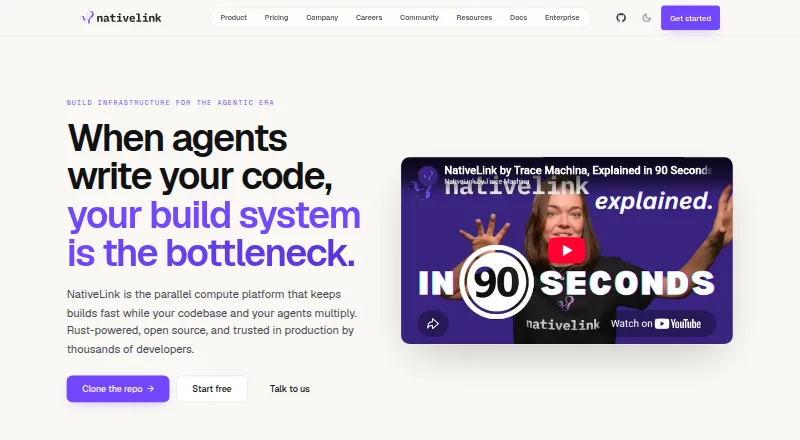
NativeLink is a Rust-native build platform that brings remote caching, distributed execution, and build observability together. Its content-addressed cache deduplicates build outputs so teams, CI systems, and coding agents can reuse results. It can distribute compilation and tests across workers on AWS, GCP, or bare metal, including GPU, ARM, and Apple Silicon support. Listed build systems include Bazel, Buck2, Siso, Soong, Pants, Goma, BuildStream, and CMake through recc; CI connections include GitHub Actions, GitLab, Buildkite, and Jenkins. NativeLink is available as a self-hosted Rust binary, configurable as cache, scheduler, and worker. The free Open Source plan costs nothing and includes community Slack support. Enterprise Tier 1 costs $180,000 a year, billed monthly; Tier 2 costs $360,000 a year, billed monthly. Client support covers Linux, macOS, and Windows, while servers support Linux and macOS. Some metrics and remote persistent worker modules require Enterprise or a separate license for shared production use.
Who it suits
NativeLink suits teams using supported build systems that want shared build caching and distributed compilation or tests. Self-hosting is an option, though server support is limited to Linux and macOS.
What it does well
- Free Open Source plan with community Slack support.
- Supports multiple build systems, including Bazel and CMake via recc.
- Execution workers can use GPUs, ARM, and Apple Silicon.
- Lists integrations with four CI platforms.
- Security page states SOC 2 and ISO 27001 are complete.
What to know first
- Servers support Linux and macOS, not Windows.
- Some modules require Enterprise or a separate production-use license.
- Enterprise plans cost 180000.00 USD or $360,000 a year.
Limits
The free Open Source tier includes community Slack support. Metrics and remote persistent workers are Business Source License modules that require Enterprise or a separate license for shared production use; Enterprise Tier 1 includes 6 support hours per month and a 24-hour response SLA, while Tier 2 includes 12 hours and a 4-hour response SLA.
Plans
| Plan | Billed and limits | Price |
|---|---|---|
| Open Source | Self-hosted · community Slack support · distributed scheduler and remote caching · all build systems · major cloud providers | Free |
| Enterprise Tier 2 | billed monthly · Public companies or private companies valued at $100M+ · self-hosted on Kubernetes · 12 support hours/month · 4-hour response SLA | On request |
| Enterprise Tier 1 | billed monthly · Private companies under $100M valuation · self-hosted on Kubernetes · 6 support hours/month · 24-hour response SLA | On request |
As nativelink.com lists them, read 29 Sept 2026. The maker's own page has the final word.
Getting started
- Visit https://nativelink.com/.
- Choose the free Open Source tier or an Enterprise tier.
- For self-hosting, use the documented single Rust binary and configure it as cache, scheduler, or worker.
- Run the server on Linux or macOS; clients are supported on Linux, macOS, and Windows.
- Connect a supported build system and CI platform.
NativeLink is a self-hosted Rust platform for sharing build artifacts and running compilation or tests on distributed workers. It suits engineering organizations with demanding, repeatable builds across multiple developers, CI jobs, or AI coding agents. Its open-source entry tier is unusually capable, but teams must be comfortable operating Linux or macOS servers and reviewing licensing boundaries for production use.
Overview
NativeLink combines a content-addressed build cache with remote execution and observability. The cache deduplicates artifacts, allowing developers, CI pipelines, and agents to reuse results instead of rebuilding identical outputs. Remote execution sends compilation and tests to worker fleets on AWS, GCP, or bare metal, including GPU, ARM, and Apple Silicon machines.
Deployment is flexible but not managed: one Rust binary can be configured as the cache, scheduler, or worker. NativeLink is built by Trace Machina, which serves sectors including semiconductors, robotics, autonomous vehicles, AI research, life sciences, and financial services. See Build Cache Software for related products.
Key features
Cache and execution coverage
NativeLink supports Bazel, Buck2, Siso, Soong, Pants, Goma, BuildStream, and CMake through recc. Language and compiler coverage includes C++, Rust, Python, Go, Java, Kotlin, and Swift. That breadth makes it a credible shared backend for polyglot repositories, while teams using an unlisted build system should not assume compatibility.
Remote workers can include GPUs, ARM processors, and Apple Silicon, so heterogeneous hardware is a practical advantage for specialized builds. The trade-off is infrastructure ownership: customers provision and maintain the server and worker fleet.
Integrations and controls
CI integrations cover GitHub Actions, GitLab, Buildkite, and Jenkins. Cloud and storage connections include AWS, GCP, Azure, S3, GCS, and Redis. The product also lists Claude Code, Copilot Workspace, Devin, Cursor, and Windsurf, making shared build results relevant to AI-assisted development workflows.
Security controls include SSO/SAML, mutual TLS, signed inputs, hermetic builds, and queryable audit trails. NativeLink states that SOC 2 and ISO 27001 are complete and that it complies with GDPR and CCPA/CPRA. These controls are useful for regulated teams, though self-hosting still makes architecture and operations your responsibility.
Pricing
Open Source
The Open Source plan costs free. It is self-hosted, includes community Slack support, distributed scheduling, remote caching, all listed build systems, and major cloud providers. This is the sensible starting point for individuals, open-source projects, and teams able to run their own service.
The important limitation is licensing rather than a usage quota. Most of the monorepo is FSL-1.1-Apache-2.0, while metrics and remote persistent workers are Business Source License modules. Shared production use of those modules requires Enterprise or a separate license, so a nominally free deployment may not cover every production requirement.
Enterprise tiers
Enterprise Tier 1 costs $180,000 a year, billed billed monthly. It targets private companies under $100M valuation and includes self-hosting on Kubernetes, six support hours per month, and a 24-hour response SLA. It fits organizations that need contractual support and Kubernetes deployment without the higher service commitment.
Enterprise Tier 2 costs $360,000 a year, billed billed monthly. It is for public companies or private companies valued at $100M or more, with 12 support hours monthly and a four-hour response SLA, alongside Kubernetes self-hosting. The price is difficult to justify for smaller teams, but the faster response target is aimed at production-critical build infrastructure.
Platforms
Clients run on Linux, macOS, or Windows. Servers support Linux and macOS, so Windows-only server environments are not a fit. NativeLink is self-hosted and available as a configurable Rust binary rather than a hosted endpoint.
Who it's for
Choose NativeLink when shared caching and distributed execution can materially shorten large builds, especially with Bazel-family systems, mixed CPU architectures, GPUs, or Apple Silicon. It is also a strong candidate for organizations that need audit trails, enterprise identity controls, and integration with established CI.
Look elsewhere if you want a fully managed cache, a Windows server, or a simple single-developer compiler cache. Operating workers, storage, upgrades, and licensing compliance requires platform expertise that smaller projects may not have.
Pros and cons
- Pros: Combines remote caching and execution in one deployable binary, supports broad build-system and language coverage, handles GPU/ARM/Apple Silicon workers, and offers substantial security and CI integrations.
- Pros: The free self-hosted tier includes distributed scheduling, remote caching, all listed build systems, and major cloud providers.
- Cons: Server support excludes Windows, and customers must operate the infrastructure themselves.
- Cons: Metrics and remote persistent workers have Business Source License restrictions for shared production use.
- Cons: Enterprise pricing starts at $180,000 a year, with support hours capped by tier.
Alternatives
- Bitrise is the better choice for mobile teams wanting a freemium service with hosted Android and iOS workflows and a free Hobby tier.
- Ccache suits developers who only need a free, single-file compilation cache under GNU GPL rather than remote execution.
- EngFlow Remote Caching is worth considering for a hosted-style free tier limited to one machine and 32 CPU cores, with enterprise expansion.
- cachepot is a straightforward Apache-2.0 open-source cache with no hosted plans stated.
- FosterStack offers a self-hosted MIT-licensed cache and a paid team tier for multi-user controls.
- MozJPEG is for JPEG encoding, not general remote build caching or execution.
- bazel-remote is preferable when you need a configurable-size Apache-2.0 cache focused on Bazel-compatible workloads.
- BuildFetch Cache provides a free hosted/open-source cache allowance with stated storage, traffic, request, and retention caps.
Verdict
NativeLink is a strong choice for build-heavy organizations that can self-host and want one platform for shared artifacts, remote workers, and enterprise controls across varied hardware. Its main reason to choose it is the combination of broad build-system support and distributed execution in a free entry tier. Look elsewhere if managed hosting, Windows servers, or a lightweight local cache matters more than fleet-scale capability and control.
Verdict
NativeLink combines caching and remote execution for teams working with its supported build systems. Its free self-hosted plan is available, but check server compatibility and licensing limits for metrics and persistent workers before choosing it.
Questions
Is NativeLink free?
The Open Source tier is free and self-hosted. Enterprise Tier 1 is $180,000 a year billed monthly, and Enterprise Tier 2 is $360,000 a year billed monthly.
Is NativeLink open source?
Yes. The product FAQ says most of the monorepo is FSL-1.1-Apache-2.0. Metrics and remote persistent workers are Business Source License modules requiring Enterprise or a separate license for shared production use.
Which operating systems does NativeLink support?
Clients support Linux, macOS, and Windows. The server supports Linux and macOS.
Which build systems and CI platforms are supported?
Listed build systems include Bazel, Buck2, Siso, Soong, Pants, Goma, BuildStream, and CMake via recc. CI integrations include GitHub Actions, GitLab, Buildkite, and Jenkins.
Who builds NativeLink?
NativeLink is built by Trace Machina.
What support comes with the tiers?
The free Open Source tier includes community Slack support. Enterprise Tier 1 lists 6 support hours per month and a 24-hour response SLA; Tier 2 lists 12 support hours per month and a 4-hour response SLA.
Facts from NativeLink's own pages
- AI tools
- The product page lists Claude Code, Copilot Workspace, Devin, Cursor, and Windsurf as AI coding platform integrations. · nativelink.com, 29 Sept 2026
- Build systems
- The product lists Bazel, Buck2, Siso, Soong, Pants, Goma, and CMake via recc among its supported build systems. · nativelink.com, 29 Sept 2026
- Caching
- Its content-addressed cache deduplicates build artifacts so teams, CI, and agents can reuse prior results. · nativelink.com, 29 Sept 2026
- Company
- NativeLink is built by Trace Machina, whose company page describes work for industries including semiconductors, robotics, autonomous vehicles, AI research, life sciences, and financial services. · nativelink.com, 29 Sept 2026
- Deployment
- The documentation describes NativeLink as a single Rust binary that can act as the cache, scheduler, and worker with different configurations. · docs.nativelink.com, 29 Sept 2026
- Integrations
- It lists GitHub Actions, GitLab, Buildkite, and Jenkins for CI, plus AWS, GCP, Azure, S3, GCS, and Redis integrations. · nativelink.com, 29 Sept 2026
- Licensing limit
- The product FAQ says most of the monorepo is FSL-1.1-Apache-2.0, while metrics and remote persistent workers are Business Source License modules requiring Enterprise or a separate license for shared production use. · nativelink.com, 29 Sept 2026
- Product
- NativeLink combines remote build caching, remote execution, and observability in a Rust-native platform. · nativelink.com, 29 Sept 2026
- Remote execution
- NativeLink distributes compilation and tests across worker fleets on AWS, GCP, or bare metal, with support for GPUs, ARM, and Apple Silicon. · nativelink.com, 29 Sept 2026
- Security
- The security page states SOC 2 and ISO 27001 are complete, and GDPR and CCPA/CPRA compliant. · nativelink.com, 29 Sept 2026
- Security controls
- The product page lists SSO/SAML, mutual TLS, signed inputs, content-addressed artifacts, hermetic builds, and queryable audit trails. · nativelink.com, 29 Sept 2026
- Server compatibility
- The product FAQ says clients support Linux, macOS, and Windows, while the server supports Linux and macOS. · nativelink.com, 29 Sept 2026
- Support
- The free Open Source tier provides community Slack support, while Enterprise includes dedicated engineering support. · nativelink.com, 29 Sept 2026
Where NativeLink stands on Freedom251
- Build Cache Software#11 of 23