Freedom251 › Build Cache Software
Ccache
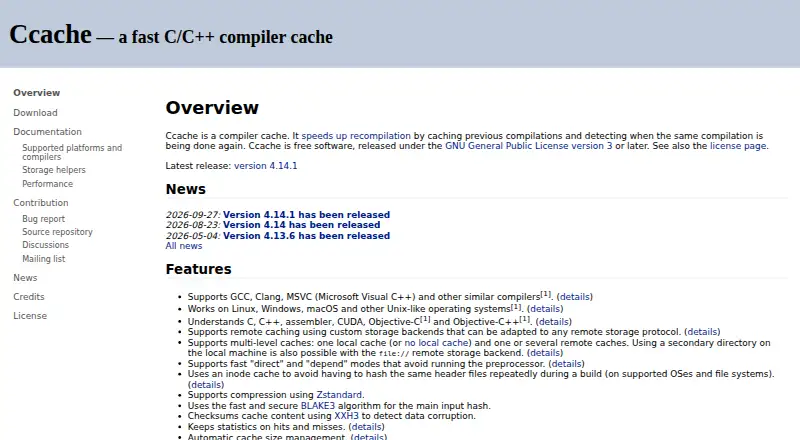
What Ccache is
Ccache is free software that can speed repeated compilations by storing earlier results and recognizing when the same compilation recurs. It supports GCC, Clang, MSVC, and similar compilers, along with C, C++, assembler, CUDA, Objective-C, and Objective-C++, though support varies by compiler and language. Runtime support includes Linux, macOS, and native Windows; Windows with MSYS2 and other Unix-like systems are also listed at a different support level. Direct and depend modes can skip the preprocessor, while adaptable storage backends allow remote caching. Helpers support HTTP, HTTPS, and Redis protocols.
Ccache tracks hit and miss statistics, manages cache size, and supports Zstandard compression. It uses BLAKE3 for its main input hash and XXH3 checksums to detect cache corruption. It works with build systems including Make, CMake, Ninja, and Visual Studio. Its scope is limited to compiling one file at a time: multi-file compilation, linking, and builds using unsupported flags fall back to the real compiler. The project says cache misses add overhead and recommends measuring typical workloads. Ccache is released under GNU GPL version 3 or later.
Who it suits
Ccache suits developers and build workflows that repeat supported single-file compilations, including projects using Make, CMake, Ninja, or Visual Studio. It can also suit teams configuring remote cache storage.
What it does well
- Free software under GNU GPL version 3 or later.
- Supports GCC, Clang, and MSVC.
- Remote caching can use adaptable storage backends.
- Tracks cache statistics and manages cache size.
What to know first
- Only caches compilation of a single file.
- Linking and multi-file builds use the real compiler.
- Unsupported flags fall back to the real compiler.
- Cache misses add overhead.
Limits
The free plan caches single-file compilations; multi-file compilation, linking and compilations using unsupported flags fall back to the real compiler. Cache misses typically add 5%–20% overhead, or 1%–3% with depend mode enabled.
Plans
| Plan | Billed and limits | Price |
|---|---|---|
| Ccache | Free software under GNU GPL version 3 or later · Caches single-file compilations · Some compiler flags fall back to the real compiler | Free |
As ccache.dev lists them, read 30 Sept 2026. The maker's own page has the final word.
Getting started
- Visit https://ccache.dev/ and choose a download for your platform.
- Use a listed source archive or a Linux, macOS or Windows binary.
- Use Ccache with a supported compiler and build system such as Make, CMake, Ninja or Visual Studio.
- Configure a remote storage backend if you need remote caching.
Overview
Ccache is a free software build utility that reuses results from repeated compilations. It suits developers whose builds repeatedly compile eligible source files; it is not a whole-build cache, so its value depends on how much time those compilations account for.
Its compiler and platform coverage is broad, and it can work with local or adapted remote storage. The central trade-off is narrow scope: multi-file compilation, linking, and compilations with unsupported flags still run through the compiler.
Key features
Reuse with a defined boundary
Ccache detects repeated single-file compilations, and its direct and depend modes can avoid running the preprocessor. That can reduce work on a hit, while the single-file boundary means projects dominated by linking or other ineligible steps should look elsewhere. Cache misses typically add 5%–20% overhead; with depend mode enabled, the stated range is 1%–3%. Measuring a representative workload is important before relying on it for a speedup.
Toolchains and build systems
Supported compilers include GCC, Clang, MSVC, NVCC, Intel C++, QNX, and EDG-based compilers. Supported languages include C, C++, assembler, CUDA, Objective-C, and Objective-C++; support levels vary, so broad coverage is not a guarantee that every compiler-language combination behaves alike. Make, CMake, Ninja, and Visual Studio are supported build systems.
Storage, operation, and integrity
Ccache supports remote caching through custom backends that can be adapted to remote storage protocols, with helpers for HTTP, HTTPS, Redis, rediss, and redis+unix. That flexibility is useful for teams with storage infrastructure to integrate, but it is not a hosted cache service. Zstandard compression, BLAKE3 input hashing, and XXH3 checksums address storage efficiency, cache keys, and detection of cache-data corruption. Hit and miss statistics and automatic cache-size management help keep the cache operational. Direct mode has a documented corner case that can produce false-positive cache hits, a consideration for workloads where incorrect reuse would be consequential.
Release archives from version 4.12 onward are signed with minisign, and the download page provides verification instructions. Support and community channels include bug reports, issue tracking, discussions, and a mailing list.
Pricing
Ccache is free software under the GNU General Public License version 3 or later. Its Ccache plan costs nothing, with no free trial. The plan covers single-file compilation caching; some compiler flags fall back to the real compiler. There are no paid tiers or seat, quota, or renewal terms to weigh in this offer, making it suitable where a free, self-hosted tool is preferable to a managed service.
Platforms
Runtime support is level A for Linux, macOS, and native Windows, and level B for Windows with MSYS2 and other Unix-like platforms. Downloads include source archives, macOS and Linux binaries, and a Windows x86_64 binary for version 4.14.1. The self-hosted option and support across these environments make Ccache relevant to teams maintaining their own build infrastructure.
Who it's for
Ccache is best for developers and build teams with recurring single-file compilations on supported toolchains who can assess cache misses and configure storage themselves. It is a weaker fit when linking or multi-file compilation dominates build time, or when a team needs a turnkey remote cache rather than adaptable backends.
Pros and cons
- Pros: Free, GPL-licensed software with support for major compilers, several languages, and common build systems; useful breadth for teams with mixed development environments.
- Pros: Direct and depend modes, remote-backend flexibility, hit/miss statistics, and automatic size management cover practical cache operation without a hosted plan.
- Cons: It only caches single-file compilation; linking, multi-file compilation, and unsupported flags still use the real compiler.
- Cons: Cache misses add overhead, and direct mode has a false-positive-hit corner case; careful workload measurement and mode choice matter.
Alternatives
Bitrise is worth considering for a small project that needs build credits a few times per month and a free plan for a team of one.
EngFlow Remote Caching may fit better when in-cluster remote caching on one Linux machine with up to 32 CPU cores is the target; its Enterprise plan uses custom pricing.
cachepot is another free, open-source option for Linux, macOS, self-hosted, and Windows environments, with Apache-2.0 licensing.
FosterStack offers a full self-hosted cache server on its MIT-licensed Free plan, with security patches and a FIPS image included, for teams seeking that server offering.
NativeLink is a free self-hosted option for teams seeking a distributed scheduler and remote caching across build systems and major cloud providers.
Buildless may suit users seeking a web and API cache service: its Individual / OSS plan is marked coming soon and includes one project, one user, 3GB cache space, and 100GB transfer.
Cachely is a web and API alternative whose Free plan includes 1 GiB managed storage, 500K requests per month, three workspaces, five API tokens, and a build insights dashboard.
Vercel is a web and API platform rather than a like-for-like compiler cache; its Hobby plan is for personal, non-commercial use and includes monthly CDN, transfer, and function-invocation allowances.
For more options, see Build Cache Software.
Verdict
Choose Ccache if repeated single-file compilations are a meaningful part of your builds and you want a free, self-hosted tool with broad toolchain support and adaptable storage. Look elsewhere if your bottleneck is linking or multi-file work, or if you need a managed remote cache rather than a cache whose performance and configuration you will measure and manage.
Verdict
Ccache targets repeated single-file compilation and supports a range of compilers, languages, and build systems. Its limits and miss overhead make workload measurement relevant.
Questions
How much does Ccache cost?
The listed plan costs nothing. It is free software under GNU GPL version 3 or later.
Is there a free plan or trial?
Ccache has a free plan. There is no free trial.
Which platforms does it support?
Runtime support includes Linux, macOS and native Windows. Windows with MSYS2 and other Unix-like platforms are also supported at a different level.
Which compilers and languages does it support?
Compiler support includes GCC, Clang, MSVC and similar compilers. Supported languages include C, C++, assembler, CUDA, Objective-C and Objective-C++; support levels vary.
Can it cache linking or multi-file compilation?
No. Ccache handles compilation of a single file; multi-file compilation and linking fall back to the real compiler.
Who maintains Ccache?
Joel Rosdahl has developed and maintained Ccache since 2010.
Facts from Ccache's own pages
- Cache management
- It tracks cache hit and miss statistics and manages cache size automatically. · ccache.dev, 30 Sept 2026
- Cache modes
- Direct and depend modes can avoid running the preprocessor. · ccache.dev, 30 Sept 2026
- Compilation limits
- Ccache handles compilation of one file at a time; multi-file compilation and linking fall back to the real compiler. · ccache.dev, 30 Sept 2026
- Compilers
- The site lists GCC, Clang, MSVC, and other similar compilers, with support levels varying by compiler. · ccache.dev, 30 Sept 2026
- Compression and hashes
- Ccache supports Zstandard compression, uses BLAKE3 for its main input hash, and uses XXH3 checksums to detect cache corruption. · ccache.dev, 30 Sept 2026
- Compression and hashing
- Ccache supports Zstandard compression, uses BLAKE3 for the main input hash and uses XXH3 checksums to detect cache data corruption. · ccache.dev, 29 Sept 2026
- Downloads
- The download page lists source archives, macOS and Linux binaries, and a Windows x86_64 binary for version 4.14.1. · ccache.dev, 30 Sept 2026
- Integrity caveat
- The site notes that direct mode has a corner case that can cause false-positive cache hits. · ccache.dev, 30 Sept 2026
- Languages
- It supports C, C++, assembler, CUDA, Objective-C, and Objective-C++. · ccache.dev, 30 Sept 2026
- License
- Ccache is free software released under the GNU General Public License version 3 or later. · ccache.dev, 29 Sept 2026
- Limitations
- Ccache only caches compilation of a single file; multi-file compilation and linking fall back to the real compiler, as do compilations using unsupported flags. · ccache.dev, 29 Sept 2026
- Maintainer
- Ccache has been developed and maintained by Joel Rosdahl since 2010. · ccache.dev, 30 Sept 2026
- Operating systems
- Runtime support includes Linux, macOS and native Windows at support level A, plus Windows with MSYS2 and other Unix-like platforms at level B. · ccache.dev, 29 Sept 2026
- Performance caveat
- The site says cache misses typically add 5%–20% overhead, or 1%–3% with depend mode enabled, and recommends measuring typical workloads. · ccache.dev, 29 Sept 2026
- Platforms
- Runtime support is rated A for Linux, macOS, and native Windows; other Unix-like platforms and Windows with MSYS2 are rated B. · ccache.dev, 30 Sept 2026
- Purpose
- Ccache speeds up recompilation by caching previous compilations and reusing results when the same compilation is repeated. · ccache.dev, 30 Sept 2026
- Release verification
- Release archives starting with version 4.12 are signed with minisign, and the download page explains how to verify them. · ccache.dev, 30 Sept 2026
- Remote caching
- Ccache supports remote caching through custom storage backends adaptable to remote storage protocols. · ccache.dev, 30 Sept 2026
- Security
- Release archives starting with version 4.12 are signed with minisign, and the download page gives instructions for verifying them. · ccache.dev, 29 Sept 2026
- Storage integrations
- Listed storage helpers support HTTP, HTTPS, Redis, rediss, and redis+unix protocols. · ccache.dev, 30 Sept 2026
- Support
- The site directs users to its bug report page, issue tracker, discussions, and mailing list. · ccache.dev, 30 Sept 2026
- Support and community
- The site directs users to report bugs, open issues, contribute through the source repository, and use discussions or the mailing list. · ccache.dev, 29 Sept 2026
Where Ccache stands on Freedom251
- Build Cache Software#6 of 23