Freedom251 › Build Cache Software

EngFlow Remote Caching
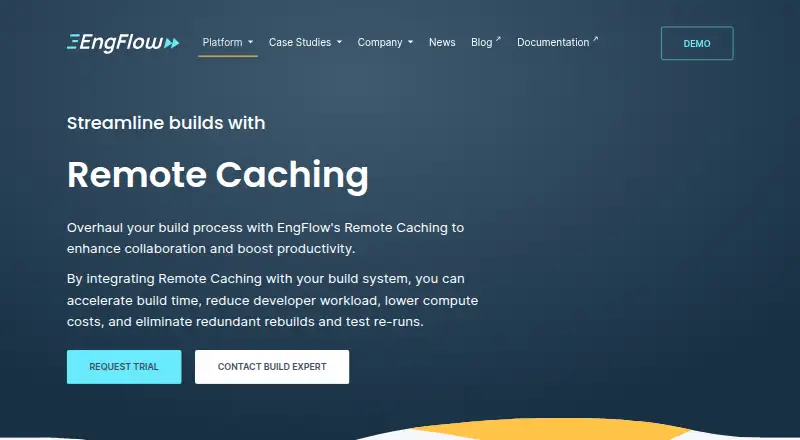
What EngFlow Remote Caching is
EngFlow Remote Caching stores build results remotely so teams can reuse work instead of repeating builds and test runs. It is designed to reduce developer workload and compute costs. Its transfer approach combines gRPC, cache compression, and Build without the Bytes to limit latency and unnecessary data movement. A layered cache keeps frequently requested data available, while the Build & Test UI reports cache hit rates, build time, and build status in real time.
The Free plan supports Bazel and provides in-cluster caching on one Linux machine with 32 CPU cores. Enterprise supports Bazel, Goma for Chromium, and Soong for AOSP, with in-cluster or external cache storage such as S3 and GCS. Enterprise also allows unlimited machines and CPU cores. Deployment can be self-hosted or managed on Enterprise; listed infrastructure options vary by plan and include AWS, GCP, Kubernetes, and OpenStack for Free, with Azure, MacStadium, and Orka added for Enterprise. EngFlow says builds run in isolated, encrypted environments with dedicated infrastructure by default, and that its solutions receive regular third-party audits against the five SOC 2 principles. The product supports C/C++ with GCC, Clang, or MSVC, Java, GitHub Actions, Buildkite, and remote execution.
Who it suits
The Free plan suits Bazel users who can work within one Linux machine and 32 CPU cores. Enterprise is aimed at teams needing more machines, additional build systems, external cache storage, or managed deployment.
What it does well
- Build and test status, cache hit rates, and build time appear in real time.
- Layered caching keeps frequently accessed data available.
- Free plan includes in-cluster caching and 32 CPU cores.
- Enterprise supports Bazel, Goma, and Soong.
- Remote execution and GitHub Actions and Buildkite support are listed.
What to know first
- Free is limited to one machine and 32 CPU cores.
- Free supports Bazel and Linux.
- External cache storage is listed for Enterprise, not Free.
Limits
Free is limited to one machine, 32 CPU cores, Linux, Bazel, and in-cluster caching. Enterprise has unlimited machines and CPU cores and supports external storage; its price is by custom quote.
Plans
| Plan | Billed and limits | Price |
|---|---|---|
| Free | 1 machine · 32 CPU cores · in-cluster remote caching · Linux | Free |
| Enterprise | Custom quote · Unlimited machines and CPU cores · in-cluster or external-storage caching · Linux, macOS, Windows | On request |
As engflow.com lists them, read 30 Sept 2026. The maker's own page has the final word.
Getting started
- Visit the EngFlow Remote Caching product page.
- Choose the Free plan for free, or request Enterprise pricing by custom quote.
- For Free, set up self-hosted deployment on a listed option such as AWS, GCP, Kubernetes, or OpenStack.
- Connect a Bazel project to the Free tier's in-cluster cache.
- Use the product page's trial request form to request a trial.
EngFlow Remote Caching is shared remote build caching for software teams that want to reduce duplicate builds and test runs. It is most compelling for Bazel teams that can operate a self-hosted service, while larger organizations can buy broader system and deployment support. The free tier has firm capacity and platform limits; Enterprise expands those choices at a custom price.
Overview
EngFlow aims to shorten builds and reduce developer workload and compute costs by reusing build outputs across a team. It uses gRPC, compression, and Build without the Bytes to limit latency and unnecessary transfers. A layered cache is designed to keep frequently used data readily available, reducing repeat requests and network load.
The Build & Test UI reports cache hit rates, build time, and status in real time. That makes it easier to assess whether caching is helping and to spot changes in cache effectiveness. Remote execution is supported, along with C/C++ using GCC, Clang, or MSVC and Java.
Key features
Cache performance and visibility
Compression and reduced data transfers target the network overhead that can blunt the gains from remote caching. The layered architecture is intended to serve frequent requests efficiently, and the UI gives teams useful measures of cache behavior and build progress. These features are relevant for build-heavy projects, though their impact depends on the workload and the cache configuration.
Security and scale
EngFlow says builds run in isolated environments with encryption and dedicated infrastructure by default. It also says its solutions receive regular third-party audits against the five SOC 2 principles. The service is designed to distribute parallel work and cache loads across multiple servers, which gives it a path from small teams to enterprise-scale projects.
Pricing
| Plan | Price | What it includes | Best fit |
|---|---|---|---|
| Free | free | 1 machine, 32 CPU cores, in-cluster remote caching, Linux, and Bazel support. Deployment is self-hosted, with bare metal, AWS, GCP, Kubernetes, and OpenStack options. Authentication includes HTTP basic authentication and mTLS; support is community-based. | Bazel teams that can work within a single machine and Linux setup and want to start without a subscription. |
| Enterprise | Custom pricing | Unlimited machines and CPU cores, in-cluster or external-storage caching, and Linux, macOS, and Windows. It supports Bazel, Goma (Chromium), and Soong (AOSP), plus self-hosted or managed deployment. Options add Azure, MacStadium, and Orka; authentication adds GCP IAM, Google OAuth, SAML, and custom options. A dedicated engineer is included. | Organizations that need more capacity, another listed build system, external storage, managed deployment, or dedicated support. |
The Free plan makes the initial cost clear, but its single-machine and 32-core ceiling can constrain larger or concurrent workloads. Enterprise removes those stated capacity limits and adds broader system and infrastructure choices, but the custom quote makes the total cost dependent on the buyer's needs. EngFlow offers a trial request form; no trial duration is stated.
Platforms
EngFlow supports Linux, macOS, and Windows, as well as API, web, and self-hosted access. The Free plan is Linux-only; macOS and Windows are Enterprise options. Teams can deploy Free on bare metal, AWS, GCP, Kubernetes, or OpenStack. Enterprise adds Azure, MacStadium, and Orka among its deployment choices, and can be self-hosted or managed.
Who it's for
This is a strong fit for Bazel teams that want shared caching, build visibility, and a free self-hosted starting point within a defined capacity. Enterprise is aimed at organizations running larger workloads or using Goma or Soong, and at teams that need external S3 or GCS storage, managed deployment, additional authentication methods, or a dedicated engineer. Teams seeking an inexpensive, unrestricted plan or a cache for a build system outside those named should compare other options.
Pros and cons
- Pros: The Free plan includes remote caching for Bazel at no charge, with 1 machine and 32 CPU cores clearly defined.
- Pros: Real-time cache hit, build-time, and status metrics help teams evaluate cache effectiveness.
- Pros: Enterprise offers unlimited machines and cores, external S3 and GCS storage, managed deployment, and support for Goma and Soong.
- Pros: EngFlow says builds are isolated and encrypted, with dedicated infrastructure by default and regular third-party audits against the five SOC 2 principles.
- Cons: Free is limited to Linux, Bazel, one machine, and 32 CPU cores, so teams with other system or platform needs must consider Enterprise.
- Cons: Enterprise requires custom pricing, which leaves the cost uncertain until a quote is obtained.
- Cons: External cache storage and managed deployment are reserved for Enterprise, limiting the Free plan's infrastructure flexibility.
Alternatives
Compare build cache software if you want to weigh EngFlow against a wider set of caching tools.
Choose Bitrise instead if you want a freemium build platform with a free Hobby plan for a one-person team and build credits for a small project a few times per month.
Ccache is a free option for caching single-file compilations; it may suit a narrower compiler workflow, though some compiler flags fall back to normal compilation.
Consider cachepot if an Apache-2.0-licensed open-source option is the priority and you do not need a stated hosted plan.
FosterStack is another freemium self-hosted cache, with a free MIT-licensed server and security patches; its Team plan is $49 a month.
MozJPEG is a free open-source JPEG encoder library, a better fit for JPEG encoding than shared build caching.
Pick NativeLink if you want a free, self-hosted open-source option with a distributed scheduler and remote caching across all build systems and major cloud providers.
bazel-remote is a free Apache-2.0-licensed self-hosted cache whose size can be configured, making it an option for teams that want control over cache sizing.
BuildFetch Cache may suit teams looking for a metered free cache, with 20GB fast storage, 50GB network traffic, 100,000 cache requests, and 45-day LRU retention.
Verdict
Choose EngFlow Remote Caching if your team uses Bazel and wants shared remote caching with live build and cache metrics, or if your organization needs Enterprise capacity, broader build-system support, and deployment options. The free plan is a practical entry point for Linux teams that fit its one-machine, 32-core limit. Look elsewhere if you need a known Enterprise price before engaging, or if your build and storage requirements do not fit EngFlow's plan boundaries.
Verdict
Choose EngFlow Remote Caching if you use a supported build system and want shared remote caching with build visibility. The Free plan gives Bazel users a defined way to start; teams needing unlimited capacity, other listed build systems, or external storage should consider Enterprise, which is sold by custom quote.
Questions
What does EngFlow Remote Caching cost?
The Free plan is listed as free. Enterprise is billed by custom quote.
What is included in the Free plan?
It includes one machine, 32 CPU cores, in-cluster remote caching, and Linux. The Free tier works with Bazel.
Which build systems does it support?
Free supports Bazel. Enterprise lists Bazel, Goma for Chromium, and Soong for AOSP.
Can it be self-hosted?
Yes. Free is listed as self-hosted; Enterprise can be self-hosted or managed.
Which platforms and languages are listed?
Platforms include API, Linux, macOS, self-hosted, web, and Windows. Compiler and language support includes C/C++ with GCC, Clang, or MSVC, and Java.
How can I request a trial?
The product page offers a trial request form.
Facts from EngFlow Remote Caching's own pages
- Analytics
- The Build & Test UI provides real-time information on cache hit rates, build time, and status. · engflow.com, 30 Sept 2026
- Authentication
- The pricing comparison lists HTTP basic authentication and mTLS for Free, with GCP IAM, Google OAuth, SAML, and custom options added for Enterprise. · engflow.com, 30 Sept 2026
- Cache architecture
- A layered caching strategy keeps frequently accessed data readily available to reduce redundant requests and network load. · engflow.com, 30 Sept 2026
- Cache storage
- The Free tier includes in-cluster caching; Enterprise also supports cache storage in external services such as S3 and GCS. · engflow.com, 30 Sept 2026
- Compliance
- EngFlow says its solutions receive regular third-party audits against the five SOC 2 principles. · engflow.com, 30 Sept 2026
- Deployment
- The pricing page lists Free as self-hosted and Enterprise as self-hosted or managed, with deployment options that include bare metal, AWS, GCP, Kubernetes, and OpenStack for Free, plus Azure, MacStadium, and Orka for Enterprise. · engflow.com, 30 Sept 2026
- Headquarters
- Austin, Texas, United States · engflow.com, 23 Sept 2026
- Purpose
- Remote Caching is designed to speed builds, reduce developer workload and compute costs, and eliminate redundant rebuilds and test reruns. · engflow.com, 30 Sept 2026
- Scalability
- The product is designed for projects ranging from small development teams to enterprise-scale software, with parallelism and cache loads distributed across multiple servers. · engflow.com, 30 Sept 2026
- Security
- EngFlow says builds run in isolated environments with encryption and, by default, dedicated infrastructure. · engflow.com, 30 Sept 2026
- Support
- The pricing page lists community support for Free and a dedicated engineer for Enterprise. · engflow.com, 30 Sept 2026
- Supported build systems
- The Free tier works with Bazel; Enterprise lists Bazel, Goma (Chromium), and Soong (AOSP). · engflow.com, 30 Sept 2026
- Transfers
- The service uses gRPC, cache compression, and Build without the Bytes to reduce latency and unnecessary data transfers. · engflow.com, 30 Sept 2026
- Trial
- The product page offers a trial request form but does not state a trial duration. · engflow.com, 30 Sept 2026
Where EngFlow Remote Caching stands on Freedom251
- Build Cache Software#9 of 23