Freedom251 › Build Cache Software
BuildFetch Cache
What BuildFetch Cache is
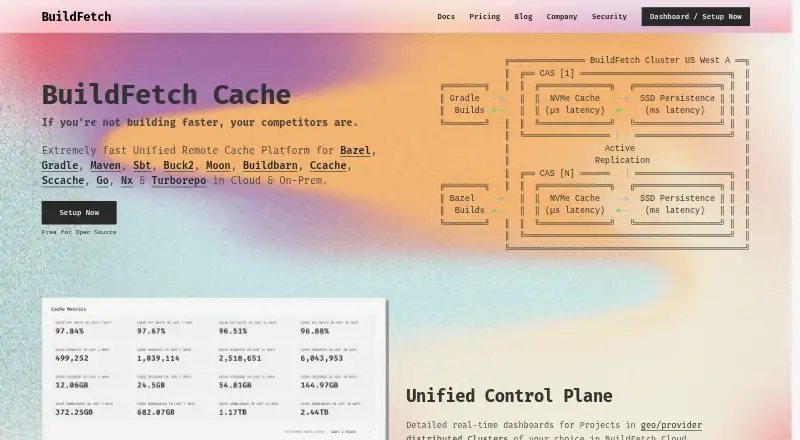
BuildFetch Cache is a remote cache platform intended to reduce build times and CI costs by sharing build outputs across engineer workstations, CI and AI agent environments. It lists support for Bazel, Gradle, Maven, Sbt, Buck2, Moon, Buildbarn, Ccache, Sccache, Go, Nx and Turborepo; Bazel can use either gRPC or HTTP remote cache APIs. The service uses NVMe for ephemeral cache storage and SSD for persistent storage. A project dashboard shows throughput, tail latency, request volume and storage use, while scoped project tokens can grant read-only or read-write access. BuildFetch says data is encrypted in transit with TLS and at rest with LUKS AES-256 or similar technologies. It is available through BuildFetch Cloud or as a Custom Cloud or on-premise Kubernetes deployment. Listed regions are US West and EU Central. The free plan has resource caps; paid plans start at $55 a month, and a 45-day trial is listed. Basic and Pro plans allow separately priced storage, traffic and request overages.
Who it suits
It suits teams using supported build systems that want to share cached outputs across developers, CI and AI agents. Organizations can choose a cloud service or a self-hosted deployment, including on-premise Kubernetes.
What it does well
- Supports a wide range of listed build systems.
- Shares cache outputs across workstations, CI and AI agents.
- Dashboard shows throughput, latency, requests and storage.
- Offers scoped read-only and read-write project tokens.
- On-premise Kubernetes deployment is available.
What to know first
- Free plan resource caps cannot be exceeded.
- Basic and Pro overages are separately priced.
- Paid plans start at $55 a month.
- Listed regions are US West and EU Central.
Limits
The free Open Source plan includes 20GB fast cache storage, 50GB network traffic, 100,000 cache requests, and 45 days of LRU retention; its resource caps cannot be exceeded. Basic includes one project, 50GB fast cache storage, 100GB network traffic, 300,000 requests, and 45 days of retention. Pro provides 75 days of retention and unlimited projects and users.
Plans
| Plan | Billed and limits | Price |
|---|---|---|
| Cache Open Source | Free · 20GB Fast Cache Storage · 50GB Network Traffic · 100,000 Cache Requests · 45 days LRU retention | Free |
| Cache Pro | $160/m · 170GB Fast Cache Storage · 500GB Network Traffic · 1,000,000 Cache Requests · Unlimited Projects & Users · 75 days LRU retention | $160 a month |
| Cache Custom | Starting at $5k/m · Unlimited Projects & Users · Unlimited Cache Storage · Custom Cloud or On-Premise Kubernetes · 45 days of free Trial | $5,000 a month |
| Cache Basic | $55/m · 50GB Fast Cache Storage · 100GB Network Traffic · 300,000 Cache Requests · 1 Project and unlimited Open Source Projects · 45 days LRU retention | $55 a month |
As buildfetch.com lists them, read 8 Oct 2026. The maker's own page has the final word.
Getting started
- Visit the BuildFetch website.
- Choose BuildFetch Cloud, custom cloud, or on-premise Kubernetes deployment.
- Select the Open Source plan or a paid plan; the free plan includes a 45-day trial.
- Configure a supported build system to use the remote cache.
- Use scoped project tokens to set read-only or read-write access.
Verdict
BuildFetch Cache pairs broad build-system support with shared remote caching, usage metrics and deployment choices. Review the free-tier caps and overage terms, or consider self-hosting if the listed cloud regions do not fit.
Questions
Is BuildFetch Cache free?
Yes. Cache Open Source is free and includes 20GB fast cache storage, 50GB network traffic, 100,000 cache requests, and 45 days of LRU retention.
What do the paid plans cost?
Cache Basic costs $55/m, Cache Pro costs $160/m, and Cache Custom starts at $5k/m.
Does BuildFetch offer a trial?
Yes. The pricing note includes a 45-day trial. Cache Custom lists 45 days of free trial.
Which build systems does it support?
The listed systems are Bazel, Gradle, Maven, Sbt, Buck2, Moon, Buildbarn, Ccache, Sccache, Go, Nx, and Turborepo. Bazel supports gRPC and HTTP remote cache APIs.
Can BuildFetch be self-hosted?
Yes. It can be deployed in custom cloud or on-premise Kubernetes environments, as well as used through BuildFetch Cloud.
Who makes BuildFetch Cache?
BuildFetch Inc. says it was founded in Wyoming, USA, in 2025.
Facts from BuildFetch Cache's own pages
- Access controls
- BuildFetch offers scoped project tokens, including read-only and read-write access for different users and workflows. · buildfetch.com, 8 Oct 2026
- Build systems
- The product lists native support for Bazel, Gradle, Maven, Sbt, Buck2, Moon, Buildbarn, Ccache, Sccache, Go, Nx, and Turborepo. · buildfetch.com, 8 Oct 2026
- Cache protocols
- For Bazel, BuildFetch supports both gRPC and HTTP remote cache APIs. · buildfetch.com, 8 Oct 2026
- Cloud regions
- The homepage lists US West and EU Central as available regions and says US East is coming later. · buildfetch.com, 8 Oct 2026
- Company
- BuildFetch Inc. says it was founded in Wyoming, USA, in 2025. · buildfetch.com, 8 Oct 2026
- Dashboard
- The project dashboard provides live throughput, tail latency, request volume, and storage usage metrics. · buildfetch.com, 8 Oct 2026
- Data privacy
- BuildFetch says it does not sell customer data to third parties and references GDPR in its data protection statement. · buildfetch.com, 8 Oct 2026
- Deployments
- The product is offered in BuildFetch Cloud and can also be deployed in Custom Cloud or on-premise Kubernetes environments. · buildfetch.com, 8 Oct 2026
- Encryption
- BuildFetch says data is encrypted in transit with TLS and at rest with LUKS AES-256 or similar technologies. · buildfetch.com, 8 Oct 2026
- Founded
- 2025 · buildfetch.com, 28 Sept 2026
- Notable limits
- Open Source cache resource caps cannot be exceeded, while Basic and Pro allow separately priced storage, traffic, and request overages. · buildfetch.com, 8 Oct 2026
- Product
- BuildFetch Cache is a unified remote cache platform for build systems, intended to reduce build times and CI costs. · buildfetch.com, 8 Oct 2026
- Shared builds
- Remote cache outputs can be shared across engineer workstations, CI, and AI agent environments. · buildfetch.com, 8 Oct 2026
- Storage
- The service uses NVMe for ephemeral cache storage and SSD for persistent storage. · buildfetch.com, 8 Oct 2026
- Support
- The plans list email support response times from five business days on Open Source to 24 hours for Custom, with video and on-site support available on Custom. · buildfetch.com, 8 Oct 2026
Where BuildFetch Cache stands on Freedom251
- Build Cache Software#8 of 23