Freedom251 › Build Cache Software
Cachely
What Cachely is
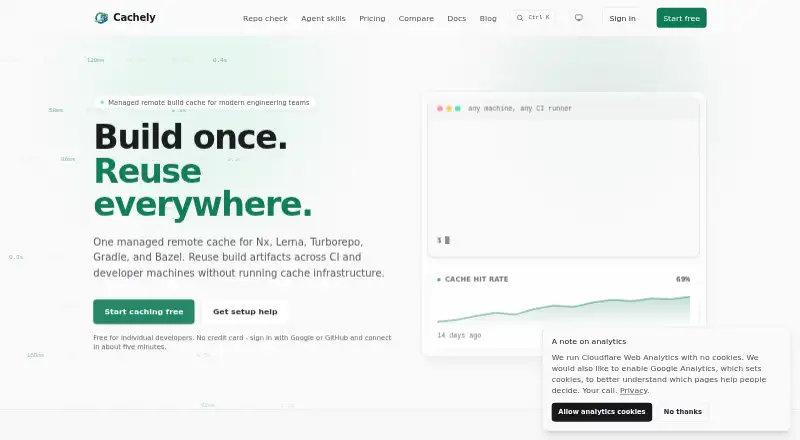
Cachely is a managed remote build cache that shares build artifacts between CI runners and developer machines. It supports Nx, Lerna, Turborepo, Gradle, and Bazel, along with CI platforms including GitHub Actions, GitLab CI, CircleCI, Jenkins, Buildkite, Woodpecker, Drone, and self-hosted runners. The dashboard tracks cache hit rate, slow tasks, and estimated CI time and cost savings. Setup involves creating a workspace, generating a token, and configuring a build tool; the maker says this takes about five minutes. Tokens are hashed, workspace-scoped, revocable, and set as read-only or read-write when created. Artifacts are immutable, served over HTTPS, encrypted at rest by Cloudflare R2, and expire after 20 days. The free plan includes 1 GiB of storage and 500K requests per month. Team costs $29.99 per month or $24.99 per year billed yearly. Cachely says it does not connect to repositories, but configured clients send task outputs and content hashes, which can include source-derived files.
Who it suits
Cachely suits individual developers and teams using its supported build systems who want a managed shared cache. Teams that need additional capacity can consider the Team plan.
What it does well
- Supports five named build systems.
- Dashboard tracks cache and estimated savings insights.
- Tokens are revocable and workspace-scoped.
- Artifacts expire automatically after 20 days.
- Limits do not trigger overage billing.
What to know first
- No formal attestation such as SOC 2 yet.
- No self-hosted option.
- Artifacts expire after 20 days.
- Configured outputs may include source-derived files.
Limits
Free includes 1 GiB managed storage and 500K requests per month. When storage or request limits are reached, Cachely stops storing new artifacts or returns cache misses so the build tool rebuilds tasks locally; it does not bill overages. Stored artifacts automatically expire 20 days after upload.
Plans
| Plan | Billed and limits | Price |
|---|---|---|
| Free | $0 forever · 1 GiB managed storage · 500K requests/month · 3 workspaces · 5 API tokens · build insights dashboard | Free |
| Team (yearly billing) | $24.99/mo billed yearly (2 months free); $299.88 per year · 100 GiB managed storage · 20M requests/month · 20 workspaces · 100 API tokens · priority email support | $299.88 a year |
| Team | $29.99 per month · 100 GiB managed storage · 20M requests/month · 20 workspaces · 100 API tokens · priority email support | $29.99 a month |
| Enterprise | Custom talk to us · 1 TiB managed storage · unlimited requests · unlimited workspaces · unlimited API tokens · dedicated support | On request |
As cachely.dev lists them, read 30 Sept 2026. The maker's own page has the final word.
Getting started
- Open the Cachely website.
- Choose the Free plan, Team plan, or contact the maker about Enterprise.
- Create a workspace.
- Generate a token and choose read-only or read-write access.
- Point a supported build tool at the cache.
Verdict
Cachely offers a managed cache with support for several build systems, CI platforms, and usage insights. Consider its 20-day retention, lack of formal attestation, and the data sent by configured clients when assessing fit.
Questions
Does Cachely have a free plan?
Yes. Free costs nothing, billed $0 forever, and includes 1 GiB managed storage, 500K requests per month, three workspaces, five API tokens, and the build insights dashboard.
How much does Team cost?
Team is $29.99 per month. Yearly billing is listed at $24.99/mo billed yearly, or $299.88 per year.
Which build systems and CI platforms does Cachely support?
Build systems are Nx, Lerna, Turborepo, Gradle, and Bazel. CI platform support includes GitHub Actions, GitLab CI, CircleCI, Jenkins, Buildkite, Woodpecker, Drone, and self-hosted runners.
How long does setup take?
The maker says setup takes about five minutes. It involves creating a workspace, generating a token, and pointing the build tool at the cache.
Does Cachely offer self-hosting or remote execution?
No. The listed facts say Cachely has no self-hosted option and does not support remote execution.
What happens when I reach a storage or request limit?
Cachely stops storing new artifacts or returns cache misses, after which the build tool rebuilds tasks locally. It does not charge overage billing.
Facts from Cachely's own pages
- Artifact integrity
- Managed artifacts are content-addressed and immutable, and an existing cache key cannot be overwritten. · cachely.dev, 30 Sept 2026
- Audience
- The Free plan is described as being for individual developers, while Team is for teams seeking production headroom. · cachely.dev, 30 Sept 2026
- Compliance
- Cachely states that it does not yet hold a formal attestation such as SOC 2. · cachely.dev, 30 Sept 2026
- Data handling
- Cachely says it does not clone or connect to repositories; configured cache clients send task outputs and content hashes, which may include source-derived files if configured as outputs. · cachely.dev, 30 Sept 2026
- Insights
- The dashboard tracks cache hit rate, slow tasks, and estimated CI time and cost savings. · cachely.dev, 30 Sept 2026
- Integrations
- Cachely supports the Nx self-hosted remote cache protocol, which also powers Lerna, plus Turborepo, Gradle HTTP Build Cache, and Bazel HTTP remote cache protocols. · cachely.dev, 30 Sept 2026
- Limits behavior
- When storage or request limits are reached, Cachely stops storing new artifacts or returns cache misses so the build tool rebuilds tasks locally, without overage billing. · cachely.dev, 30 Sept 2026
- Product
- Cachely is a managed remote build cache for Nx, Lerna, Turborepo, Gradle, and Bazel, sharing build artifacts across CI runners and developer machines. · cachely.dev, 30 Sept 2026
- Security
- Tokens are SHA-256 hashed, scoped to one workspace, revocable, and fixed at creation as read-only or read-write. · cachely.dev, 30 Sept 2026
- Setup
- The maker says setup takes about five minutes and requires creating a workspace, generating a token, and pointing the build tool at the cache. · cachely.dev, 30 Sept 2026
- Storage and retention
- Artifacts are stored on Cloudflare R2, served over HTTPS, encrypted at rest by R2, and automatically expire 20 days after upload. · cachely.dev, 30 Sept 2026
- Support
- Setup questions can be asked in the Cachely Discord, while account-specific issues can be emailed to [email protected]. · cachely.dev, 30 Sept 2026
Where Cachely stands on Freedom251
- Build Cache Software#10 of 23