Freedom251 › Build Cache Software
FosterStack
What FosterStack is
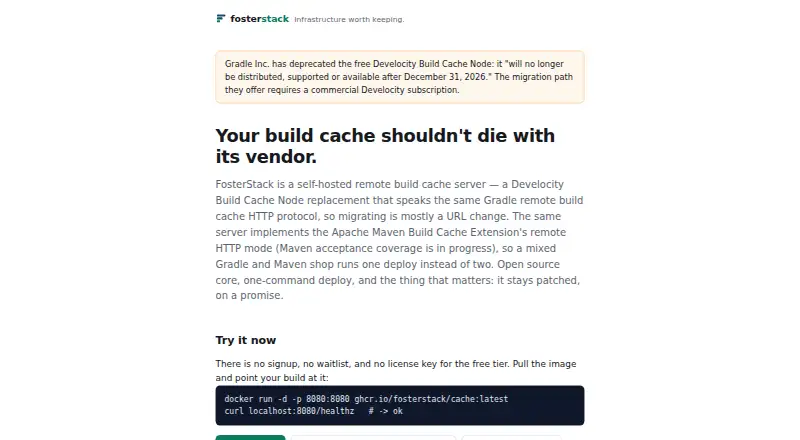
FosterStack is a self-hosted remote build cache server for teams using Gradle or Maven that want an alternative to the discontinued standalone Develocity Build Cache Node. It runs as a Docker image or static binary on Linux or macOS; Windows builds are not available or planned. The server supports Gradle and Maven’s remote HTTP cache mode, though Maven acceptance coverage is still in progress. Its size-capped LRU policy removes older entries to make room for new ones. HTTP Basic Auth runs over TLS, with constant-time credential comparison and no credential logging. Prometheus metrics and a read-only status page show hit rates and cache size against its cap. The core is MIT-licensed, and the free tier includes security patches. The maker says the free core makes no outbound connections and collects no usage data or telemetry. FosterStack identifies the product as v0.1 and says it is not yet used outside its own work in a production build pipeline. The free plan is $0.00 per free; paid plans are listed from $49.00 per month, but those tiers are not yet available.
Who it suits
FosterStack suits Gradle or Maven teams that want to host a remote build cache themselves. Its current maturity may matter to teams considering production use.
What it does well
- Self-hosted deployment via Docker image or static binary
- Supports Gradle and Maven remote HTTP mode
- Size-capped LRU eviction manages cache space
- Prometheus metrics and read-only status page
- Free tier includes security patches
What to know first
- Maven acceptance coverage is still in progress
- Windows builds are not available or planned
- Paid tiers are described but not yet available
- Not yet used outside its maker’s work in production
Limits
The free plan is the full self-hosted cache server and includes security patches and a -fips image. Team, Business, and Compliance features are described but not yet available.
Plans
| Plan | Billed and limits | Price |
|---|---|---|
| Free | Full self-hosted cache server · MIT-licensed · security patches and -fips image included | Free |
| Business | Everything in Team · HA/replication · priority support with CVE-response target · described, not yet available | $199 a month |
| Team | Multi-user access control · SSO (OIDC) · per-project usage analytics · email support (1-business-day target) · described, not yet available | $49 a month |
| Compliance | billed annually · Everything in Business · FIPS 140-3 applicability statement · signed per-release attestation letters · security-questionnaire support up to 8 hours per year (async) · named-version LTS · described, not yet available | $499 a year |
As fosterstack.com lists them, read 3 Oct 2026. The maker's own page has the final word.
Getting started
- Visit the FosterStack website.
- Choose the Linux or macOS release binary for your architecture, or use the Docker image.
- Run FosterStack on infrastructure you manage.
- Configure Gradle or the Maven Build Cache Extension to use its remote HTTP cache.
- Use the free plan, or review the described paid plans for their availability.
Overview
FosterStack is an open-source, self-hosted remote build cache for teams using Gradle or Maven. It is best suited to teams seeking a replacement for the discontinued standalone Develocity Build Cache Node and willing to operate an early-stage service themselves.
Its useful controls and no-cost core are balanced by v0.1 maturity, incomplete Maven acceptance coverage and paid tiers that are not yet available.
Key features
FosterStack supports Gradle and implements Maven’s remote HTTP cache mode, though Maven acceptance coverage remains in progress. That makes Gradle the more established fit for teams evaluating build-tool compatibility; Maven users should account for the unfinished acceptance work.
A size cap and least-recently-used eviction keep the cache within a chosen limit by removing older entries when new ones arrive. HTTP Basic Auth over TLS, constant-time credential comparison and no credential logging provide a focused access-control baseline. Prometheus metrics and a read-only status page show hit rates and cache size against its cap, giving operators visibility into cache use.
Teams can deploy a Docker image or static binary. Signed releases and SLSA provenance add artifact-verification evidence, while the MIT-licensed core receives security patches in the free tier. The maker says that core makes no outbound connections and collects no telemetry or usage data. FosterStack is not FedRAMP or CMMC compliant; its published evidence and validated crypto are intended to support a customer’s own compliance program, not replace compliance.
The product is v0.1, and nobody outside the maker’s own work is yet running it in a production build pipeline. That is a material adoption risk for teams that need an established production track record. Windows is not built or planned.
Pricing
The pricing model is freemium, with a free self-hosted core and paid plans described at $49/mo and above. The paid tiers are not yet available, so their features and support should not be treated as purchasable today.
| Plan | Price | What it includes |
|---|---|---|
| Free | free | Full self-hosted cache server, MIT license, security patches and -fips image. |
| Team | $49 a month | Multi-user access control, OIDC SSO, per-project usage analytics and email support with a one-business-day target. Described, not yet available. |
| Business | $199 a month | Everything in Team, plus HA/replication and priority support with a CVE-response target. Described, not yet available. |
| Compliance | $499 a year, billed annually | Everything in Business, an FIPS 140-3 applicability statement, signed per-release attestation letters, up to eight hours per year of asynchronous security-questionnaire support and named-version LTS. Described, not yet available. |
The free plan supplies the full self-hosted cache and security patches, but lacks the multi-user controls, SSO, analytics and support commitments described for paid plans. Team is aimed at groups that need those capabilities; Business adds resilience and priority support; Compliance adds documentation, questionnaire assistance and LTS. Since none of the paid tiers is available yet, teams needing those services now should look elsewhere. GitHub issues are the route for bug reports and questions in the meantime.
Platforms
FosterStack runs on Linux and macOS, with release binaries for amd64 and arm64 on both. It is self-hosted and can run as a Docker image or static binary. Windows is not supported or planned, so Windows-reliant teams should choose a different option.
Who it's for
FosterStack is a plausible fit for Gradle teams, and for Maven teams prepared to account for acceptance coverage still in progress, that want a self-hosted cache with open-source licensing, size controls and operator-facing metrics. It is less suitable for teams that require a proven production deployment, Windows builds, remote execution, or available paid support and access-control tiers. Remote execution is not part of the product.
Pros and cons
Pros
- Full cache server at no cost: the free plan includes the self-hosted server, MIT license and security patches.
- Operational visibility and limits: Prometheus metrics, a read-only status page and size-capped LRU eviction help teams monitor and bound cache use.
- Verifiable release practices: signed artifacts and SLSA provenance support release verification.
- Privacy-oriented core: the maker says the free core makes no outbound connections and collects no telemetry or usage data.
Cons
- Very early maturity: it is v0.1, with no external production build-pipeline users reported by the maker.
- Maven coverage is unfinished: acceptance work is still in progress, making it a less settled choice for Maven users.
- Paid capabilities are not available: multi-user access, OIDC SSO, analytics, HA/replication and the described support commitments cannot yet be bought.
- No Windows support or remote execution: both are exclusions for teams that require those capabilities.
Alternatives
Build Cache Software is the broader category directory for comparing cache options.
- Bitrise is worth considering when a team wants a freemium build platform with a one-person Hobby plan and a small-project allowance of build credits a few times per month, rather than FosterStack’s self-hosted cache server.
- Ccache is a free option for Linux, macOS, Windows and self-hosted environments when single-file compilation caching is the need; some compiler flags fall back to the compiler.
- EngFlow Remote Caching fits teams that want a free in-cluster option limited to one machine, 32 CPU cores and Linux, or an enterprise plan with custom pricing.
- cachepot is a free Apache-2.0 option for teams looking for open-source cache software across Linux, macOS, Windows and self-hosted environments.
- MozJPEG is a free open-source JPEG encoder library with a demo cjpeg tool, not a substitute when the need is a Gradle or Maven remote build cache.
- NativeLink is a free self-hosted alternative when distributed scheduling, remote caching across all build systems, major cloud providers and community Slack support are priorities.
- bazel-remote is a free, Apache-2.0 self-hosted cache with configurable cache size for teams whose needs align with that option.
- BuildFetch Cache offers a free tier with 20GB fast cache storage, 50GB network traffic, 100,000 cache requests and 45 days of LRU retention; consider it when those published quotas suit the workload.
Verdict
Choose FosterStack if your Gradle or Maven team wants an MIT-licensed, self-hosted remote cache and can accept v0.1 maturity, with Maven users especially mindful of incomplete acceptance coverage. Its free core combines cache controls, authentication and monitoring without telemetry, but teams needing production-proven software or paid access controls and support today should look elsewhere.
Verdict
FosterStack offers a free, self-hosted cache with authentication, metrics, and cache-size controls. Its v0.1 status, incomplete Maven acceptance coverage, and unavailable paid tiers are important constraints to weigh.
Questions
Is FosterStack free?
Yes. Its Free plan costs nothing and includes the full self-hosted cache server.
What does the Team plan cost?
It is listed at $49 a month, but is described and not yet available.
Which build systems does it support?
FosterStack supports Gradle and the Apache Maven Build Cache Extension remote HTTP mode. Maven acceptance coverage is in progress.
Is FosterStack open source?
Yes. Its core is MIT-licensed.
Where can I run it?
FosterStack is self-hosted and can run from a Docker image or static binary. Release binaries are available for Linux and macOS on amd64 and arm64.
Does it provide remote execution?
No. Remote execution is not supported.
Facts from FosterStack's own pages
- Authentication
- It supports HTTP Basic Auth over TLS, with constant-time credential comparison and no credential logging. · fosterstack.com, 3 Oct 2026
- Build tools
- It supports Gradle and implements the Apache Maven Build Cache Extension remote HTTP mode, with Maven acceptance coverage in progress. · fosterstack.com, 3 Oct 2026
- Cache management
- The server provides size-capped LRU eviction to make room for new entries. · fosterstack.com, 3 Oct 2026
- Compliance
- FosterStack says it is not FedRAMP or CMMC compliant; its published evidence and validated crypto are intended to support a customer's compliance program. · fosterstack.com, 3 Oct 2026
- Deployment
- The product is self-hosted and can be run from a Docker image or as a static binary. · github.com, 3 Oct 2026
- Intended users
- The product is aimed at teams using Gradle or Maven that want a self-hosted replacement for the discontinued standalone Develocity Build Cache Node. · github.com, 3 Oct 2026
- Maturity
- The maker identifies the product as v0.1 and says nobody outside its own work is yet running it in a production build pipeline. · fosterstack.com, 3 Oct 2026
- Metrics
- It exposes Prometheus metrics and provides a read-only status page with hit rates and cache size versus cap. · fosterstack.com, 3 Oct 2026
- Operating systems
- Release binaries are available for Linux amd64 and arm64 and macOS amd64 and arm64; Windows is not built or planned. · github.com, 3 Oct 2026
- Privacy
- The maker says the free core makes no outbound connections and collects no telemetry or usage data. · fosterstack.com, 3 Oct 2026
- Product
- FosterStack is a self-hosted remote build cache server intended as a replacement for Develocity Build Cache Node. · fosterstack.com, 3 Oct 2026
- Security
- The core is MIT-licensed, releases include signed artifacts and SLSA provenance, and security patches are included in the free tier. · fosterstack.com, 3 Oct 2026
- Support
- Bugs and questions can be reported through GitHub issues; the listed paid tiers describe email and priority support but are not yet available. · fosterstack.com, 3 Oct 2026
Where FosterStack stands on Freedom251
- Build Cache Software#12 of 23