Freedom251 › Integration Platform as a Service Software

Nango
by Nango
What Nango is
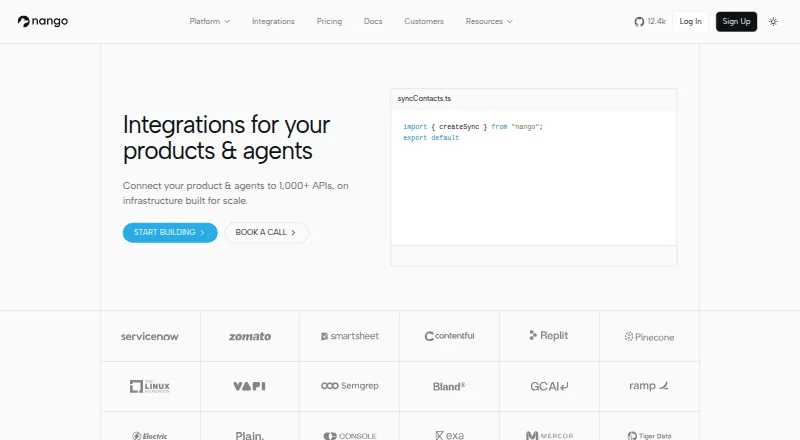
Nango provides infrastructure for building and operating integrations between products or AI agents and external APIs. It supports authentication, agent tools, webhooks, triggers and managed incremental data syncs, with a catalog of more than 1,000 supported APIs. Integrations are written as code, with local development, CI/CD and multiple environments in the workflow. Authentication options include OAuth 2.0, OAuth 1.0a, API keys, JWT, Basic auth and MCP auth. Nango manages token refresh and encrypts credentials at rest and in transit, with tenant isolation. Runtime features include resumable executions, retries, rate-limit handling, logs, metrics and alerts. Developers can self-host and build custom connectors. The Free plan costs nothing and is capped monthly at 10 connections, 10 compute hours and 10GB of data transfer. Pay-as-you-go is $50 a month and includes $50 in monthly credits, with listed rates for connections, compute and data transfer. Nango says it does not currently offer EU-hosted cloud; Enterprise BYOC instances are available in AWS, GCP or Azure regions.
Who it suits
Nango is suited to developers building or maintaining integrations with external APIs, including integrations for AI agents. Teams needing self-hosting, custom connectors or managed authentication can consider its corresponding capabilities.
What it does well
- Catalog lists more than 1,000 supported APIs
- Supports multiple authentication methods
- Token refresh is managed
- Supports local development and CI/CD
- Self-hosting and custom connectors are supported
What to know first
- Free plan caps connections at 10 monthly
- Free plan caps compute at 10 hours monthly
- Free plan caps data transfer at 10GB monthly
- No EU-hosted cloud is currently offered
Limits
The Free plan resets its hard caps monthly: 10 connections, 10 compute hours, and 10GB of data transfer. Pay-as-you-go costs $50 a month and includes $50 in credits, with additional listed charges of $0.29 per connection, $0.72 per compute hour, and $0.5 per GB transferred.
Plans
| Plan | Billed and limits | Price |
|---|---|---|
| Pay-as-you-go | $50 /mo · $50 monthly usage credits · $0.29/connection · $0.72/compute hour · $0.50/GB egress | $50 a month |
| Free | $0 /mo · API & MCP auth, tools & syncs · 10 connections · 10 compute hours/month · 10GB data transfer/month · hard-capped monthly limits | Free |
| Growth add-on | $450/mo · 5-day requested-integration delivery · adds growth features to Pay-as-you-go | $450 a month |
| Enterprise | Custom pricing · Commitment discounts · self-hosting or BYOC · MSA · SLA · 2-day requested-integration delivery | On request |
As nango.dev lists them, read 15 Oct 2026. The maker's own page has the final word.
Getting started
- Open https://nango.dev/.
- Choose the Free plan or Pay-as-you-go plan to begin in the cloud.
- Build integrations as code using the supported local development and CI/CD workflow.
- Select authentication methods and supported APIs for the integration.
- Use the self-hosted deployment option if that fits your setup.
Nango is integration infrastructure for connecting products and AI agents to external APIs while keeping integration logic in code. It is aimed at engineering teams that need authentication, synchronization, and runtime operations managed around their own connectors. The main question is whether its developer control and operational safeguards justify its usage charges and deployment constraints.
Overview
Nango combines a catalog of more than 1,000 supported APIs with infrastructure for building and maintaining connections. Its patterns cover authentication, AI-agent tools, webhooks, triggers, and managed incremental data syncs. That makes it more suitable for a product with integrations that must keep running and recover from failures than for a one-off data transfer.
The code-based workflow preserves control of business logic and supports local development, CI/CD, and multiple environments. The trade-off is that developers still write and maintain the integration behavior; this is not a visual, no-code builder. Self-hosting and custom connectors broaden deployment and coverage options.
Key features
Prebuilt tooling for authorization, pagination, rate limits, and webhooks can remove repetitive connector plumbing across the API catalog. Authentication supports OAuth 2.0, OAuth 1.0a, API keys, JWT, Basic auth, and MCP auth. Nango manages token refresh, encrypts credentials at rest and in transit, and isolates tenants, useful safeguards for software serving multiple customer accounts.
Runtime features include resumable executions, retries, rate-limit handling, logs, metrics, and alerts. These controls help teams operate integrations through transient API failures and ongoing changes rather than treating them as fragile scripts. Reusable workflows and webhook triggers support recurring integration patterns, while custom connectors cover APIs outside the catalog.
The authentication interface can be branded or customized. Bringing your own OAuth application enables a fully white-label sign-in experience, which matters when end users should see your product rather than an infrastructure provider.
Nango lists SOC 2 Type II certification, and its authentication materials cite SOC 2, GDPR, and HIPAA compliance. Support is in-app chat for Free and pay-as-you-go customers; Growth add-on and Enterprise customers receive a private Slack Connect channel with Nango engineers.
Pricing
Free
The Free plan costs nothing and includes 10 connections, 10 compute hours per month, and 10GB of data transfer per month. These are hard caps that reset monthly, so it can work for prototypes or small integration footprints but gives little room for a growing production workload.
Pay-as-you-go
Pay-as-you-go costs $50 a month, billed at $50 /mo, and includes $50 in monthly credits. Usage beyond the included allowance is charged at $0.29 per connection, $0.72 per compute hour, and $0.5 per GB of data transfer. This is the practical step up for teams whose usage is variable and who need more capacity than the free ceilings, though costs rise with connection count, runtime, and data volume.
Enterprise
Enterprise has custom pricing, with discounts for commitments, self-hosting, an MSA, and an SLA. It is the relevant tier for organizations that need contractual terms or want to run an Enterprise BYOC instance.
Platforms
Nango is offered through web and API access, with self-hosted deployment supported. Nango says it does not currently provide an EU-hosted cloud. Enterprise customers can use BYOC instances in AWS, GCP, or Azure regions, which is the route for teams with stricter regional hosting requirements.
Who it's for
Nango fits developers building SaaS products, internal platforms, or AI agents that need many third-party connections and dependable synchronization. It is particularly compelling when code ownership, white-label authentication, tenant isolation, and operational visibility matter. Small experiments can start free, but the hard monthly caps make the free tier unsuitable for sustained, high-volume production use. Teams seeking a visual integration designer, or a standard EU-hosted cloud without an Enterprise arrangement, should look elsewhere.
Pros and cons
- Pros: More than 1,000 APIs and tooling for authorization, pagination, rate limits, and webhooks reduce common connector work.
- Pros: Broad authentication support, token refresh, encryption, and tenant isolation address recurring security and credential-management tasks.
- Pros: Retries, resumable executions, logs, metrics, alerts, and managed incremental syncs support production operations.
- Pros: Code workflows, custom connectors, self-hosting, and white-label OAuth provide control over implementation and presentation.
- Cons: The Free plan is hard-capped at 10 connections, 10 compute hours, and 10GB of monthly transfer.
- Cons: Usage-based charges can increase as connections, compute, and transferred data grow beyond the $50 monthly credit.
- Cons: There is no EU-hosted cloud; regional control requires Enterprise BYOC deployment.
Alternatives
Choose Knit instead if you need Android and iOS access alongside web and API platforms, with a Start Up plan at $499 a month that includes 100K API calls and unlimited data usage.
Apache Camel is the better choice for a free, open-source, self-hosted framework under the Apache License 2.0.
Pick Apache NiFi for a free Apache-licensed platform spanning desktop operating systems, web, API, and self-hosted deployment.
TransportAPI suits a narrower API use case when a free forever plan with 30 API hits per day is sufficient.
Choose Windmill if a free and open-source platform with self-hosting, three workspaces, and up to 50 users better matches your operating model.
Celigo is an option for web-based flows, with its free plan limited to two endpoints, one flow, and one production environment.
Pick Workato Agent Studio when agent-focused capabilities and a free allocation of 50,000 one-time credits are the priority; its Pro plan is $75 a month.
Google Cloud Application Integration is worth considering when a cloud billing account and a free tier of up to 400 executions and 20 GiB processed monthly fit your needs.
For broader comparisons, see API Integration Platforms and Integration Platform as a Service Software.
Verdict
Nango is a strong choice for engineering-led products that want code-owned integrations with managed authentication, resilient execution, and extensive API coverage. Choose it for the operational tooling and white-label control; look elsewhere if the free limits are too restrictive or EU-hosted cloud is a requirement without an Enterprise BYOC deployment.
Verdict
Nango combines code-based integration development with authentication and runtime management. Its free limits and the absence of EU-hosted cloud may matter when assessing deployment needs.
Questions
Is Nango free?
Yes. The Free plan includes 10 connections, 10 compute hours per month, and 10GB of monthly data transfer.
How much does Pay-as-you-go cost?
It costs $50 a month and includes $50 in monthly credits. Listed additional rates are $0.29 per connection, $0.72 per compute hour, and $0.5 per GB of data transfer.
Can Nango be self-hosted?
Yes. Self-hosted deployment is supported. Enterprise also lists self-hosting, MSA, and SLA.
What authentication methods are supported?
Nango lists OAuth 2.0, OAuth 1.0a, API keys, JWT, Basic auth, and MCP auth.
Does Nango have EU-hosted cloud?
Nango says it does not currently have an EU-hosted cloud. Enterprise BYOC instances are available in AWS, GCP, or Azure regions.
Who makes Nango?
The maker is Nango, headquartered in the United States. The company was founded in 2023.
Facts from Nango's own pages
- API catalog
- Nango lists more than 1,000 supported APIs, with prebuilt tooling for authorization, rate limits, pagination, and webhooks. · nango.dev, 29 Sept 2026
- Authentication
- Its Auth product manages OAuth 2.0, OAuth 1.0a, API keys, JWT, Basic authentication and MCP authorization, including token refresh and scopes. · nango.dev, 15 Oct 2026
- Cloud region limitation
- Nango says it does not currently offer an EU-hosted cloud; Enterprise BYOC can run in AWS, GCP or Azure regions instead. · nango.dev, 15 Oct 2026
- Company legal name
- Crunchbase identifies the operating company as Nango Inc., a private, for-profit business. · crunchbase.com, 15 Oct 2026
- Company location and size
- LinkedIn lists Nango as headquartered in San Francisco, privately held, founded in 2022 and employing 11–50 people. · linkedin.com, 15 Oct 2026
- Compliance
- The pricing page lists SOC 2 Type II certification and HIPAA support with a Business Associate Agreement, while the repository describes GDPR compliance. · nango.dev, 15 Oct 2026
- Credential handling
- Nango manages token refresh and encrypts credentials at rest and in transit, with tenant isolation. · nango.dev, 29 Sept 2026
- Data sync
- Nango Functions support scheduled incremental or two-way synchronization, transformations and checkpointed execution for external data. · nango.dev, 15 Oct 2026
- Developer SDK
- The quickstart documents a Node SDK package named @nangohq/node plus direct cURL calls to the public API. · nango.dev, 15 Oct 2026
- Developer workflow
- Integrations are built as code, and the platform lists local development, CI/CD, and multiple environments as supported workflow features. · nango.dev, 29 Sept 2026
- Documentation
- Documentation covers connection setup, API keys, functions, action triggering, logs, custom functions, syncing and agent tool exposure with runnable examples. · nango.dev, 15 Oct 2026
- Founded
- 2023 · nango.dev, 28 Sept 2026
- Free plan
- Yes · nango.dev, 20 Sept 2026
- Funding news
- Nango announced on April 1, 2026 that it raised a $7.5 million seed round led by Gradient with Horizon, Y Combinator and angel investors participating. · nango.dev, 15 Oct 2026
- Headquarters
- United States · nango.dev, 28 Sept 2026
- Independent review coverage
- CheckThat reports no Nango reviews on Capterra, TrustRadius, Product Hunt or Hacker News and says available feedback is concentrated on G2. · checkthat.ai, 15 Oct 2026
- Integration patterns
- The platform supports authentication, AI agent tools, webhooks, triggers, and managed incremental data syncs. · nango.dev, 29 Sept 2026
- Integrations
- The catalog lists over 1,000 supported APIs with authorization, rate-limit, pagination and webhook tooling, and allows contributions or requests for additional APIs. · nango.dev, 15 Oct 2026
- Latest changelog
- The September 14, 2026 update announced support for more than 1,000 APIs and added stronger webhook signature verification for several providers. · nango.dev, 15 Oct 2026
- Latest release
- GitHub release v0.71.13 dated October 14, 2026 added an Agent Playground, remote MCP discovery and execution, new provider integrations and Azure BYOC changes. · github.com, 15 Oct 2026
- Licence
- The public repository is open source under the Elastic License, and the company identifies it as Elastic License 2.0 in its terms. · github.com, 15 Oct 2026
- Limit: connector completeness
- G2 reviewers report that some listed integrations are bootstrapped or incomplete, and that templates can be outdated or lack workflow orchestration. · g2.com, 15 Oct 2026
- Limit: data-platform scope
- Integrate.io says Nango is not a full ETL, CDC or data-warehouse loading platform and requires engineering work because of its code-first model. · integrate.io, 15 Oct 2026
- Limit: documentation and onboarding
- G2 complaints include insufficient beginner documentation, limited training material and a learning curve for new users. · g2.com, 15 Oct 2026
Where Nango stands on Freedom251
- Integration Platform as a Service Software#3 of 113
- Unified Api#1 of 28
- Unified APIs Software#1 of 22
- API Integration Platforms#3 of 37