Freedom251 › Integration Platform as a Service Software

Apache NiFi
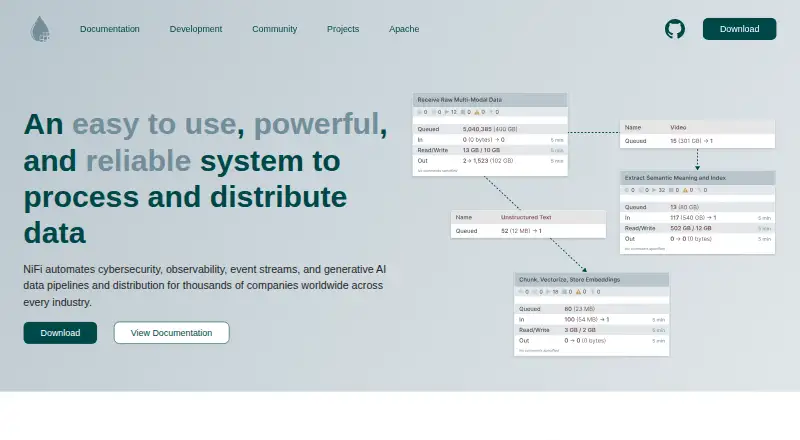
What Apache NiFi is
Apache NiFi is free, open-source software for automating data flows between systems, including cybersecurity, observability, event-stream, and generative AI pipelines. Its browser-based interface lets users design, control, and monitor flows and receive feedback. NiFi records and indexes provenance data to help track information as it moves through the system. Flow controls include guaranteed delivery, back pressure, prioritized queues, and quality-of-service settings for individual flows. Users can modify dataflows in real time, applying changes to affected components without stopping the entire flow. Documented processors connect with Kafka, AWS, Azure, Google Cloud, databases, Slack, S3, and Salesforce. The project lists HTTPS, configurable authentication, multi-tenant authorization, and encrypted communications such as TLS and SSH. NiFi runs in a JVM on a host operating system and can be installed from a ZIP archive; it supports clustering and can be scaled down for edge devices through MiNiFi. The project lists a users mailing list and Slack workspace for assistance. Users are responsible for the security of operating-system commands and custom code they configure.
Who it suits
NiFi suits teams that need to automate and monitor data movement between systems, with controls for flow behavior and provenance tracking. Its clustering and MiNiFi options may fit deployments ranging from server clusters to edge devices.
What it does well
- Browser-based interface for designing and monitoring flows
- Tracks information with indexed provenance data
- Real-time flow changes avoid stopping the entire flow
- Processors connect to listed cloud and messaging services
- Supports clustering and edge deployments through MiNiFi
What to know first
- Users are responsible for configured commands and custom code
- Version 1.28 reached end of support on 2024-12-08
Plans
| Plan | Billed and limits | Price |
|---|---|---|
| Apache NiFi | Free to download under the Apache License, Version 2.0 · No commercial plan or usage limits stated on the official pages reviewed | Free |
| Apache NiFi self-hosted open-source distribution | downloadable tar.gz or ZIP · self-managed infrastructure · Java 21 required | Free |
As nifi.apache.org lists them, read 4 Oct 2026. The maker's own page has the final word.
Getting started
- Visit the Apache NiFi website.
- Download the ZIP archive.
- Prepare a host operating system with a JVM.
- Install NiFi on the host.
- Open its browser-based interface to design and monitor dataflows.
Apache NiFi is a free, open-source platform for moving data between systems, from event streams to cybersecurity and generative AI pipelines. It is a strong fit for teams that want to operate and adjust dataflows themselves. Its combination of visual control and traceability is compelling, but users retain responsibility for deployment and the security of commands and custom code they configure.
Overview
NiFi puts dataflow design, control, monitoring, and feedback in a browser-based interface, while running in a JVM on a host operating system. That split suits operators who want a visual view of running flows without giving up control of where the software runs. Installation from a ZIP archive and support for clustering offer deployment flexibility, while MiNiFi provides a way to scale down for edge devices. The trade-off is that teams must manage the runtime and its security themselves.
Its scope includes cybersecurity, observability, event-stream, and generative AI data pipelines. Provenance records and indexes information as it moves, so operators can trace data through a flow rather than treating movement as a black box. The project lists Apache NiFi 2.12.0, released 2026-09-13; NiFi 1.28 is the final minor release in the version 1 series, whose support ended 2024-12-08.
Key features
Visual flow operation and provenance
The browser interface brings design and live oversight together, with feedback on dataflows. Provenance adds a record of information's movement, which is useful for investigating flow behavior. Users can also modify flows in real time, with changes applied to affected components without stopping the whole flow. That helps teams make targeted adjustments, though it still calls for people able to operate and secure the running system.
Delivery controls and integrations
Guaranteed delivery, back pressure, prioritized queues, and flow-specific quality-of-service settings give operators several ways to shape how data moves. These controls matter when a pipeline needs more than a simple connection between systems. Documented processors connect with Kafka, AWS, Azure, Google Cloud, databases, Slack, S3, and Salesforce, giving NiFi reach across a varied service environment.
Security and responsibility
The project lists HTTPS, configurable authentication, multi-tenant authorization, and encrypted communications such as TLS and SSH. These protections do not remove the operator's obligations: authenticated and authorized users are responsible for the security of operating-system commands and custom code they configure. NiFi is a better choice for teams prepared to own that risk than for those seeking software that abstracts it away.
Pricing
Apache NiFi costs nothing, billed Free to download under the Apache License, Version 2.0. It is a free, open-source option for teams able to install and run the software themselves. No commercial plan or usage limits are stated on the official pages reviewed, so buyers should not assume a vendor-managed service or commercial support tier is part of this offer.
Platforms
NiFi is listed for API, Linux, macOS, self-hosted, web, and Windows environments. Its runtime runs in a JVM on a host operating system; the browser interface provides the web-based control surface. Clustering supports broader deployments, while MiNiFi supports scale-down use on edge devices.
Who it's for
NiFi suits teams that need to move information across multiple systems and value both operational visibility and configurable flow behavior. It is particularly relevant where provenance, delivery controls, or real-time changes matter, and where deployment flexibility across clustered and edge environments is useful. Teams without the capacity to manage a self-hosted runtime or review the security of configured commands and code should look elsewhere.
Pros and cons
- Pros: Visual design and monitoring paired with indexed provenance make flows easier to operate and trace.
- Pros: Delivery controls and real-time component changes give operators practical control without stopping an entire flow.
- Pros: Documented integrations span cloud services, databases, collaboration tools, and streaming systems.
- Pros: Clustering and MiNiFi support both larger deployments and edge-device use.
- Cons: Users must run the JVM-based software on a host operating system, so NiFi is not a hands-off hosted service.
- Cons: Users configuring operating-system commands or custom code remain responsible for their security.
Alternatives
Consider Kestra as another free, Apache 2.0-licensed platform if you want to compare a different open-source option. DataKitchen TestGen may suit a small project that can work within its free tier of one user, one connection, and one project, with unlimited tables and data volume. Apache Airflow is another free Apache-licensed choice to consider for data workflow needs. Apache Hop is an open-source alternative for teams whose environment can use Java 21 for release 2.19.0.
Keboola offers a free plan with 120 compute minutes in its first month and 60 minutes per month thereafter, with additional compute at $0.14 per minute; it may fit a project able to work within those metered limits. Prefect is worth considering for a small orchestration setup that fits its Hobby limits of two users, one workspace, five deployments, 500 minutes per month of Prefect Serverless, and seven days of run retention. Mage is a paid alternative with a Starter plan at $29 a month, plus $0.50 per CPU-hour, for one developer seat and one development environment. Dagster is another alternative.
For a broader comparison, explore DataOps Platforms, API Integration Platforms, ETL Software, Stream Processing Software, and Integration Platform as a Service Software.
Verdict
Choose Apache NiFi if your team needs visual control over cross-system dataflows, traceable provenance, and delivery controls, and is prepared to operate the software and secure configured commands and code. Its main reason to choose is the breadth of control over how data moves; its main reason to look elsewhere is the operational and security responsibility that comes with self-hosting.
Verdict
NiFi combines visual flow management with provenance tracking, flow controls, and a range of documented integrations. Before configuring it, account for the security responsibility users retain for commands and custom code.
Questions
How much does Apache NiFi cost?
The listed plan is free, under the Apache License, Version 2.0.
Is Apache NiFi open source?
Yes. It is free open-source software under the Apache License, Version 2.0.
Which platforms does NiFi support?
The listed platforms are API, Linux, macOS, self-hosted, web, and Windows.
Can NiFi connect to other services?
Documented processors connect with Kafka, AWS, Azure, Google Cloud, databases, Slack, S3, and Salesforce.
How is NiFi deployed?
NiFi runs in a JVM on a host operating system and can be installed from a downloaded ZIP archive.
What support channels does the project list?
The project lists a users mailing list and a Slack workspace for questions, help, and problem reports.
Facts from Apache NiFi's own pages
- AWS Kinesis integration
- The ConsumeKinesis processor reads Kinesis streams and uses DynamoDB checkpointing to resume reliably after restarts. · nifi.apache.org, 15 Oct 2026
- Azure Event Hubs integration
- ConsumeAzureEventHub supports checkpointed consumption and distributes messages across cluster nodes in clustered deployments. · nifi.apache.org, 15 Oct 2026
- Back pressure
- Queues can buffer data, apply back pressure at configured limits, or age out data after a configured period. · nifi.apache.org, 15 Oct 2026
- Company project facts
- LinkedIn lists Apache NiFi as a nonprofit software project founded in 2014 with 51–200 employees. · linkedin.com, 15 Oct 2026
- Current release
- The downloads page lists Apache NiFi 2.12.0, released 2026-09-13. · nifi.apache.org, 4 Oct 2026
- Data provenance
- NiFi records fine-grained provenance so users can inspect, download and replay data at points in its lifecycle. · nifi.apache.org, 15 Oct 2026
- Deployment
- NiFi runs in a JVM on a host operating system and can be installed from a downloaded ZIP archive. · nifi.apache.org, 4 Oct 2026
- Developer SDK guidance
- The developer guide explains how to build extensions but says detailed method information is in JavaDocs and assumes Java and Maven familiarity. · nifi.apache.org, 15 Oct 2026
- Documentation
- Official documentation includes overview, getting started, user, expression-language, administration, toolkit, walkthrough, developer and REST API guides plus processor references. · nifi.apache.org, 15 Oct 2026
- Extensibility
- Extension points include processors, controller services, reporting tasks, prioritizers and custom user interfaces, with classloader isolation for bundles. · nifi.apache.org, 15 Oct 2026
- Flow controls
- Features include guaranteed delivery, back pressure, prioritized queues, and flow-specific quality-of-service settings. · nifi.apache.org, 4 Oct 2026
- FlowFiles
- NiFi represents each moving data object as a FlowFile containing content plus key-value attributes. · nifi.apache.org, 15 Oct 2026
- GetApp integration evidence
- GetApp's review analysis identifies Apache Kafka and Amazon Kinesis as integrations mentioned by NiFi users. · getapp.com, 15 Oct 2026
- Guaranteed delivery
- Persistent write-ahead logging and repositories are used to support guaranteed delivery and high transaction rates. · nifi.apache.org, 15 Oct 2026
- Installation
- Downloads provide tar.gz packaging aimed at Linux and ZIP packaging aimed at Windows, while macOS users can use the tarball or Homebrew. · nifi.apache.org, 15 Oct 2026
- Integrations
- The component catalog lists connectors for Kafka, AWS services, Azure services, Google Cloud, databases, HDFS, Elasticsearch, MQTT, Slack, FTP and many other systems. · nifi.apache.org, 15 Oct 2026
- Kafka integration
- Kafka processors publish records through configurable Kafka connection services, including an Amazon MSK implementation. · nifi.apache.org, 15 Oct 2026
- Latest release
- The download page lists Apache NiFi 2.12.0 released on 2026-09-13 and encourages users to upgrade to NiFi 2. · nifi.apache.org, 15 Oct 2026
- License
- The project uses Apache License Version 2.0 and distributes LICENSE and NOTICE files with source and binary packages. · nifi.apache.org, 15 Oct 2026
- Limit: documentation
- Capterra reviewers repeatedly describe the documentation as limited or difficult, making advanced use harder. · capterra.com, 15 Oct 2026
- Limit: documentation and complexity
- Software Advice reviewers say documentation is sparse or complicated and that some complex pipeline logic cannot be handled well. · softwareadvice.com, 15 Oct 2026
- Limit: monitoring and operations
- G2 reviewers report that node monitoring and debugging can be complex, and stuck high-memory flows may require cluster restarts. · g2.com, 15 Oct 2026
- Limit: resource-heavy flows
- A Capterra reviewer reports that resource-heavy pipelines can stall and take a long time to continue, while complex logic may exceed NiFi's fit. · capterra.com, 15 Oct 2026
- Limit: scripting changes
- A G2 reviewer says Python or other-language script changes can require redeploying or restarting NiFi. · g2.com, 15 Oct 2026
Where Apache NiFi stands on Freedom251
- Integration Platform as a Service Software#5 of 113
- API Integration Platforms#2 of 37
- Data Integration#2 of 26
- Stream Processing Software#2 of 26
- ETL Software#3 of 28
- DataOps Platforms#2 of 16