Freedom251 › Task Automation Software

Node-RED
by Node-RED
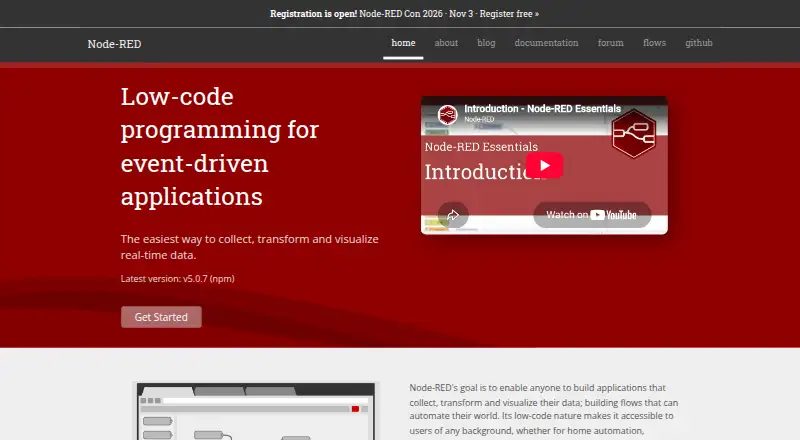
What Node-RED is
Node-RED is free, open-source software for building event-driven applications that collect, transform, and visualize data. Its browser-based editor lets users connect nodes into flows and deploy them to a runtime. The lightweight runtime is built on Node.js and is designed to run on low-cost edge hardware such as Raspberry Pi or in the cloud. Core nodes include tools for triggering, inspecting, transforming, routing, and templating messages. The community Flow Library contains more than 5,000 nodes and flows. Flows are stored as JSON and can be imported, exported, or shared through the library. Projects use Git to version-control flow files and support collaboration through remote repositories. Installation options listed by the project include local computers, Raspberry Pi, Docker, BeagleBone boards, Android via Termux, AWS, and Microsoft Azure. The editor is unsecured by default, meaning anyone who can access its IP address can access it and deploy changes; the security guide describes HTTPS and authentication options. The project began in 2013.
Who it suits
Node-RED may suit people building event-driven applications that need to collect, transform, or visualize data. Its listed deployment choices also make it relevant to users working with edge devices, cloud environments, or local computers.
What it does well
- Browser editor connects nodes into deployable flows.
- Runtime is designed for edge hardware or cloud.
- Flow Library offers more than 5,000 nodes and flows.
- Flows can be shared as JSON.
- Projects use Git for version control and collaboration.
What to know first
- Editor access is unsecured by default.
- Windows installation requires a supported Node.js version.
- Inject node intervals have a maximum of 596 hours.
Limits
The core Inject node interval can be set to a maximum of 596 hours. For longer intervals that must handle outages and restarts, the documentation recommends a scheduler node.
Plans
| Plan | Billed and limits | Price |
|---|---|---|
| Node-RED | Open-source project; no paid plans or usage limits stated | Free |
| Free | Open-source Node-RED runtime · self-hosted deployment | Free |
As nodered.org lists them, read 11 Oct 2026. The maker's own page has the final word.
Getting started
- Open https://nodered.org/ and choose a supported way to run Node-RED.
- For a local Windows installation, follow the installation instructions and use a supported version of Node.js.
- Open the browser-based flow editor and wire nodes into a flow.
- Deploy the flow to the runtime.
- Use the Flow Library to import, export, or share flows; use Git projects to version control flow files.
Node-RED is a low-code tool for building event-driven applications from connected nodes. It suits developers and technically minded teams who want to shape data flows and choose where the runtime runs. Its flexibility and open-source price are compelling; operating and securing the editor are part of the job.
Overview
A browser-based editor lets users wire nodes into flows and deploy them to a lightweight Node.js runtime. That visual model makes triggers, transformations, and routing legible as a flow, while Function nodes leave room for custom logic. Node-RED is best for people comfortable managing a runtime; it is less suited to anyone seeking a fully managed automation service.
The runtime can run on low-cost edge hardware such as a Raspberry Pi or in the cloud. Deployment options include local computers, Docker, BeagleBone boards, Android through Termux, AWS, and Microsoft Azure. The editor is unsecured by default: anyone who can reach its IP address can access it and deploy changes. HTTPS and authentication options are described in the security guide, and should be addressed before making the editor reachable on a network.
Key features
Core nodes handle the basic work of a flow: Inject triggers messages, Debug inspects them, Function and Change transform them, Switch routes them, and Template formats them. These building blocks support workflow orchestration, data transformation, real-time sync, and API management. The trade-off is that users assemble and maintain the logic themselves rather than selecting a finished recipe.
The community Flow Library has more than 5,000 nodes and flows, giving builders a broad pool of extensions. Flows are stored as JSON and can be imported, exported, and shared through the library. Projects use Git for version control and can collaborate through remote repositories, which makes the format practical for teams reviewing and managing flow changes.
Credential files need separate care when sharing a project. The Projects guide strongly recommends encrypting them and keeping the encryption key outside the project. For timing, the core Inject node supports intervals up to 596 hours; longer schedules that must survive outages and restarts call for a scheduler node.
Pricing
Node-RED is free and open source. The Node-RED plan costs nothing, with no paid plans or usage limits stated. There is no trial period to weigh against a subscription, and no per-seat or usage cap is stated. This is a strong fit for individuals and teams who can provide their own runtime and want to avoid software fees; the cost advantage comes with responsibility for setup, security, and operation.
Platforms
Node-RED supports Android, API, Linux, macOS, self-hosted use, web, and Windows. The Windows local installation guide requires a supported version of Node.js. The range of installation options makes it adaptable across personal computers, edge devices, and cloud environments, though users still need to select and manage where it runs.
Who it's for
Choose Node-RED if you want a visual way to build event-driven applications, need to connect or transform data, and value control over the runtime. Its low-cost hardware support, JSON flows, and Git-based projects suit builders who want to tailor and maintain their own automation. Look elsewhere if you need a managed service or cannot take responsibility for securing an editor that is open by default.
Pros and cons
- Pros: Free and open source, with a lightweight runtime suited to low-cost edge hardware or cloud deployment.
- Pros: More than 5,000 community nodes and flows extend the core set of message-building tools.
- Pros: JSON flow sharing and Git-based project versioning support reuse and collaboration.
- Cons: The editor has no security by default, so network access can let others change and deploy flows.
- Cons: Users must choose and operate a runtime; Node-RED is a programming tool, not a ready-made hosted automation service.
- Cons: The core Inject interval tops out at 596 hours, so longer outage-resilient schedules need a scheduler node.
Alternatives
FlexGet is another free option for readers seeking a multipurpose media automation tool installable through pip. Make may suit readers who prefer a hosted-style free tier: it includes up to 1,000 credits per month, two active scenarios, and a 15-minute minimum interval. Ui.Vision RPA is an alternative for readers considering a free personal edition from an RPA-focused maker.
IFTTT fits readers looking for a free mobile app and straightforward applets, with two applets, standard speeds, and unlimited runs on its free plan. Macro Recorder is an alternative for readers comparing desktop recording tools. Windmill may fit teams seeking a free plan with three workspaces and support for up to 50 users. Activepieces offers a free plan with 1,000 monthly credits and unlimited flows, while Browserflow is another free-tier option for browser automation, with one cloud flow and 30 minutes of cloud automation per month.
Readers comparing broader categories can also browse Task Automation Software and Integration Platform as a Service Software.
Verdict
Node-RED is a strong choice for builders who want free, flexible event-driven flows and control over deployment, especially on edge hardware or in the cloud. Its community library and Git-based projects add room to extend and manage that work. Choose another tool if you need managed operations, or if you cannot secure the editor before connecting it to a network.
Verdict
Node-RED offers a visual flow editor, a lightweight runtime, and a large community library. Its default editor security is important to address before deployment.
Questions
Is Node-RED free?
Yes. The listed plan is free, and the pricing model is open source.
What platforms can run Node-RED?
The listed platforms are Android, API, Linux, macOS, self-hosted, web, and Windows. The getting-started guide also lists local computers, Raspberry Pi, Docker, BeagleBone boards, Android via Termux, AWS, and Microsoft Azure.
Does Node-RED have a free trial or paid plan?
There is no free trial. The listed plan says there are no paid plans or usage limits stated.
Can I share and version control flows?
Flows are JSON files that can be imported, exported, and shared through the online Flow Library. Projects use Git to version control flow files and support collaboration through remote repositories.
Is the editor secure by default?
No. By default, anyone who can access the editor’s IP address can access it and deploy changes. The security guide describes HTTPS and authentication options.
What is the Inject node interval limit?
A core Inject node interval can be set up to a maximum of 596 hours. The documentation recommends a scheduler node for longer intervals that need to handle outages and restarts.
Facts from Node-RED's own pages
- Admin HTTP API
- The runtime exposes an HTTP Admin API used by the editor and command-line admin tool. · nodered.org, 14 Oct 2026
- Android support caveat
- The official Android guide uses Termux and warns that the Play Store version of Termux may not be maintained; the Node-RED team does not support Termux. · nodered.org, 14 Oct 2026
- API capabilities
- Admin endpoints cover authentication, settings, diagnostics, flows, runtime state and node-module installation or management. · nodered.org, 14 Oct 2026
- API management
- Yes · nodered.org, 20 Sept 2026
- Community ecosystem
- The project site reports more than 5,000 community Nodes and Flows. · nodered.org, 14 Oct 2026
- Company facts
- FlowFuse, the commercial company built around Node-RED, is listed on LinkedIn as founded in 2021, headquartered in San Francisco and employing 11–50 people. · linkedin.com, 14 Oct 2026
- Core features
- Core nodes include Inject, Debug, Function, Change, Switch, and Template nodes for triggering, inspecting, transforming, routing, and templating messages. · nodered.org, 11 Oct 2026
- Credential security
- The Projects guide strongly recommends encrypting credential files before sharing a project, with the encryption key kept outside the project. · nodered.org, 11 Oct 2026
- Data transformation
- Yes · nodered.org, 20 Sept 2026
- Documentation
- The documentation includes installation guides, platform instructions, user guides, API references, node-creation material and security guidance. · nodered.org, 14 Oct 2026
- Editor
- Its browser-based flow editor lets users wire nodes into flows and deploy them to the runtime with one click. · nodered.org, 11 Oct 2026
- Extensibility APIs
- Hooks, storage, logging, context-store, library-store, editor and module APIs support custom runtime behavior, plugins and embedding in Node.js applications. · nodered.org, 14 Oct 2026
- Flow portability
- Flows are stored as JSON and can be imported and exported for sharing. · nodered.org, 14 Oct 2026
- Flow sharing
- Flows are stored as JSON and can be imported, exported, and shared through the online Flow Library. · nodered.org, 11 Oct 2026
- Founded
- 2013 · nodered.org, 28 Sept 2026
- Funding news
- FlowFuse announced a $7.25 million funding round on 10 June 2025. · flowfuse.com, 14 Oct 2026
- Google Play availability
- A third-party Node-RED Client Editor listing shows 10K+ downloads, in-app purchases and a last update of 1 March 2021. · play.google.com, 14 Oct 2026
- Hardware limitation
- The Raspberry Pi guide says Node.js 24 has no 32-bit builds, so ARMv6 Raspberry Pi devices are no longer supported with that setup. · nodered.org, 14 Oct 2026
- Installation platforms
- The getting-started guide lists local computers, Raspberry Pi, Docker, BeagleBone boards, Android via Termux, AWS, and Microsoft Azure as ways to run Node-RED. · nodered.org, 11 Oct 2026
- Integrations
- Official getting-started material covers local computers, Docker, Raspberry Pi, BeagleBone, Android through Termux, AWS and Microsoft Azure. · nodered.org, 14 Oct 2026
- JavaScript functions
- The editor includes a rich text editor for creating JavaScript functions inside flows. · nodered.org, 14 Oct 2026
- Legal and funding facts
- Crunchbase identifies FlowFuse's legal name as FlowForge Inc, lists two seed rounds and six investors, and names WestWave Capital and Uncorrelated Ventures among them. · crunchbase.com, 14 Oct 2026
- License
- Node-RED core is licensed under Apache 2.0; third-party nodes may use different licenses. · nodered.org, 14 Oct 2026
- Limit: dashboards
- A G2 reviewer reports that the dashboard experience is still not optimal. · g2.com, 14 Oct 2026
Where Node-RED stands on Freedom251
- Task Automation Software#1 of 35
- Integration Platform as a Service Software#4 of 113