
Mattrbld
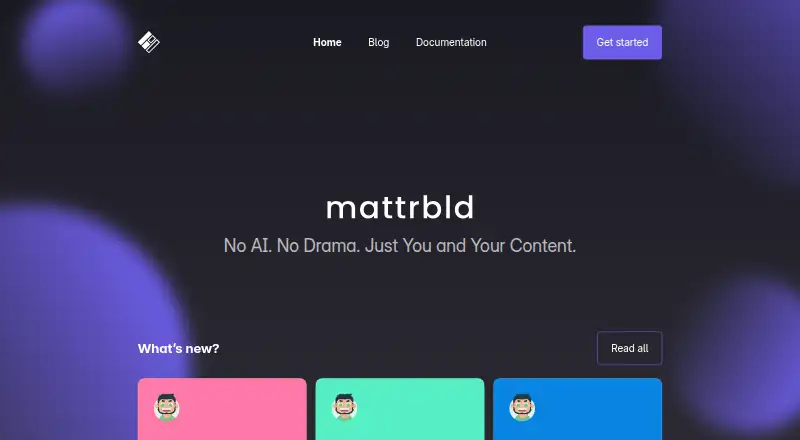
What Mattrbld is
Mattrbld is a Git-based headless CMS for creating and managing content without tying the editing interface to a particular frontend framework. Content remains in Git repositories rather than Mattrbld’s external servers. After importing a project, users can create and edit content offline, but must reconnect to publish changes. Schemas define content fields and validation rules, which Mattrbld uses to create editing forms. It supports JSON and Markdown files with YAML frontmatter; plain YAML support is planned but not implemented. Developers can build a preview route using Mattrbld’s protocol so editors can see content changes in real time. Repository communication uses Git, and the documentation names GitLab, GitHub and Bitbucket as providers that require a CORS proxy. Mattrbld does not require its own account, though collaborators need provider accounts to access private repositories or sync. It can be self-hosted as a single-page application. The free hosted instance has no availability guarantee, and its provided proxy is intended for small-scale private projects.
Who it suits
Mattrbld is aimed at developers or agencies helping small to medium-sized clients manage website content. It is not a drag-and-drop website builder.
What it does well
- Content is kept in Git repositories
- Editing can continue offline after project import
- Schemas generate forms with validation rules
- Supports JSON and Markdown with YAML frontmatter
- Can be self-hosted as a single-page application
What to know first
- Publishing changes requires reconnecting
- Plain YAML support is not implemented
- GitLab, GitHub and Bitbucket require a CORS proxy
- Hosted instance has no availability guarantee
Limits
The official hosted instance has no availability guarantee, and its provided CORS proxy is intended for small-scale private projects. Self-hosted core includes core features. Mattrbld does not support Git LFS, and offline editing cannot publish changes until reconnection.
Plans
| Plan | Billed and limits | Price |
|---|---|---|
| Official hosted instance | Free to try · No guarantee for availability · Provided CORS proxy intended for small-scale private projects | Free |
| Self-hosted core | Free to use for self-hosting · Open source under GNU AGPL · Core features | Free |
As mattrbld.com lists them, read 5 Oct 2026. The maker's own page has the final word.
Getting started
- Open https://mattrbld.com/ to use the official hosted instance.
- Choose the self-hosted core if you want to build and host the single-page application yourself.
- Import a project from a Git repository.
- Use a Git-provider account to access private repositories or sync changes.
- Configure a CORS proxy when required for a Git provider.
Mattrbld is a Git-based headless CMS for teams managing website content independently of a frontend framework. It suits developers and agencies supporting small to medium-sized clients who want structured editing within a Git workflow. Its open-source self-hosted core and offline editing are useful, but publishing automation and media-heavy projects are weak fits.
Overview
Content remains in Git repositories rather than Mattrbld’s external servers, making the product a natural fit when version-controlled files are already part of the publishing process. Mattrbld supports JSON and Markdown files with YAML frontmatter; plain YAML support is planned but not implemented. It is a CMS, not a drag-and-drop website builder.
Schemas define fields and validation rules, which Mattrbld turns into editing forms. That gives editors a structured way to work with content without requiring them to edit files directly. Developers can also implement a preview route using Mattrbld’s protocol, so editors can see updates in real time.
Key features
Git workflow and offline editing
Mattrbld communicates with repositories through Git rather than proprietary provider APIs. Collaborators need accounts with their Git provider, and must authenticate to import private repositories or sync changes. GitLab, GitHub and Bitbucket require a CORS proxy. Mattrbld says it does not store passwords or access tokens, but credentials and repository requests pass through the configured proxy when one is needed, a consideration for teams assessing their infrastructure and security requirements.
Once a project is imported, users can create and edit content offline. They cannot publish changes until they reconnect, so offline work helps with drafting but does not remove the need for connectivity to sync.
Media and publishing limits
Mattrbld does not support Git LFS and is not suited to projects with heavy media use or large amounts of binary content. It also cannot schedule publishing: the application runs only while someone is actively using it. Teams that need scheduled releases or large media libraries should look elsewhere.
Pricing
Mattrbld offers two plans, both at no cost. The Official hosted instance is free to try and includes a provided CORS proxy intended for small-scale private projects, but availability is not guaranteed. That caveat makes it a cautious choice for projects that depend on a hosted service. The Self-hosted core is free to use for self-hosting, open source under GNU AGPL, and includes core features; it suits teams prepared to build and host the application themselves.
For self-hosting, Mattrbld can be built from source and hosted as a single-page application on a service of the user’s choice. This avoids reliance on the hosted instance, but makes hosting the team’s responsibility.
Platforms
Mattrbld is available on Android, iOS, the web and as a self-hosted application. Its hosting model is both hosted and self-hosted.
Who it's for
Mattrbld is best for developers or agencies helping small to medium-sized clients manage website content in Git. It is a stronger fit for structured text workflows than for teams seeking a visual site builder, automated publishing or repositories dominated by binary media.
Pros and cons
Pros
- Content stays in Git repositories, not Mattrbld’s external servers, which suits teams that want version-controlled content.
- Schemas generate editing forms with validation, giving editors structure while keeping content in supported file formats.
- Offline editing allows users to create and revise content after importing a project, even though publishing must wait for reconnection.
- The self-hosted core is free and open source under GNU AGPL, with hosting on a service of the user’s choice.
Cons
- The hosted instance has no availability guarantee, and its provided CORS proxy is intended for small-scale private projects.
- GitLab, GitHub and Bitbucket require a CORS proxy; credentials and repository requests pass through it when required.
- No Git LFS support makes media-heavy or binary-rich projects a poor fit.
- Publishing cannot be scheduled because Mattrbld only runs while someone is using it.
- Plain YAML support is planned but not implemented.
Alternatives
Git-Based CMS is a useful starting point for comparing products in this category. Choose Quiqr instead if you want a free, open-source CMS across desktop and self-hosted platforms. deco CMS is another option for teams seeking an open-source, self-hostable core.
Decap CMS is worth considering when its free plan’s one-site and one-seat allowance suits the project. Dhub may fit a personal GitHub workflow limited to public repositories and the default branch; its Hobby plan is free for one user. HugoCMS offers a free plan per domain, with multilingual support and unlimited updates.
Keystatic may suit teams that need up to three users per team on its free plan. Kiln offers a free, open-source self-hosted plan, with the user running the worker and GitHub App and providing the site host. Netlify is an alternative when a broader web platform’s free plan, with 300 credits per month, one concurrent build and one team owner, matches the need.
Verdict
Choose Mattrbld if your team wants schema-driven editing while keeping content in Git, and can accommodate its proxy requirements and lack of scheduled publishing. Its free self-hosted core is a clear reason to consider it; teams needing guaranteed hosted availability, Git LFS or automated release timing should look elsewhere.
Verdict
Mattrbld fits teams that want structured content editing tied to Git rather than an external content store. Check the offline publishing boundary, proxy requirements and hosted-instance caveat against your workflow.
Questions
Is Mattrbld free?
Yes. The official hosted instance is free, and the self-hosted core is free to use.
Can I host Mattrbld myself?
Yes. It can be built from source and hosted as a single-page application on a hosting service of your choice.
Which content formats does it support?
It supports JSON and Markdown files with YAML frontmatter. Plain YAML support is planned but not implemented.
Does Mattrbld require an account?
Mattrbld does not require its own account. Collaborators need Git-provider accounts to access private repositories or sync changes.
Which Git providers are named?
The documentation names GitLab, GitHub, and Bitbucket as providers requiring a CORS proxy.
Can editors work offline?
After importing a project, users can create and edit content offline. They must reconnect to publish changes.
Facts from Mattrbld's own pages
- Authentication
- Mattrbld does not require its own account, but collaborators need accounts with the Git provider and must authenticate to import private repositories or sync changes. · mattrbld.com, 5 Oct 2026
- Automation
- Mattrbld cannot schedule publishing because it only runs while a user is actively using it. · mattrbld.com, 5 Oct 2026
- Content storage
- Content lives in Git repositories and is not stored on Mattrbld’s external servers. · mattrbld.com, 5 Oct 2026
- Credential handling
- Mattrbld says it does not store passwords or access tokens, but credentials and repository requests pass through the configured CORS proxy when one is required. · mattrbld.com, 5 Oct 2026
- Data modelling
- Schemas define content fields and validation rules, and Mattrbld uses them to generate editing forms. · mattrbld.com, 5 Oct 2026
- Git integrations
- Mattrbld communicates with repositories using Git rather than proprietary provider APIs, and its documentation names GitLab, GitHub, and Bitbucket as providers requiring a CORS proxy. · mattrbld.com, 5 Oct 2026
- Intended users
- The maker describes it as suited to developers or agencies helping small to medium-sized clients manage website content, and says it is not a drag-and-drop website builder. · mattrbld.com, 5 Oct 2026
- Live previews
- Developers can implement a preview route using Mattrbld’s protocol so editors can see content updates in real time. · mattrbld.com, 5 Oct 2026
- Notable limitation
- Mattrbld does not support Git LFS and is not suited to media-heavy projects or content containing large amounts of binary data. · mattrbld.com, 5 Oct 2026
- Offline editing
- After importing a project, users can create and edit content offline, but cannot publish changes until they reconnect. · mattrbld.com, 5 Oct 2026
- Product
- Mattrbld is a Git-based headless CMS for creating, editing, and managing content independently of a particular frontend framework. · mattrbld.com, 5 Oct 2026
- Self-hosting
- Mattrbld can be built from source and hosted as a single-page application on a hosting service of the user’s choice. · mattrbld.com, 5 Oct 2026
- Supported content formats
- Mattrbld supports JSON and Markdown files with YAML frontmatter; plain YAML support is planned but not implemented. · mattrbld.com, 5 Oct 2026
Where Mattrbld stands on Freedom251
- Git-Based CMS#8 of 23