Freedom251 › AI Video Lip Sync Tools
LatentSync
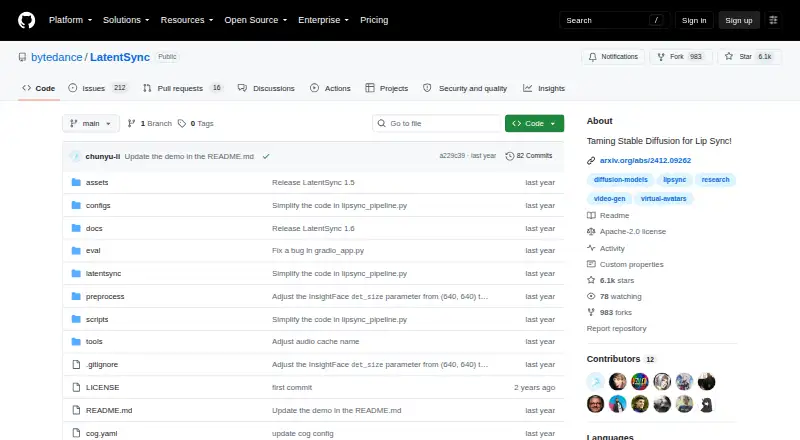
What LatentSync is
LatentSync is a free, open-source method for syncing video lip movements to audio using audio-conditioned latent diffusion models. Whisper converts mel spectrograms into audio embeddings, which are integrated into the U-Net through cross-attention layers. The project provides a Gradio app and command-line interface for inference, as well as inference code and checkpoints, a data processing pipeline, and training code. Version 1.6 was trained on 512 × 512 resolution videos to address blurry teeth and lips. The stated minimum inference memory is 8 GB of VRAM for version 1.5 and 18 GB for version 1.6. More inference steps can improve visual quality but slow generation; increasing guidance scale can improve lip-sync accuracy but may introduce distortion or jitter. U-Net training configurations require 20–55 GB of VRAM, depending on configuration. The documented data pipeline uses PySceneDetect for scene detection and InsightFace landmarks to transform faces. The repository lists an Apache-2.0 license, while the Hugging Face model card lists openrail++. The model page says version 1.6 is not deployed by an Inference Provider.
Who it suits
LatentSync suits Linux and self-hosted users who need inference tools or want access to training code and data processing resources. Its stated inference memory requirements may help determine whether a user's hardware fits.
What it does well
- Free open-source release includes inference code and checkpoints.
- Offers both Gradio and command-line inference.
- Includes data processing and training code.
- Version 1.5 minimum inference requirement is 8 GB VRAM.
What to know first
- Version 1.6 requires at least 18 GB VRAM for inference.
- U-Net training configurations require 20–55 GB VRAM.
- More inference steps slow generation.
- Higher guidance scale may cause distortion or jitter.
Limits
The free open-source release requires self-hosted inference. Minimum inference VRAM is 8 GB for LatentSync 1.5 and 18 GB for 1.6; U-Net training configurations require 20–55 GB. Output resolution is listed as 720p or lower.
Plans
| Plan | Billed and limits | Price |
|---|---|---|
| Open-source release | Inference code and checkpoints · data processing pipeline · training code | Free |
As github.com lists them, read 8 Oct 2026. The maker's own page has the final word.
Getting started
- Open the LatentSync project on GitHub.
- Use the open-source release, which includes inference code and checkpoints.
- Choose the Gradio app or command-line interface for inference.
- Run it on Linux with at least 8 GB VRAM for version 1.5 or 18 GB for version 1.6.
- For training, review the included code and the 20–55 GB VRAM configurations.
LatentSync is an open-source, self-hosted system for synchronizing mouth movements to speech with audio-conditioned latent diffusion. It suits developers, creators, and research-minded teams running Linux GPUs who want control over inference or training. Its strongest advantage is a complete zero-cost pipeline; its main constraint is the substantial VRAM and tuning work required.
Overview
LatentSync uses Whisper to turn mel spectrograms into audio embeddings, then injects those embeddings into a U-Net through cross-attention. That design gives technically capable users a modifiable model workflow rather than a hosted editor, but it also puts installation, model execution, and hardware management on the operator.
Version 1.6 was trained on 512 × 512 video to address blurry teeth and lips. The stated minimum inference memory is 18 GB of VRAM, while version 1.5 requires 8 GB. Version 1.6 is therefore the more demanding choice; version 1.5 is better suited to users whose GPU cannot meet the newer model's floor. More inference steps can improve visual quality but slow generation. A higher guidance scale can improve synchronization accuracy while introducing distortion or jitter, so producing a clean result involves balancing speed, accuracy, and stability.
Key features
- Two inference interfaces: A Gradio app provides a graphical entry point, while a command-line interface fits scripted or terminal-based workflows. They cover different operating styles, but neither removes the need to operate compatible Linux hardware.
- Complete open-source pipeline: The release includes inference code, checkpoints, a data-processing pipeline, and training code. That is valuable for teams that need to inspect, adapt, or retrain the workflow instead of stopping at prebuilt inference.
- Documented data preparation: The pipeline uses PySceneDetect for scene detection and InsightFace landmarks to transform faces. These components provide a defined route from source footage to training-ready data, while adding preprocessing stages that operators must manage.
- Adjustable generation behavior: Inference steps and guidance scale expose meaningful quality controls. They also create predictable trade-offs: slower rendering for more steps, and possible visual defects when guidance is pushed too high.
- Consumer-GPU training path: The README describes an efficient stage-two configuration as suitable for consumer hardware such as an RTX 3090. However, listed U-Net training configurations span 20–55 GB of VRAM, so training feasibility depends heavily on the selected configuration.
Pricing
| Plan | Price | Includes |
|---|---|---|
| Open-source release | free | Inference code and checkpoints, data-processing pipeline, and training code |
The free plan is the entire published offering: there is no subscription, seat charge, or usage quota stated. It is a strong fit for individuals and teams able to supply their own compute and maintain a self-hosted deployment. The trade-off is operational rather than financial: GPU memory, setup, preprocessing, and generation time remain your responsibility. The repository identifies an Apache-2.0 license, while the Hugging Face model card identifies LatentSync's license as openrail++, so organizations should review those terms for their intended use.
Platforms
LatentSync targets Linux and self-hosted deployment. It is not offered as a managed web service; the Hugging Face model page says LatentSync 1.6 is not deployed by an Inference Provider. The published deployment profile also lists 720p or lower output, both proxy protocols, SSL inspection, web filtering, and user authentication. Those deployment attributes may help environments with controlled network or access requirements, but the core workflow still depends on local GPU capacity.
Who it's for
Choose LatentSync if you are comfortable with Linux, model checkpoints, GPU memory planning, and command-line or Gradio operation. It is particularly appropriate for creators who need local control, developers building a lip-sync pipeline, and teams interested in retraining or modifying the supplied code. Version 1.5 is the practical starting point below the 18 GB threshold; version 1.6 makes more sense when its higher memory requirement is available and reducing blurry teeth and lips is a priority.
It is a poor fit for users seeking instant browser-based editing, hosted inference, or minimal technical administration. A machine with only modest VRAM may not run the preferred version, and training demands can rise as high as 55 GB.
Pros and cons
Pros
- Free and open source: The single plan includes inference, checkpoints, data processing, and training without a published fee.
- Flexible operation: Gradio and CLI interfaces accommodate both graphical and automated workflows.
- Adaptable training stack: Included training code and preprocessing tools support users who need more than fixed-model inference.
- Clear quality controls: Steps and guidance scale let operators trade speed against quality and synchronization accuracy.
Cons
- High hardware demands: Minimum inference VRAM jumps from 8 GB in version 1.5 to 18 GB in version 1.6, with training configurations requiring 20–55 GB.
- Tuning can introduce defects: Excessive guidance may cause distortion or jitter, while more steps increase generation time.
- Self-hosting burden: Users must handle Linux deployment, data preparation, and their own compute because there is no hosted inference provider for version 1.6.
- Resolution ceiling: The published output profile is 720p or lower.
Alternatives
For a broader directory of infrastructure choices, see Forward Proxy Software. For comparable lip-sync products, browse AI Video Lip Sync Tools.
Cloudflare Gateway is the better choice when you need a managed, cross-platform gateway with a perpetual free tier for 50 users and up to 24 hours of standard log retention; its pay-as-you-go plan is $7 a month.
mitmproxy fits users seeking free, open-source interactive HTTPS proxy software across Linux, macOS, self-hosted, web, and Windows rather than a lip-sync model.
3proxy, Privoxy, Squid, Apache Traffic Server, and Tinyproxy are free self-hosted proxy alternatives when network proxying, not audio-driven video generation, is the requirement. Skyhigh Private Access is a paid alternative for organizations wanting a cross-platform access product with custom pricing.
Verdict
LatentSync is a strong choice for technically capable Linux users who want a free, inspectable lip-sync pipeline with both inference and training resources. Choose it for local control and extensibility, especially when you can meet the relevant VRAM requirement and tune around speed and visual artifacts. Look elsewhere if you need hosted inference, a lightweight setup, or hardware requirements below the stated 8–18 GB inference range.
Verdict
LatentSync provides inference and training resources for self-hosted lip-sync work, with different stated memory requirements by version. Users should weigh generation speed and possible visual artifacts when tuning inference.
Questions
Is LatentSync free?
Yes. The open-source release is listed as free and includes inference code and checkpoints, a data processing pipeline, and training code.
Which platforms does it support?
LatentSync lists Linux and self-hosted deployment. Inference is available through a Gradio app or command-line interface.
What hardware does inference require?
The stated minimum is 8 GB of VRAM for LatentSync 1.5 and 18 GB for LatentSync 1.6.
What licenses are listed?
The GitHub repository identifies Apache-2.0, while the Hugging Face model card identifies openrail++.
Can I use a hosted inference provider?
The Hugging Face model page says LatentSync 1.6 is not deployed by an Inference Provider.
Facts from LatentSync's own pages
- Audio conditioning
- Whisper converts mel-spectrograms into audio embeddings that enter the U-Net through cross-attention. · raw.githubusercontent.com, 21 Oct 2026
- Community complaint: GPU compatibility
- Open issues include requests for RTX 5090 support and reports that older PyTorch versions do not work with 50-series Nvidia cards. · github.com, 21 Oct 2026
- Community complaint: output quality
- Open issues include reports of red faces, blurry mouths, face misalignment and visible teeth artifacts. · github.com, 21 Oct 2026
- Community issue volume
- The GitHub issue tracker showed 211 open issues and 16 pull requests when opened. · github.com, 21 Oct 2026
- Data pipeline
- Its processing pipeline resamples video to 25 FPS and audio to 16 kHz, detects scenes, splits clips into 5–10 second segments, aligns faces and filters low-quality samples. · raw.githubusercontent.com, 21 Oct 2026
- Data processing tools
- The documented data pipeline uses PySceneDetect for scene detection and InsightFace landmarks to transform faces. · github.com, 8 Oct 2026
- Dependencies
- Pinned dependencies include PyTorch 2.5.1, Diffusers 0.32.2, Transformers 4.48.0, Gradio 5.24.0 and GPU ONNX Runtime 1.21.0. · github.com, 21 Oct 2026
- Developer extensibility
- The repository exposes scripts for preprocessing, inference, U-Net training and file-list generation, enabling custom training workflows. · raw.githubusercontent.com, 21 Oct 2026
- Efficient training tradeoff
- The 20 GB efficient Stage 2 configuration may slightly reduce visual quality and temporal consistency compared with the 30 GB configuration. · raw.githubusercontent.com, 21 Oct 2026
- Environment
- The setup script creates a Conda environment with Python 3.10.13, installs FFmpeg and requires the Linux package libgl1. · github.com, 21 Oct 2026
- Generation trade-off
- The README says more inference steps can improve visual quality but slow generation, while higher guidance scale can improve lip-sync accuracy but cause distortion or jitter. · github.com, 8 Oct 2026
- Hardware requirement
- The stated minimum inference VRAM is 8 GB for LatentSync 1.5 and 18 GB for LatentSync 1.6. · github.com, 8 Oct 2026
- Hosted API inputs
- Layer's schema requires at least one source-video file and one reference-audio file and supports seed and guidance-scale fields. · layer.ai, 21 Oct 2026
- Hosted API option
- Layer documents a POST inference endpoint that accepts a source video and reference audio through bearer-authenticated JSON requests. · layer.ai, 21 Oct 2026
- Hugging Face availability
- The model page provides Diffusers usage instructions and links to Google Colab and Kaggle notebooks. · huggingface.co, 21 Oct 2026
- Independent description
- ExplainGit describes LatentSync as a ByteDance research tool that replaces a video's lip movements to match a new audio track using Stable Diffusion and Whisper. · explaingit.com, 21 Oct 2026
- Independent setup assessment
- ExplainGit rates setup difficulty as hard and estimates more than one hour to reach a first run. · explaingit.com, 21 Oct 2026
- Inference interfaces
- The repository provides both a local Gradio application and a command-line inference script. · raw.githubusercontent.com, 21 Oct 2026
- Inference memory 1.5
- LatentSync 1.5 requires at least 8 GB of VRAM for inference. · raw.githubusercontent.com, 21 Oct 2026
- Inference memory 1.6
- LatentSync 1.6 requires at least 18 GB of VRAM for inference. · raw.githubusercontent.com, 21 Oct 2026
- Inference options
- The project provides a Gradio app and a command-line interface for inference. · github.com, 8 Oct 2026
- Intended users
- The README describes an efficient stage-two training configuration as suitable for consumer-grade GPUs such as the RTX 3090. · github.com, 8 Oct 2026
- License
- The source repository is licensed under Apache License 2.0. · raw.githubusercontent.com, 21 Oct 2026
- Limit: hardware
- Zenn identifies relatively high hardware requirements and recommends about 20 GB of VRAM. · zenn.dev, 21 Oct 2026
Where LatentSync stands on Freedom251
- AI Video Lip Sync Tools#1 of 28