Freedom251 › AI Video Lip Sync Tools

LipDub
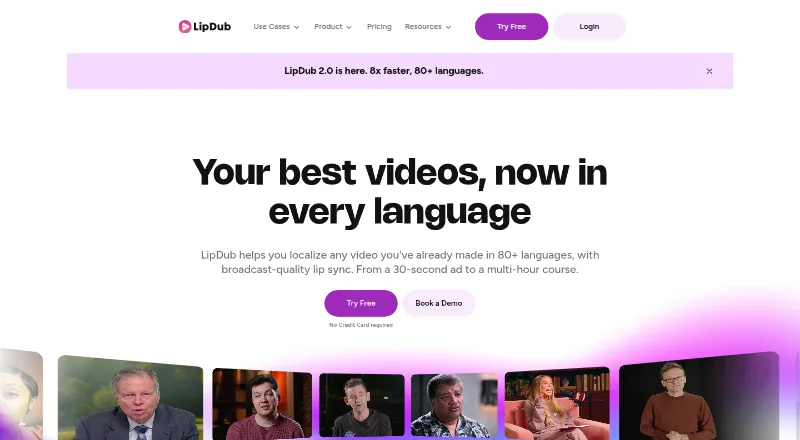
What LipDub is
LipDub localizes videos by dubbing them into other languages while keeping the on-camera person and synchronizing their lips. Its workflow takes users from video upload through transcript translation and refinement, voice selection or cloning, lip sync, and export. It supports 80+ languages out of the box, with user-provided audio available for other languages, dialects, accents, and fictional languages. Listed tools include a translation editor, stock voices, instant voice cloning, dubbing, and lip sync. The free Seed plan allows one minute of 1080p video and adds a watermark. Core costs $29 per month and allows videos up to 10 minutes; Growth costs $99 per month and allows up to 60 minutes; Scale costs $249 per month and allows up to 120 minutes, 4K output, and API access. Enterprise offers unlimited length at custom pricing. The pricing FAQ says it works best with simple productions and footage where the speaker is clearly visible. Paid plans include unlimited seats and concurrent jobs, while security and support options vary by tier.
Who it suits
LipDub suits creators and teams localizing ads, courses, podcasts, panels, brand videos, training, or talking-head content. It is a better fit for productions where the speaker is clearly visible.
What it does well
- Supports 80+ languages out of the box.
- Includes transcript editing and voice cloning.
- Free Seed plan includes one minute of video.
- Paid plans include unlimited seats and concurrent jobs.
- Scale includes API access and 4K output.
What to know first
- Seed video exports include a watermark.
- Seed is limited to one minute.
- Core allows videos up to 10 minutes.
- Works best when the speaker is clearly visible.
Limits
Seed allows up to 1 minute at 1080p and adds a watermark. Core allows up to 10 minutes, Growth up to 60 minutes, and Scale up to 120 minutes; Enterprise allows unlimited length.
Plans
| Plan | Billed and limits | Price |
|---|---|---|
| Seed | Free tier · 1 minute · 1080p · watermark · AI dubbing, voice cloning and lip sync | Free |
| Scale | $ 249 / mo · Up to 120 min · 4K · API · priority · lip sync from $2.50/min · dubbing from $1.50/min | $249 a month |
| Core | $ 29 / mo · Up to 10 min · 1080p · no watermark · lip sync from $3.50/min · dubbing from $1.70/min | $29 a month |
| Growth | $ 99 / mo · Up to 60 min · voice cloning · 1 glossary · lip sync from $3.00/min · dubbing from $1.60/min | $99 a month |
| Enterprise | Custom · Unlimited length · 4K · SSO · CSM · SLAs | On request |
As lipdub.ai lists them, read 29 Sept 2026. The maker's own page has the final word.
Getting started
- Open the LipDub website and choose a plan.
- Upload an existing or generated video.
- Translate and refine the transcript.
- Clone a voice or select one from the available voices.
- Lip sync the video and export the localized version.
- For API integration, choose Scale or Enterprise and use the API documentation.
LipDub is a video-localization service for translating and dubbing footage while synchronizing the on-camera speaker’s lips. It suits creators and teams adapting clear, speaker-led videos for other languages. Its appeal is the joined-up workflow; video-length caps and paid feature gates make the tier choice important.
Overview
LipDub takes a video from upload through transcript translation and editing, voice selection or cloning, lip sync, and export. It supports 80 languages out of the box, and can use user-provided audio for other languages, dialects, accents, or fictional languages. That gives teams a route beyond its standard language coverage, provided they can supply suitable audio.
The pricing FAQ names ads, courses, podcasts, panels, brand videos, instructor-led training, and talking-head content as suitable projects. LipDub says it works best with simple productions and broadcast-grade footage where the speaker is clearly visible. That makes it a stronger fit for direct-to-camera material than for visually complex scenes or footage where the speaker is hard to see.
Key features
- One localization workflow: Translation editing, dubbing, lip synchronization, and export sit in the same process. That is useful for teams producing localized versions repeatedly, rather than stitching these tasks together across separate tools.
- Voice choices: The feature set includes a stock voice library and instant voice cloning. The Seed plan includes voice cloning, as does Growth; Core does not name it among its plan features, so frequent users should check the tier fit before committing.
- API access: Scale and Enterprise include API access, and LipDub provides API documentation for integrating translation, dubbing, and lip sync into a product. This is relevant to product teams automating localization, but not a reason to pay for Scale if a standalone workflow is enough.
- Team and enterprise controls: Paid plans include unlimited seats and concurrent jobs, while MFA is available on paid tiers. Enterprise adds SSO/SAML, dedicated support, a customer success manager, custom SLAs, and a DPA—controls that matter more to larger organizations than to individual creators.
Pricing
LipDub has a free tier and a free trial, with paid plans starting at $29 per month. The tier differences are consequential: video caps rise from one minute on Seed to 10 on Core, 60 on Growth, and 120 on Scale; Enterprise allows unlimited length.
- Seed — free: Up to one minute, 1080p, watermark, AI dubbing, voice cloning, and lip sync. It is a way to try the workflow or handle a very short clip, but the watermark and one-minute ceiling make it a poor fit for finished or longer work.
- Core — $29 a month: Up to 10 minutes, 1080p, no watermark, lip sync from $3.50/min, and dubbing from $1.70/min. It suits short, finished videos; the per-minute starting rates mean subscription cost is not the whole cost of usage.
- Growth — $99 a month: Up to 60 minutes, voice cloning, one glossary, lip sync from $3.00/min, and dubbing from $1.60/min. It is the more practical step for regular or longer projects, with lower starting rates than Core and a glossary for consistent terminology.
- Scale — $249 a month: Up to 120 minutes, 4K, API access, priority, lip sync from $2.50/min, and dubbing from $1.50/min. It best fits high-volume teams or product integrations that need the longer cap, 4K output, or API; occasional short-video creators may not need those upgrades.
- Enterprise — custom pricing: Unlimited length, 4K, SSO, a customer success manager, and SLAs. It is the tier for organizations needing the highest usage ceiling and enterprise support and controls.
Unlimited seats and concurrent jobs across paid plans make the subscriptions usable by teams without a per-seat constraint. The Seed watermark and short cap are the main compromises at no cost; moving up removes the watermark on Core and increases both resolution and length at higher tiers. LipDub says Stripe handles payment information and that it does not store or otherwise process credit card information; users can request access to, correction of, or deletion of personal information.
Platforms
LipDub is available on the web and through an API. The API is a Scale or Enterprise feature, so teams evaluating automation should account for that plan gate.
Who it's for
LipDub is best suited to creators, educators, marketers, and production teams localizing clear speaker-led material, especially when they want translation, voice work, and lip sync in one workflow. It is less suitable for complex visual productions or anyone whose normal videos exceed the lower tiers’ length limits. A demo booking link is available for teams assessing the workflow.
Pros and cons
- Pro: Translation editing, dubbing, voice options, lip sync, and export are combined, reducing the number of separate steps for localized versions.
- Pro: Support for 80 languages plus user-provided audio broadens the potential language range beyond the built-in set.
- Pro: Paid plans have unlimited seats and concurrent jobs, which avoids seat-based scaling for growing teams.
- Con: Seed is limited to one minute and carries a watermark, limiting its usefulness for finished videos.
- Con: API access requires Scale or Enterprise, putting product integrations behind a substantial plan step.
- Con: LipDub is optimized for simple footage with a clearly visible speaker, narrowing its fit for complex scenes.
Alternatives
Browse AI Video Lip Sync Tools to compare more options in this category. Choose VEED instead if you want a tool spanning Android, iOS, browser extension, and web; its free exports are capped at 720p and carry a watermark, while Creator exports up to 1080p without one.
Muse is a free, open-source MIDI-output option, rather than a direct video-localization substitute. SadTalker is worth considering if you prefer free, offline code on Linux or Windows, with an Apache 2.0 license except for listed third-party components.
CHAMELAION LipSync API may suit a low-cost API trial: its free Starter plan gives 24,000 tokens for two minutes of video translation and lip sync, with a watermark and no credit card required; Basic is €5 a month. lipsyn.cc is an option for a short, one-off job, with a five-second free preview and a Quick Take priced at $6.99, paid once for five minutes.
Morph Studio is the more relevant alternative for text- or image-to-video creation, with a free plan that includes 75 monthly credits and video style transfer. Rendley is another freemium web and API option, and its free plan has no time limit. Sync Labs may be preferable for trying limited sync generations without a card: its free plan includes three generations a month, each up to 20 seconds, plus other capped generation allowances.
Verdict
Choose LipDub if you regularly localize clear, speaker-led videos and value having transcript work, dubbing, voice options, and lip sync together. The principal reason to look elsewhere is fit: longer videos, complex visuals, or a need for API integration below Scale may make its caps and plan gates hard to justify.
Verdict
LipDub combines translation, dubbing, voice options, and lip synchronization in a single localization workflow. Compare video-length limits and plan-specific features before choosing a tier.
Questions
Does LipDub have a free plan?
Yes. Seed costs nothing and allows up to 1 minute of video at 1080p with a watermark.
How much do paid plans cost?
Core is $29 a month, Growth is $99 a month, and Scale is $249 a month. Enterprise uses custom pricing.
How long can videos be?
Seed allows up to 1 minute, Core up to 10 minutes, Growth up to 60 minutes, and Scale up to 120 minutes. Enterprise allows unlimited length.
Does LipDub offer API access?
Yes. API access is available on Scale and Enterprise, and the homepage links to API documentation for translation, dubbing, and lip sync integration.
What languages does LipDub support?
It supports 80+ languages out of the box. User-provided audio can be used for other languages, dialects, accents, and fictional languages.
What video content is LipDub suited to?
The pricing FAQ names ads, courses, podcasts, panels, brand videos, instructor-led training, and talking-head content. It says the platform works best with simple productions and footage where the speaker is clearly visible.
Facts from LipDub's own pages
- API
- LipDub offers API access on the Scale and Enterprise plans, and its homepage links to API documentation for integrating translation, dubbing, and lip sync into a product. · lipdub.ai, 29 Sept 2026
- Content constraints
- The pricing FAQ says it works best with simple productions and broadcast-grade footage where the speaker is clearly visible. · lipdub.ai, 29 Sept 2026
- Features
- The pricing page lists lip sync, audio dubbing, translation editor, stock voice library, and instant voice cloning among its features. · lipdub.ai, 29 Sept 2026
- Languages
- The platform supports 80+ languages out of the box and says user-provided audio can be used for other languages, dialects, accents, and fictional languages. · lipdub.ai, 29 Sept 2026
- Privacy
- The privacy policy says payment information is collected by Stripe and that LipDub does not store or otherwise process credit card information. · lipdub.ai, 29 Sept 2026
- Privacy rights
- The privacy policy describes rights to request access, correction, or deletion of personal information. · lipdub.ai, 29 Sept 2026
- Security and enterprise controls
- The plan comparison lists MFA on paid tiers and SSO/SAML, dedicated support, custom SLAs, and DPA on Enterprise. · lipdub.ai, 29 Sept 2026
- Support
- The pricing page lists dedicated support and a customer success manager for Enterprise, and the homepage offers a demo booking link. · lipdub.ai, 29 Sept 2026
- Team access
- Every paid plan includes unlimited seats and unlimited concurrent jobs according to the pricing page. · lipdub.ai, 29 Sept 2026
- Usage limits
- The Free tier allows up to 1 minute, while Core, Growth, and Scale allow videos up to 10, 60, and 120 minutes respectively; Enterprise is unlimited. · lipdub.ai, 29 Sept 2026
- Use cases
- The pricing FAQ names ads, courses, podcasts, panels, brand videos, instructor-led training, and talking-head content as suitable content types. · lipdub.ai, 29 Sept 2026
- What it does
- LipDub is a video localization platform that dubs existing or generated videos into other languages while retaining the person on camera and synchronizing their lips. · lipdub.ai, 29 Sept 2026
- Workflow
- The workflow covers uploading video, translating and refining a transcript, cloning or selecting a voice, lip syncing, and exporting localized versions. · lipdub.ai, 29 Sept 2026
Where LipDub stands on Freedom251
- AI Video Lip Sync Tools#7 of 28